Fertilizer Shares Leap 76% as 20% of Global Supply Sits Stranded Near the Strait of Hormuz
- CF Industries has surged 76% to a record high since fighting blocked Middle East fertilizer exports.
- Roughly one-fifth of global ammonia, urea and phosphate shipments are idled in the Persian Gulf.
- European natural-gas prices have jumped 58%, while U.S. gas futures are up only 13%, handing cost advantages to domestic producers.
- Analysts expect U.S. nitrogen makers to capture market share and widen margins this spring planting season.
Investors are betting that cheap American natural gas and stranded Mideast cargoes will keep fertilizer prices—and share prices—elevated.
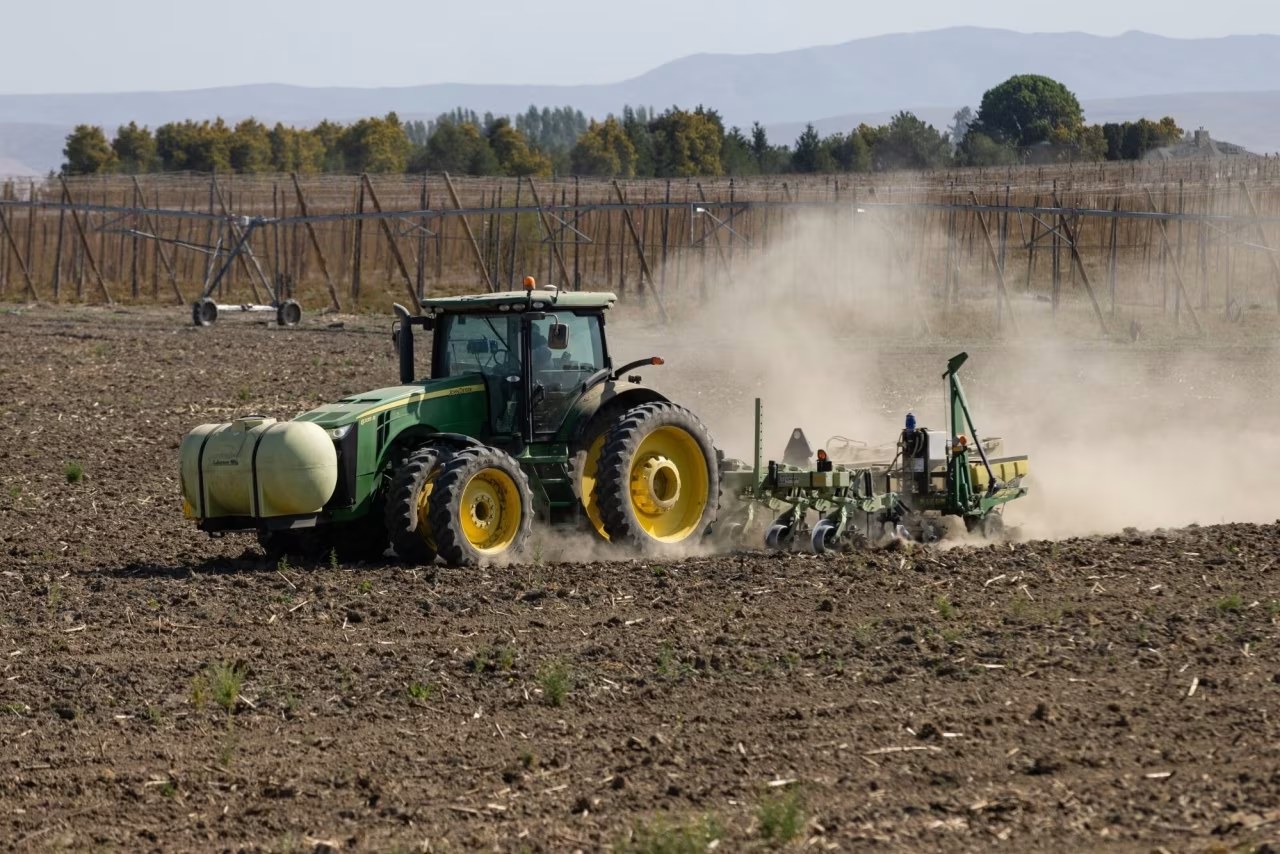
STRAIT OF HORMUZ—Shares of North American fertilizer manufacturers vaulted to unprecedented levels as military tensions near the Strait of Hormuz stranded an estimated 20% of the world’s ammonia, urea and phosphate supply, forcing farmers and traders to scramble for available tons ahead of spring planting.
The rally, led by CF Industries Holdings with a 76% year-to-date advance, underscores how quickly energy-intensive commodity markets can realign when war chokes key maritime chokepoints. With liquefied natural gas (LNG) also curtailed, European producers face feedstock costs that have risen 58% since the U.S.-Israeli bombardment of Iran began, while U.S. gas futures added a comparatively modest 13%.
That cost divergence is drawing hedge-fund and retail money into stocks that had been left for dead during last year’s bear cycle. “Investors are combing listings for winners in an otherwise down market,” Mizuho analyst Edlain Rodriguez told clients this week, noting that CF can now price its nitrogen fertilizers at international parity while holding a gas-cost advantage.
How the Strait of Hormuz Became a Fertilizer Flashpoint
The Strait of Hormuz—only 21 nautical miles wide at its narrowest—carries 20–30% of seaborne ammonia and phosphate exports from Qatar, Saudi Arabia, Kuwait and the UAE. When insurers slapped wartime premiums on hulls transiting the Persian Gulf after the latest air strikes, more than 60 bulk carriers laden with fertilizer raw materials were left at anchor, according to ship-tracking data compiled by Bloomberg.
Phosphate rock from Morocco and ammonia out of the Arabian Gulf jointly feed nutrient blending plants in Brazil, India and the European Union. With spring application season only weeks away in the Northern Hemisphere, the bottleneck has erased the customary safety buffer that allows growers to pre-buy crop nutrients. “Any supply shock in March or April is magnified because farmers have to plant regardless of price,” explains Alexis Maxwell, president of Green Markets, a fertilizer research firm.
Energy, not ore, is the real chokepoint
While phosphate rock is mined and shipped in bulk, nitrogen fertilizers are synthesized from natural gas through the Haber-Bosch process. Roughly 80% of cash production cost for ammonia is energy, so even modest moves in gas prices cascade through global nitrogen pricing. European TTF gas futures have climbed 58% since mid-October, pushing regional ammonia production cash costs above $1,100 per metric ton, according to ICIS. U.S. Henry Hub gas futures, by contrast, trade near $2.60 per million British thermal units—about one-fifth of European levels after adjusting for shipping and processing.
That cost wedge explains why CF Industries, which operates the world’s largest single-train ammonia complex in Donaldsonville, Louisiana, has emerged as the poster child for wartime commodity plays. The company consumes 1.6 billion cubic feet of gas daily—enough to supply Boston—yet its delivered cost of ammonia remains roughly $300 per ton below European rivals.
History shows such spreads can persist for months. During the 2019 Strait of Hormuz tanker attacks, urea prices jumped 25% in six weeks and kept climbing until the U.S. dispatched naval escorts. Today, with no diplomatic off-ramp in sight, traders are pricing in a prolonged disruption. “Markets remember 2019,” says Chris Lawson, head of fertilizers at UK-based Argus Media. “Buyers are front-loading purchases before product disappears.”
The rally has room to run if European plants begin curtailing output. Norway’s Yara International, the world’s largest nitrogen producer, has already warned investors it may idle 30% of European ammonia capacity if margins stay negative. Each ton of shuttered capacity tightens the global balance and hands pricing power to low-cost exporters in North America and Russia.
Why CF Industries Is the Biggest Beneficiary
CF Industries’ 76% share-price surge this year has vaulted its market capitalization above $23 billion, eclipsing the combined equity value of Mosaic, Nutrien and Intrepid Potash. The move is not merely speculative: the company’s plants sit atop the lowest-cost natural-gas basin in the industrialized world and ship into the planet’s largest corn and soybean market.
Investor logic is straightforward. Every $1 per MMBtu change in U.S. natural-gas prices alters CF’s annual cash flow by roughly $250 million, according to company filings. With European gas quadrupling relative to Henry Hub, CF can undercut competitors by $150–$200 per ton of urea while still capturing record margins. Mizuho’s Rodriguez calculates that CF’s EBITDA could top $4 billion in 2024 if today’s price spreads hold—double last year’s figure.
Operational leverage meets tight supply
Beyond cost advantage, CF benefits from operational leverage. Its Donaldsonville complex can swing between urea, urea ammonium nitrate (UAN) and ammonia depending on spot pricing, allowing management to chase the highest-margin product. During the 2022 Ukraine war rally, CF shifted 600,000 tons of annual capacity from UAN to urea in six weeks, capturing an extra $180 million in profit.
The company also owns extensive ammonia storage caverns along the Mississippi River, giving it seasonal supply flexibility that rivals lack. When spring application begins, CF can draw down inventory rather than bidding for spot gas, insulating margins from short-term price spikes.
Wall Street has noticed. Of 22 analysts covering the stock, 18 rate it a buy and none recommend selling. Even after the recent run, the consensus 12-month price target sits 12% above current levels, according to FactSet. Short interest has fallen to 2.1% of float—half the chemicals-industry median—signaling that bearish bets have been squeezed out.
Yet risks remain. A sudden cease-fire could send Mideast cargoes flooding back into the market, and U.S. gas prices could spike if an Arctic blast freezes wells. CF also faces long-term decarbonization pressure: ammonia production emits 2.3 tons of CO₂ per ton of product. Carbon taxes or green-ammonia mandates could erode its cost edge. For now, however, traders are focused on the immediate supply vacuum—and betting CF keeps winning.
What the Fertilizer Rally Means for U.S. Farmers
For U.S. growers, the fertilizer rally is a double-edged sword. On the input side, the average Illinois corn farmer paid $227 per acre for nutrients in 2023, according to USDA. If today’s spot prices hold, that figure could climb above $290 by planting—erasing roughly 12% of projected gross revenue at current corn futures near $4.40 per bushel.
Yet higher fertilizer costs are already baked into grain futures. December corn has rebounded 8% since early February, while November soybeans added 6%, as traders price in both Ukraine export uncertainty and reduced U.S. acreage if nutrients stay dear. Farmers who locked in sales early could actually see net-cash margins improve if fertilizer rallies coincide with grain gains.
Shifting acreage and nutrient rates
Extension agronomists report that growers are reassessing application rates. Iowa State University estimates that cutting phosphorus and potassium by 20% on medium-testing soils trims only 1.3 bushels per acre from corn yield—worth $5.70 at today’s prices but saving $18 in nutrients. Across 90 million corn acres, such micro-adjustments could free up 400,000 tons of phosphate demand.
There is also evidence of switching to soybeans, which require half the nitrogen of corn. University of Illinois farm economists project a 1.2 million-acre swing from corn to soy in 2024 if urea remains above $500 per short ton. That shift would ripple through the nitrogen complex, trimming ammonia demand by 200,000 tons—equal to one month of CF sales.
Retailers say growers are accelerating purchases to beat further increases. Helena Agri-Enters, the third-largest U.S. fertilizer distributor, reports ammonia bookings up 22% year-over-year in January and February. Early demand could tighten inventories further, reinforcing the price spike and rewarding producers who hold inventory.
Longer term, the fertilizer shock highlights the vulnerability of American farms to geopolitical risk. The U.S. imports 27% of its potash and 14% of its nitrogen, mostly from Canada and Trinidad, but prices are set in global markets. As climate policy pushes farmers toward precision application and biologicals, nutrient efficiency is becoming as critical as yield. For now, growers are bracing for the most expensive spring in a decade—and praying the Strait of Hormuz reopens before seeding ends.
Could Fertilizer Prices Keep Climbing?
History suggests fertilizer rallies driven by supply shocks—not demand booms—tend to fade once trade routes reopen. But several structural factors argue for sustained price strength this cycle. First, European gas storage sits at only 58% of capacity, well below the five-year average, leaving the continent vulnerable to any cold snap. Second, new nitrogen capacity additions are minimal: only 2.3 million metric tons of urea capacity is slated to start up globally in 2024, versus 5 million tons in 2017, according to the International Fertilizer Association.
Meanwhile, China—the swing exporter—has imposed export restrictions on urea and phosphate to protect domestic food security. Beijing capped 2024 urea exports at 5 million tons, down from 8 million in 2022, tightening seaborne availability just as India tenders for spring deliveries.
Risk matrix: upside vs downside
Upside risks include another Red Sea attack on an LNG carrier, which could send European gas above $50 per MMBtu and lift ammonia to $1,400 per ton—levels last seen after Russia’s invasion of Ukraine. Downside catalysts range from a cease-fire in Gaza that allows insurers to resume coverage, to the restart of Libya’s 120,000 ton-per-month ammonia plant that has been offline since December.
Traders are pricing in a 35% probability that urea stays above $450 per short ton through June, according to CME options data. That implies a fair-value EBITDA multiple of 6.8× for CF Industries—still below its 10-year average of 7.4×, suggesting equity upside even if commodity prices plateau.
Bottom line: unless Middle East cargoes resume within 60 days, global inventories will be too depleted to prevent a seasonal spike. U.S. producers with cheap gas and deep-water ports—CF, Nutrien, and Koch’s Mosaic—are positioned to harvest what may be the last super-margin cycle before green-ammonia technologies mature later this decade.
Global Trade Flows Redraw the Fertilizer Map
The Hormuz bottleneck is accelerating a tectonic shift that began in 2022: fertilizer trade is pivoting away from just-in-time shipping toward a hub-and-spoke model centered on the U.S. Gulf Coast. Port Houston has seen ammonia vessel loadings rise 18% year-over-year, while New Orleans urea barges are trading at a $40 per ton premium to Middle East FOB quotes—the widest spread on record.
India, the world’s largest urea importer, is responding by extending long-term supply contracts with U.S. producers. Indian Farmers Fertiliser Cooperative (IFFCO) signed a three-year offtake agreement with CF Industries in February for 1.2 million tons annually—double last year’s volume. The deal includes optionality to lift extra tons if Gulf exports remain disrupted, effectively capping India’s price exposure.
New corridors, new chokepoints
Meanwhile, Russia is redirecting Baltic ammonia to Southeast Asia via the Northern Sea Route, cutting voyage time to 28 days from 42 via Suez. Although volumes are small—about 300,000 tons—Moscow’s pivot underscores how geopolitics is reshaping even bulk-commodity flows.
Europe, shut out of cheap Mideast ammonia, is ramping up imports from Trinidad and Algeria, but those routes require passage through the Strait of Gibraltar, itself a potential flashpoint. Spanish customs data show ammonia arrivals from Trinidad up 44% in January, yet prices remain 30% above pre-crisis levels because of higher freight.
The net result is a fragmented market where regional premiums persist. U.S. Gulf urea now trades at a 12% premium to China FOB, reversing the historical discount. For producers with spare tons and deep-water access, that arbitrage is pure profit. For import-dependent farmers in Europe and South Asia, it is inflationary headwind that could last well beyond the current planting season.
Frequently Asked Questions
Q: Why are fertilizer stocks rising right now?
Fertilizer stocks are jumping because fighting near the Strait of Hormuz has stranded roughly 20% of global ammonia, urea and phosphate supply, allowing low-cost U.S. producers such as CF Industries to raise prices while their natural-gas input costs climb only 13% versus 58% in Europe.
Q: How much has CF Industries stock gained?
CF Industries has advanced 76% since the Middle East conflict escalated, hitting an all-time high as investors bet the Northbrook, Illinois nitrogen giant can expand margins while competitors face stranded cargoes and pricier European gas.
Q: What share of LNG supply is stuck in the Persian Gulf?
Roughly 20% of global liquefied natural gas is blocked inside the Persian Gulf, cutting off the key feedstock for European and Asian fertilizer plants and widening the cost advantage of U.S. gas-based producers.
Q: Which nutrients are most affected by the shipping disruptions?
Ammonia, urea, sulfur and phosphates—the four building blocks of most nitrogen and phosphate fertilizers—have seen large volumes held up at Gulf export terminals, tightening global inventories ahead of the Northern Hemisphere spring planting season.
📰 Related Articles
- Crude Caps 11% Weekly Surge as Hormuz Tanker Routes Remain Paralyzed
- Steel, Chemicals and Aluminum Face Crossroads as Costs, Breakup Calls and Supply Risks Collide
- IEA’s 400-Million-Barrel Release Fails to Dent Brent at $91 as Hormuz Risks Dominate
- Valor’s Electrochemical Breakthrough Could Free US Critical Minerals From Smelters
