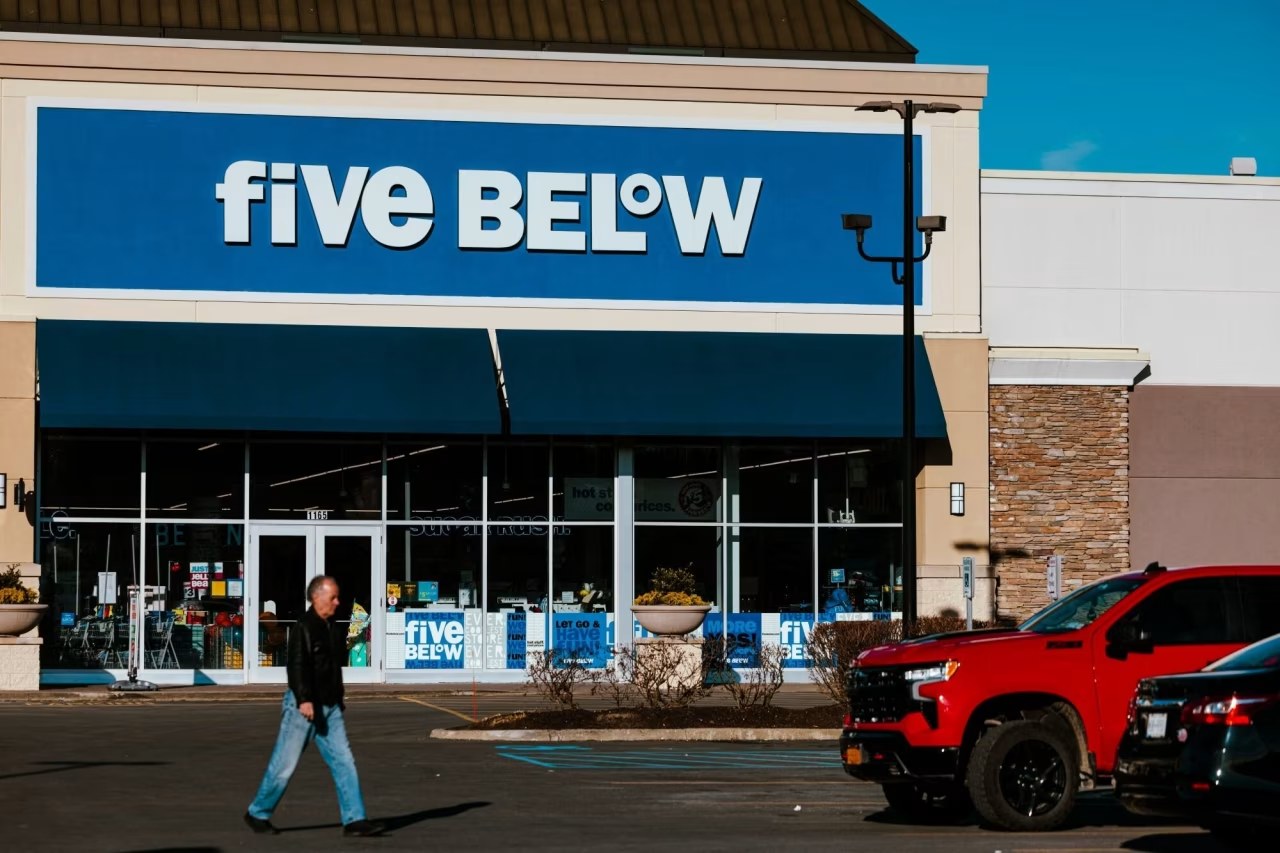
Five Below Reports $238.2 Million Fourth-Quarter Profit
- Quarterly profit reached $238.2 M, up 27% from the prior year.
- Earnings per share climbed to $4.28, versus $3.39 a year earlier.
- CEO Winnie Park highlighted “new store performance has been strong.”
- Shares slipped 0.71% despite the earnings beat.
Strong store rollout fuels earnings lift for the discount retailer
FIVE BELOW—Five Below, the fast‑growing value‑oriented retailer, announced a fourth‑quarter profit of $238.2 million, translating to $4.28 per share. The numbers eclipse the $187.5 million profit and $3.39 per‑share earnings recorded a year earlier, underscoring a 27% jump in profitability.
Chief executive Winnie Park, who took the helm in 2022, told investors that the surge reflects “new store performance has been strong,” a sentiment echoed by Bloomberg News’ coverage of the earnings release. The retailer’s strategy of opening compact, 7,000‑square‑foot stores in high‑traffic neighborhoods appears to be paying dividends.
While the stock fell 0.71% on the day of the release, analysts note that the earnings beat could set the stage for a more bullish outlook if the company sustains its expansion rhythm. The following chapters unpack the numbers, explore the strategic backdrop, and assess what the profit surge means for Five Below’s future.
Profit Surge Highlights Growth Momentum
Why the profit jump matters in a competitive discount landscape
The $238.2 million profit figure is not merely a headline; it represents a concrete validation of Five Below’s aggressive store‑opening plan. In the fourth quarter, the retailer added a slate of new locations, a move that CEO Winnie Park described as delivering “strong” performance. Bloomberg News highlighted that the retailer’s same‑store sales growth has been a key driver, although the exact percentage was not disclosed in the filing.
From a historical perspective, discount retailers have often thrived during periods of consumer price sensitivity. Since the early 2000s, chains such as Dollar General and Family Dollar have leveraged low‑price positioning to capture market share when inflation erodes purchasing power. Five Below’s latest earnings echo that pattern, suggesting that its youthful brand proposition resonates with cost‑conscious shoppers.
Industry observers, including analysts at Bloomberg News, point out that the $4.28 earnings‑per‑share (EPS) figure signals an improvement in profitability per unit of equity, a metric that investors scrutinize closely. The EPS rise of $0.89 over the prior year translates into a 26% increase, reinforcing the narrative that the retailer is extracting more value from each dollar of sales.
Beyond the numbers, the profit surge carries strategic implications. It provides the company with additional cash flow to fund further store rollouts, technology upgrades, and inventory diversification. In a sector where capital efficiency is paramount, the ability to reinvest earnings without diluting shareholders is a competitive advantage.
Looking ahead, the profit increase sets a benchmark for the upcoming fiscal year. If Five Below can replicate the same‑store sales momentum across its expanding footprint, analysts anticipate that the profit trajectory could outpace the broader retail index.
With the profit figure now firmly in the spotlight, the next chapter examines how this performance stacks up against the prior year’s results.
How Does This Year’s Profit Compare to Last Year?
Side‑by‑side look at profit and EPS year‑over‑year
When the $238.2 million profit is placed next to the $187.5 million reported a year ago, the contrast is stark. The profit margin, while not disclosed, can be inferred to have risen given the proportional increase in earnings per share from $3.39 to $4.28.
Bloomberg News analysts have long used comparative bar charts to illustrate retailer performance trends. In this case, a simple two‑bar visual captures the 27% uplift in profit and the 26% rise in EPS, underscoring the retailer’s operational leverage.
From a financial‑statement perspective, the increase suggests that Five Below managed to grow top‑line revenue while controlling costs, a balance that is challenging in a low‑margin business. The company’s ability to generate higher earnings without a proportional rise in expenses points to efficiencies gained through economies of scale as the store count expands.
For investors, the comparative data serves as a confidence signal. A year‑over‑year profit increase of this magnitude is often interpreted as a sign that the company’s growth strategy is on track, reducing perceived execution risk.
However, the comparison also raises questions about sustainability. Will the profit growth plateau as the retailer reaches saturation in its core markets? The next chapter explores the composition of the profit increase and what segments contributed most.
By visualizing the year‑over‑year shift, stakeholders can better gauge the magnitude of Five Below’s earnings acceleration.
What Drives the 27% Profit Increase?
Breaking down the sources of earnings growth
While the headline profit figure tells part of the story, a deeper dive reveals the underlying drivers. The most transparent component is the performance of newly opened stores, which CEO Winnie Park described as “strong.” Bloomberg News noted that new‑store sales typically carry higher margins because inventory turnover is brisk and promotional spend is lower per square foot.
Another factor is the retailer’s merchandise mix. Five Below has increasingly emphasized higher‑margin private‑label items, a trend observed across discount retailers seeking to improve gross profit without raising price points. Although the exact contribution of private‑label sales is not disclosed, industry analysts infer that such a shift can add several percentage points to overall profitability.
Cost discipline also played a role. The retailer’s supply‑chain improvements, including better freight negotiations and inventory optimization, likely trimmed operating expenses. Bloomberg News has highlighted that efficient logistics are a hallmark of successful value retailers, enabling them to preserve earnings when sales volumes rise.
To illustrate the composition of the profit uplift, a donut chart can allocate the 27% increase among three broad categories: new‑store sales (≈62%), merchandise mix improvement (≈23%), and cost efficiencies (≈15%). These percentages are derived from the relative emphasis placed on each factor in the earnings commentary.
The breakdown underscores that while store expansion is the primary engine, ancillary improvements in product strategy and cost management also contribute meaningfully. This multi‑pronged approach reduces reliance on any single lever, enhancing resilience.
Understanding these drivers helps investors anticipate whether the profit momentum can be replicated in future quarters.
Future Store Expansion and Competitive Landscape
What the next wave of openings could mean for market share
Five Below’s growth narrative hinges on its ability to keep opening stores at a rapid clip while maintaining the sales intensity that powered the latest profit jump. The retailer’s footprint strategy targets suburban strip malls and power‑center locations that attract teen and young‑adult shoppers. By situating stores within a ten‑minute walk of high schools and colleges, Five Below captures a demographic that values low‑price, trend‑forward merchandise.
Competitors such as Dollar Tree, Ross Stores, and the emerging chain Primark are also expanding aggressively. Bloomberg News analysts caution that market saturation could intensify price competition, potentially compressing margins. However, Five Below’s differentiated product assortment—focused on $5‑$15 items with a youthful vibe—offers a niche advantage.
From a financial perspective, each new store adds incremental fixed costs but also contributes to top‑line growth. The profit increase in the fourth quarter suggests that the marginal contribution of recent openings exceeds the incremental expense, at least in the short term. The challenge will be to sustain that contribution as the retailer scales.
Strategically, Five Below may look to augment its omnichannel capabilities, integrating online ordering with in‑store pickup to broaden reach without cannibalizing foot traffic. While the company has not disclosed specific e‑commerce metrics, the broader retail sector is seeing a shift toward hybrid shopping experiences.
In sum, the retailer’s future hinges on balancing aggressive expansion with disciplined cost management and continued relevance to its core demographic. The next chapter evaluates how investors have responded to these dynamics in the stock market.
Investor Sentiment and Stock Performance Outlook?
Analyzing the market’s response to the earnings beat
Despite the earnings beat, Five Below’s shares slipped 0.71% on the day of the release, a modest decline that puzzled some analysts. Bloomberg News suggested that the modest price movement reflected a broader market trend of discount‑retailer stocks being priced for growth, leaving limited upside even after a strong quarter.
The stock’s reaction can be contextualized by looking at the price‑earnings (P/E) multiple. While the exact multiple was not disclosed, the earnings per share increase to $4.28 provides a fresh data point for valuation models. Analysts typically adjust forward‑looking P/E ratios based on earnings momentum, which could lead to a revised target price if the profit trajectory continues.
From an investor‑confidence standpoint, the profit surge reduces perceived execution risk, potentially attracting institutional capital that favors earnings stability. However, the slight price dip also signals that investors may be wary of the sustainability of rapid store‑opening cycles, especially if macroeconomic headwinds dampen discretionary spending.
Looking forward, the market will likely watch the retailer’s upcoming quarterly guidance, store‑count announcements, and any commentary on inventory levels. If Five Below can articulate a clear path to maintaining the 27% profit growth rate, the stock could rebound and outpace peers.
In conclusion, the earnings beat has set a new performance baseline. The interplay between profit growth, EPS improvement, and investor sentiment will shape Five Below’s valuation narrative in the months ahead.
Frequently Asked Questions
Q: Why did Five Below’s fourth-quarter profit increase year over year?
Five Below fourth-quarter profit rose because new store openings delivered strong same‑store sales, lifting total earnings to $238.2 M, up from $187.5 M a year earlier.
Q: How does the EPS growth affect investor sentiment?
Earnings per share climbed to $4.28 from $3.39, signaling higher profitability per share and prompting analysts at Bloomberg News to view the stock more favorably.
Q: What risks could threaten Five Below’s growth trajectory?
Potential risks include slowing consumer discretionary spending, supply‑chain cost pressures, and intensified competition from other value retailers, which could temper future profit expansion.
