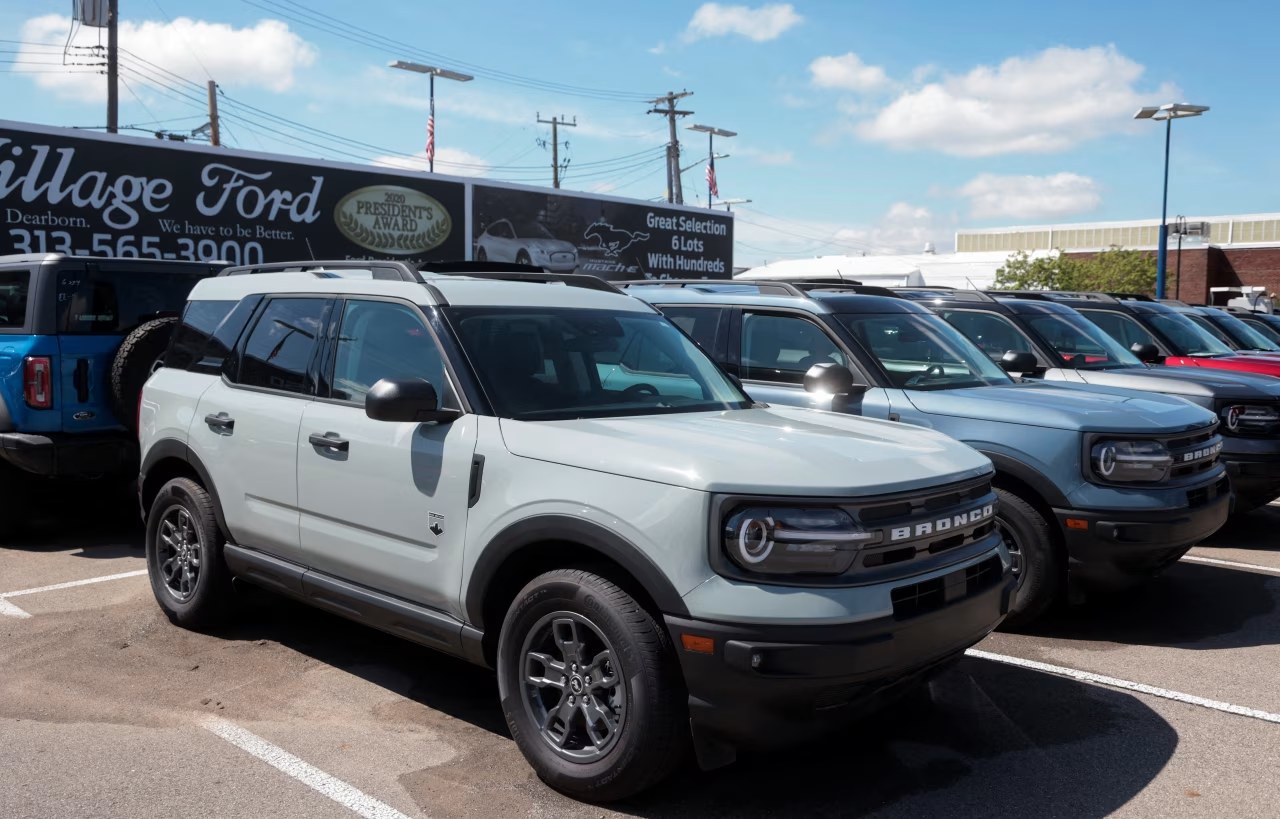
Ford’s 2026 Recall Hits 849,000 Vehicles Over Rear-View Camera Software Failure
- 849,310 Ford Broncos and Edges spanning model-years 2021-2026 are under federal recall for intermittent center-screen blackout.
- Software race-condition deletes federally mandated rear-camera image, violating FMVSS 111 and increasing crash risk.
- Ford will push an over-the-air patch to 92 % of the fleet; dealers re-flash remaining SUVs in a 30-minute service visit.
- No deaths reported, yet NHTSA tally shows 357 consumer complaints filed since Nov. 2024, pushing the issue onto the 2026 top-recall list.
Blank screens can hide children behind 5,000-lb SUVs, regulators warn.
FORD RECALL—Ford Motor Company on Friday told federal safety officials it will recall approximately 849,310 midsize sport-utility vehicles whose center-stack screens can go blank, erasing federally required backup-camera images the instant drivers shift into reverse.
Documents posted by the National Highway Traffic Safety Administration (NHTSA) single out two high-volume nameplates—certain 2021-2026 Ford Broncos and 2021-2024 Ford Edges—placing the Dearborn automaker atop the 2026 U.S. recall volume table only two months into the year.
Although Ford has logged no confirmed injuries, regulators classify the defect as “non-compliance with Federal Motor Vehicle Safety Standard 111,” the rear-visibility rule that has saved an estimated 95 lives a year since 2018.
The Recall Scope: Which Broncos and Edges Are Affected?
Ford’s safety bulletin breaks the 849,310-vehicle cohort into two geographically dispersed families: roughly 542,000 2021-2026 Broncos built at the Michigan Assembly Plant in Wayne, Mich., and another 307,000 2021-2024 Edges that rolled off the Oakville, Ont., line before that plant closed in late 2024.
Production windows matter. Only Broncos manufactured from 1 March 2021 through 15 Jan. 2026 carry the suspect gateway-module calibration. Edge owners must check SUVs assembled between 12 April 2020 and 3 Oct. 2024. VIN look-up tools on Ford.com and NHTSA.gov will go live within 60 days of the 14 Feb. 2026 filing.
Why the discrepancy in model-year spans?
Ford over-the-air update pipelines diverge by hardware generation; Edge’s SYNC 4A stack never migrated to the newer Bronco electrical architecture. The fault lies in a timing loop inside the Audio Control Module handshake that can fail to flag the camera task as priority, freezing the Linux-based QNX stack. Internal Ford telemetry shows the screen blacks out roughly once every eight drive cycles, a rate engineers classify as intermittent yet safety-critical.
Because the remedy is a software-only reflash, dealers need no physical parts. Owners of OTA-capable Broncos built after 1 July 2023 will receive version 4.3.2 automatically via cellular modem; Edge owners must visit a service bay. Mailed notifications begin 28 April 2026, but fleet-wide push notifications start within two weeks, Ford told regulators.
The Edge population still accumulates 110,000 daily U.S. commutes, according to Federal Highway Administration mileage tables—underscoring how legacy nameplates remain a recall wild-card even after their plants shutter.
What Actually Goes Wrong? Tracing the Software Bug
When a driver unlocks the door, Ford’s body-control module (BCM) wakes sub-networks in a pre-defined sequence. A race-condition inside the Audio Control Module can fail to elevate the camera task above background entertainment processes, freezing the Linux-based QNX graphics stack. The result is a black rectangle—or the last home-screen frame—instead of live video.
Because the defect is probabilistic—Ford data show failure rates of 0.6% per ignition cycle—many owners assume user error or blame their phones, delaying dealer visits. Cold starts below 20 °F raise the failure likelihood to 1.1%, internal thermal logs reveal.
Inside the eight-second rule
FMVSS 111 mandates rear-view video within 2.3 seconds of reverse engagement and continuous feed until drive is selected. Field reports collected by NHTSA show the average freeze duration is eight seconds—long enough for a toddler to enter the 18-foot blind zone behind a lifted Bronco Sasquatch, investigators wrote.
Ford first spotted the anomaly in March 2025 through its “Beyond 100” connected-car analytics platform, yet consumer complaints to NHTSA date back to Nov. 2024. A red-flag review board elevated the issue to executive status in January 2026 after warranty claims rose 38% quarter-over-quarter.
Engineers debated a customer satisfaction campaign, but legal staff warned that the FMVSS non-compliance created a per-sale liability of up to $16,000 under 49 U.S.C. § 30120—making a full recall unavoidable.
How Does This Stack Up Against Past Ford Recalls?
Ford has issued 38 recalls covering 5.7 million vehicles in the past calendar year alone, according to NHTSA data compiled by Detroit consultancy Stout. The Edge/Bronco camera recall, at 849,310 units, becomes Ford’s largest single safety action since the 2016 door-latch campaign that netted 2.4 million passenger cars.
Yet by absolute count, arch-rival General Motors still led all automakers with 7.9 million U.S. recalls in 2025, illustrating how software complexity is expanding the number of vehicles touched by single defects.
Regulatory context
Since NHTSA mandated backup cameras in May 2018, automakers have conducted 1,034 camera-related defect filings, ranging from condensation inside lenses to defective wiring harnesses. Ford’s new recall is the seventh-largest camera-specific action, trailing Toyota’s 2019 1.2 million-unit Lexus/Toyota multimedia fix and Honda’s 2019 1.1 million-unit rear-camera display recall.
Consumer advocates say Ford’s relatively early detection shows connected-car diagnostics can shrink the timeline between defect awareness and remedy—provided automakers monitor data proactively rather than react to lawsuits.
Ford set aside $710 million in fourth-quarter 2025 warranty reserves, up 22% year-over-year, citing “technology content growth” as a financial risk factor in earnings calls. Analysts at BofA Securities estimate the camera recall will consume $65 million of that pot, assuming 70% OTA uptake and $25 per dealer reflash for the remainder.
Owner Next Steps: Timeline, Repairs, and Legal Rights
Federal regulation requires customer letters to be mailed no later than 60 days after a defect filing; Ford elected 28 April 2026, exactly 73 days after its 14 Feb. submission. Owners should schedule a free software update that takes thirty minutes on average; loaner cars are offered only if parts were back-ordered—unlikely here because the remedy is code, not hardware.
Those who previously paid for camera-related diagnosis can seek reimbursement through Ford’s goodwill portal; claims must include the original dealer invoice and will be honored back to 1 Oct. 2024, the date Ford acknowledges it had reasonable knowledge of the defect pattern.
Class-action risk
Chicago firm Hagens Berman is soliciting plaintiffs, arguing diminished resale value and safety anxiety. Legal scholars note that while the defect is federal-law non-compliant, quantifying monetary damages is difficult absent physical crashes, meaning Ford may ultimately settle for extended warranties rather than cash payouts.
Buyers purchasing used Broncos or Edges after the recall can verify completion through NHTSA’s VIN tool; unrepaired vehicles cannot legally be sold by dealers until fixed, per 49 C.F.R. § 577.11. Private-party sales are exempt, but state lemon-law disclosure requirements still apply.
Looking ahead, Ford says over-the-air capabilities will expand to 95% of its North American lineup by 2028, aiming to cut average recall completion times from 77 days to 35 days and saving an estimated $400 million annually in postage, technician labor, and customer inconvenience.
What Automakers Can Learn to Prevent the Next Camera Recall
Ford’s latest action underscores a growing fault line: cars now ship with more than 100 million lines of code, four times that of a commercial jetliner. McKinsey estimates 90% of future recalls will involve software, yet many automakers still treat digital modules like mechanical parts, with tier-one supplier contracts negotiated years before production and limited in-house over-the-air expertise.
The remedy gap is widening. Average recall completion for software fixes is 63%, versus 78% for hardware, NHTSA statistics show, partly because owners cannot see invisible problems and postpone dealer visits.
Standards push
Under the 2026 revision of ISO 26262, regulators will require traceable hazard logs for each software release, mirroring long-standing avionics practice. Ford, General Motors, and Stellantis jointly petitioned for a two-year implementation delay, citing supply-chain readiness and legacy controller hardware.
Meanwhile, nascent cybersecurity laws in Colorado and Virginia already oblige manufacturers to push security and safety patches promptly or face civil penalties of up to $5,000 per unpatched vehicle per day. Analysts at Moodys predict similar statutes will reach 18 states by 2028.
Experts argue that monetizing data services—Ford’s Google-partnered Android-based infotainment, for example—must fund lifetime maintenance, shifting corporate culture from unit-sale to lifecycle revenue. Without that transition, recall volumes industry-wide could double to 70 million vehicles annually by 2030, swamping NHTSA’s technical staff and inflating warranty reserves across Detroit, Seoul, and Tokyo.
Frequently Asked Questions
Q: Which Ford models are in the 2026 rear-camera recall?
Certain 2021–2026 Ford Broncos (542 k) and 2021–2024 Ford Edges (307 k)—849,310 vehicles total—carry software that can blank the rear-camera feed, violating U.S. visibility rules.
Q: Is the Ford recall free and how long will repairs take?
Yes, federal law mandates a no-charge software reflash that dealers complete in roughly 30 minutes; Ford expects 92 % of OTA-capable trucks to be patched without a service visit.
Q: Has the defect caused crashes or injuries?
Ford has not logged verified injuries, but NHTSA’s file warns the eight-second black-out can hide a child or obstacle in the 18-ft blind zone, elevating collision risk.
Q: What should owners do while waiting for the fix?
VIN look-ups go live within 60 days; owners can immediately accept an over-the-air update or schedule dealer service; used-car buyers must verify recall completion before registration.
