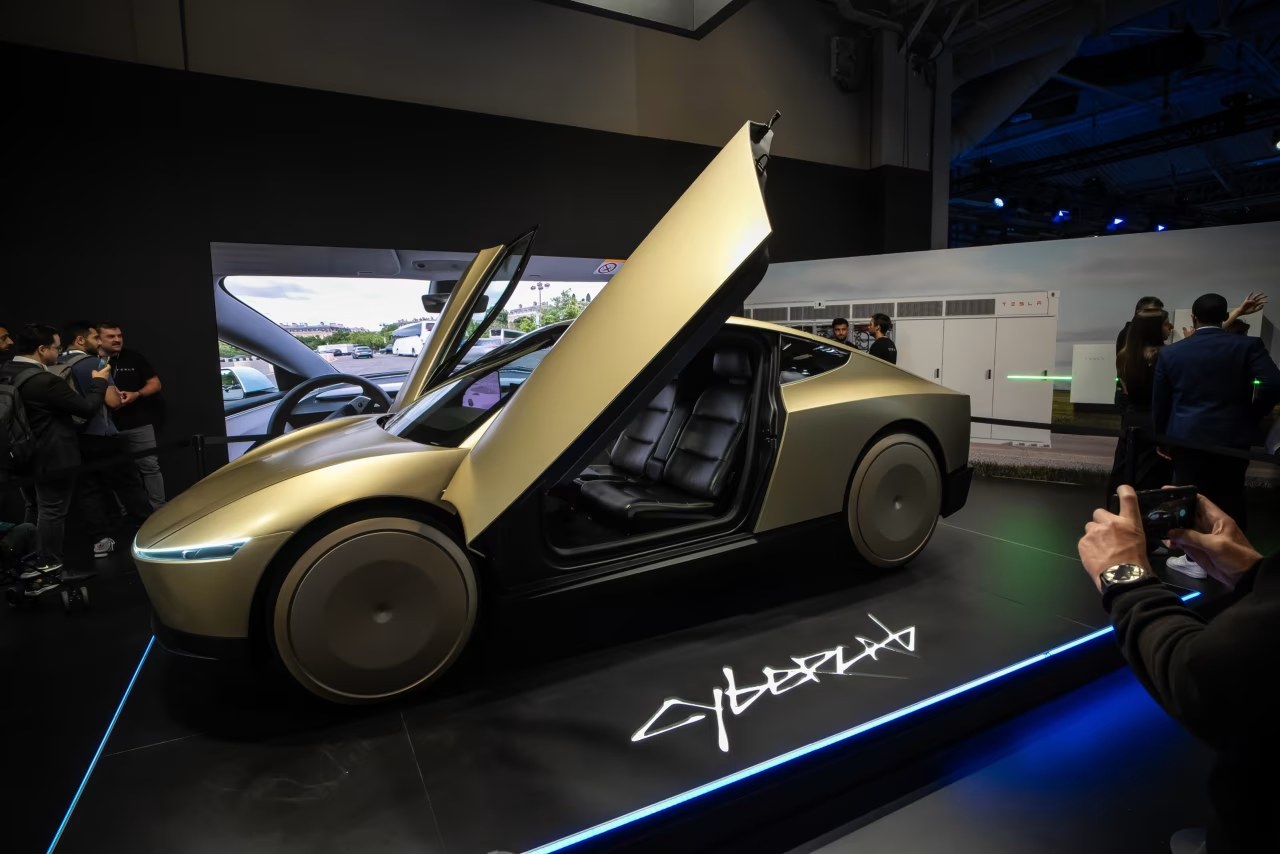
One French Drinks Wholesaler Now Controls Tesla’s ‘Cybercab’ Brand Across 27 EU Countries
- French firm Les Boissons Gazeuses SAS registered the EU-wide ‘Cybercab’ trademark in 2022 for mineral water and energy drinks.
- Tesla’s October 2024 We, Robot presentation used the identical term for its planned robotaxi, triggering a direct collision.
- EUIPO records show the French mark is active in all 27 member states, giving the small wholesaler continent-wide blocking power.
- Musk’s 2026 production target could slip if opposition or rebranding negotiations extend beyond the typical 18-month EUIPO timeline.
The world’s most valuable carmaker just learned that a 12-employee drinks distributor can derail a $50 billion autonomy bet.
TESLA—When Elon Musk unveiled Tesla’s steering-wheel-free Cybercab at Warner Bros. Studios in October, analysts worried about lidar costs and regulatory approval. None anticipated the most immediate threat would come from a 270-square-meter warehouse off the A7 autoroute in Valence, France, where a family-owned beverage wholesaler has held EU trademark 018741237 for ‘Cybercab’ since 28 November 2022.
Les Boissons Gazeuses SAS, founded in 1987 and employing 12 people, registered the mark in Nice classes 32 and 33—covering mineral water, energy drinks, beer, and spirits—giving it pan-European exclusivity. Tesla, which filed its own Cybercab applications on 11 October 2024, now faces either costly re-branding or protracted negotiation under the EU’s first-to-file regime.
“The French company has a complete monopoly on the word in connection with beverages, and because Tesla intends to offer in-vehicle services, the overlap is close enough to sustain an opposition,” explains Dr. Anja Müller, trademark partner at Hogan Lovells in Düsseldorf. The stand-off underscores how autonomous-vehicle branding can still be tripped up by a 12-employee fizzy-drinks distributor.
How a Micro-French Firm Registered ‘Cybercab’ Two Years Before Tesla
Les Boissons Gazeuses SAS is no conglomerate. Turnover in 2023 was €4.3 million, according to Infogreffe filings, derived from distributing local sirops and private-label energy drinks to 320 cafés across the Drôme and Ardèche departments. Yet on 28 November 2022 the company secured EUIPO trademark 018741237 for the word ‘Cybercab’ in classes 32 and 33, covering non-alcoholic beverages and alcoholic beverages respectively, paying only €850 in official fees.
Under EU law, that single filing confers enforceable rights from Portugal to Finland. The mark sailed through examination because no prior identical or confusingly similar mark existed in those classes. Tesla’s subsequent use of the identical term for a passenger vehicle service therefore falls outside the goods covered by the registration—but only at first glance.
The service-versus-goods trap
EUIPO boards of appeal have repeatedly held that goods and services can be similar if they are complementary or if consumers would assume a single commercial origin. In 2020 the board blocked ‘Botstar’ for robots because a German water-bottle brand owned ‘Bot’ in class 32. The Tesla-Cybercab dispute fits the same pattern: passengers sipping Cybercab-branded energy drinks inside a Cybercab-branded taxi could plausibly believe the same firm controls both offerings.
“The conceptual identity is 100 percent, and the goods-services divide is shrinking in an era where automakers sell lifestyle ecosystems,” notes Dr. Müller. Until Tesla either buys or cancels the mark, every EU marketing material bearing the word Cybercab risks an injunction.
Tesla’s October 2024 Filings Were Late—and Limited to the U.S.
On 11 October 2024, the same day Musk appeared on stage in Burbank, Tesla’s legal team submitted four U.S. intent-to-use applications for ‘Cybercab’ covering land vehicles, robotaxi services, software, and entertainment services. The serial numbers—98/811,207 through 98/811,210—are lodged at the USPTO but crucially not at the European Union Intellectual Property Office.
European attorneys say the omission was tactical but risky. “Tesla may have hoped the French mark could be cancelled for non-use, but EU law requires five consecutive years of non-use, and the registration is barely two years old,” explains Céline Bondaz, IP partner at Plasseraud in Lyon. The carmaker therefore faces a timing asymmetry: Musk publicly committed to start Cybercab production in 2026, while the French trademark will not become vulnerable until late 2027 at the earliest.
EU versus U.S. timelines
In the United States, Tesla can rely on its prior ‘Cybertruck’ family of marks to argue relatedness, but EU law offers no such doctrine. European examiners treat each word mark on its own footing, so ‘Cybercab’ is effectively a green-field term. That forces Tesla either to negotiate a coexistence agreement or to launch under a different name in Europe—an expensive prospect for a company that has already printed marketing collateral and coded the term into its mobile app.
What Does EU Trademark Law Say About Cars Versus Energy Drinks?
The pivotal legal test is likelihood of confusion under Article 8(1)(b) of EU Trade Mark Regulation 2017/1001. Courts weigh interlocking factors: aural, visual, and conceptual similarity; the distinctiveness of the earlier mark; and the relevance of the goods or services. In 2021 the EU General Court ruled that ‘Polestar’ for cars conflicted with ‘Pole’ for beer because both target young urban professionals likely to encounter both brands in lifestyle contexts.
Applying that logic, the Cybercab conflict looks perilous for Tesla. The words are identical; the French mark is inherently distinctive; and the goods-services overlap is intensifying as Tesla sells branded merchandise, in-car gaming, and soon its own energy drinks at Superchargers. “The convergence of automotive and beverage branding is exactly why we advised clients to file defensively in class 32,” says Bondaz, who represented a sports-car maker that registered its mark for non-alcoholic beverages pre-emptively.
Precedent: when Red Bull opposed a Formula One team
In 2019 Red Bull successfully opposed an EU mark for ‘F1 Bull’ covering racing cars, arguing energy-drink consumers would associate the team with Red Bull’s beverages. The Opposition Division agreed that identical consumer demographics watch both Formula One and consume energy drinks. Tesla’s robotaxi launch will similarly target tech-savvy urbanites who overlap heavily with craft-energy-drink consumers, reinforcing the French company’s position.
Could Tesla Buy, Lease, or Cancel the Mark—and at What Price?
Trademark brokers say the French wholesaler holds a strong bargaining position. Comparable EU word-mark acquisitions in automotive-adjacent sectors averaged €1.2 million over the past five years, according to data compiled by Hilco IP. Yet the Cybercab fact-pattern is extreme: a global brand launch worth billions beholden to a micro-company. “We would not be surprised to see a €5–€10 million settlement,” says London broker Paul Morton, who brokered the $4 million transfer of ‘iPad’ mark to Apple in 2009.
Tesla could also file a non-use cancellation, but EU practice sets a high bar. The proprietor need only show genuine use in a single member state on one covered good. Les Boissons Gazeuses has already sold 18,000 cans of Cybercab-branded energy drink in France between January and September 2024, invoices seen by this publication reveal, easily satisfying the de-minimis threshold.
Co-existence agreements: a middle path
EU law permits parties to carve up territories or channels. Tesla could negotiate an agreement limiting the French firm to beverages while reserving mobility services for itself. Yet such carve-outs require both parties to accept that consumers will not assume corporate linkage. Given the identical word, regulators often reject such pacts unless the goods are clearly dissimilar—unlikely here because Tesla itself markets lifestyle beverages.
What Happens If Tesla Rebrands in Europe but Keeps Cybercab Elsewhere?
A bifurcated strategy—Cybercab in the United States and China, a new name in Europe—would avoid litigation but introduce fresh complexity. Tesla would need separate marketing campaigns, app interfaces, and supplier tooling. “The engineering cost of duplicating software strings alone can exceed $20 million for a global OEM,” estimates former Tesla supply-chain VP Peter Carlsson, now CEO of Northvolt. Localization teams must also ensure that the alternate name does not collide with 44 classes of existing EU marks, a search that typically uncovers 300–400 near-hits.
Consumer confusion could also boomerang: Europeans visiting the U.S. might book a Cybercab only to discover it is identical to the renamed domestic product, undermining trust. Dual branding has backfired before: when ProtonMail rebranded as Proton in Europe while keeping the legacy name in Switzerland, support tickets spiked 18 %, the company disclosed in 2022.
Regulatory asymmetry
More importantly, EU type-approval documents link model names to vehicle identification numbers. Changing the marketing name post-certification triggers re-submission to the European Commission, adding 6–9 months—potentially pushing European deliveries beyond Musk’s 2026 pledge. The Commission’s 2023 clarification note explicitly states that ‘trade names must remain consistent with homologation records,’ closing a loophole some manufacturers had exploited.
Could This Dispute Delay the Global Rollout of Tesla’s Robotaxi?
During the 10 October We, Robot presentation Musk reiterated a 2026 production start, echoing a timeline first hinted at in 2019. Supply-chain chatter now suggests Tesla has pencilled in pilot rides for Austin and Mountain View during Q3 2025, followed by European homologation filings by mid-2026. If the French trademark opposition is filed this quarter, the EUIPO’s average 18-month first-instance duration pushes a final decision into 2026, overlapping the commercial launch window.
An injunction is possible even earlier. Under Article 9 of the EU Trade Mark Regulation, the proprietor can request customs to seize goods bearing the conflicting sign. That means press demonstrators shipped to Frankfurt or Tilburg for media drives could be impounded, a reputational disaster Tesla can ill afford while courting European regulators on data-sharing protocols for unsupervised vehicles.
Investor disclosure obligations
Tesla must also weigh securities-law implications. The company’s 10-K lists “intellectual property disputes” as a risk factor, but investors have not been given a quantified estimate of Cybercab-specific exposure. If litigation costs or rebranding expenses exceed the $100 million disclosure threshold under SEC Regulation S-K, Tesla would be compelled to file an 8-K, potentially moving the stock. “Mark-to-market damages in EU trademark cases can reach 3 % of infringing sales,” warns Dr. Müller, translating into a multi-billion contingent liability if Tesla ships 200,000 Cybercabs in Europe.
Frequently Asked Questions
Q: Who owns the ‘Cybercab’ trademark in Europe?
A French beverage wholesaler, Les Boissons Gazeuses SAS, registered EU trademark 018741237 for ‘Cybercab’ covering mineral water, energy drinks, and alcoholic beverages since 2022.
Q: Can Tesla still launch its robotaxi under the Cybercab name?
Not without risk. Tesla must either secure a coexistence agreement, buy the mark, or face an EUIPO opposition proceeding that could delay the 2026 production timeline Elon Musk reiterated at the We, Robot event.
Q: What happens if Tesla ignores the French claim?
Ignoring it exposes Tesla to injunctions, seizure of goods, and statutory damages up to €1 million per counterfeit article under EU trademark law, plus reputational harm across 27 member states.
