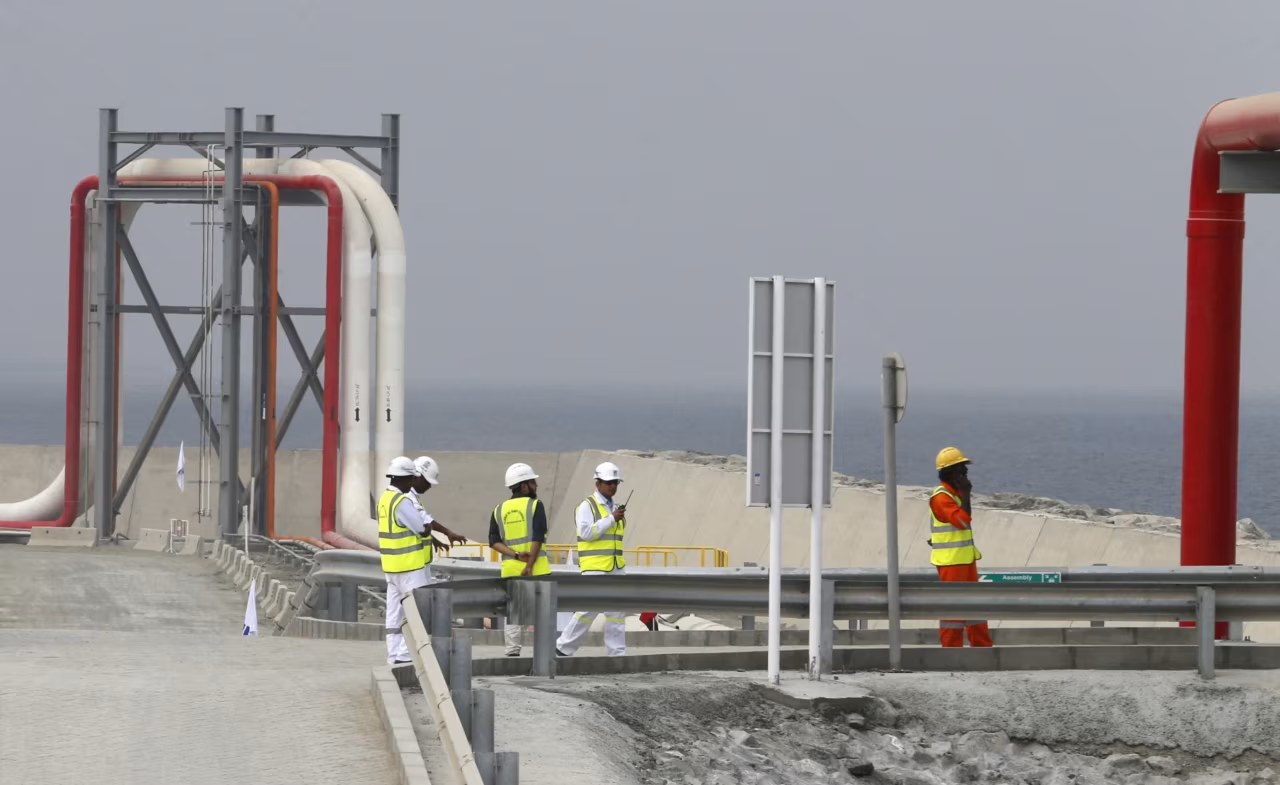
Two Pipelines Now Move 3 Million Barrels a Day Around Hormuz Chokepoint
- The Abu Dhabi Crude Oil Pipeline ends at Fujairah and can pump 1.5 million barrels daily.
- Saudi Arabia’s 1980s-era East-West Petroline is now running near its 1.8 million barrel capacity to Yanbu.
- Combined capacity equals barely 14% of the 21 million barrels that normally sail through Hormuz.
- Analysts at Rystad Energy warn any pipeline outage would send Brent crude above $120 within days.
Built as insurance against Iran-Iraq War attacks, the lines have become the region’s last reliable oil escape routes.
STRAIT OF HORMUZ—When drones struck tankers inside the Arabian Gulf last month, crude traders instantly priced in the nightmare scenario: a full blockade of the Strait of Hormuz. What kept the market from total panic was the knowledge that two bypass pipelines—one in Saudi Arabia, one in the United Arab Emirates—were still accepting barrels. Together the Saudi East-West Petroline and the Abu Dhabi Crude Oil Pipeline (ADCOP) can export roughly 3 million barrels a day, giving producers a narrow but vital detour to the open ocean.
The lines were never meant to replace seaborne exports; they were built as geopolitical insurance. Yet with repeated attacks on commercial shipping and escalating rhetoric over Tehran’s nuclear program, that insurance policy is now paying out daily. Riyadh has pushed flows through its 1,200-kilometre Petroline to the Red Sea port of Yanbu to near-nameplate levels for the first time since the 1980s, according to tanker-tracking data compiled by Kpler. Meanwhile, state-owned ADNOC has maximised throughput on ADCOP, sending 1.5 million barrels a day from the desert fields of Habshan to the Indian Ocean terminal at Fujairah.
Energy Aspects analyst Richard Bronze puts the strategic value bluntly: “Without those two pipes, Brent would already be in triple-digit territory.” The arithmetic is brutal: Hormuz handles about one-fifth of global petroleum consumption, so even a partial interruption ricochets through every refinery from Rotterdam to Ras Tanura. The pipelines blunt, but do not eliminate, that shock. Their combined capacity covers roughly 14% of Hormuz volumes, leaving the world still exposed to a 18-million-barrel-a-day shortfall in a worst-case shutdown.
Why the 1980s Petroline Is Saudi Arabia’s Pressure Valve
Constructed at a cost of $3.2 billion between 1979 and 1981, the East-West Petroline was the largest civil-engineering project in the kingdom’s history at the time. Its 48-inch diameter pipe can move 1.8 million barrels per day from Abqaiq, the world’s biggest oil-processing facility, to Yanbu on the Red Sea. The line was explicitly commissioned after repeated attacks on shipping during the Iran-Iraq War convinced policymakers in Riyadh that dependence on Hormuz was a national-security risk.
Reviving mothballed spur lines
To squeeze out another 200,000 barrels a day, Saudi Aramco has restarted two spur pipelines that feed Petroline from the offshore Safaniya and Zuluf fields, according to company presentations seen by Energy Intelligence. The upgrade required re-laying 70 km of 30-year-old pipe and installing three new pumping stations, a six-month project finished quietly in March. Consultants at Wood Mackenzie estimate the work added $1.20 per barrel in transport cost, still far cheaper than the $6–8 per barrel war-risk premium now baked into tanker freight rates for Gulf loadings.
Energy historian Gregory Brew at Yale University notes the irony: “A pipeline built to beat Carter-era embargoes is now shielding a 2024 market from Houthi drones.” The revival also undercuts Saudi Arabia’s own green-energy branding; the kingdom has pledged net-zero by 2060, yet it is expanding fossil-fuel export infrastructure. Aramco insiders counter that the Petroline expansion is “capacity optimisation, not growth,” allowing the company to redirect exports away from danger rather than raise overall output.
Forward-looking, Riyadh is studying a second parallel line that could double Yanbu capacity to 3.6 million barrels a day, according to a tender document circulated last year. Financing remains uncertain: the project would cost an estimated $7 billion and take six years, timelines that clash with volatile oil-price cycles. Yet every regional escalation makes the business case more persuasive. Analysts at Goldman Sachs now assign a 65% probability that Saudi Arabia commits to the expansion before 2027 if attacks on shipping persist.
Fujairah’s ADCOP: UAE’s Fast-Track Insurance Policy
While Saudi Arabia relied on 1980s steel, the UAE commissioned the Abu Dhabi Crude Oil Pipeline in 2008, a post-9/11 project accelerated after a series of al-Qaeda attacks on Gulf oil facilities. The 36-inch, 360-kilometre line runs from the onshore Habshan field to the Fujairah port on the Gulf of Oman, skirting Hormuz entirely. Designed capacity is 1.5 million barrels per day, enough to handle more than half of the emirate’s current output.
Engineering under sand and mountains
Technip of France and China Petroleum Pipeline Bureau laid the pipe through the Hajar Mountains using horizontal directional drilling to avoid coral reefs near Fujairah, a technique that added $400 million to the $3.3 billion budget. The line is double-coated with fusion-bonded epoxy to survive summer ground temperatures above 50 °C. A 2022 smart-pig inspection found wall-thinning of less than 0.2%, giving ADCOP an expected 40-year life.
“Fujairah gives ADNOC optionality,” explains Laurie Foon, Middle East upstream analyst at Rystad Energy. “They can load VLCCs on the Indian Ocean side without asking permission from Tehran or Washington.” The terminal has seven storage tanks holding 7 million barrels and a single-point mooring buoy capable of loading 300,000 barrels per hour, enough to fill a supertanker in 48 hours. Vortexa data show ADCOP has run at 98% uptime since January, compared with 89% for the region’s tanker fleet that faces intermittent delays from war-risk insurance inspections.
The UAE is now expanding Fujairah’s onshore storage to 10 million barrels and adding a second loading buoy by 2026, according to port-authority documents reviewed by S&P Global. Once complete, the upgrade will allow ADCOP to operate at 1.65 million barrels per day, shaving two days off the average VLCC turnaround time. The extra 150,000 barrels would equal the daily crude imports of Hungary, underscoring how incremental Gulf capacity still moves global balances.
How Insurers Price War Risk When Pipelines Replace Tankers
Marine insurers classify the Persian Gulf as a Listed Area, forcing tanker owners to pay an additional 0.75% of hull value per voyage, or about $400,000 for a very-large-crude-carrier. Pipelines remove that exposure, but introduce new liabilities: political violence cover for onshore assets now costs 0.35% of replacement value, according to Marsh McLennan. For ADCOP’s $3.3 billion infrastructure, that translates to $11.5 million in annual premiums, still far below the $35 million war-risk tab borne by an equivalent tanker fleet.
Reinsurance capacity crunch
After the 14 April drone barrage that hit Saudi pumping stations, Lloyd’s of London syndicates raised deductibles for Gulf energy assets by 25%. Only 12 underwriters now offer political-violence cover for pipelines inside 100 km of the Iranian coast, down from 21 in 2022, says Chris Lay, head of energy at broker Willis Towers Watson. The shrinking panel means longer placement times: ADCOP’s latest renewal took seven weeks versus the historical norm of 10 days.
Forward cover is getting creative. ADNOC recently bought a parametric policy that pays $150 million within 72 hours if pipeline flow drops below 1.2 million barrels per day for reasons other than maintenance, regardless of physical damage. Premium is $9 million annually, equivalent to $0.16 per barrel. Goldman Sachs estimates similar parametric triggers could be adopted by Saudi Arabia and, eventually, Iraq’s planned Basra-Aqaba pipeline, creating a new asset class of pipeline-linked catastrophe bonds.
Could a Third Bypass Pipeline Emerge?
Iraq has floated the 1,700-kilometre Basra-Aqaba line that could move 1 million barrels a day to Jordan’s Red Sea coast. A feasibility study by Petrofac in 2021 priced the project at $9 billion and a nine-year build, but Baghdad has yet to secure financing. The route would cross 600 km of Anbar province, where ISIS cells still carry out ambushes, raising security premiums. Turkey has lobbied for an alternative that revives the 1980s Iraq-Turkey pipeline to Ceyhan, but that would still require tankers to transit the crowded Bosporus.
Kuwait’s hidden ace
Kuwait Petroleum Corporation owns a 0.6-million-barrel spur into Saudi Arabia’s Petroline, but the link has sat idle since 2015 for want of upstream investment. Reactivating it would cost only $200 million and take 18 months, according to internal KPC documents seen by Energy Intelligence. Yet political sensitivities over sovereignty have stalled talks; Kuwaiti lawmakers fear becoming dependent on Saudi infrastructure. Analysts at FGE say a trilateral GCC agreement could add 0.5 million barrels a day of spare bypass capacity by 2027, equivalent to the crude imports of the Czech Republic.
What Happens If One of the Two Pipelines Fails?
Rystad Energy modelled a 30-day outage on either ADCOP or Petroline. The scenario sees Brent spike to $123 per barrel within a week, erase 1.1% from global GDP growth and add 0.8 percentage points to OECD inflation. Strategic Petroleum Reserve releases of 1 million barrels a day from the US, 0.5 million from the IEA and 0.3 million from China would only cover two-thirds of the shortfall. Refiners in South Korea and India would face the steepest feedstock losses, forcing run cuts of 12% and 9% respectively.
Spare capacity is thinning
OPEC+ already holds just 3.4 million barrels of effective spare capacity, mostly in Saudi Arabia. If Petroline were offline, Riyadh could reroute about 1 million barrels back through Hormuz, but that defeats the security purpose. UAE has no such flexibility; ADCOP is its only export route besides Hormuz. A Fujairah terminal fire in January 2022—caused by a fuel-truck explosion—knocked out ADCOP for 36 hours and briefly lifted Brent by $2.50. A deliberate attack could keep the line shut for weeks, according to a technical assessment by DNV GL.
Market adaptation would be swift but painful. European refiners would bid up West African grades, pushing Nigerian Bonny Light to a $9 premium over Brent, while US Gulf refiners would maximise shale-linked Light Louisiana Sweet. Asia would absorb more US Gulf and Brazilian barrels, lengthening voyages by 14 days and adding $1.20 per barrel in freight. The net result: global oil supply would fall by 1.5 million barrels a day for at least two months, enough to wipe out OECD commercial stock builds projected for the year.
Frequently Asked Questions
Q: How much oil can the Abu Dhabi Crude Oil Pipeline move daily?
The Abu Dhabi Crude Oil Pipeline (ADCOP) can carry up to 1.5 million barrels per day from Habshan to Fujairah on the Gulf of Oman, equal to roughly 6% of global seaborne crude trade.
Q: Why was the Saudi East-West Petroline built?
Completed in 1981 during the Iran-Iraq War, the 1,200 km Petroline was built so Saudi crude could reach the Red Sea port of Yanbu, avoiding the Strait of Hormuz chokepoint.
Q: Can these pipelines fully replace Hormuz tanker flows?
No. Together they can export about 3 million barrels a day, barely 25% of the 21 million barrels that normally transit Hormuz, so any shutdown still triggers a global supply shock.
