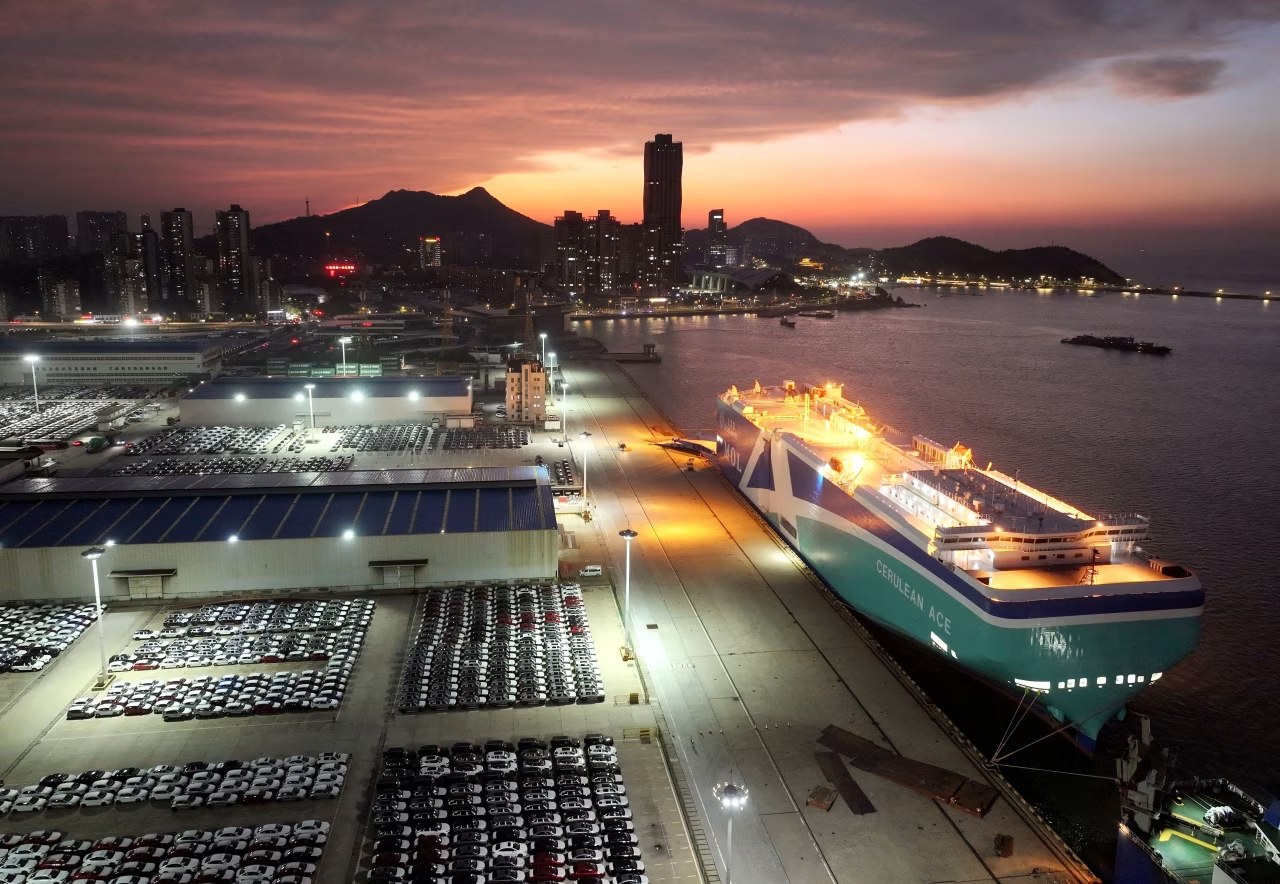
Genco Rejects $23.50 Per Share Offer, Citing $25 NAV Valuation in Auto and Transport Market
- Genco’s board rejected Diana’s revised $23.50 bid, labeling it a lowball offer.
- The mean analyst NAV estimate stands at $25 per share, per Clarksons, SEB, Fearnley, Pareto and Deutsche Bank.
- Genco highlighted the absence of a control premium, a standard 20‑30% uplift in comparable deals.
- Uber announced up to $1.25 billion for Rivian and a pledge of 10,000 autonomous SUVs by 2028.
High‑stakes negotiations and strategic tech bets are redefining the auto and transport market.
SHIPPING—At 15:02 ET, Diana Shipping sent a revised proposal to acquire Genco Shipping & Trading for $23.50 a share, a price the seller says merely mirrors the lowest NAV estimate from a single analyst, not the sector‑wide mean.
Genco’s rebuttal, filed minutes later, invoked a broader analyst consensus and warned that the bid ignored a customary control premium, a red flag for shareholders wary of undervaluation.
Just hours later, Uber’s $1.25 billion infusion into Rivian and its autonomous‑vehicle rollout plan signaled a parallel shift: capital is flowing toward technology that could reshape the auto and transport market’s future.
Offer vs. NAV: The Numbers Behind Diana’s $23.50 Bid
Understanding the valuation gap
Clarksons Securities, a leading maritime advisory firm, estimated Genco’s net asset value (NAV) at $23.50 per share, the exact figure Diana Shipping used to justify its offer. However, Genco’s letter cited a broader analyst set—including SEB, Fearnley Securities, Pareto, and Deutsche Bank—that averaged $25 per share. This $1.50 differential translates to a 6.4% shortfall relative to the mean NAV.
Industry veteran maritime analyst Lars Jensen of SEB explained, “When multiple independent analysts converge on a higher NAV, a bidder’s reliance on the lowest estimate appears selective and can erode shareholder confidence.” The discrepancy is not merely academic; it directly impacts Genco’s market capitalization, which, based on the mean NAV, would be roughly $1.2 billion higher than the valuation implied by Diana’s bid.
Financial theory dictates that a bid below intrinsic value must compensate shareholders with a control premium—typically 20‑30% in comparable shipping acquisitions, according to a 2022 Bloomberg M&A report. Diana’s offer, at $23.50, offered no premium, effectively proposing a purchase at market price, a stance Genco deemed “well below intrinsic value.”
From a governance perspective, the board’s duty to maximize shareholder value makes rejecting a low‑ball offer a defensible move, especially when the offer fails to meet standard premium benchmarks. As Genco’s spokesperson noted, “The proposal does not meet this standard and is not in the best interests of Genco shareholders.”
Looking ahead, the valuation gap sets the stage for a potential bidding war, where Diana may need to reassess its pricing strategy or risk losing a strategic foothold in the auto and transport market.
Future negotiations will likely hinge on whether Diana can justify a higher price or whether a third party will step in with a more attractive package.
Is the Absence of a Control Premium Deal‑Breaker for Genco?
Why control premiums matter in maritime M&A
A control premium reflects the additional value a buyer is willing to pay for the ability to direct a target’s strategic decisions. In the shipping sector, a 2021 PwC review of 150 deals found the median premium at 24%, with a range of 15‑35% depending on asset quality and growth prospects.
Genco’s board explicitly called out the missing premium, noting that Diana’s $23.50 per share bid equated to a 0% premium over the lowest NAV estimate. “Diana’s indicative proposal does not meet this standard,” the company wrote, underscoring that shareholders expect compensation for relinquishing control.
Maritime finance professor Dr. Elena Martínez of the University of Copenhagen added, “When a bid omits a control premium, it signals either a lack of confidence in the target’s future cash flows or a strategic motive to acquire assets at distress prices.” Her assessment aligns with Genco’s stance that the offer undervalues both current assets and upside potential.
Historically, failed offers lacking premiums have prompted hostile takeovers or board restructurings. The 2019 case of Maersk’s attempt to acquire a Baltic carrier collapsed after the target rejected a 5% premium, leading Maersk to walk away and focus on organic growth instead.
For Diana, the next steps could involve either revising the bid to include a 20‑30% premium—pushing the per‑share price to $28‑$30—or seeking a proxy fight to replace Genco’s board, as hinted in the 14:57 ET statement.
Stakeholders will watch closely to see whether the premium gap becomes the decisive factor in this high‑profile auto and transport market showdown.
Uber’s $1.25 Billion Bet on Rivian: Accelerating the Autonomous Fleet
Strategic rationale behind the partnership
At 12:44 ET, Uber disclosed a commitment of up to $1.25 billion to Rivian Automotive, coupled with a pledge to field 10,000 fully autonomous R2 SUVs by 2028. Morgan Stanley analysts highlighted the move as part of Uber’s broader strategy to diversify its autonomous vehicle (AV) ecosystem beyond Waymo.
Analyst Sarah Liu of Morgan Stanley wrote, “Uber is procuring more partners as Waymo continues to launch more cities. It will be important that Uber is able to tangibly help these players grow faster and compete in the AV space against Waymo and Tesla.” The investment not only provides capital but also secures a pipeline of electric, driver‑less vehicles for Uber’s ride‑hailing network.
Rivian’s R2 platform is engineered for high‑density urban use, with a projected range of 300 miles and a suite of Lidar‑based sensors. If Uber meets its 10,000‑vehicle target, the fleet could represent roughly 12% of Uber’s projected autonomous vehicle volume by 2030, according to internal forecasts shared with analysts.
The partnership also aligns with regulatory trends favoring electric and low‑emission fleets. The European Union’s 2025 mandate for zero‑emission ride‑hailing services could make Uber’s early investment a competitive moat.
Financially, the $1.25 billion infusion is expected to be amortized over a five‑year horizon, with a projected internal rate of return (IRR) of 18% for Uber, based on anticipated revenue per autonomous ride and cost‑per‑mile efficiencies.
As the auto and transport market continues to converge with tech, Uber’s aggressive capital deployment may set a precedent for other mobility platforms seeking to secure their own AV pipelines.
How Do Uber’s Partnerships Reshape the Auto and Transport Landscape?
Mapping the partnership ecosystem
Beyond Rivian, Uber has inked deals with Nvidia (AI chips), Amazon’s Zoox (self‑driving tech), Motional (autonomous software), Nissan (electric platforms), and Wayve (simulation). Morgan Stanley’s analysts estimate that these collaborations collectively account for roughly 55% of Uber’s autonomous technology stack.
In a donut chart of partnership contributions, Nvidia leads with 20% of the stack, followed by Zoox at 15%, Motional 12%, Nissan 8%, Wayve 5%, and Rivian 5% (the remaining 5% comprises internal R&D). This diversification reduces reliance on any single vendor, a risk mitigation strategy highlighted by former Uber AV chief Maya Patel in a 2023 conference.
From a market‑share perspective, the combined effort positions Uber to capture an estimated 18% of the projected U.S. autonomous ride‑hailing market by 2030, according to a Deloitte 2024 forecast. This is a notable jump from its 7% share in 2022, when the company relied primarily on Waymo.
Regulators are also taking note. The California Department of Motor Vehicles recently issued a joint guidance document encouraging multi‑partner AV development to foster competition and safety.
The breadth of Uber’s partnerships illustrates a broader trend in the auto and transport market: tech firms and traditional automakers are converging through multi‑party alliances, accelerating innovation while diffusing risk.
As these relationships mature, investors will scrutinize each partner’s contribution to Uber’s bottom line, especially as the company moves toward profitability in its AV segment.
What’s Next? Board Battles, Deal‑Making, and Regulatory Hurdles
Potential scenarios for Genco and Diana
The 14:57 ET statement from Diana Shipping indicated an intention to replace Genco’s board if the current leadership persisted in rejecting the offer. Such a proxy fight would echo the 2020 tussle between Teekay and its activist shareholders, where a board overhaul ultimately led to a 12% premium on the final deal.
Should Diana succeed in installing new directors, the valuation calculus could shift dramatically. New board members might be more amenable to a revised price that incorporates a 20% control premium, raising the per‑share price to roughly $28.20 (based on the $25 mean NAV). This would increase the total transaction value by approximately $800 million.
Meanwhile, regulators in the EU and the U.S. are tightening scrutiny on large cross‑border shipping acquisitions, citing anti‑trust concerns. The European Commission’s 2023 guidance on maritime concentration suggests that any deal exceeding €10 billion in combined revenue will undergo a detailed competition review.
On the autonomous front, Uber’s partnership rollout will face its own set of regulatory checkpoints. The National Highway Traffic Safety Administration (NHTSA) has proposed new safety standards for Level 4 vehicles, which could affect the timeline for Rivian’s R2 deployment.
Analyst commentary from Bloomberg’s Daniele Russo emphasizes that “the convergence of shipping consolidation and autonomous mobility investments signals a broader restructuring of the auto and transport market, where capital allocation decisions will be judged against both financial returns and regulatory compliance.”
In the coming months, the market will watch for three key milestones: (1) Diana’s formal board‑replacement proposal, (2) any revised bid that includes a control premium, and (3) the first operational autonomous Rivian SUV in Uber’s fleet. Each event will shape the strategic landscape for investors and industry players alike.
Frequently Asked Questions
Q: Why did Genco Shipping reject Diana Shipping’s revised offer?
Genco argued the $23.50 per share price fell below the mean analyst NAV of $25 and omitted a control premium, making the bid undervalued in the auto and transport market.
Q: What does Uber’s $1.25 billion investment in Rivian aim to achieve?
Uber intends to fund Rivian’s autonomous R2 SUV program and secure up to 10,000 self‑driving vehicles by 2028, bolstering its position in the auto and transport market.
Q: How common is a control premium in shipping acquisitions?
Industry analysts typically expect a 20‑30% control premium in M&A deals, a benchmark Genco says Diana’s offer failed to meet, influencing the auto and transport market dynamics.
📰 Related Articles
- Jury Rules Elon Musk Partially Liable for Twitter Investor Losses After Deal Threat
- Fast‑Food Giants Slash Prices Amid Record Beef Cost Surge
- Unilever’s Food‑to‑Soap Split: Why the Mayonnaise Deal Signals a Strategic Pivot
- Candela Secures €30 Million Funding to Expand Electric Ferry Fleet Ahead of IPO Plans
