Goldman Sachs Adds $8 to 2026 Brent Call as Hormuz Risk Premium Widens
- Brent forecast raised to $85/bbl from $77 for calendar-year 2026.
- West Texas Intermediate target lifted to $79/bbl from $72, a 9.7% bump.
- Bank describes current disruption as the ‘largest oil supply shock ever’.
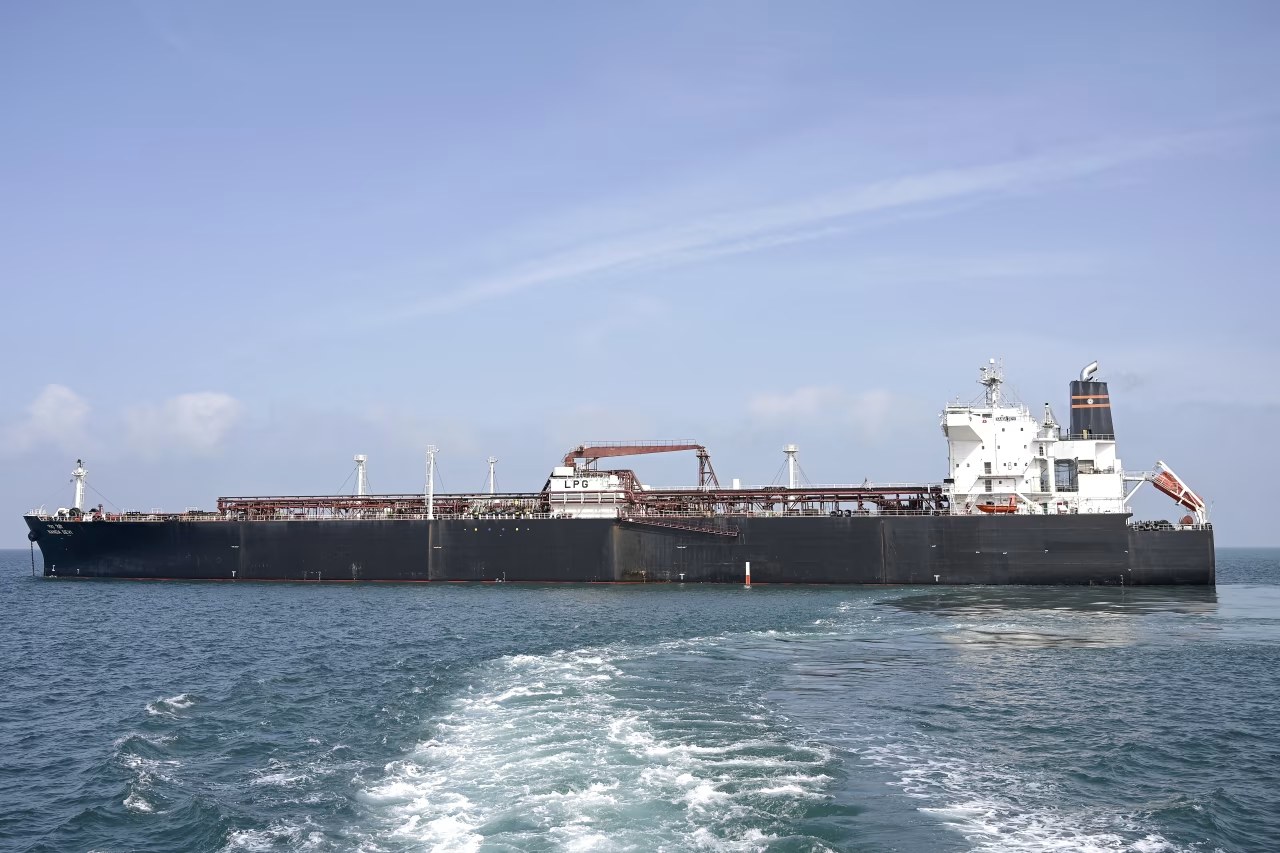
- Tanker ‘Nanda Devi’ cleared to exit Hormuz on March 17 after Iranian inspection.
The upgrade signals Wall Street’s growing conviction that a 21-mile waterway is now the single biggest swing factor for global inflation and energy security.
GOLDMAN SACHS—Goldman Sachs has rewritten its 2026 oil playbook overnight, lifting its Brent crude forecast by 10% to $85 a barrel and West Texas Intermediate to $79 as the Strait of Hormuz remains partially throttled. The revision—one of the largest mid-cycle adjustments in the bank’s energy coverage—reflects what analysts term the most severe supply shock since the 1973 Arab oil embargo.
The move comes after Iran allowed the LPG carrier ‘Nanda Devi’ to exit the choke-point on March 17, a decision that briefly lowered Brent’s front-month premium before fresh naval activity reignited fears of slower transit times. Goldman’s commodities desk now prices in a 1.1 million barrel-per-day (bpd) supply deficit for 2026, compared with a previously expected 0.3 million bpd surplus.
Energy economists warn the revision carries far-reaching consequences: every $8 increase in Brent adds roughly 0.3 percentage points to global headline CPI, according to IMF models, complicating the inflation fight for central banks from Frankfurt to New Delhi.
The Anatomy of a 10% Forecast Jump
Goldman’s overnight revision is notable both for its magnitude and its timing. The bank had stood pat on its $77 Brent call since October, arguing that non-OPEC supply growth led by U.S. shale and Guyana would cap rallies. That calculus changed when satellite data showed daily tanker transits through Hormuz falling below 40 vessels for five consecutive sessions, the lowest since the U.K.-Iran tanker standoff of mid-2019.
Why $85 became the new base case
Using its S-Curve model, Goldman’s commodities team estimates that a sustained 15% drop in Hormuz flows equates to a 6-8% uplift in Brent spot prices. With Brent averaging $81 so far this quarter, the model spits out an $84-86 range for 2026—hence the headline $85 target that traders now quote.
The bank’s prior bearish bias had rested on two pillars: a 900 kbpd U.S. production increase and a 400 kbpd recovery in Kazakh output after Kashagan maintenance. Both assumptions remain intact, yet they are now overwhelmed by a 1.4 mbpd geopolitical risk wedge baked into the new forecast.
Energy Aspects director Amrita Sen calls the move ‘a textbook risk-premium repricing’ and notes that Goldman’s forecast is still conservative relative to futures curves currently pricing calendar-2026 Brent at $87.50. ‘The disconnect tells us either Goldman expects partial normalization, or the street is underestimating demand elasticity,’ Sen told clients in a note reviewed by this publication.
Forward-looking implication: if Hormuz volumes remain curtailed beyond Q2, Goldman concedes an upside skew toward $90 is ‘non-trivial,’ language that option desks have translated into fresh call buying at the $90 and $95 strikes.
Why the Strait of Hormuz Still Rules the Oil World
Wedged between Oman and Iran, the 21-mile-wide channel carries 21 million barrels of crude, condensate and refined products daily—roughly 21% of global petroleum liquids consumption, according to the U.S. Energy Information Administration. No alternative pipeline network in the region can absorb more than 30% of those volumes, making Hormuz the single most critical maritime oil artery.
From 2019 to today: a timeline of tension
In July 2019, Iran seized the U.K.-flagged Stena Impero, sending Brent up 6% in two sessions. Fast-forward to March 2025: the ‘Nanda Devi’ incident marked the first Iranian board-and-search of an LPG carrier in 18 months, signaling a potential shift from saber-rattling to selective interference with commercial traffic.
Insurance giant Lloyd’s List Intelligence reports that war-risk premiums for tankers transiting the strait have quadrupled since December, adding roughly $0.65 per barrel to delivered crude costs in Asia. Those higher insurance costs are now embedded into forward curves, effectively putting a $2-3 floor under prompt-month Brent even if diplomacy eases.
Harvard Kennedy School energy historian Meghan O’Sullivan frames the current episode as part of a broader pattern: ‘Every decade since the 1980s, a geopolitical event in the Persian Gulf has erased 1-2 mbpd of effective supply for at least six months,’ she said, referencing the 1987 reflagging operation and the 2019 drone attacks on Saudi Aramco facilities. ‘The market keeps underestimating recurrence risk,’ she added.
Looking ahead, the International Maritime Organization is lobbying Gulf states to revive the dormant Hormuz Peace Initiative, but diplomats privately concede progress is unlikely before the summer driving season, leaving traders to price in at least four more months of disruption risk.
What Does an $8 Higher Oil Price Mean for Inflation?
Using Federal Reserve staff estimates, every $10 sustained increase in Brent adds roughly 0.35 percentage points to U.S. headline CPI within 12 months. Goldman’s $8 revision therefore implies an additional 0.28 ppt of inflation, enough to erase the disinflationary progress that the Fed has priced into its March dot plot.
Europe and Asia face steeper passthrough
Because of higher fuel taxes, euro-area CPI is twice as sensitive to crude moves as the U.S. Oxford Economics calculates that an $8 spike lifts euro-zone HICP by 0.55 ppt, complicating the ECB’s communication that rate cuts remain ‘data dependent.’
India, the world’s third-largest oil importer, sees its current-account deficit widen by $9 billion for every $1 increase in annual average Brent, according to RBI models. With India’s fiscal year ending March 31, New Delhi has already deferred its planned fuel-tax cut, a move Deutsche Bank says adds ‘incremental stagflationary pressure’ to Asia’s fastest-growing major economy.
Corporate sector impacts diverge. U.S. airlines hedge 37% of jet fuel, but European carriers are only 18% hedged for 2026, exposing them to margin compression. Conversely, U.S. shale producers with unhedged volumes stand to gain: Goldman estimates that an $8 uplift raises the S&P 500 energy sector’s 2026 EPS by 18%, the single biggest earnings revision across all sectors.
Policymakers’ bottom line: central banks can no longer treat energy shocks as transitory, a lesson the Bank of Japan learned in 2023 when core CPI remained above 2% despite falling commodity prices.
Can U.S. Shale or Strategic Stocks Fill the Hormuz Gap?
The short answer is only partially. The U.S. Energy Information Administration expects domestic crude output to rise by 900 kbpd in 2026, but pipeline and labor constraints mean the year-over-year gain is front-loaded into the second half. Even if all 900 kbpd were redirected to the export market, it would offset less than two-thirds of a hypothetical 1.4 mbpd Hormuz shortfall.
SPR releases: political option, logistical headache
The U.S. Strategic Petroleum Reserve currently holds 364 million barrels, down from 621 million in 2020. A sale of 30 million barrels would add roughly 165 kbpd over six months—helpful but not game-changing. More importantly, Congress must authorize non-emergency sales, a process that takes 45-60 days, timeframes incompatible with a sudden Hormuz closure.
Oilfield services giant Baker Hughes reports that the U.S. frac fleet has been flat at 268 spreads since January, evidence that capital discipline remains intact despite higher prices. Pioneer Natural Resources CEO Richard Dealy told investors on March 12 that ‘double-digit inflation in steel and labor’ prevents his peers from ramping activity quickly, a view echoed by Goldman’s supply-side model that caps U.S. growth at 1.2 mbpd even at $90 Brent.
Global coordination offers limited relief. IEA member states hold 1.5 billion barrels in public stocks, but joint releases require unanimity and typically deliver only 60% of announced volumes to the market due to logistical lags. With Europe’s 2025 storage directive mandating 90% capacity by October, EU countries are reluctant to draw down inventories prematurely.
Bottom line: without a diplomatic breakthrough, the market will need to ration demand via price, a dynamic that underpins Goldman’s $85 base case and the upward skew toward $90.
What Happens Next: Scenarios Beyond $85
Goldman’s baseline assumes a 70% restoration of Hormuz flows by mid-2026. The bank’s bull case—priced at 15% probability—sees full disruption persist, pushing Brent to $100 and WTI to $94. The bear case (20% probability) assumes a diplomatic accord within one quarter, dropping Brent back to $75.
Options markets already price extreme tails
Open interest in December-2026 Brent $120 calls has tripled since January, indicating traders are hedging tail risk rather than forecasting a gradual grind higher. Skew, a measure of downside versus upside insurance cost, is at its most extreme since the 2022 Ukraine invasion.
China’s import response is pivotal. Customs data show the country imported 11.3 mbpd in February, the second-highest on record. If Beijing decides to front-load strategic purchases, it could add 200-300 kbpd of incremental demand, enough to erase the slim surplus implied under Goldman’s base case.
Currency channels amplify volatility. A 10% depreciation in the dollar historically correlates with a $4 rise in Brent, according to BNP Paribas FX strategists. With the Fed’s real broad dollar index down 3% year-to-date, the FX impulse alone could add another $1.20 to crude even if geopolitics stabilize.
Investor positioning is the swing factor. CFTC data show money-manager net length in WTI at 207k contracts, still 28% below the 2022 peak, suggesting room for fresh buying. A breakout above $90 could trigger algorithmic momentum trades that commodity veterans liken to ‘a coiled spring.’
Forward-looking conclusion: while Goldman’s $85 forecast anchors consensus, the range of plausible outcomes—from $75 to $100—has never been wider, leaving energy desks to trade the distribution rather than the point estimate.
Frequently Asked Questions
Q: Why did Goldman Sachs raise its 2026 oil price forecast?
Goldman lifted its 2026 Brent target to $85/bbl from $77, citing an extended Strait of Hormuz disruption that it labels the ‘largest oil supply shock ever’.
Q: How much did Goldman increase its WTI forecast?
The bank raised its West Texas Intermediate call to $79/bbl from $72, a 9.7% revision that mirrors the tighter global supply outlook.
Q: What is the Strait of Hormuz disruption?
Iran has intermittently restricted tanker traffic through the 21-mile-wide channel that carries about a fifth of global oil trade, forcing reroutings and lifting risk premiums.
📰 Related Articles
- Elliott Investment Management Takes Multibillion-Dollar Position in Synopsys, Aims to Boost Software Services Revenue
- Index Funds Still Outperform Despite AI Stock Concentration Risk
- S&P 500 Index to Trade Nonstop as Owner Licenses Benchmark to Crypto Exchange Hyperliquid
- Trump Order Targets ESG Funds for Fiduciary Breach, Putting $8.4 Trillion Industry on Notice
