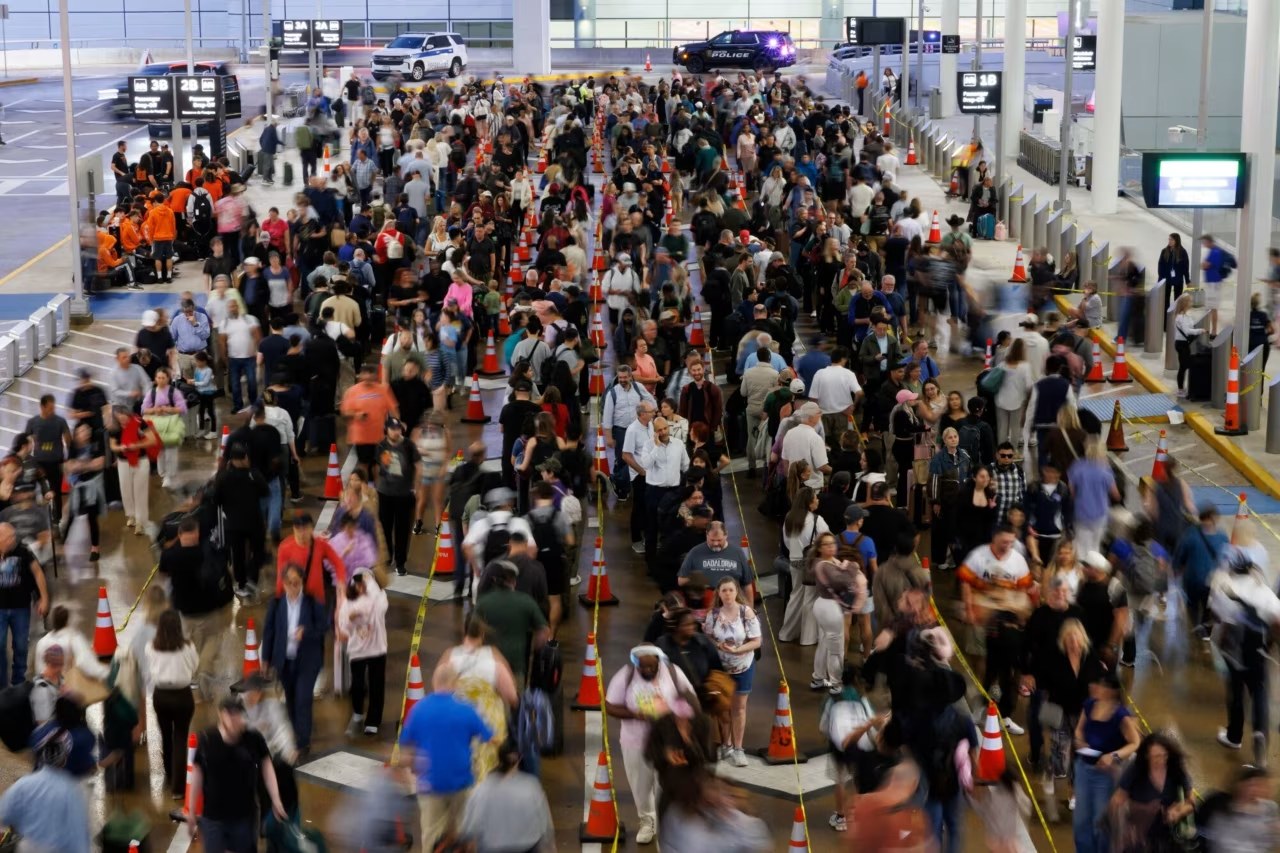
59,000 TSA agents face unpaid work as GOP senators ask White House to declare national emergency
- Senate Republicans privately urged the White House to invoke emergency powers so TSA screeners keep receiving paychecks if DHS funding lapses before the weekend.
- Negotiators have set a self-imposed weekend deadline to finish a Homeland Security bill as spring-break, Easter and Passover travelers crowd airports.
- White House press secretary Karoline Leavitt confirmed the administration is weighing ‘a number of ideas to blunt the impact of the Democrat shutdown crisis.’
- Any emergency declaration would test legal limits and almost certainly draw court challenges from Congress.
Republicans gamble that invoking a national emergency is faster than waiting for a Senate deal
TSA FUNDING—With Congress deadlocked over a Homeland Security spending bill and the Easter travel crush only days away, several Republican senators have asked President Donald Trump to do something lawmakers themselves have not: guarantee that 59,000 Transportation Security Administration officers keep getting paid even if the department’s funding lapses.
The request, described by people familiar with private conversations on Capitol Hill, amounts to a high-stakes end-run around Senate Democrats who insist any DHS bill must also resolve broader immigration disputes. By urging the White House to declare a national emergency, Republicans hope to tap unspent disaster-relief dollars to cover TSA payroll obligations without waiting for a bipartisan accord that may not arrive before the weekend.
White House press secretary Karoline Leavitt confirmed the administration is weighing ‘a number of ideas to blunt the impact of the Democrat shutdown crisis,’ but declined to say whether the president has decided to pull the emergency lever. The tactic would revive a legal strategy used in previous shutdowns while testing new boundaries of executive authority—and almost certainly inviting litigation from Congress.
Why TSA Paychecks Are Caught in a Homeland Security Funding Logjam
Homeland Security is the only large federal agency whose appropriations have not yet cleared Congress this year. The resulting standoff means that roughly 59,000 transportation-security officers—everyone who runs the blue-uniformed checkpoints at U.S. airports—would be required to work without pay if funding expires before the weekend, mirroring the 34-day partial shutdown that ended in January 2019.
During that earlier lapse, TSA absenteeism jumped above 10 percent, snarling security lines at Atlanta, Houston, Seattle and other hubs. Union leaders warned at the time that screeners were taking part-time jobs or calling in sick to make rent. ‘We cannot repeat that debacle,’ said Hydrick Thomas, then-president of the American Federation of Government Employees TSA council, whose members ultimately received back pay once the government reopened.
Senate Appropriations Chairman Susan Collins, a Maine Republican, has floated a ‘clean’ one-year extension for DHS that omits immigration riders sought by Democrats. Majority Leader John Thune told reporters the chamber could finish the bill ‘in hours’ if those side issues were dropped. Democrats counter that any DHS measure must also extend the Deferred Action for Childhood Arrivals program and protect existing asylum pathways—guarantees Republicans have so far rejected.
The impasse leaves TSA payroll in limbo. Unlike other federal workers, screeners are classified as ‘excepted’ personnel, required to stay on the job because their duties relate directly to life-and-safety functions. That means they work without knowing when—or if—their next paycheck will arrive, a dynamic that economists at the Congressional Budget Office estimate cost the economy $11 billion in lost productivity during the 2018-19 shutdown.
Airports brace for a repeat of 2019-style sick-outs
Industry groups are already warning of longer wait times. Airlines for America, the trade association representing carriers such as Delta, United and Southwest, says passenger volumes this week are running 6 percent above pre-pandemic levels. Any spike in TSA absenteeism would ripple through hubs like Denver International, where screeners handled a record 1.8 million travelers during the same Easter week in 2019.
Paul Hudson, president of FlyersRights.org, argues the spectacle of unpaid screeners ‘undermines the very security theater the TSA is supposed to provide.’ His group sent a letter to Senate leaders urging immediate passage of a stop-gap bill, warning that morale among officers is ‘already fragile’ after two years of pandemic-era stress and chronic understaffing.
Whether Congress acts in time remains uncertain. Negotiators have penciled in a self-imposed weekend deadline so that any deal can reach the president’s desk before Monday, when the Senate is scheduled to adjourn for a two-week recess. If talks collapse, the administration’s next move could determine whether TSA agents see their wages interrupted—or whether an emergency declaration ushers in a new constitutional clash over who controls the power of the purse.
What Emergency Powers Could—and Couldn’t—Do for TSA Payroll
Republican senators want the White House to dust off statutes that let presidents tap rainy-day money when Congress fails to appropriate funds. The most frequently cited vehicle is the National Emergencies Act, which gives the executive broad leeway to reprogram unobligated defense and disaster-relief dollars for ‘essential’ operations. A 2020 Government Accountability Office opinion concluded that payroll for excepted personnel can qualify as an ‘emergency’ expenditure if health or safety is deemed at risk.
But any such move would collide with the Antideficiency Act, the 1880s law that bars agencies from spending money Congress has not provided. Courts have long held that the constitutional power of the purse belongs to the legislative branch. When President Trump declared a national emergency in 2019 to reprogram military funds for border-wall construction, the House sued and won an initial ruling that the administration had overstepped—though the Supreme Court later allowed construction to continue while appeals played out.
‘The legal terrain is murky,’ says Peter Shane, an Ohio State constitutional-law professor who specializes in separation-of-powers disputes. ‘An emergency declaration to pay TSA salaries would almost certainly be challenged as an end-run around the Appropriations Clause, but courts are reluctant to second-guess presidential determinations about what constitutes a national emergency.’
One precedent working in the administration’s favor is a 1990 Office of Legal Counsel memo that allowed the Coast Guard to keep paying military members during a budget lapse because their functions were ‘necessary for the safety of human life.’ TSA’s life-safety rationale—preventing terrorist attacks on aircraft—could be framed similarly, though no court has ever ruled on whether that logic extends to civilian screeners.
Where the money would come from
The Federal Emergency Management Agency currently holds roughly $23 billion in unobligated disaster-relief balances, according to the most recent Congressional Research Service tally. The White House could redirect a slice of those funds to cover TSA payroll for a few weeks, buying time for a broader deal. Yet that would drain reserves earmarked for hurricane season, which begins in June, and could invite fresh criticism from governors in flood-prone states.
Another option is tapping the Defense Department’s counter-drug accounts, the same pool Trump used for the border wall. Those coffers hold about $3.6 billion, but diverting them would require Pentagon sign-off and could delay other national-security programs, according to a March Congressional Budget Office analysis.
Administration officials insist no final decision has been made. ‘We’re looking at every lawful tool to keep officers on the job and travelers moving,’ said one senior White House aide, who requested anonymity to discuss internal deliberations. Still, the mere talk of invoking emergency powers signals how aggressively Republicans are willing to test executive authority—and how little faith they have that the Senate can break its impasse before the weekend travel crush begins.
How 2019 Shutdown Woes Shape Today’s GOP Strategy
Memories of the last DHS funding lapse loom large over Capitol negotiations. From December 2018 until January 2019, about 800,000 federal employees missed at least one paycheck, but TSA screeners became the public face of the disruption. News footage of snaking security lines at Atlanta’s Hartsfield-Jackson and Miami International dominated holiday travel coverage, and the agency reported a 55 percent spike in officer sick-day usage compared with the same period a year earlier.
Republicans absorbed most of the political blame. A January 2019 CBS News poll found 71 percent of Americans thought the shutdown was ‘unacceptable,’ and approval for the GOP dipped five points during the standoff. Senate Majority Leader Mitch McConnell ultimately urged the president to reopen government without border-wall money, a retreat that still stings conservative hard-liners.
‘We learned that letting TSA funding lapse is a political loser,’ says a GOP Senate aide involved in this year’s talks. ‘Democrats know it, we know it, so the question becomes who can position themselves as the one keeping paychecks flowing.’
That calculus explains why Republicans are now pushing an emergency declaration rather than risk a repeat of 2019 imagery. By framing the move as a way to ‘protect national security and holiday travel,’ party strategists believe they can shift blame onto Democrats for insisting on immigration add-ons. The tactic also sidesteps the need to compromise on DACA or asylum provisions that many GOP primary voters oppose.
Union leaders warn of déjà vu
Everett Kelley, national president of the American Federation of Government Employees, says officers are ‘already fielding calls from worried families’ asking whether to book flights after Easter. AFGE’s TSA council has begun distributing leaflets at airports explaining workers’ legal right to refuse unsafe work, a campaign that could amplify absenteeism if paychecks stop.
‘We’re not encouraging anyone to call in sick,’ Kelley insists, ‘but we’re reminding them that working without pay is a choice, not an obligation.’ The distinction matters: during the 2019 lapse, TSA management threatened disciplinary action against officers who cited financial hardship as a reason for absence, but the agency later backed off after AFGE filed unfair-labor-practice charges.
Whether history repeats may hinge on the next 48 hours. Negotiators resumed closed-door sessions late Wednesday, with some floating a three-day stop-gap to buy breathing room. If that fails, the White House faces a choice between presiding over travel chaos or testing the outer limits of emergency powers—knowing that either path could define the mid-term narrative over who caused the mess.
Could a Court Block an Emergency Pay Check for TSA Officers?
Any White House move to fund TSA salaries without congressional appropriation would land in court within days. House Democrats have already instructed their general counsel to draft a complaint modeled on the 2019 border-wall case, according to a senior Democratic aide. The likely argument: paying civilian workers under an emergency declaration violates the Constitution’s Appropriations Clause, which vests spending authority exclusively in Congress.
Legal scholars are split on the outcome. ‘The Supreme Court has never blessed the proposition that the president can unilaterally pay federal employees during a lapse,’ notes Kate Shaw of Cardozo Law School, who served in the Obama White House counsel’s office. ‘But the justices are also reluctant to second-guess presidential determinations about what constitutes an emergency, especially when national security is invoked.’
A complicating factor is standing. In 2019 the House sued as an institution and won a district-court injunction, but the Supreme Court’s conservative majority signaled skepticism about legislative standing in similar contexts. Individual TSA officers could sue, yet they would first have to demonstrate concrete harm—easy if paychecks stop, but harder if the administration promises retroactive pay once a deal is reached.
Precedent from the Coast Guard
The closest parallel is a 1990 opinion by the Justice Department’s Office of Legal Counsel, which allowed the Coast Guard to keep paying military members during a shutdown because their duties were ‘necessary for the safety of human life.’ The memo relied on an exception in the Antideficiency Act that permits ‘emergency’ spending to protect life or property. TSA could argue that preventing terrorist attacks on aircraft meets the same threshold, though no court has ruled on whether the logic extends to civilian screeners rather than uniformed service members.
Another hurdle is timing. Emergency reprogramming requires sign-off from the Office of Management and Budget, the comptroller general and—in the case of FEMA funds—the Homeland Security secretary. With only days until the deadline, officials would have to compress a process that normally takes weeks into a single weekend, all while preparing litigation defenses.
All of which explains why Republican senators are pressing the White House to act sooner rather than later. ‘Every hour we wait, the legal window narrows,’ says Sen. Ted Cruz, who has advocated emergency powers since the standoff began. Whether the administration listens—and whether courts ultimately bless the maneuver—could determine not just this year’s holiday travel season, but the long-term balance of power between the executive and legislative branches over federal spending.
What Happens Next If Congress Misses the Weekend Deadline
The Senate’s self-imposed weekend deadline is less a legal cliff than a political marker. Under chamber rules, Majority Leader Thune promised to file cloture on a yet-to-be-released DHS bill by Friday evening, setting up a final vote as early as Sunday afternoon. If no accord is reached, the department would enter a partial shutdown at 11:59 p.m. Sunday night, furloughing about 15 percent of its 250,000-person workforce while requiring the rest—including all TSA screeners—to work without pay.
The practical impact would be visible almost immediately. TSA has instructed airport directors to prepare for lane closures if officer absenteeism tops 7 percent, a threshold surpassed during week three of the 2019 lapse. Major hubs like Chicago O’Hare and Los Angeles International have already activated contingency plans to deploy National Guard members for non-screening tasks such as queue management and document checking, freeing sworn officers to operate magnetometers.
Airlines, meanwhile, are weighing schedule reductions. Delta chief executive Ed Bastian told investors the carrier could trim peak-hour departures by up to 5 percent if wait times exceed 30 minutes, a scenario federal data show occurred on 42 percent of days during the last shutdown. Such cuts would cascade through crew schedules, aircraft utilization and ultimately quarterly earnings, according to a March analysis by Raymond James.
Officers prepare for the worst
Inside TSA, morale officers are circulating tip sheets on how to apply for unemployment benefits while still classified as employed—a bureaucratic dance that delayed aid to thousands of workers in 2019. The agency’s credit union is again offering zero-interest ‘shutdown loans,’ but those advances must be repaid within 60 days once back pay arrives, creating a debt spiral for junior officers earning $38,000 a year.
‘We’re telling people to stockpile groceries and defer any big purchases,’ says one TSA supervisor at Orlando International, who requested anonymity to avoid disciplinary action. The airport expects 2.4 million passengers during the two-week spring-break window, a 9 percent increase over last year. Any uptick in sick calls would magnify delays in a concourse where security wait times already average 22 minutes, according to TSA’s own dashboard.
All of which raises the stakes for a last-minute deal—or a dramatic executive intervention. If talks collapse, the White House must decide within hours whether to sign an emergency declaration, risk travel chaos, or blink first on immigration riders. Whatever the outcome, travelers from Phoenix to Philadelphia will know by Monday morning whether the only thing standing between them and their gate is a paycheck that may never arrive.
Frequently Asked Questions
Q: Can a national emergency be used to pay federal workers during a shutdown?
Yes. Laws such as the Stafford Act and the National Emergencies Act give presidents latitude to reprogram unused disaster-relief dollars for ‘emergency’ personnel costs, but any move would trigger immediate court challenges from Congress.
Q: How many TSA agents would miss paychecks if DHS funding lapses?
Roughly 59,000 transportation-security officers nationwide would be required to work without pay, the same as the 2018-19 partial shutdown that pushed absenteeism at airports above 10 percent.
Q: When is the current DHS funding deadline?
Senate negotiators have set a self-imposed weekend deadline—before the Easter and Passover rush—to finish a Homeland Security appropriations bill or face a mini-shutdown of DHS operations.
