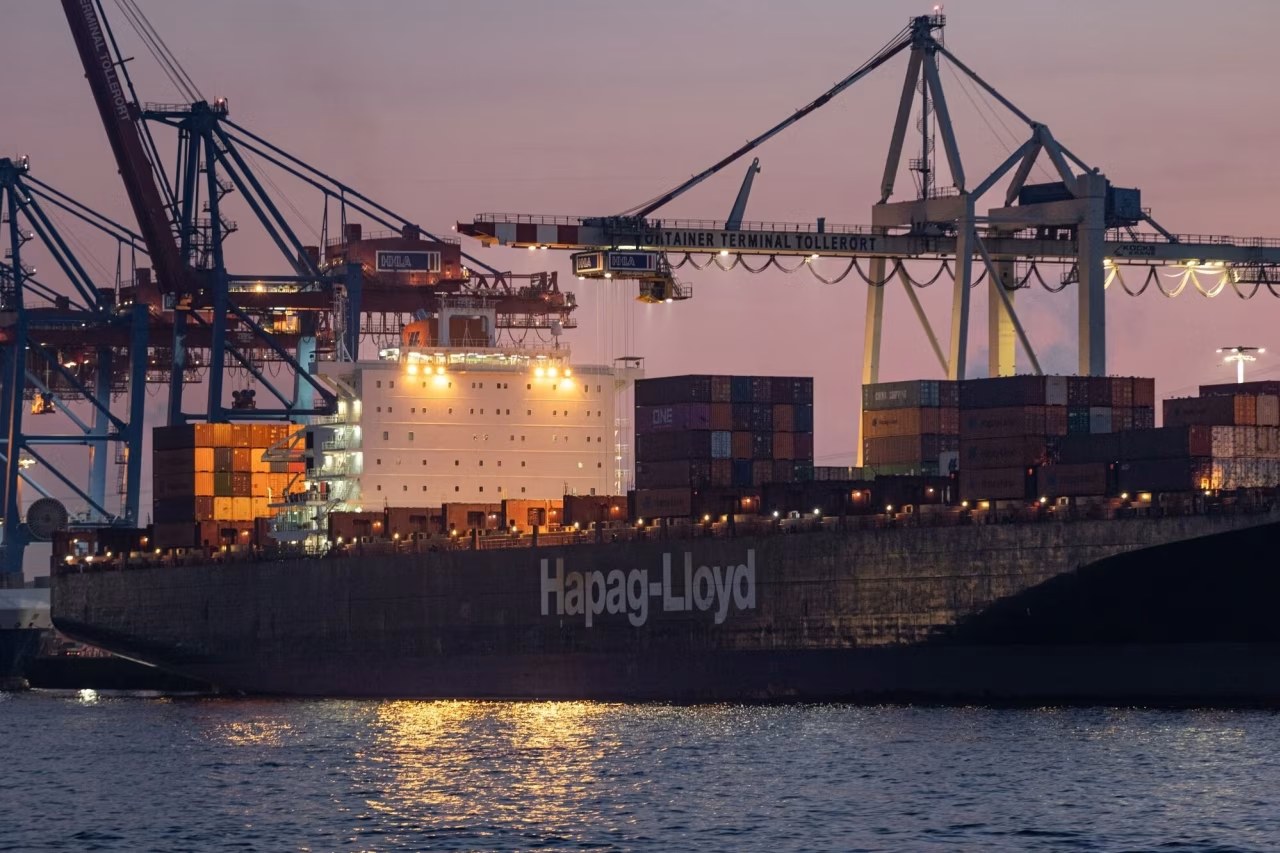
Hapag-Lloyd Guides 35% EBITDA Slide to €0.9–2.6B for 2026 as Red Sea Rerouting Costs Mount
- Hapag-Lloyd expects 2026 EBITDA of €0.9–2.6B versus an estimated €3.2B in 2025.
- Red Sea diversions have lengthened Asia-Europe voyages by 14–18 days, pushing fuel and charter costs higher.
- Management warns EBIT could swing from a €1.3B loss to a €400M profit depending on freight-rate recovery.
- Global container spot rates have fallen 31% year-to-date despite longer sailing distances.
The world’s fifth-largest carrier is bracing for a third straight year of shrinking profits as supply outstrips demand.
HAPAG-LLOYD—German container line Hapag-Lloyd on Friday became the first major ocean carrier to quantify the earnings hit from the Middle East security crisis, guiding for full-year 2026 EBITDA of between €900 million and €2.6 billion—down from roughly €3.2 billion projected for 2025—as attacks on merchant vessels force costly detours and a glut of new ships keeps freight rates under pressure.
The Hamburg-based company said earnings before interest and tax could land anywhere between a €1.3 billion loss and a €400 million profit, underscoring the widening disconnect between operating costs and pricing power in a market where capacity is expanding faster than trade volumes.
Chief executive Rolf Habben Jansen told analysts that roughly 40% of the carrier’s east-west strings now route around the Cape of Good Hope, adding about 3,000 nautical miles and two to three weeks to each Asia-Europe rotation. The longer sailings consume an extra 40–50 metric tons of low-sulphur fuel per day, while prolonged charter contracts and war-risk insurance premiums have added “several hundred dollars” to the cost of moving each container.
From Record Windfall to Profit Compression: Hapag-Lloyd’s Three-Year Slide
Only two years after posting a record €18.9 billion EBITDA on the post-pandemic freight boom, Hapag-Lloyd is now facing a potential 90% earnings contraction. The midpoint of its 2026 guidance implies EBITDA of €1.75 billion, 64% below the 2022 peak and 35% lower than the midpoint of its 2025 estimate, according to company figures reviewed by Lloyd’s List.
Why the 2022 bonanza unraveled so fast
Container shipping’s pandemic windfall was driven by a temporary demand spike—U.S. retail inventories rose 12% in 2021 alone—while port closures limited effective capacity. Once congestion eased in 2023, spot rates collapsed. Shanghai-to-North Europe prices slid from a peak of $14,700 per forty-foot equivalent unit (FEU) in January 2022 to $1,450 by December 2023, data from the Shanghai Shipping Exchange show.
At the same time, the orderbook placed during the boom is delivering. Maritime analyst Alphaliner estimates the global cellular fleet grew 8% in 2024 and will add another 5% in 2025, outstripping demand growth of 3–4%. Hapag-Lloyd’s own capacity will rise to 2.4 million TEU once 18 new vessels—each between 13,200 and 16,000 TEU—enter service through 2026, pressuring load factors and pricing discipline.
“The industry is repeating its classic cycle: cash gets converted into steel, and then rates fall,” said Lars Jensen, CEO of Vespucci Maritime. “For Hapag-Lloyd, the timing is especially painful because the Red Sea disruption is masking a supply overhang rather than solving it.”
Management has responded by accelerating its cost-savings program, dubbed Strategy 2030, which targets €500 million in recurring savings by 2026 through route optimization, slow-steaming and digital documentation. Yet those efficiencies barely offset the extra bunker consumption from Africa detours, executives conceded.
Looking ahead, the carrier’s ability to restore margins hinges on whether freight rates stabilize above $1,600 per FEU on Asia-Europe, a level that covers cash costs plus the premium for low-carbon fuels, analysts at Bernstein estimate. Without a demand shock or accelerated scrapping, that benchmark may not return until 2027.
How Red Sea Diversions Erase $1 Billion in Profit
Hapag-Lloyd’s finance chief Mark Frese quantified the immediate cost of avoiding the Suez Canal: each Asia-Europe round-voyage now burns an extra 3,000 metric tons of very-low-sulphur fuel, worth roughly $2.1 million at Singapore bunker prices of $700 per ton. Multiply that by the 46 weekly strings the carrier operates and the annualized impact exceeds $1 billion, erasing the equivalent of last year’s net profit.
Insurance and charter premiums add another layer
War-risk underwriters have widened hull deductibles to 5% of insured value from 1% and imposed surcharges of $50,000 per passage through the Gulf of Aden. Hapag-Lloyd has elected to reroute rather than pay, but that choice triggers charter-party clauses allowing shipowners to reset daily hire rates. Clarksons data show 8,500-TEU panamax vessels have been re-let at $42,000 per day, up from $28,000 before the Red Sea crisis.
Frese told investors the carrier has secured coverage for 70% of its fleet through the Norwegian Hull Club at rates 25% above 2023 levels, but reinsurers are reviewing terms every quarter. A single missile strike on a 15,000-TEU ship could generate a $200 million claim, equivalent to 11% of the guided 2026 EBITDA midpoint.
Despite the detours, schedule reliability has improved to 55% from 48% in January, according to Sea-Intelligence, because carriers are adding two extra vessels per loop to maintain weekly departures. That buffer, however, ties up 10% of global capacity and prevents a quick re-absorption of surplus ships, keeping rate pressure alive.
“Even if the Houthis declared a cease-fire tomorrow, the industry would still face a capacity glut that depresses pricing,” said Simon Heaney, senior manager at Drewry. “For Hapag-Lloyd, the Red Sea is a cost, not a revenue, story.”
The carrier expects to pass part of the expense through emergency bunker surcharges of $160–$480 per TEU, but forward markets indicate only 60% of the increase is sticking as shippers resist long-term contracts above $1,350 per FEU.
Why Fleet Overcapacity Will Outlast the Middle East Crisis
Even if Iran-linked hostilities ceased tomorrow, the orderbook pipeline guarantees at least 2.1 million TEU of new capacity will hit the water in each of the next three years, equivalent to adding the fifth-largest carrier annually. Hapag-Lloyd’s own fleet plan shows net growth of 11% between 2024 and 2026, outpacing the 3% compound annual growth in containerized trade projected by the IMF.
Scrapping cannot keep pace
Owners demolished only 200,000 TEU in 2024, the lowest figure since 2016, because high steel prices and low charter rates made demolition unattractive. The average recycling price for a 4,000-TEU panamax is $520 per light-displacement ton, down 18% year-on-year, according to cash-buyer GMS. Meanwhile, the carbon-intensity index is prompting carriers to idle rather than scrap younger vessels, swelling the inactive fleet to 650,000 TEU, data from Alphaliner show.
Environmental regulations add another twist. From 2027 the EU Emissions Trading System will require carriers to purchase CO₂ allowances for 40% of voyages calling at European ports, equating to €25–30 per TEU on Asia-Europe. Hapag-Lloyd estimates its annual EUA bill at €350 million, a cost it cannot recoup unless spot rates rise above $1,600 per FEU, a level last seen in late 2022.
“The industry is sleep-walking into a supply trap,” said Nitin Mathur, analyst at Jefferies. “By the time the Red Sea is safe, the fundamental imbalance will be worse than in 2019, pushing EBITDA margins into single digits.”
Management insists that disciplined capacity management—blank sailings, slow-steaming and idling—can keep load factors above 85%, but shippers have already locked in 60% of 2026 volumes at rates averaging $1,280 per FEU, 12% below 2025 levels, according to Xeneta contract data.
Can Cost Cuts and Green Premiums Offset Lower Rates?
Hapag-Lloyd’s Strategy 2030 program aims to strip €500 million in annual costs by 2026 through digital bills of lading, AI-based stowage plans and renegotiated terminal contracts. The carrier has already converted 38% of shipments to electronic documentation, saving €6 per container in handling fees, and is rolling out a machine-learning tool that cuts reefer power consumption by 7%, according to chief operating officer Maximilian Rothkopf.
Green fuels could justify a rate premium—if customers pay
The company has earmarked $3 billion to retrofit 150 vessels with dual-fuel engines capable of running on green methanol or liquefied natural gas. Trials on the 15,000-TEU Brussels Express showed CO₂ emissions per container-mile fall 35% when using bio-methanol, but the fuel costs 2.4 times more than conventional heavy-sulphur bunker.
To close the gap, Hapag-Lloyd is lobbying the EU to grant extra free carbon allowances for ships using renewable fuels and is pitching customers a “green premium” of $150 per TEU on Asia-Europe. Early adopters—mostly apparel and electronics firms—have signed up for only 12% of available green slots, well below the 70% threshold needed to break even on fuel cost, internal figures show.
“Without regulatory subsidies, the green premium is dead on arrival in a down market,” said Isabelle Durant, former deputy secretary-general of UNCTAD. “Carriers need carbon pricing that penalizes fossil fuels, not incentives that reward token volumes.”
Meanwhile, the carrier is accelerating shore-power installations to avoid EU port dues, saving €8,000 per call at Rotterdam, and is renegotiating transhipment via Tangier rather than Algeciras to shave €35 per container in handling fees. Combined, these measures yield €120 million annually—about 24% of the targeted savings—but are insufficient to offset the $1 billion cost inflation from Red Sea reroutes.
Management now admits that reaching the 2026 margin goal—EBITDA/revenue of 12%—requires freight rates to rebound to at least $1,450 per FEU on Asia-Europe, a level futures markets do not price in until the second half of 2027.
What a Sub-€1B EBITDA Would Mean for Shareholders and the Industry
If Hapag-Lloyd lands at the low end of its guided range—€900 million EBITDA—it would mark the weakest result since 2016 and trigger covenants that restrict dividend payouts to 30% of net profit, down from the 60% distributed in 2022. With net debt at €6.8 billion and gearing already at 65%, credit-rating agencies have placed the issuer on negative watch, implying a one-notch downgrade that would raise borrowing margins by 75 basis points and add €20 million in annual interest expense.
Capital markets are pricing in a rights issue
The carrier’s 2027 senior unsecured bonds trade at 94 cents on the euro, yielding 7.4%—a 420-basis-point spread over German sovereigns—and equity analysts at Berenberg model a €1.2 billion rights issue in 2027 to fund fleet decarbonization. Such a move would dilute existing holders by 18% at the current share price of €118, down 46% year-to-date.
Peer comparisons underscore the squeeze. Danish rival Maersk guided 2026 EBITDA of $5–6 billion, implying an enterprise-value/EBITDA multiple of 4.2× versus Hapag-Lloyd’s 6.8×, a premium investors say is unjustified given similar exposure to overcapacity. “If Hapag-Lloyd delivers sub-€1B EBITDA, the board will face pressure to explore mergers,” said Marc Zeck, analyst at Commerzbank. “A tie-up with a cost-disciplined Asian carrier could unlock €800 million in annual synergies.”
Management insists the balance sheet can absorb a downturn, citing €4.6 billion in undrawn credit lines and no major maturities until 2028, but shareholders have already felt the chill: the stock has underperformed the DAX Transport index by 32% since the Red Sea crisis began. Without a swift rebound in rates or a permanent reroute that tightens effective supply, the carrier’s 2026 results could redefine the bottom of the cycle—and set the stage for consolidation.
Frequently Asked Questions
Q: What EBITDA range did Hapag-Lloyd guide for 2026?
Management forecast 2026 EBITDA between €900 million and €2.6 billion, down from an estimated €3.2 billion in 2025, citing weaker rates and Middle East rerouting costs.
Q: How much of Hapag-Lloyd’s fleet is affected by Red Sea diversions?
Roughly 40% of the carrier’s east-west sailings now round the Cape of Good Hope, adding 3,000 nautical miles and 14–18 days to Asia-Europe loops.
Q: Why are freight rates falling despite longer voyages?
New-vessel deliveries pushed global fleet capacity up 8% in 2024 while demand rose only 3%, eroding spot rates by 31% year-to-date according to Xeneta data.
Q: Could EBIT turn negative in 2026?
Yes—Hapag-Lloyd’s EBIT guidance spans a €1.3 billion loss to a €400 million profit, reflecting high fuel, charter and insurance costs plus pricing pressure.
📰 Related Articles
- Designer Brands’ Q4 Comparable Sales Slip as Direct‑to‑Consumer Channel Slows
- Delivery Hero Earnings Surge 30% in 2025, Paving Way for 2026 Expansion
- Vinci Seals $1.6 Billion Deal to Buy 9 Indian Toll Roads From Macquarie
- Henkel Snaps Up Olaplex in $1.4 Billion Deal to Supercharge Premium Hair-Care Line
