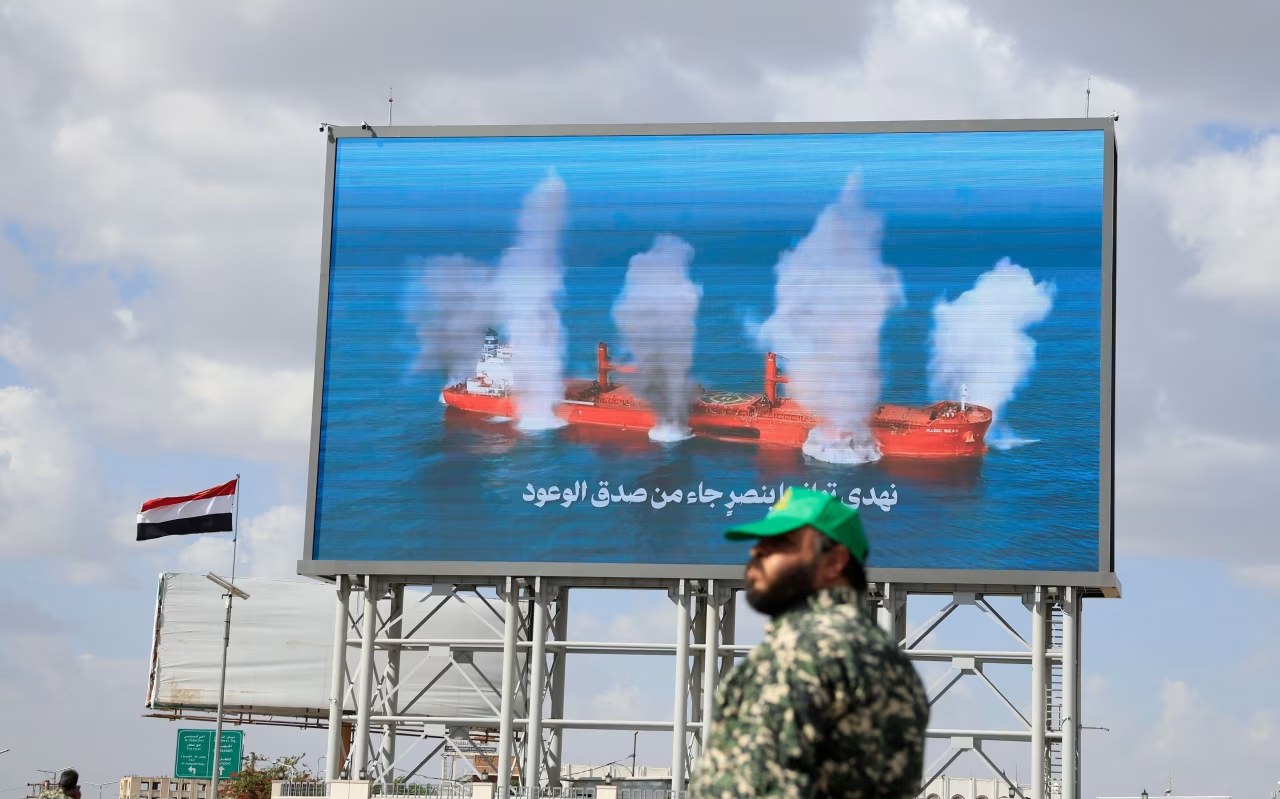
Houthis Could Shut Red Sea Oil Route That Carries 5.5 Million Barrels a Day
- Seven percent of seaborne oil transits the 18-mile-wide Bab el-Mandeb chokepoint.
- Houthis have already deployed 150 drone boats and 1,000-km-range cruise missiles.
- A single strike would reroute tankers 3,000 miles around Africa, adding 15 days.
- Energy Aspects sees Brent spiking $8-12/barrel if the strait is mined.
Tehran’s Yemen allies now hold the last maritime escape hatch for Gulf oil exports.
RED SEA—As Iran tightens its grip on the Persian Gulf, the Red Sea has become the world’s insurance policy for energy flows. Roughly 5.5 million barrels of crude and refined products squeeze daily through the Bab el-Mandeb strait—only 18 miles wide at its narrowest—carrying 7% of seaborne oil and 10% of global refined fuels. That slender waterway is now in the cross-hairs of Yemen’s Houthi movement, an Iran-backed militia that has already proven it can hit Saudi refineries 800 miles away.
The Houthis, armed with cruise missiles and explosive drone boats, have so far refrained from large-scale attacks on commercial tankers. Analysts warn that restraint is tactical. “They are keeping the option dry until Tehran gives the green light,” says Ala Alrababa’h, senior Gulf analyst at the New York-based Eurasia Group. A single successful strike, energy traders fear, would force insurers to declare the strait a listed war-risk zone, rerouting vessels around the Cape of Good Hope—a detour that adds 15 sailing days and $2.2 million in extra fuel costs per very-large-crude-carrier (VLCC).
Shipping markets already price the danger. War-risk premiums for tankers calling north of latitude 18°N jumped 15% in June, according to London insurance broker Willis Towers Watson. Brent crude futures briefly spiked 3% last month after the Houthis test-fired a missile toward the Greek-flagged tanker MT Nissos Chios, missing by 200 meters. “The market is one incident away from a $10 oil spike,” says Amrita Sen, director of research at Energy Aspects. With Iran’s Revolutionary Guards leveraging their Yemeni allies, the Red Sea could become the next Persian Gulf—only this chokepoint has no easy workaround.
Why the Red Sea Became Oil’s Last Escape Hatch
When Tehran seized the Marshall Islands-flagged tanker Advantage Sweet in April, insurers quietly shifted liability models. Roughly 21% of the world’s seaborne oil once transited the Strait of Hormuz; today that share is down to 16% as Asian importers reroute cargoes through Saudi Arabia’s 1,200-mile East-West Petroline and the Red Sea. Bab el-Mandeb—Arabic for “Gate of Tears”—is the final pinch point before tankers reach Egypt’s Suez Canal and the Sumed pipeline.
The arithmetic is brutal. The U.S. Energy Information Administration counts an average of 65 large crude carriers passing Bab el-Mandeb each day. If the strait closes, refiners in Europe and North America must draw on inventories, pushing OECD stockcover below the 90-day mandated minimum, according to the International Energy Agency. “There is no Plan C,” says Richard Bronze, head of geopolitics at Energy Aspects. “Either the Red Sea stays open or oil hits triple digits.”
Houthis have already rehearsed. In October 2022 the group hijacked the UAE-flagged cargo ship Rwabee, claiming it carried military equipment. A year later they seized the Galaxy Leader, a Bahamian-flagged car carrier partly owned by an Israeli firm. Both incidents occurred inside the 18-mile-wide corridor, proving the group’s ability to board vessels under naval escort. The militia’s media office warned that “all enemy ships” are targets, language that reinsurers read as a blanket threat.
The Insurance Trigger That Could Paralyze Trade
London’s Joint War Committee added Yemen’s Red Sea coastline to its Listed Areas in May, a technical move that raises hull premiums by 0.05% of insured value—or $250,000 on a $500 million VLCC. If a second incident occurs within 90 days, the surcharge doubles under reinsurance treaties. “That is the point where cargo owners start cancelling sailings,” says Mike Salthouse, global claims director at NorthStandard, a major P&I club.
Shipping data show the first tremors. Port calls at Yemen’s Hodeidah, once a refuelling stop, fell 40% year-over-year in June, while waiting times at Djibouti’s anchorage rose 22% as captains await naval convoys. Container giant Maersk now routes Asia-Europe sailings 1,500 miles east along the Omani coast before turning toward the Suez, adding $600,000 in bunker fuel per roundtrip. Oil markets are watching for the moment a tanker owner refuses the risk.
Houthis’ Arsenal: From Drone Boats to 1,000-km Missiles
The Houthis’ weapons catalog reads like a Cold-War wish list. According to a UN Security Council panel of experts, the group now possesses Iranian-supplied Saad-1 cruise missiles with a 1,000-kilometer range—enough to strike tankers anywhere inside the Red Sea or hit Saudi Aramco’s Yanbu terminal on the opposite coast. U.S. Navy vessels have intercepted at least 150 explosive-laden drone boats since 2021, many assembled in Hodeidah workshops using commercially available outboard engines and 300 kg of RDX.
What changed in 2024 is guidance. Satellite imagery analysed by the Washington-based Center for Strategic and International Studies shows extended runways at Saada airport, allowing Iranian-supplied Shahed-136 drones to take off with full fuel loads. “They are no longer lobbing missiles into the desert; they are testing grid coordinates against AIS ship-tracking data,” says Fabian Hinz, missile analyst at the International Institute for Strategic Studies. The March strike against the Saudi Aramco depot in Jeddah—300 km from the Yemeni border—landed within 50 meters of a crude-storage tank.
Tankers are soft targets. A VLCC carries up to 2 million barrels of oil; a shaped-charge warhead punching through the double hull can ignite cargo vapours, creating an inferno visible from space. The U.S. Navy’s Fifth Fleet calculates that a fire on a fully laden tanker inside Bab el-Mandeb would block the strait for at least five days while salvage tugs battle flames and remove wreckage. “One hit closes the waterway; insurers don’t wait for a second,” says Admiral John Miller (ret.), former commander of U.S. Naval Forces Central Command.
Inside the Houthi Decision Chain
Contrary to popular belief, the Houthis do not act as Iranian puppets. A three-tier system governs target approval: local field commanders propose, the Sana’a-based political council endorses, and a Tehran-linked advisory cell provides intelligence. Western diplomats who negotiated the 2022 truce say Iran’s Quds Force can veto but not order attacks. “It’s a red-yellow-green traffic light, not a remote control,” says a senior European envoy who asked not to be named.
The traffic light is now amber. Iranian state media in June broadcast footage of IRGC commander Brigadier General Mohammad Reza Naqdi touring a Houthi naval base, a deliberate signal that the corridor remains an option. Shipping executives note a 30% uptick in Houthi small-boat patrols since that visit, tracked by transponder data showing nightly sorties from Hodeidah. The next step—turning the light green—depends on Tehran’s calculus inside nuclear talks and Gulf diplomacy.
What a Red Sea Closure Would Cost the Global Economy
Energy Aspects modelled two scenarios: a limited mining of Bab el-Mandeb that closes the strait for 30 days, and a full military escalation that keeps it shut for six months. In the short-shock case, Brent crude rises to $95/barrel, adding $0.35 per gallon to U.S. gasoline and shaving 0.3 percentage points off global GDP growth. In the protracted closure, oil exceeds $120, inflation jumps 1.2 percentage points, and the IMF estimates a $400 billion hit to world output.
Refiners cannot easily pivot. Europe’s 24 million barrels of emergency stocks cover only 65 days of net imports; Asia’s stocks are lower at 54 days. Saudi Arabia’s Petroline can divert 5 million barrels per day to Yanbu, but after that excess capacity must sail around Africa, tying up 45 extra VLCCs and raising freight rates above $100,000 per day—triple today’s level. Shipbrokers at Simpson Spence Young estimate the detour would add $2.2 million in bunker fuel per round-trip to Europe.
Food security is collateral damage. Roughly 3.8 million metric tons of Ukrainian grain reached Asia via the Red Sea in 2023. Closure would send wheat futures above $9/bushel, the highest since the first week after Russia’s invasion, according to Chicago futures data. Egypt, the world’s largest wheat importer, would face a $1.2 billion increase in its annual import bill, forcing Cairo to draw down foreign reserves already at 15-month lows.
The Hidden Tax on Every Consumer
Oxford Economics calculates that a $20 oil price jump transfers roughly $110 billion annually from consumers to producers. American households would pay an extra $95 per year for gasoline alone; Europeans would see diesel and heating oil rise €0.08 per liter. The inflationary pulse arrives just as central banks contemplate rate cuts. “It’s the kind of supply shock that stagflates the global economy,” says Ben May, director of global macro research at Oxford.
Insurance costs ripple outward. Reinsurers model a 0.5% hull-loss probability per transit—tiny, but multiplied by 1,800 annual tanker passages yields a $450 million expected loss. Premiums would rise ten-fold, adding $0.40 per barrel to delivered crude. For a mid-size European refinery processing 200,000 barrels per day, that is $30 million per year, enough to erase operating margins already squeezed by carbon-compliance costs.
Can Naval Power Keep the Waterway Open?
A UN-brokered cease-fire that halted Houthi offensives inside Yemen lapsed in October 2023, but informal talks continue in Muscat. Western diplomats dangle reconstruction aid worth $6.4 billion over six years if the group pledges to keep Red Sea shipping safe. The Houthis counter that any deal must include a permanent Saudi withdrawal from Yemeni airspace and a cut in coalition naval patrols—conditions Riyadh so far rejects.
European powers floated a compromise: expand the cease-fire to include a maritime de-escalation clause, monitored by the UN mission in Hodeidah. The proposal would allow EU naval ships to inspect Houthi-controlled ports for missiles, similar to the UNIFIL model in Lebanon. Tehran, whose diplomats attended the last Muscat session, signalled it would not block an agreement provided sanctions relief on Iranian oil exports remains on the table in Vienna nuclear talks.
Is There a Way to Avert the Next Oil Shock?
Industry veterans see only two levers: deterrence and diversification. The U.S. has moved the amphibious assault ship USS Bataan into the Red Sea, carrying 2,200 Marines and F-35B jets capable of striking coastal missile sites. Yet military planners privately say pre-emptive raids risk wider escalation with Iran. The second lever—oil stock releases—offers short-term relief. IEA rules allow members to release 1.5 billion barrels collectively, enough to cover 300 days of lost Red Sea flows.
But stock draws do not solve freight bottlenecks. Around 45 VLCCs would still be needed to sail the Cape route, absorbing 6% of the global fleet and raising tanker rates above $150,000 per day. Shipowners are already ordering more new-builds: 42 VLCCs are under construction, the highest since 2017, yet deliveries stretch into 2026. “By the time new ships arrive, the geopolitical chessboard may look very different,” says Espen Fjermestad, shipping analyst at Fearnleys.
Long-term insurance reform could soften the blow. The International Maritime Organization is debating a war-risk pool funded by a per-barrel levy—$0.02 on every barrel of crude—to cover catastrophic strait closures. The idea echoes the post-9/11 Terrorism Risk Insurance Act in the U.S. Yet oil majors resist new taxes, and Gulf states fear any scheme that legitimises Houthi threats by pricing them into business-as-usual.
What Investors Should Watch Next
Crude traders track three signals: AIS gaps (ships switching off transponders), war-risk premiums, and the daily count of tankers waiting at Djibouti’s anchorage. A sudden spike in any two indicators historically precedes a $5-10 oil move within 72 hours, according to Goldman Sachs commodity research. “The market is flying blind on geography it barely mapped a decade ago,” says Jeff Currie, global head of commodities at the bank. “When the first VLCC is hit, the bid will gap, not slide.”
For consumers, the takeaway is straightforward: the era of stable maritime chokepoints is over. Iran controls the Persian Gulf; the Houthis hover over the Red Sea. The next oil shock may not come from OPEC production cuts but from a speedboat packed with explosives in a 1,000-year-old strait.
Whether diplomacy can head off that scenario depends on a fragile truce in Yemen, Iranian nuclear calculus, and the willingness of global navies to stay deployed in Middle Eastern waters well into the next decade. Until then, every tanker that slips past Bab el-Mandeb is a roll of geopolitical dice.
Frequently Asked Questions
Q: How much oil moves through the Red Sea?
Roughly 7% of seaborne crude and 10% of refined products pass Bab el-Mandeb daily, about 5.5 million barrels. Closure would force tankers around Africa, adding 15 days and $2.2 million per voyage.
Q: Could Houthi missiles actually hit tankers?
Yes. Since 2023 the group has fielded cruise missiles with 1,000 km range and explosive-laden drone boats. A single strike on the Saudi tanker Abqaiq in 2018 shows how even limited hits raise war-risk premiums 30%.
Q: What would a Red Sea closure cost?
Analysts at Energy Aspects estimate Brent would jump $8-12/barrel, adding $0.25 per U.S. gallon of gasoline. Insurers already raised rates 15% for voyages north of 18°N latitude.
