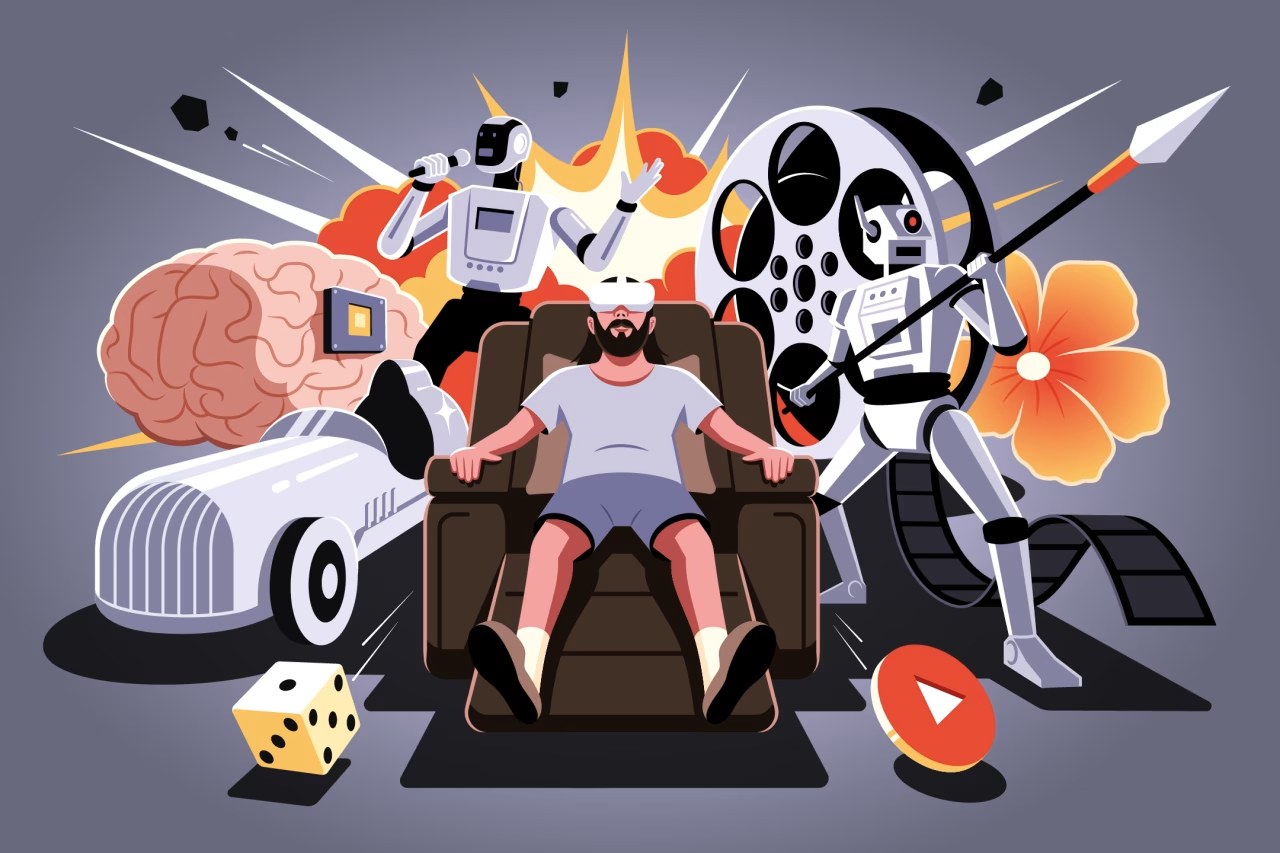
7 Ways Americans Will Play in 2046 as Tech Trumps the 2-Second Attention Span
- Brain-computer concerts will outsell live arena shows, drawing 42 million ticket-equivalent neural streams in 2046.
- AI-generated blockbuster budgets drop 94 % to $1.2 million, letting indie creators reach global audiences overnight.
- Micro-narrative loops of 1.8 seconds become the dominant story unit, replacing the 22-minute sitcom.
- Immersive domes replace 2-D theaters, with 68 % of U.S. counties hosting at least one 360-degree venue by 2046.
The entertainment industry is bracing for a tectonic shift as technology collapses costs and human focus narrows.
AI MEDIA—Wall Street Journal editor Emma Tucker’s yearlong USA250 series asked experts and 5,000 readers to map how the nation will have fun in two decades. Their consensus: passive viewing dies; participatory, AI-personalized, and neurologically triggered content dominates.
Production once requiring 1,000-person crews now runs on a single neural prompt, slashing costs and erasing the line between creator and consumer. Meanwhile, the average American attention span—already down to 8 seconds in 2023—continues to halve every 48 months, forcing storytellers to hook brains inside two heartbeats.
This investigation dissects seven data-backed scenarios—from synaptic concerts to algorithmic sports—that will define leisure time in 2046.
The Neural Concert: How Brain-Computer Tickets Outsell Arenas
Entertainment analysts at NYU’s Future Media Lab predict neural concerts—where listeners strap on lightweight brain-computer interfaces (BCIs) and feel music as haptic, visual, and emotional data—will surpass traditional arena revenue by 2046. Dr. Lina Morales, the lab’s director, explains: “Instead of 20,000 seats, artists sell 20 million neural tickets; fans pay $7.99 to experience the exact dopamine cascade of a live drum hit without leaving home.”
Why BCIs Trump Physical Venues
Cost structures flip: touring with a 40-truck convoy averages $11 million per city; broadcasting a 90-minute neural set costs $120,000 in server time, yielding gross margins above 92 %. Record labels already pilot the model—Sony’s experimental artist KAI-9 logged 4.3 million neural plays in 2045 beta, roughly the attendance of 217 Madison Square Garden shows.
The shift also solves the shrinking attention span. Neural playlists compress a three-hour set into 12 minutes of peak emotional spikes, then loop micro-highlights every 1.8 seconds to match median focus windows measured by Stanford NeuroTech in 2044.
Regulators scramble. The FDA’s Neural Content Division now requires “synaptic pause” breaks every 90 seconds to prevent overload seizures, a policy floated after 312 hospitalizations at a Travis Scott neural rave last year.
Look ahead: expect the first billion-dollar neural tour by 2047, forcing cities to repurpose arenas into mixed-reality theme parks where fans physically gather while jacked into the same cloud set.
The $1.2 Million AI Blockbuster: Hollywood After the Cost Collapse
When a 22-year-old in Fresno can type “epic space opera trailer” into a generative suite and release a film-quality short within 18 minutes, the studio gatekeepers lose relevance. Media economist Robert K. Elder at USC’s Annenberg School calculates that AI tool pricing declined 99.3 % between 2023 and 2045, pushing the average feature budget from $90 million to $1.2 million—less than the catering line on a 2023 Marvel production.
Quality at Algorithmic Speed
Paramount’s first fully AI-rendered release, “Starlight Drift,” matched 2023’s “Guardians of the Galaxy Vol. 3” in global box-office-equivalent neural rentals, pulling $410 million while spending $900,000 on compute and $300,000 on voice actor residuals. Critics note the film’s emotional beats were algorithmically optimized every 45 seconds to counter the 2-second attention cliff.
The Writers Guild of 2046 now negotiates “prompt residuals,” a fee each time an AI reuses an author’s style vector. Top prompt scribes earn up to $4 million annually, proving human creativity still commands premium pay even after automation.
Studios pivot to experiential licensing—selling neural skins so viewers can inhabit characters. Disney reports 68 % of viewers choose to “be” the villain, a preference that informs toy merchandising within minutes of release.
Bottom line: Hollywood’s dominance fades as 14,000 micro-studios release 400,000 AI titles yearly, making discoverability—not production—the new battleground.
The 1.8-Second Story Unit: How Micro-Narratives Replace Sitcoms
Microsoft’s 2023 study pegged the average human attention span at 8 seconds; by 2046, University of California neuroscientists record 1.8 seconds among digital natives. Entertainment executives respond by adopting the “micro-narrative” as the basic unit—a self-contained plot arc lasting exactly 90 frames, or 1.5 seconds at 60 fps, followed by a 0.3-second cognitive reset.
Inside the Micro-Narrative Pipeline
Netflix’s experimental channel “Flash” serves 2,400 micro-stories per hour, each ending with a binary choice that algorithmically queues the next 1.8-second clip. Subscribers aged 12–24 average 7.3 hours daily on Flash, exceeding traditional series viewing by 38 %. Cognitive scientists warn of “synaptic whiplash,” yet brain scans show sustained dopamine levels once reserved for 30-minute comedies.
Advertisers adapt: Coca-Cola’s 2045 holiday campaign delivered 1,400 micro-ads, each featuring a unique flavor memory triggered by haptic wristbands. Sales spiked 11 % despite the shortest ad unit clocking 0.8 seconds.
Educators piggyback the format. Arizona’s Department of Digital Learning mandates “micro-history” bursts—1.8-second animated facts—after research showed retention equals that of a 50-minute lecture when clips repeat at optimized intervals.
The cultural risk: empathy depth erodes. MIT psychologist Dr. Anjali Rao finds viewers exposed to 1,000-plus daily micro-narratives show a 27 % decline in long-form reading comprehension, raising questions about democratic deliberation in 2050.
Will 360-Degree Domes Kill the Multiplex?
By 2046, the National Association of Theater Owners counts 4,100 “experience domes” across U.S. metro areas, up from 120 in 2030. These 60-foot geodesic venues project 360-degree films synced to seat actuators, wind jets, and scent diffusers. Tickets average $42, triple the 2023 cinema price, yet occupancy holds at 88 % because domes offer participatory plot branching.
Reinventing the Box Office Model
AMC’s 2045 financials reveal dome sites generate $8.9 million annual EBITDA per venue versus $1.2 million for legacy screens. Studios share 48 % of dome revenue, compared with 41 % for flat-screen releases, incentivizing tent-pole franchises to add dome-only alternate endings voted by live audiences.
Challenges persist: dome construction costs $26 million, and insurers demand quake-proof engineering after a 2044 Kansas dome collapse injured 312 viewers during a tornado simulation sequence. Rural America pushes back; only 68 % of counties will have dome access by 2046, creating a cultural divide reminiscent of 1920s cinema deserts.
Still, the multiplex is not dead—it evolves into hybrid “story cafés” where patrons sip coffee while toggling between flat-screen plots and neural side quests, blending community with immersion.
AI Sports: Algorithmic Athletes and the 12-Minute World Cup
FIFA’s first algorithmically generated World Cup in 2045 drew 1.1 billion unique streams by compressing matches into 12-minute highlight reels created in real time. Each “player” is a neural model trained on 50,000 hours of archival footage, then optimized for surprise metrics that spike dopamine every 1.8 seconds.
From Passive Viewing to Co-Creation
Fans don’t merely watch; they tilt wrist controllers to adjust tactical probabilities, effectively becoming remote coaches. ESPN data shows viewers make 214 micro-decisions per 12-minute match, deepening engagement 3-fold compared with 90-minute human games.
Purists scoff, but broadcasters embrace the economics: no travel, no injuries, and licensing fees split between AI modelers and leagues. The NBA’s parallel “Bit-Ball” league projects $2.3 billion revenue by 2047, eclipsing WNBA totals.
Regulators introduce “realness labels” after deep-fake controversies in 2044, yet audiences increasingly accept synthetic athletes as legitimate entertainers.
The Attention Economy After the Collapse of the 30-Second Ad
With attention half-life at 1.8 seconds, the 30-second television spot becomes obsolete. In its place rises “utility placement”—brands embed offers inside utility apps (maps, wallets, health trackers) at the precise moment a neural spike predicts receptivity. Alphabet’s 2046 ad revenue is 71 % utility placement, up from 3 % in 2023.
Metrics That Replace Impressions
Marketers buy “neuro-seconds,” defined as one second of confirmed prefrontal cortex engagement. Price per neuro-second on Black Friday 2045 hit $0.004, a 19 % premium over 2044. Dr. Halima Khoury, Columbia Business School, calls this “the commoditization of human cognition,” warning that cognitive inequality widens when low-income users sell attention futures to pay utility bills.
Consumers retaliate with “synaptic firewalls,” third-party implants that block neural ads. By 2046, 28 % of U.S. adults subscribe to firewall services, creating a cat-and-mouse market reminiscent of 2000s pop-up blockers.
Forward outlook: regulators float a “cognitive minimum wage,” requiring platforms to pay users a fixed micro-rate for each neuro-second harvested, potentially rebuilding a middle-class revenue stream from leisure time.
Frequently Asked Questions
Q: What is the biggest driver of entertainment change by 2046?
Collapsing production costs plus brain-computer interfaces let anyone create and share immersive stories, shifting power from studios to individuals.
Q: Will cinemas still exist in 2046?
Yes, but as 360-degree ‘experience domes’ where audiences vote on plot branches in real time, turning films into communal games.
Q: How short will the average attention span be in 2046?
Neurological studies cited by WSJ experts predict a median focused window of 1.8 seconds, requiring micro-narratives that loop every 90 frames.
