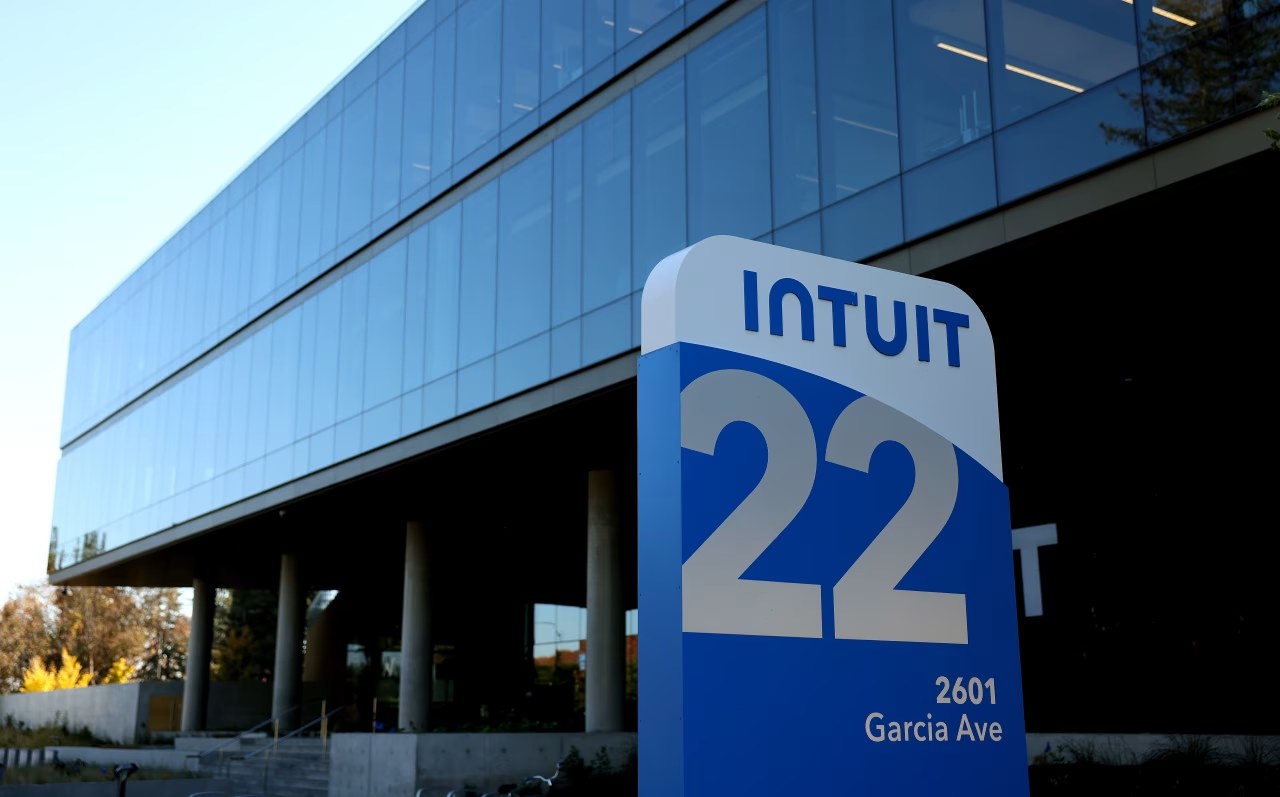
Intuit Suspends Executive Share Sales and Boosts Buybacks as 33% Plunge Deepens AI Concerns
- Intuit has frozen scheduled stock sales by senior management, eliminating a potential overhang of insider supply.
- The company is simultaneously accelerating share repurchases to absorb stock-market pressure.
- Shares have fallen about 33% this year, lagging the S&P 500 by roughly 40 percentage points.
- Investors are rotating capital toward AI-native platforms, questioning the moat around legacy tax and accounting software.
- Intuit owns TurboTax, QuickBooks, Credit Karma and Mailchimp, serving 100M+ customers globally.
Management’s move underscores how quickly AI anxiety is reshaping valuations across established software franchises.
INTUIT—Intuit, the Mountain View-based fintech giant behind TurboTax and QuickBooks, told investors it will halt pre-scheduled share sales by executives and step up the pace of buybacks, a rare two-pronged effort to steady a stock that has tumbled about 33% since January. The decision, disclosed through the company’s investor-relations site, removes a source of incremental supply at a time when algorithm-driven traders are already dumping shares on fears that generative-AI tools will commoditize tax prep and small-business bookkeeping.
While Intuit has not specified the dollar amount of accelerated repurchases, the announcement alone was enough to lift the stock 4% in after-hours trading, according to FactSet data. Still, the shares remain 40 percentage points behind the S&P 500 this year, reflecting a broader rotation away from productivity software incumbents toward AI-native challengers such as fintech startups embedding large-language models directly into accounting workflows.
“The board wants to send a clear signal: we are confident in our cash-flow durability and we will use every lever to protect shareholder value,” chief corporate affairs officer Tania Secor said in a brief statement. The freeze on management stock sales is effective immediately and covers all Section 16 officers, including CEO Sasan Goodarzi, who has historically sold $15–$20 million worth of shares each quarter through 10b5-1 plans.
Inside the 33% Selloff: Why AI Fears Hit Intuit Harder Than SaaS Peers
Intuit’s 33% year-to-date slide is almost triple the 12% average decline among large-cap software names, a divergence that puzzles some analysts because the company still guides for double-digit revenue growth through fiscal 2027. The answer lies in how investors are re-pricing durability: whereas platforms serving developers or large enterprises benefit from high switching costs, consumer- and SMB-facing tax software is viewed as more vulnerable to free or low-cost AI copilots.
Comparative valuation metrics reveal the gap
At 22-times forward earnings, Intuit now trades at a 35% discount to its five-year average, according to Bloomberg data. That multiple is also below the 26-times median for the S&P 500 software sub-index, a reversal from 2021 when the stock commanded a 25% premium. Short interest has climbed to 4.1% of float, the highest level since the 2018 Tax Cuts & Jobs Act overhaul, indicating hedge funds are betting the AI narrative has further to run.
“Investors are asking whether Intuit becomes the next TurboTax or the next Blockbuster,” says Gil Luria, technology strategist at D.A. Davidson. “The concern is that generative-AI models trained on open-source IRS forms can replicate 80% of the value proposition without the $89 price tag.” Luria points to experiments on Reddit forums where users already upload W-2 images into ChatGPT and receive completed 1040s within seconds, albeit with no guarantee of accuracy.
Intuit counters that its data moat—210 billion transactions anonymized across 100 million customers—feeds proprietary AI that improves year-over-year filing accuracy to 98.7%. The company also notes that IRS free-file partnerships cap the addressable market for no-cost alternatives at 70% of filers, leaving 30% who value guided workflows, audit defense and refund-maximization tools.
Still, the market is voting with its feet. Net outflows from INTU ETFs have totaled $1.3 billion since March, the largest five-month drain on record, according to Morningstar Direct. Options pricing implies a 12% post-earnings move, double the eight-quarter average, suggesting traders expect the AI debate to intensify when fiscal Q4 results are released next month.
The takeaway is that Intuit’s brand equity, while strong, is no longer viewed as AI-proof. Accelerated buybacks may cushion the share price, but sustained outperformance will hinge on whether the company can demonstrate that its own AI layer—rather than third-party chatbots—becomes the preferred interface for next-generation tax and accounting tasks.
What Halting Executive Share Sales Actually Removes From Supply
Intuit’s decision to suspend pre-scheduled 10b5-1 plans for all Section 16 officers eliminates an estimated $55–$65 million in quarterly stock supply that would otherwise hit the open market, based on the trailing four-quarter average disclosed in SEC filings. While that figure represents only 0.2% of the company’s $95 billion equity value, the psychological impact is larger because insider selling has risen every year since 2020, according to InsiderScore data.
Historical pattern of management liquidations
Over the past 36 months, CEO Sasan Goodarzi sold 560,000 shares worth $285 million, CFO Michelle Clatterbuck disposed of 180,000 shares for $92 million, and three other executive vice presidents collectively unloaded $310 million. All transactions occurred through Rule 10b5-1 automatic plans, meaning the new freeze breaks a predictable cadence that algorithmic traders had begun to front-run.
“When insiders stop selling, it removes a technical headwind and forces shorts to re-evaluate the downside,” says Ben Silverman, research director at VerityData. Silverman notes that Intuit’s insider selling velocity ranked in the 85th percentile among S&P 500 issuers during the first half of 2026, a statistic that buy-side analysts increasingly flag in risk models.
The company has not indicated how long the moratorium will last, only that it will remain in place “until further notice.” If history is a guide, similar pauses at Adobe and Salesforce lasted three to four quarters and coincided with 15–20% relative outperformance versus the sector, according to a Goldman Sachs review of 20 precedents since 2015.
Offsetting the supply reduction is Intuit’s ongoing equity compensation. The firm issued $1.1 billion in restricted stock units last fiscal year, equivalent to 0.9% of shares outstanding. Consequently, investors should view the sales suspension as a temporary brake on dilution rather than a permanent shrinkage of float.
Bottom line: eliminating a reliable drip of insider supply removes a narrative negative, but the medium-term trajectory will still depend on whether fundamentals stabilize rather than on technicals alone.
Accelerated Buybacks: Can They Bridge a $30 Billion Valuation Gap?
Intuit has not disclosed the size or speed of its accelerated repurchase program, but CFO Michelle Clatterbuck told analysts on the last earnings call that the board had authorized $6.5 billion in remaining capacity under the 2024 share-repurchase plan. Deploying even half of that amount at current prices would retire roughly 4% of shares outstanding, enough to add $0.45 to next year’s earnings per share, according to Morgan Stanley calculations.
Cash generation supports aggressive deployment
Free cash flow for the trailing 12 months totaled $4.3 billion, and Intuit carries $6.1 billion in cash and marketable securities against $6.8 billion in long-term debt. The company’s net-debt-to-Ebitda ratio of 0.6-times is well below the 2.5-times covenant limit, giving management flexibility to fund buybacks without jeopardizing investment-grade ratings.
“The balance sheet is under-levered for a software franchise with 80% gross margins,” says Keith Weiss, software analyst at Morgan Stanley. Weiss argues that Intuit could borrow an incremental $10 billion at an average after-tax cost of 3.3% and still remain within single-A credit metrics, enabling the repurchase of 10% of the float accretive by roughly $1.05 to EPS.
Yet accelerated buybacks work only if the stock is undervalued. At 22-times forward earnings, Intuit trades near the lowest multiple since 2017, but AI-driven downside risk could push valuations toward legacy tax-prep comps such as H&R Block, which trades at 12-times. In that scenario, buybacks executed today would destroy rather than create value.
History provides mixed precedent. Adobe bought back $9.8 billion of stock during 2021–2023 and outperformed the Nasdaq by 1,300 basis points, whereas IBM repurchased $45 billion across 2014–2016 and underperformed by 3,400 basis points as fundamentals eroded faster than share count declined.
The forward-looking calculus is that Intuit’s AI roadmap must stabilize revenue growth above 10% for buybacks to generate excess returns; otherwise, the company risks the same value trap that snared legacy tech names of the previous decade.
AI Disruption Timeline: Which Intuit Products Are Most Exposed?
Generative-AI models capable of ingesting IRS forms and producing completed returns represent a direct threat to TurboTax, which generated $4.6 billion in revenue last year, or roughly 38% of total company sales. QuickBooks, serving 7.2 million small-business subscribers, faces a similar risk as large-language models automate bookkeeping and payroll workflows that previously required paid software.
Product-level vulnerability scoring
According to a recent survey by tech-focused hedge fund Coatue Management, 64% of SMB owners would consider switching to a free AI-powered accounting tool if accuracy exceeded 95%. TurboTax users exhibit slightly higher loyalty, yet 41% still express willingness to try no-cost alternatives, a three-fold increase from 2023.
Intuit is responding with its own generative-AI layer called Intuit Assist, embedded across TurboTax, QuickBooks, Credit Karma and Mailchimp. Early data show that customers who engage with the AI assistant file returns 17% faster and claim 8% more deductions, suggesting productivity upside even if pricing power erodes.
“The key is to make the AI so tightly integrated that leaving feels like ripping out a central nervous system,” says Alex Johnson, fintech analyst at Cornerstone Advisors. Johnson notes that Mint’s demise in early 2024 drove 1.5 million users to Credit Karma, illustrating how ecosystem lock-in can offset price competition.
Regulatory timing adds another wrinkle. The IRS’s Direct File pilot, expanded to 13 states for tax-year 2025, could cap TurboTax’s upside if Congress mandates a permanent government option. Analysts at Cowen estimate that a nationwide free-file program would reduce Intuit’s U.S. tax revenue by 15–20%, equivalent to $700 million annually.
The forward risk matrix places TurboTax in the highest-impact quadrant—large revenue exposure plus nascent AI substitutes—while QuickBooks benefits from stickier workflows and lower media scrutiny. Credit Karma and Mailchimp are deemed moderately insulated because credit-score monitoring and marketing automation are less commoditized by generic AI chatbots.
Bottom line: Intuit’s AI defense strategy must show measurable user-engagement gains before next filing season; otherwise, the narrative of irrelevance could harden, making buybacks a mere finger in the dike.
What Comes Next: Earnings, Guidance and the AI Roadmap
Intuit is scheduled to report fiscal fourth-quarter results in six weeks. Consensus revenue stands at $3.4 billion, up 11% year-over-year, while adjusted EPS is projected at $1.49, according to FactSet. Investors will focus less on headline numbers and more on fiscal 2027 guidance, particularly whether management can reiterate 10–15% growth targets amid AI headwinds.
Key metrics to watch
Credit Karma member growth re-accelerated to 5% last quarter, but average revenue per user fell 3% as credit-card originations slowed. QuickBooks Online subscribers rose 13%, yet monthly churn ticked up 30 basis points to 3.2%, the highest since 2020. TurboTax units grew only 1% as DIY filers migrated toward free alternatives.
On the cost side, Intuit guided to $2.6 billion in R&D spending, with 40% allocated to generative-AI initiatives. If revenue growth slows to high-single digits, operating-margin pressure could emerge because AI investments are amortized over shorter useful lives, according to UBS accounting analyst Kunal Madhukar.
Capital-return policy will also be scrutinized. Management has historically returned 85% of free cash flow to shareholders via buybacks and dividends. Accelerating repurchases before the AI roadmap proves durable could provoke activist investors if the stock subsequently underperforms.
“The window for narrative turnaround is narrow,” says Rishi Jaluria, software analyst at RBC Capital Markets. Jaluria argues that if fiscal 2027 guidance falls below 10% revenue growth, the stock could re-rate toward legacy tax-prep comps, implying a sub-$300 price target versus today’s $420 handle.
Conversely, evidence that Intuit Assist increases conversion and retention could restore premium multiples. A pilot with 500,000 TurboTax users showed a 7% uplift in paid-tier attachment, suggesting AI can enhance rather than cannibalize revenue.
The next chapter hinges on whether Intuit can convince investors that its data advantage—210 billion transactions—translates into an AI moat. If not, even aggressive buybacks may fail to overcome structural growth doubts, and the 33% decline could be a prologue rather than a bottom.
Frequently Asked Questions
Q: Why did Intuit stop management stock sales?
Intuit suspended scheduled share sales by senior executives to prevent additional downward pressure on a stock that has already fallen 33% this year amid investor fears that artificial-intelligence tools could erode demand for traditional tax and accounting software.
Q: How much has Intuit stock fallen in 2026?
Intuit shares have declined approximately 33% year-to-date, underperforming both the S&P 500 and the Nasdaq Composite as growth investors rotate away from legacy software providers toward AI-native platforms.
Q: What products does Intuit own?
Intuit’s portfolio includes TurboTax for do-it-yourself tax filing, QuickBooks for small-business accounting, Credit Karma for consumer credit scores and personal finance, and Mailchimp for marketing automation.
Q: Does accelerating buybacks guarantee a higher share price?
No. While buybacks reduce shares outstanding and can signal management confidence, they do not change underlying fundamentals; if AI-driven competition materially lowers long-term growth or margins, the stock could remain under pressure regardless of repurchase activity.
