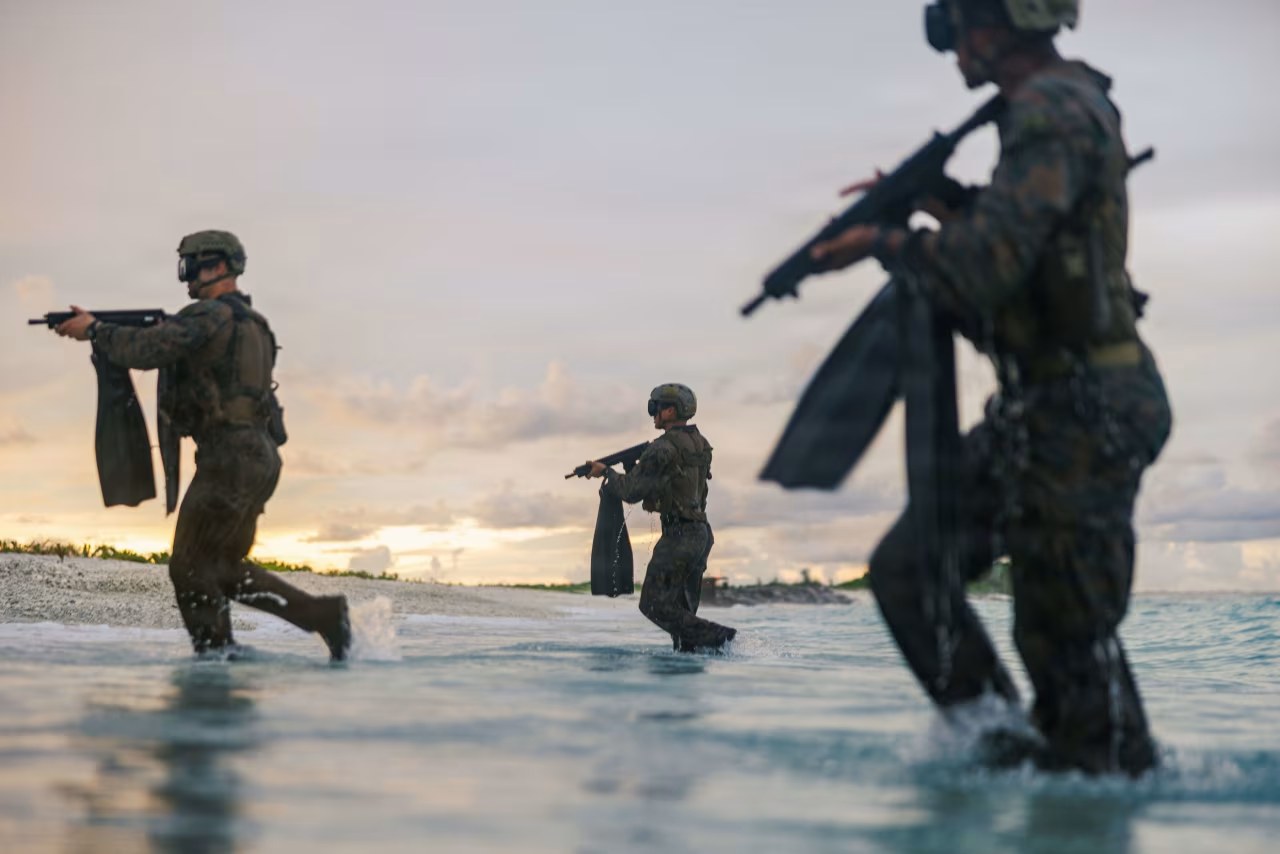
31st Marine Expeditionary Unit Lands in Mideast as Iran Vows to ‘Count the Moments’ Until U.S. Forces Are Destroyed
- Forward elements of the 31st Marine Expeditionary Unit have arrived in the Middle East, expanding President Trump’s rapid-response options.
- Tehran responded within hours, saying its military is tracking every U.S. move and will destroy troops if a ground invasion is ordered.
- The warning came after Iran suffered one of the war’s deadliest civilian-casualty days, raising fears of spiral toward direct conflict.
- Despite the escalation, U.S. equities closed steady, with investors pricing in only a limited chance of full-scale war.
Deployment of elite Marines shifts deterrence calculus—and Tehran is already reacting
IRAN—The arrival of the 31st Marine Expeditionary Unit in the Middle East late this week has put fresh steel behind Washington’s saber-rattling, giving President Donald Trump a mobile, sea-based force that can seize territory, conduct raids, and intercept vessels within hours of orders.
Within minutes of open-source flight trackers spotting Marine KC-130 tankers descending into an undisclosed Gulf base, Iran’s armed forces issued a chilling communiqué: they are “counting the moments” to destroy U.S. troops if Trump opts for a ground invasion.
The speed of the Iranian response—less than a day after the first Marine boots hit the ground—underscores how combustible the region has become. It also highlights the 31st MEU’s dual role: a rapid-response spear and a diplomatic trip-wire meant to deter Tehran from escalating its proxy campaign.
Inside the 31st MEU: Why This Marine Air-Ground Task Force Changes the Military Equation
The 31st Marine Expeditionary Unit is not simply another battalion landing team. Based in Okinawa and routinely forward-deployed on U.S. Navy amphibious ready groups, the 31st MEU is America’s only permanently forward-stationed Marine air-ground task force, built around roughly 2,200 Marines and sailors.
Its composition—an infantry battalion reinforced with tanks, artillery, amphibious assault vehicles, combat engineers, logistics, and a composite aviation squadron of Ospreys, SuperCobras, and Harrier jump jets—makes it a self-contained invasion force capable of seizing a beachhead or critical terrain before heavier Army brigades arrive.
“The MEU is the Swiss-army knife of the Marine Corps,” notes Dakota Wood, senior research fellow for defense programs at The Heritage Foundation. “In 1990 it was the 31st MEU that executed the first ground seizure of the Gulf War, taking control of the U.S. embassy in Kuwait City.”
Marine Corps doctrine explicitly tasks MEUs with six core missions: amphibious raids, non-combatant evacuations, humanitarian assistance, theater security cooperation, seizure of key maritime terrain, and—crucially—limited-objective attacks against state actors. That final mission set is what alarms Tehran.
Officially, the Pentagon says the new deployment is “routine presence.” Yet the timing is conspicuous. Satellite imagery shows the amphibious transport dock USS Green Bay and dock landing ship USS Rushmore loitering off the Chagos Islands last week while Marines conducted live-fire drills. Those same ships are now inside the Arabian Sea, within 72 hours steaming distance of Iran’s coastline.
Dr. Jonathan Lord, director of the Middle East security program at the Center for a New American Security, argues the move is calibrated ambiguity. “Deploying an MEU signals resolve without the political cost of a carrier strike group,” he explains. “It gives the president a scalpel, not a sledgehammer, and it complicates Iranian calculations about U.S. intentions.”
Still, Iran’s Revolutionary Guard has decades of experience shadowing U.S. amphibious forces. During the 1987-88 Tanker War, Iranian speedboats swarmed Marine amphibious ships in the Strait of Hormuz. Today, Tehran fields anti-ship cruise missiles, smart mines, and unmanned kamikaze boats that could threaten an MEU operating close to shore.
The 31st MEU’s presence therefore raises the risk of inadvertent clashes. A single rocket fired near an American vessel could trigger the very ground war Iran says it is preparing to repel.
What Drove Iran’s ‘Counting the Moments’ Warning?
Iran’s vow to “count the moments” until it can destroy U.S. forces did not emerge in a vacuum. Hours before the Marine arrival became public, Iranian officials were already reeling from what state media described as “one of the deadliest days for civilians” since the Gaza war expanded into a regional shadow conflict.
While the WSJ dispatch does not detail the specific incident, Iranian social media channels circulated images of destroyed apartment blocks in the city of Kermanshah, blaming Israeli air strikes launched from Azerbaijani airspace. Tehran has promised “eye-for-an-eye” retaliation against any state that aids Israeli operations.
Against that backdrop, the 31st MEU’s insertion is viewed in Tehran as potential preparation for a U.S. ground thrust to degrade Iranian missile sites. The Islamic Revolutionary Guard Corps (IRGC) has long war-gamed a scenario dubbed “Mokhtar 1” in which U.S. Marines seize islands in the Persian Gulf to create forward arming and refueling points.
“Iranian threat rhetoric typically escalates in parallel with perceived U.S. force buildup,” notes Dr. Afshon Ostovar, associate professor at the Naval Postgraduate School and author of “Vanguards of the Imam.” He adds that Supreme Leader Ayatollah Khamenei has personally authorized IRGC commanders to adopt a “preemptive deterrence” posture—meaning any sign of impending attack could trigger missile launches against U.S. bases in Bahrain, Qatar, or the UAE.
Tehran’s statement also serves domestic politics. With inflation running above 40 percent and nationwide protests simmering over water shortages, the regime needs an external enemy to rally nationalist support. State television replayed archival footage of the 1983 Marine barracks bombing in Beirut—an implicit reminder that Iran-backed militants have killed U.S. Marines before.
Yet the specificity of the warning—“counting the moments”—is new. Previous rhetoric vowed to “turn the Persian Gulf into fire,” but rarely named individual U.S. units. By singling out Marines, Iran signals it has tracked the 31st MEU’s deployment cycle and is prepared to strike pre-emptively if intelligence detects an imminent raid.
Western diplomats in Muscat, where back-channel talks with Iran continue, told the WSJ that Tehran’s calculus could flip quickly if Washington offers sanctions relief on humanitarian goods. Until then, the moment-by-moment countdown remains open-ended—raising the prospect of miscalculation in crowded shipping lanes where U.S. and Iranian vessels routinely operate within visual range.
Market Resilience: Why Stocks Shrugged Off the Saber-Rattling
While Tehran and Washington exchanged threats, the S&P 500 closed within 0.3 percent of its all-time high, and Brent crude futures actually fell 92 cents to $71.40 a barrel—an counter-intuitive signal that investors see limited risk of supply disruption.
“Markets have learned to price Middle East noise at a discount,” says Dr. Anwita Bahuguna, head of multi-asset strategy at Columbia Threadneedle. She points to a Federal Reserve Bank of New York study showing that geopolitical event shocks since 2000 added on average only 1.5 percent to oil prices over 30-day windows.
Algorithmic trading models now parse official statements for keyword clusters such as “ground invasion,” “Strait closure,” or “mining.” The absence of those exact phrases in both Trump’s tweets and Khamenei’s speech led systematic funds to pare back long-oil bets, Bahuguna explains.
Corporate earnings also diluted geopolitical angst. Of the 87 S&P 500 firms reporting this week, 82 percent beat earnings estimates, according to data compiled by Bloomberg. Strong cloud-sales guidance from Microsoft and AI-chip demand from Nvidia overshadowed headlines about Marines and missiles.
Still, options markets tell a more nuanced story. The CBOE Crude Oil ETF Volatility Index ticked up 6 percent, and call skew on energy stocks widened—indicating that while the probability of war is low, the potential upside for oil in a conflict is large enough to justify cheap hedges.
History offers context. When Reagan ordered the USS New Jersey to shell Iranian oil platforms in 1988, stocks sold off 2 percent intraday but recovered fully within five sessions. When Trump ordered the drone strike that killed IRGC commander Qasem Soleimani in 2020, the S&P 500 opened down 1.2 percent and closed up 0.7 percent.
“The market’s base case is that neither side wants an uncontrollable escalation,” notes Neil Beveridge, senior oil analyst at Bernstein. He argues that the 31st MEU’s deployment is viewed as “a deterrent insurance policy” rather than a prelude to boots-on-the-ground combat.
Yet complacency can be fleeting. A single missile hitting a loaded oil tanker could push Brent past $90, Beveridge warns, adding that current fundamentals—OPEC+ spare capacity below 3 million barrels a day—leave little room for error.
Could Miscalculation Trigger a Ground War Neither Side Wants?
Strategists at both the RAND Corporation and Tehran’s Center for Strategic Studies agree on one point: neither Washington nor Tehran seeks a large-scale ground war. Yet they also warn that the 31st MEU’s presence compresses decision-making timelines to minutes, not days.
Consider the naval chokepoints. The Strait of Hormuz is only 21 nautical miles wide at its narrowest. U.S. amphibious ships must sail within 12 nm to launch Marines by V-22 Osprey onto Iranian islands. That puts them inside Iran’s territorial sea, a legal grey zone where a single warning shot could escalate.
Rules of engagement are tight, but local commanders have authority to return fire if “imminent threat” is declared. In 2016, IRGC speedboats swarmed the riverine boats USS Firebolt and USS Typhoon, leading to a diplomatic apology after U.S. sailors were briefly captured. Today, both fleets operate under the same 2014 de-confliction memorandum—yet it has no enforcement mechanism.
“The risk is not strategy, it’s tactics,” says Admiral James Foggo (ret.), former commander of U.S. Naval Forces Europe. He notes that IRGC naval commanders often act autonomously, seeking prestige inside Iran’s factional system. A lone commander could launch a shoulder-fired missile at an Osprey, triggering a retaliatory raid by Marines already on standby.
Inside the Pentagon, planners have gamed out limited-objective raids lasting 24–72 hours. Targets include radar sites on Abu Musa island and anti-ship missile batteries at Bandar Abbas. Such raids would aim to degrade, not occupy—mirroring the 1983 Grenada model. But Iran could interpret any landing on its soil as the beginning of regime-change, prompting missile salvos against U.S. bases hosting fifth-generation fighters.
Diplomatic off-ramps exist. Oman’s Foreign Ministry has offered to host back-channel talks, and Japan—holder of a small naval coalition—has proposed joint maritime patrols that would let both sides claim de-escalatory intent. So far, Washington has not accepted, insisting Iran must first halt proxy attacks on Red Sea shipping.
Meanwhile, the 31st MEU’s logistics clock is ticking. Amphibious ready groups typically sustain combat operations for 15 days before requiring an ammunition-replenishment float. If deterrence fails, planners have a narrow window to either escalate or extract forces before combat power wanes.
Key Takeaways for Investors and Citizens Watching the Standoff
First, watch the ships. The U.S. Navy’s Fifth Fleet publishes a daily “battle-force” update; a sudden reduction in destroyer count near Bahrain could indicate an amphibious group is moving into the Gulf of Oman—raising risk levels.
Second, monitor insurance not headlines. The Baltic International Freight Futures market already prices a $2.50-per-barrel war-risk premium into crude. If that spread widens above $5, energy equities will outperform tech, reversing this week’s trend.
Third, track Iraqi parliament votes. Any resolution demanding withdrawal of U.S. troops from Al-Asad airbase would signal Tehran has successfully pressured Baghdad to curtail American freedom of action, making Marine operations logistically harder.
Fourth, watch for cyber. Iran’s Islamic Revolutionary Guard has previously launched wiper malware against Saudi Aramco. A similar attack on Bahrain’s oil infrastructure could spike prices even without kinetic conflict.
Finally, keep an eye on China. Beijing recently mediated a Saudi-Iran détente; if Chinese officials suddenly announce a Gulf security dialogue, markets may interpret it as a face-saving off-ramp for both Washington and Tehran.
For ordinary citizens, the lesson is to distinguish between posturing and genuine force generation. The 31st MEU’s deployment is serious, but history shows that when both sides telegraph their moves, deterrence often succeeds—leaving markets free to focus on earnings, not ordnance.
Frequently Asked Questions
Q: Which U.S. Marine unit deployed to the Middle East?
The 31st Marine Expeditionary Unit—specializing in rapid seizure, raid, and maritime interception—has arrived, giving the White House a swift ground-strike option without full-scale mobilization.
Q: What did Iran say about the Marine deployment?
Iran’s armed forces declared they are ‘counting the moments’ to destroy U.S. troops if President Trump launches a ground invasion, framing the deployment as a casus belli.
Q: How did markets react to the escalation?
Despite the saber-rattling, major indices closed resilient, signaling investors believe Washington and Tehran will avoid open war that could disrupt oil flows and global supply chains.
📰 Related Articles
- Iran’s Hormuz Gambit Turns Energy, Chips and Rare Earths Into 21st-Century Arsenal
- Trump Rules Out Iran Cease-Fire as U.S. Rushes More Warships and Air Defenses to Gulf
- China Risks Losing Strategic Lifeline If Iran Becomes Next U.S.-Israel Battleground
- Middle East Conflict Chokes Global Oil Supply, Fuels U.S. Stagflation Fears
