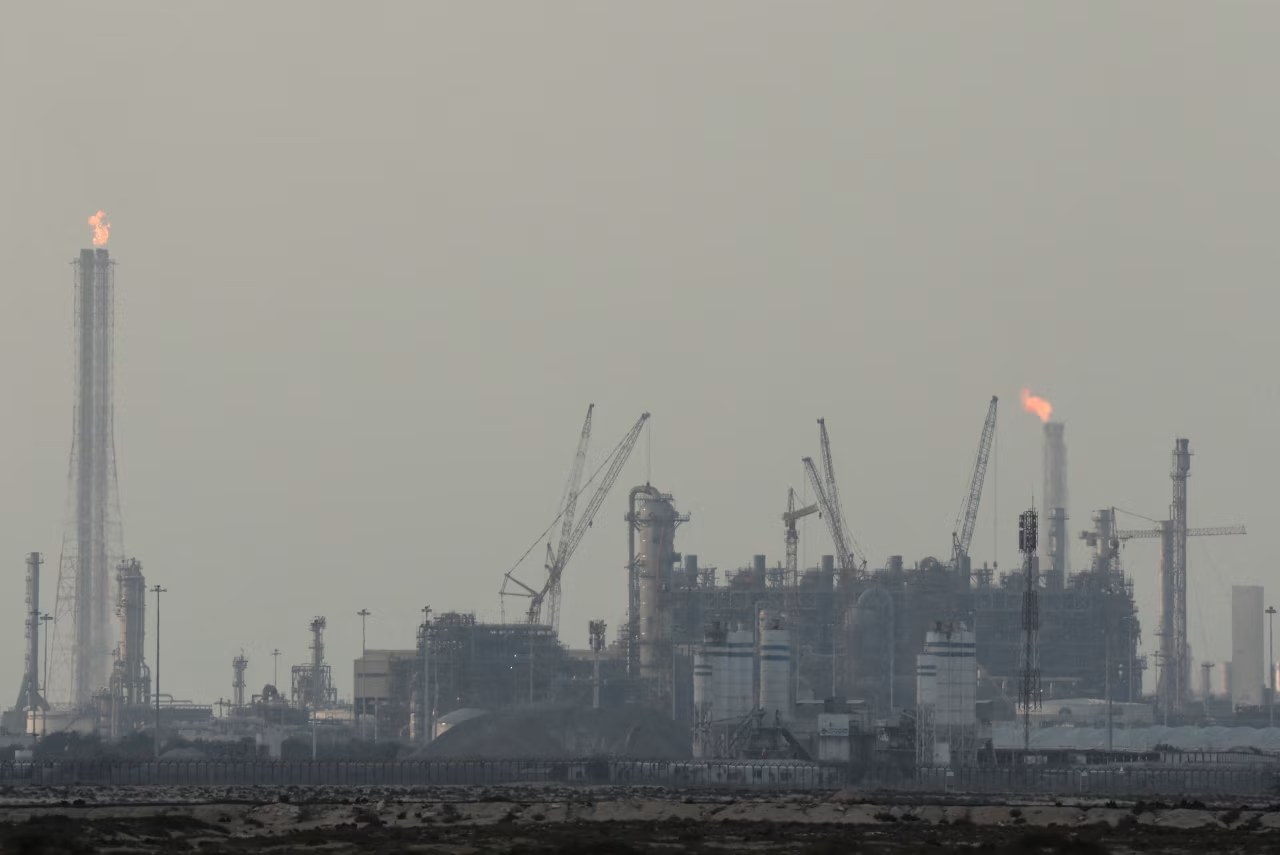
Iran’s Ras Laffan Strike Sends LNG Prices Up 18 % in a Day
- Iran hit QatarEnergy LNG trains in Ras Laffan Industrial City, the single largest LNG export point globally.
- Tehran simultaneously threatened to mine the Strait of Hormuz through which 21 million bpd of oil transits—21 % of global supply.
- Spot LNG prices leapt 18 % within six hours; Brent crude rose 7 % to $92.40, its highest since the Ukraine invasion.
- Rare earths and semiconductor supply chains now face the same weaponization risk, analysts warn.
Energy, chips and critical minerals have become the new cruise missiles—cheaper, deniable and globally disruptive.
STRAIT OF HORMUZ—In the space of a single spring afternoon, the Persian Gulf proved that the most explosive weapons in the 21st-century great-power contest are no longer ballistic missiles but liquefied natural gas terminals, rare-earth refineries and five-nanometre chip fabs. Iran’s strike on QatarEnergy’s Ras Laffan LNG complex—confirmed by a terse Reuters flash—jolted spot LNG prices up 18 % while Brent crude vaulted 7 %. The message: whoever controls chokepoints of molecules and atoms can roil the global economy faster than any standing army.
Energy markets once treated geopolitical risk as a Middle-East aftershock. Today the risk is the strategy. Tehran’s asymmetric counter-punch against U.S. and Israeli airstrikes shows how pipelines, ports and wafer fabs have become precision-guided munitions. “The extension of war into commodity chokepoints is the most significant shift in strategic thinking since the Berlin blockade,” says Emily Holland, energy-security scholar at the U.S. Naval War College.
The calculus is brutal: a single drone swarm against a $20 billion LNG train can erase 3 % of global gas supply overnight. A semiconductor export ban from Taiwan or China would idle 60 % of the world’s advanced logic chips. And China’s 87 % share of rare-earth refining gives Beijing a throttle over everything from F-35 jets to iPhone vibrators. In short, the new arms race is fought in periodic-table columns, not arms depots.
From Oil Embargoes to LNG Drones: How Energy Became a Smart Bomb
History’s first oil embargo was proclaimed in 334 BC when Persian satraps denied olive oil to Athens. Yet the 1973 Arab oil shock is the reference point for modern commodity coercion—when Arab producers cut 5.7 million barrels per day and sent oil from $3 to $12 in six months. Today’s escalation is qualitatively different: Tehran targeted not supply volumes but the physical nodes that turn molecules into money.
Ras Laffan produces 77 million tonnes per annum of LNG, equal to 11 % of global liquefaction capacity. By striking it, Iran achieved what 1973 producers could not—an instantaneous, visible price spike without severing diplomatic ties. “Physical attacks on energy hubs create a terror premium that trading algorithms price in within minutes,” says Helima Croft, head of commodities at RBC Capital Markets. Brent’s 7 % intraday jump added $2.3 billion in paper value to existing inventories worldwide.
Tehran’s playbook mirrors Ukraine’s 2022 drone raids on Russian Black Sea terminals. Both sides now calibrate attacks to maximize commodity volatility rather than battlefield attrition. The difference: the Gulf’s density—Ras Laffan sits 300 km inside a waterway that already handles one-fifth of traded petroleum—magnifies impact. Insurance on Qatari LNG cargoes spiked to 12 % of cargo value from 0.7 %, according to London broker Simpson Spence Young.
Forward curves show the market expects at least a six-month risk premium. Asian importers such as Japan and South Korea—who rely on Qatar for 18 % and 29 % of supply respectively—are scrambling for U.S. Henry Hub-linked contracts. The episode proves that in a net-zero chase, natural gas is no longer a bridge fuel; it is a geopolitical detonator.
What the 1973 embargo teaches about today’s shock absorbers
Unlike 1973, today’s consuming nations hold 1.5 billion barrels in strategic storage and the United States is the world’s top oil producer. Yet LNG is less fungible: you cannot pipe Qatari molecules to Europe if the Strait shuts. That inflexibility explains why Japan’s Ministry of Economy, Trade and Industry convened an emergency session within three hours of the Ras Laffan reports. Tokyo’s takeaway: diversify to nuclear, coal and U.S. LNG—or live at Tehran’s mercy.
Rare Earths: The 17 Elements That Can Ground an F-35 Fleet
While oil grabs headlines, the quieter chokepoint sits in Inner Mongolia’s Bayan Obo mine. There, China produces 60 % of the world’s rare-earth ore but—more importantly—87 % of refined neodymium, praseodymium and dysprosium. A single 2010 territorial spat with Tokyo prompted Beijing to cut exports by 37 %. Neodymium oxide prices surged 700 % in three months. Japan’s missile, auto and electronics sectors stalled until the World Trade Organization intervened.
Fast forward: every F-35 needs 417 kg of rare-earth magnets; each Arleigh-Burke destroyer needs 2.3 tonnes. A 30-day export halt would idle Lockheed Martin’s 140-aircraft annual output, disrupting a $1.6 trillion procurement pipeline. “Rare earths are the oil of the digital age,” says Constantine Karayannopoulos, former CEO of Neo Performance Materials. “Except you can’t recycle an F-35 magnet like you can a barrel of oil.”
Washington’s retort—the $1.2 billion Mountain Pass revival in California—still ships concentrates to China for refining. The Pentagon’s 2023 industrial-capacity report admits the U.S. lacks solvent-extraction capacity for heavy rare earths, leaving defense contractors exposed. Even Australia’s Lynas, the only non-China scale producer, sends 30 % of its oxides to Chinese separation plants. The takeaway: Tehran’s energy gambit is replicable in 17 periodic-table squares.
Weaponized geology: why China keeps export quotas opaque
Beijing’s Ministry of Commerce issues quotas twice a year but never discloses country-specific allocations. The ambiguity is deliberate—foreign manufacturers must self-censor on Taiwan or Xinjiang or risk supply disruption. In 2023 China quietly withheld europium exports to the Netherlands after ASML curbed lithography-machine sales. Dutch LED phosphor plants idled within weeks, proving again that geology trumps gunpowder.
Silicon at Sea: How Taiwan’s 2 nm Fabs Became Aircraft Carriers
TSMC’s Fab 20 campus in Hsinchu produces 13 % of the world’s logic chips on 3-nanometre nodes. A single missile strike—say, from a Chinese DF-17—would erase 60 % of Apple’s and Qualcomm’s advanced supply. Unlike oil, chip fabs cannot reroute: each plant costs $20 billion and takes five years to build. “Semiconductors are the new aircraft carriers,” says Cybersecurity and Infrastructure Security Agency director Jen Easterly. “Except carriers can redeploy; fabs can’t.”
The 2021 auto-chip drought cost Ford and GM a combined $10 billion in lost revenue from just 5 % undersupply. Scale that to 7-nm and 5-nm nodes—where only TSMC and Samsung compete—and a Taiwan conflict would idle everything from cloud servers to AI training clusters. Washington’s CHIPS Act allocates $39 billion to on-shore fabs, but Intel’s Ohio megafab will not yield revenue until 2027. Until then, the free world’s digital spine runs through the Taiwan Strait—an arena Tehran watches closely.
China’s counter is the Silicon Blockade playbook: in 2023 it banned exports of germanium and gallium—two chip-substrate metals—after Dutch curbs on lithography gear. Prices jumped 52 % in a week. Beijing can escalate by restricting rare gases such as neon, 90 % refined in Ukraine before the war. With Ukrainian plants shuttered, China now supplies 70 % of semiconductor-grade neon. A single export permit delay can stall a TSMC batch worth $150 million.
Why a 48-hour fab shutdown costs more than a carrier battle group
A Nimitz-class carrier costs $13 billion over 50 years. A two-day global chip stoppage would erase $50 billion in GDP, according to the Semiconductor Industry Association. The asymmetry explains why TSMC’s market cap ($550 billion) rivals ExxonMobil’s despite one-tenth the revenue. Control over fabs, not fleets, now dictates strategic timelines.
Is Strategic Autonomy Possible Without a 1,000-Year Supply Chain?
Washington, Brussels and Tokyo have all coined versions of “strategic autonomy.” Yet the numbers reveal a paradox: the U.S. still imports 80 % of its gallium, 100 % of its dysprosium and 35 % of its crude through Hormuz. Europe imports 90 % of its LNG via pipelines Russia can sabotage. “Autonomy is a slogan, not a spreadsheet,” says Javier Blas, Bloomberg commodities columnist. The Inflation Reduction Act earmarks $369 billion for green tech, but lithium, cobalt and nickel contracts still run through Chinese traders.
Efforts to rebuild at home stumble on geology and time. A rare-earth separation plant needs 18 months of environmental permitting in the U.S. versus 90 days in China. Semiconductor fabs require 2,000 skilled technicians—currently poached by TSMC at triple U.S. salaries. Oil storage is easier; SPR sites in Louisiana and Texas hold 60 days of imports, but LNG regas terminals take five years to permit. The net result: every reshoring announcement is back-loaded beyond the next election cycle.
Private markets are hedging via “friend-shoring.” Apple now sources 44 % of its cobalt from Australia and Canada, up from 8 % in 2019. BMW inked a $866 million deal with Lynas for rare-earth oxides mined in Australia and refined in Malaysia—still inside China’s prospective maritime cordon but outside its export-licence grasp. Yet friend-shoring merely shifts chokepoints: Malaysia’s Port Klang handles 30 % of global container traffic and sits 1,200 km from contested waters.
Stockpiles vs speed: why 60-day reserves may not outrun a drone swarm
The U.S. Defense Logistics Agency targets 180 days of rare-earth oxides, but current inventories cover 12 days of heavy REO demand. A simulated tabletop by RAND found that a six-month Chinese export ban would idle 28 % of U.S. defense contracts before alternative suppliers could scale. The bottleneck is not ore but solvents: Chinese firms control 92 % of global SX (solvent extraction) capacity, a chemistry-intensive step immune to quick reshoring.
What Iran’s Ras Laffan Raid Teaches the Next Commodity Superpower
Tehran’s strike did not seek territorial gain; it sought option value—the right to roil markets at will. That logic scales. Indonesia could throttle 30 % of global nickel by halting deep-sea tailings. Chile, facing water shortages, might cap copper output at 5 million tonnes, sending wiring-grade metal above $15,000 per tonne. “The low-cost producer is now the low-cost geopolitical saboteur,” says Riccardo Puliti, head of energy at the World Bank.
Financial markets already price this in. The five-year volatility skew for cobalt has doubled since 2021; LNG freight rates now trade like tanker war-risk premiums during the 1980s Iran-Iraq war. The new commodity supercycle will be driven less by Chinese GDP and more by export-licence politics. Investors are responding: assets under management in the abrdn Physical Critical Minerals ETF rose 340 % in 18 months, while defense-commodity hedge funds launched 14 new funds in 2023 alone.
For Washington, the lesson is procedural: sanctions must target chokepoint assets, not just barrels. After the Ras Laffan raid, Treasury officials floated insurance-linked sanctions that would freeze any vessel owner who loads at an Iranian-threatened terminal. The EU is mulling an “anti-coercion instrument” that would impose automatic tariffs on any country restricting gallium or neon exports. Yet such mechanisms remain reactive; the hardware—alternative refineries, fabs and ports—takes years to build.
Meanwhile, Tehran’s precedent emboldens mid-tier producers. Guinea’s military junta now demands a 35 % equity stake in Simandou iron ore, the world’s largest untapped reserve. Sudan’s Rapid Support Forces recently seized Port Sudan, threatening 1.2 million bpd of regional oil transit. Each episode chips away at the post-1945 norm that raw materials are neutral, ushering in a world where every mine, port or fab is a latent missile silo.
Can multilateral bodies still police the periodic table?
The WTO’s appellate body is paralyzed; the International Energy Agency has no mandate over silicon or cobalt. Proposals for a “Critical Minerals Consortium” akin to the IEA stalled after 18 nations failed to agree on stockpile obligations. Without governance, expect more Ras Laffan moments—where a single strike, ban or port seizure sends cobalt, neon or LNG into the stratosphere, and the old superpower toolkit of aircraft carriers arrives too late to cool the market.
Frequently Asked Questions
Q: Why is the Strait of Hormuz critical for global energy?
Roughly 21 million barrels of oil—about 21 % of global petroleum trade—pass through the 21-mile-wide strait daily. Iran’s coastal missiles can reach every tanker lane, giving Tehran a chokehold on supplies to Asia, Europe and the U.S. Strategic Petroleum Reserve.
Q: How do rare earths become geopolitical weapons?
China refines 87 % of the world’s rare earths needed for F-35 jets, EV motors and iPhone chips. A single export ban in 2010 sent prices up 700 %. States now stockpile and reroute supply chains, turning ore access into leverage akin to oil embargoes.
Q: Did Iran actually hit QatarEnergy LNG facilities?
According to a terse Reuters alert, Iran struck QatarEnergy’s Ras Laffan LNG trains. While Doha has not confirmed damage, spot LNG prices leapt 18 % within hours, underscoring how even rumored hits on critical plants rattle global gas markets.
📰 Related Articles
- Trump Rules Out Iran Cease-Fire as U.S. Rushes More Warships and Air Defenses to Gulf
- China Risks Losing Strategic Lifeline If Iran Becomes Next U.S.-Israel Battleground
- Middle East Conflict Chokes Global Oil Supply, Fuels U.S. Stagflation Fears
- Why Eliminating Iran’s Ballistic Missiles Could Be Difficult
