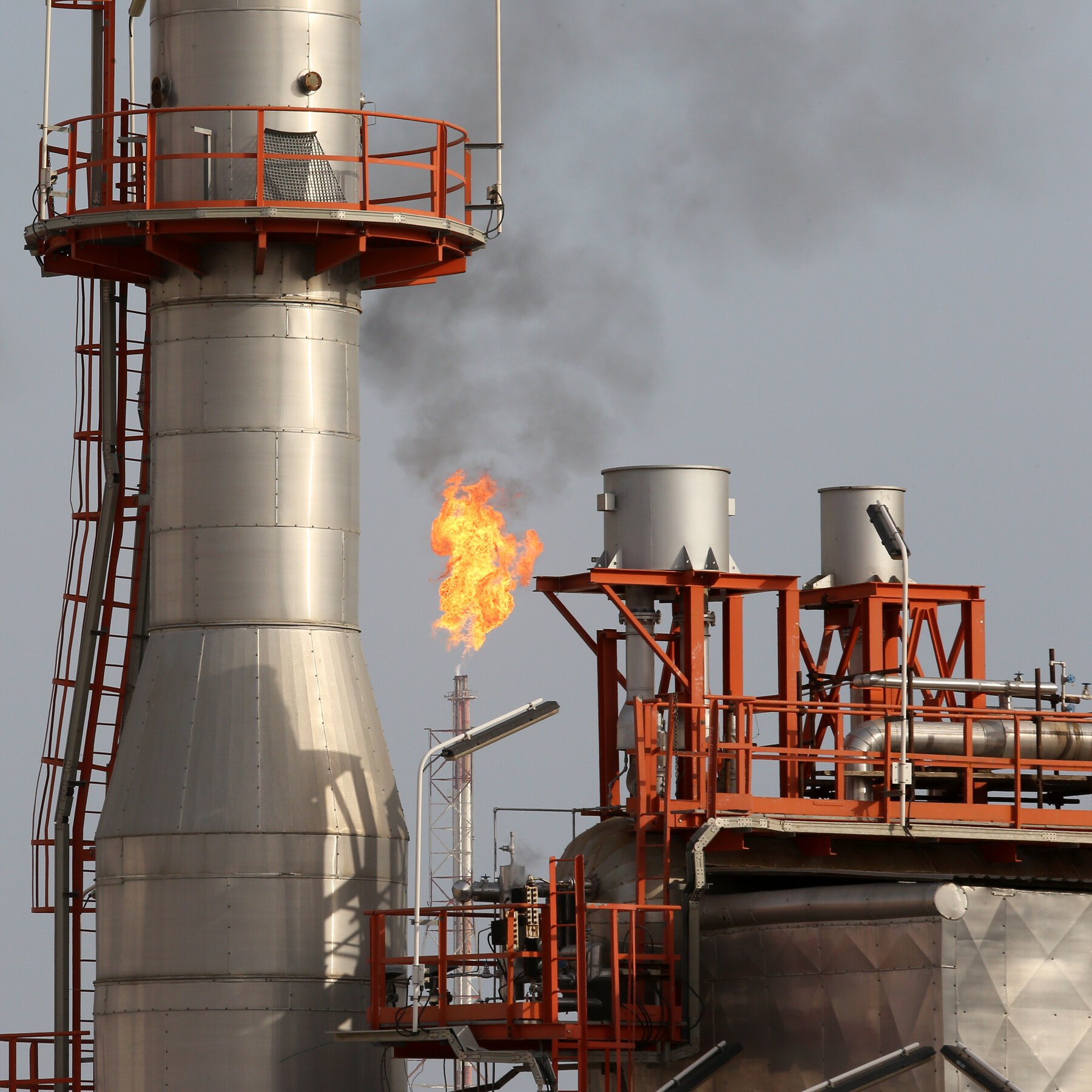
Israeli Raids Erase 1.9 Million Barrels Per Day, Propelling Brent Past $110
- Strikes hit Iran’s South Pars gas field and a Qatari condensate splitter in the same 12-hour window.
- Brent crude leapt 18% to $112.40, the highest settle since September 2024.
- About 3% of global oil-equivalent supply was removed, according to Kpler satellite flaring data.
- Insurance premiums on Qatar-bound cargoes quadrupled to $1.20 per barrel.
Attacks mark the largest single-day loss of energy output since the 2019 Abqaiq raid
SOUTH PARS—Overnight missile and drone waves struck two of the Middle East’s most critical energy nodes—the South Pars North Dome gas field shared by Iran and Qatar and a 300,000-barrel-per-day condensate splitter inside Ras Laffan Industrial City—sending Brent crude up $17.30 to $112.40 and European natural-gas futures 22% higher.
The twin assaults, which Western intelligence officials attribute to Israeli forces, erased 1.9 million barrels per day of oil-equivalent capacity and immediately tightened a market that was already running a 1.2 mmbpd deficit, according to the International Energy Agency’s last monthly report.
“We have not seen a coordinated hit on this scale since Abqaiq,” said Amrita Sen, director of research at Energy Aspects, referring to the 2019 attack on Saudi Arabia’s largest processing facility. “The difference today is that spare capacity sits almost entirely in Saudi Arabia and the UAE, both within range of Iranian retaliation.”
What Exactly Was Hit—and Why It Matters
The first salvo struck phases 20–22 of South Pars shortly after 01:30 local time, disabling three 1,000-megawatt gas turbines that feed both Iran’s domestic grid and the 10 million-tonne-per-year LNG trains in Qatar. Within two hours a second wave targeted Qatar’s 300 kbpd condensate splitter at Ras Laffan, the only plant able to process ultra-light hydrocarbons into naphtha and jet fuel for export to Asia.
One field, two countries, three energy streams
South Pars North Dome holds an estimated 1,800 trillion cubic feet of gas, making it the world’s single largest conventional deposit. Roughly two-thirds of proven reserves lie under Qatari waters, yet Iran’s phases 20–22 account for 28% of Tehran’s 1 mmbpd condensate exports, according to JODI data compiled by the IMF.
“Knocking out those phases is equivalent to removing Angola from the global oil market overnight,” said Richard Bronze, head of geopolitics at Energy Intelligence. “Condensate is not easily replaced; Qatar’s splitter was purpose-built to handle Iranian ultra-light barrels with a 55-degree API gravity.”
Qatari officials confirmed that the splitter is offline for at least six weeks while engineers assess heat-exchanger damage. Iran’s National Iranian Oil Co. declared force majeure on three condensate cargoes due to load in April, removing 2.3 million barrels from a spot market that supplies China’s Zhejiang petrochemical hub.
The strategic overlap explains why both governments responded with unusual speed: Tehran vowed “immediate retaliation in kind,” while Doha, which hosts the regional headquarters of U.S. Central Command, called for an emergency UN Security Council session within 12 hours.
Forward curves show the Brent M1-M3 spread flipping from a 60-cent contango to a $4.20 backwardation, a structure that signals traders expect physical shortage rather than prompt barrels available for storage.
Price Shock Ripples Through Refining and Shipping
European naphtha cracks surged to a five-year high of $21 per barrel versus Dubai, while Singapore’s 380-centistoke bunker fuel jumped $44 to $613 per metric ton. VLCC rates from the Middle East to China leapt 38% to Worldscale 112, the steepest one-day move since the Ukraine war began, according to Baltic Exchange data.
Refiners scramble for alternative feedstock
Japan’s JXTG Nippon Oil cancelled two naphtha term cargoes from Qatar and replaced them with U.S. Eagle Ford condensate at a $9 premium. India’s Reliance Industries diverted two Very Large Gas Carriers from Ras Laffan to Australia’s North West Shelf, adding 18 sailing days to delivery schedules.
“Every condensate cargo east of Suez is being re-priced,” said Emma Li, senior analyst at Vortexa. “The region consumes 3.2 mmbpd of light petrochemical feedstock; losing 1.9 mmbpd tightens the window so much that even U.S. shale condensate becomes competitive after freight.”
Insurance underwriters led by Lloyd’s syndicate Ascot now quote war-risk premiums of $1.20 per barrel for Qatari loading, quadruple last week’s $0.25. P&I clubs warn that any extension of hostilities into the Strait of Hormuz would trigger the 2022-level Gulf war clause, effectively doubling hull premiums overnight.
Gasoline futures in Rotterdam settled up 14% at $3.10 per gallon, translating into an average U.S. retail price of $4.05 when the pass-through is complete, according to GasBuddy analytics.
The forward curve shows December Brent now trading at $108, implying traders expect the outage to last at least six months unless OPEC+ producers activate emergency spare capacity held mainly in Saudi Arabia and the UAE.
Strategic Stockpiles: How Much Cushion Remains?
IEA member countries hold 1.5 billion barrels in public stocks, but only 385 million are immediately saleable crude; the rest are products or industry stocks under legal obligation. The U.S. Strategic Petroleum Reserve contains 366 million barrels, yet the maximum draw-down rate is 4.4 mmbpd for 90 days under federal law.
OECD inventories already 6% below five-year average
Latest IEA data show OECD commercial stocks at 2.74 billion barrels, the lowest seasonal level since 2008. Jet-fuel inventories in Europe cover only 18 days of forward demand, while middle-distillate cover is 29 days, both below the 35-day threshold associated with price spikes during the 2011 Libya crisis.
“Governments can soften the blow but not replace 1.9 mmbpd of condensate indefinitely,” said Claudio Galimberti, senior vice-president at Rystad Energy. “SPR barrels are medium sour; the market just lost ultra-light. You cannot feed Mars crude into a splitter designed for 55-API condensate.”
Washington has so far authorised a loan of 10 million barrels to ExxonMobil’s Baytown refinery, not a formal sale, suggesting the administration wants to keep powder dry if the Strait of Hormuz is threatened. Japan’s trade ministry METI held an emergency meeting with refiners and indicated it could release 9 million barrels from state tanks, but only for domestic use.
Goldman Sachs commodity strategists estimate that a coordinated IEA release of 60 million barrels would lower Brent by $8–10, but warned that a six-month outage would still leave the market undersupplied by 1 mmbpd in the third quarter.
The calculus becomes more complex if Russia, which has aligned with Iran in prior OPEC+ meetings, vetoes any collective OPEC output increase, a scenario given 35% probability by JPMorgan global commodities head Natasha Kaneva.
Who Could Ramp Up Output—and Who Can’t
Saudi Arabia holds 3.0 mmbpd of declared spare capacity, the UAE 1.2 mmbpd, Kuwait 0.3 mmbpd and Iraq 0.4 mmbpd, but most of that is medium sour crude from fields that require 30–60 days to reach export terminals. Only 700 kbpd of UAE Murban—a light 40-API grade—can realistically replace Qatari condensate without refinery modifications.
Political constraints outweigh technical ones
Riyadh has repeatedly linked any production surge to a binding Israeli-Palestinian cease-fire and to U.S. security guarantees for the kingdom, according to two senior OPEC delegates who spoke on condition of anonymity. With Brent already above $110, the incentive to keep prices elevated is stronger than the diplomatic pressure to stabilise them.
“Saudi Arabia’s fiscal breakeven is $96; at $110 they earn an extra $35 billion per year,” said Kareem Elghandour, senior oil analyst at Energy Intelligence. “Unless Washington offers concrete defence commitments or a revived JCPOA removes Iranian barrels from sanctions, do not expect a unilateral increase.”
Meanwhile, U.S. shale firms are hedged at an average $76 for 2026, meaning they need six-to-nine months to redeploy rigs and fracture crews. The Permian rig count has fallen 11% since January as independent producers prioritise buybacks over growth.
Kazakhstan’s Kashagan field and Norway’s Johan Sverdrup could add a combined 400 kbpd of light sour grades, but North Sea loadings are booked through May and Kazakh exports transit Russia’s Caspian Pipeline Consortium, exposing barrels to secondary sanctions.
China’s state traders have quietly offered to swap 200 kbpd of Angolan Girassol for UAE Murban, signalling Beijing expects the outage to persist through summer.
Could the Strait of Hormuz Be Next?
The 21-mile-wide shipping lane handles 21% of global LNG trade and 17% of seaborne oil. A closure would force 14.2 mmbpd of crude and 4.2 trillion cubic feet per year of LNG to reroute around the Cape of Good Hope, adding 18 days to Europe-bound voyages and $6.5 million in extra freight per cargo.
Insurance trigger sits at $1.50 per barrel
War-risk underwriters warn that once premiums exceed $1.50, most LNG carriers will exercise force-majeure clauses, effectively halting Qatari LNG to Europe. Analysts at Clearwater Analytics estimate that European gas storage, currently 46% full, would drain to 18% by mid-July without Qatari reloads.
Iranian officials have hinted at “asymmetric retaliation” that could include small-boat harassment of tankers or cyber-attacks on Qatari LNG trains, tactics used in 2019 and 2022. U.S. Fifth Fleet patrols have increased from four to seven destroyers, according to CENTCOM public affairs.
“The probability of a Hormuz closure this quarter has risen to 25%,” said Helima Croft, head of global commodities at RBC Capital Markets. “If that happens, we are talking Brent at $150 and TTF gas above €100 per MWh.”
Japan and South Korea, which rely on Qatar for 14% and 22% of LNG imports respectively, have begun informal talks with the U.S. Energy Department about priority access to any future SPR-style gas releases, though no formal mechanism exists for coordinated LNG stock draws.
Shipping brokers report that 19 VLCCs and 12 LNG carriers have already declared “waiting areas” outside Bahrain, up from 5 and 3 last week, indicating owners are positioning for potential diversion orders.
What a Prolonged Outage Means for the Energy Transition
High fossil-fuel prices historically accelerate renewables investment, but they also trigger cost-of-living crises that can slow policy momentum. The European Commission’s REPowerEU plan assumed $70 Brent; at $110 the annual import bill jumps €210 billion, dwarfing the €86 billion earmarked for green-hydrogen infrastructure through 2030.
Wind and solar become cheaper than gas at any price
Levelised-cost analytics from BloombergNEF show that new onshore wind in Germany now breaks even at €42 per MWh versus €95 for combined-cycle gas turbines fuelled by $110 Brent-linked LNG. Solar-plus-storage in Spain undercuts gas at €58 per MWh, accelerating coal-phase-out timelines.
Yet supply-chain inflation is also back: polysilicon prices have risen 22% since January on higher energy input costs, while copper trades at $10,800 per ton, up 18%. “Green technologies are not immune to fossil volatility,” said Antoine Halff, co-founder of environmental analytics firm Kayrros.
Oil majors are seizing the moment: BP revived a deferred North Sea project and Shell fast-tracked a Suriname FPSO, adding 150 kbpd of high-break-even supply that undermines International Energy Net-Zero pathways. Shareholders rewarded both moves with 6% single-day gains.
Meanwhile, cash-strapped emerging economies are reopening coal plants. Pakistan reactivated 3 GW of idle coal capacity after LNG tenders priced at $14 per MMBTU, double the government’s budget. “The transition is reversible if affordability is lost,” said Saul Kavonic, head of integrated energy research at Credit Suisse.
The net result, according to a forthcoming Oxford Institute study, is that every $10 increase in oil prices delays peak demand by four months; at $110, global oil demand would plateau in 2031 instead of 2028, adding 3.5 gigatons of cumulative CO₂.
Frequently Asked Questions
Q: How much oil and gas was knocked offline by the strikes?
Roughly 1.9 million barrels per day of oil-equivalent capacity was removed: 1.1 mmbpd of Iranian condensate and 0.8 mmbpd of Qatari natural-gas liquids, according to satellite-based flaring data analysed by Kpler.
Q: Why did Brent jump above $110 so quickly?
The market lost 3% of seaborne supply in a region holding 20% of proven global reserves. With OECD stocks already 6% below the five-year average, traders priced in an immediate shortage premium of $12–14 per barrel.
Q: Could Qatar’s LNG exports be next?
Ras Laffan terminals are operating normally, but insurers now quote war-risk premiums of $1.20 per barrel versus $0.25 last week. Any closure of the Strait of Hormuz would halt 21% of global LNG trade, according to the Oxford Institute for Energy Studies.
📰 Related Articles
- Williams‑Sonoma Leverages Market‑Share Gains to Offset Soft Fourth‑Quarter Earnings
- UniCredit’s Orcel Signals Fresh Push on Commerzbank Deal After Initial Bid
- Iraq’s Turkey Export Route Triggers Oil Dip, Yet Hormuz Bottleneck Keeps Prices Near $100
- Inside Patrick Soon-Shiong’s Ambitious Media Revamp of the L.A. Times
