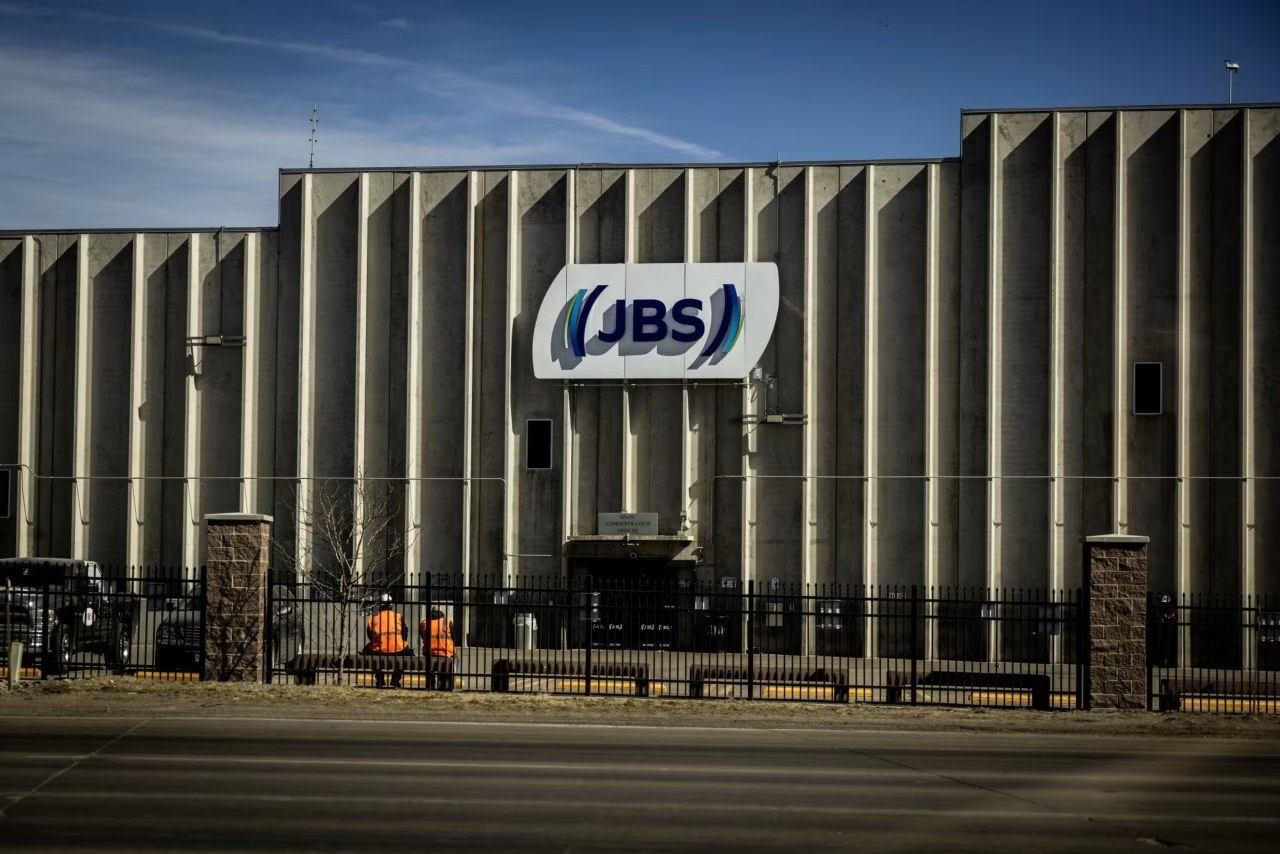
JBS Greeley Strike Halts 6,000-Cattle-a-Day Plant as Beef Prices Hit Record $8.20/lb
- Walkout began Monday at JBS USA’s Greeley, Colorado beef plant employing 3,000 workers.
- Plant accounts for 5% of U.S. beef-processing capacity; daily kill capacity 6,000 head.
- Retail choice beef prices already at record $8.20/lb, up 12% year-over-year.
- United Food & Commercial Workers Local 7 says 93% of members voted to reject prior offer.
Stoppage threatens fresh meat cases during peak summer demand.
GREELEY PLANT—GREELEY, Colo.—More than 3,000 union meatpackers walked off the job at JBS USA’s flagship beef plant Monday, shutting down a facility that butchers 6,000 cattle a day and supplies roughly one in every 20 pounds of American beef. The strike—the largest in the sector since 2004—lands at an awkward moment for consumers already paying record retail prices approaching $8.20 a pound for choice cuts.
JBS, the world’s biggest protein company, signaled it will try to reroute cattle to plants in Texas and Nebraska, but logistics constraints mean wholesale beef prices are expected to jump within days. Labor contracts covering the Greeley workforce expired in February; talks collapsed over proposed hikes to health-insurance premiums that workers say would erase modest wage gains.
Industry analysts warn a prolonged stoppage could ripple through grocery aisles just as Memorial Day weekend buying kicks off summer grilling season. “Any outage longer than two weeks tightens supply fast,” said Altin Kalo, livestock economist at Steiner Consulting. “Retailers will pass the pain on immediately.”
Inside the Greeley Plant: 5% of U.S. Beef in One Facility
Spanning 90 acres along U.S. Highway 85, the JBS Greeley complex is among the most prolific beef plants in North America. Built in 1960 and repeatedly expanded, the site now employs 3,000 people and slaughters roughly 6,000 head per day, translating to 1.5 billion pounds of beef annually. USDA data show that single plant contributes about 5% of total U.S. beef-processing capacity, making it a chokepoint for the nation’s protein supply chain.
Automation limits mean downtime equals lost cattle
Unlike poultry or pork, beef fabrication still relies on skilled knife work; only 35% of tasks on the Greeley line are mechanized, according to trade journal Meatingplace. That labor intensity magnifies the impact of a walkout. During the last Greeley strike in 1987, cattle backed up within 48 hours, forcing area feedlots to slow animals’ growth diets and costing feeders an estimated $4 million in extra rations. Today’s supply chain is leaner. “There’s no surplus cooler space to absorb a multi-day outage,” said Kalo.
JBS operates five other beef plants in the U.S., but combined they lack sufficient slack to reroute 6,000 head daily. The company’s Grand Island, Nebraska, facility, the next closest in scale, can add only 800 head per day before hitting labor-shift limits, according to people familiar with operations. Industry consultant Colorado Boxed Beef estimates the industry-wide capacity cushion at under 3%.
Local 7 members rejected a tentative agreement that would have raised base wages $1.10 over three years while increasing health-insurance premiums by 22%. “We’re not asking for the moon, just to keep up with inflation,” said Kimberly Ortega, a 14-year fabrication worker. The union says 93% of voters turned down the deal Sunday night.
Forward-looking: If the sides do not return to bargaining within a week, industry executives expect wholesale beef prices to rise 4-6% by Memorial Day, accelerating food inflation that the Federal Reserve is already watching closely.
Why Beef Prices Are Already at Historic Highs
Retail fresh beef prices climbed to an all-time average of $8.20 per pound in April, up 12% from a year earlier, according to Bureau of Labor Statistics data released Friday. Tight cattle supplies, elevated feed costs and resilient consumer demand have converged to push tags beyond the prior record set during the 2014-15 drought. The timing of the JBS strike amplifies an already inflationary backdrop.
Smallest herd since 1951 keeps supply tight
The U.S. cattle inventory on January 1 fell to 87.2 million head, the lowest since 1951, after three years of drought forced ranchers to liquidate breeding stock. Feedlot placements in Colorado, Kansas and Texas are down 4% year-to-date, limiting the number of market-ready animals. Meanwhile, export demand has rebounded; March beef shipments rose 9% from last year to 285 million pounds, according to USDA.
Packer margins, the spread between live-cattle cost and boxed-beef revenue, have ballooned to more than $600 per head, triple the 10-year average, according to HedgersEdge data. Critics argue those gains have not filtered to plant employees. “Workers see those numbers and wonder why their wages lag inflation,” said University of Missouri livestock economist Scott Brown. JBS posted $1.2 billion in North American beef operating income last year on $22 billion in sales.
Consumers already sensitive to food inflation are unlikely to absorb higher prices without cutting volume. NielsenIQ surveys show 61% of shoppers substituted chicken or pork for beef in the past month, up from 49% a year ago. Still, retailers say Memorial Day features were locked weeks ago, so any spike will hit their margins first.
Forward-looking: Analysts predict wholesale cut-out values could jump another 8% before Independence Day if the strike drags into June, potentially pushing retail tags toward $9/lb.
Labor Tensions Boil Over in Meatpacking
The United Food & Commercial Workers Local 7 represents 3,000 production, maintenance and warehouse employees at the Greeley facility. Negotiations began in January over a contract that expired February 24. Central sticking points include wage progression, health-insurance cost sharing and safety protocols. The union says JBS’s latest offer would cap top-scale pay at $24.85 an hour, a figure Local 7 president Kim Cordova calls “unacceptable in a plant posting record profits.”
High injury rates fuel worker anger
OSHA logs show Greeley recorded 3.2 recordable injuries per 100 workers last year, above the industry median of 2.5. Line speeds reach 390 head per hour, and employees describe repetitive-stress ailments. “By year 10 your shoulders are shot,” said cutter Martin Chavez, 42, who has undergone two rotator-cuff surgeries. A 2022 Government Accountability Office report found meatpacking workers are 2.5 times more likely to suffer serious injury than other manufacturing employees.
JBS counters that it invested $180 million in ergonomic tools and automation since 2020, reducing lost-time accidents 18%. The company also points to a 401(k) match increase and tuition reimbursement rolled out during talks. “We believe our proposal is fair and competitive,” said JBS USA spokesperson Cameron Bruett.
Meatpacking strikes are rare because of concentrated industry power. The last comparable work stoppage occurred in 2004 when 1,000 workers struck the then- Swift & Co. plant in Greeley over immigration-related terminations. The current walkout is already the largest in the sector since that dispute.
Forward-looking: Labor experts say the outcome could set a pattern for upcoming negotiations at Cargill’s Dodge City, Kansas, plant covering 2,500 workers later this summer.
How Long Could the Strike Last?
Historical precedent offers mixed guidance. The 1987 Greeley strike lasted 10 days before President Reagan’s administration invoked the Taft-Hartley Act to obtain an 80-day cooling-off period; workers ultimately accepted a 40-cent raise. In 2004, the Swift walkout ended in five days after the company agreed to rehire terminated employees. This time, both sides appear dug in, and the White House has not signaled federal intervention.
Company contingency plans face limits
JBS has begun shifting some cattle to a Cargill plant in Fort Morgan, 60 miles away, but Fort Morgan is already running near capacity. Industry consultant Len Steiner estimates JBS can reroute at most 2,000 head daily, leaving 4,000 head idled. Feedlots begin losing money when animals stay on ration more than 10 days past optimal market weight; after 20 days discounts escalate rapidly.
Financially, JBS can absorb short-term margin compression. Analyst Lucas Alves at Itau BBA calculates each day of lost output knocks $3 million off quarterly EBITDA, but with North American beef margins above $600/head the company could withstand a month-long outage before profits fall below year-ago levels. Still, market share erosion is a risk; rivals Cargill and National Beef could pick up long-term customers.
Local 7’s strike fund covers $200 weekly benefits for 10 weeks, providing workers limited staying power. Yet community support is robust; Colorado Governor Jared Polis publicly urged both parties to resume talks. Public polling by local firm Magellan Strategies shows 58% of Coloradans side with workers versus 18% with the company.
Forward-looking: Most analysts expect a two-to-four-week work stoppage, after which rising wholesale prices and political pressure will force renewed negotiations.
Could Government or Courts Intervene?
Under the Taft-Hartley Act, a president can seek an 80-day injunction when a work stoppage imperils national health or safety. The statute has been invoked 35 times since 1947, most recently in 2002 during the West Coast longshore dispute. Legal scholars say the bar is high and requires clear evidence of widespread economic harm, not just regional disruption.
Colorado delegation urges mediation
Senators Michael Bennet and John Hickenlooper, both Democrats, sent a joint letter Tuesday urging the Federal Mediation and Conciliation Service to appoint a special mediator. The agency confirmed it has contacted both parties but participation is voluntary. “Mediation only works when both sides feel pain,” said Cornell labor professor Kate Bronfenbrenner. “Right now each believes time is on their side.”
State lawmakers are also flexing leverage. The Colorado Department of Transportation on Wednesday delayed issuing JBS a routine overweight-truck permit used to haul byproducts, a bureaucratic signal that political patience is limited. Governor Polis controls a state-owned rail spur that serves the plant; his office declined to comment on whether access could be curtailed.
Meanwhile, meat-industry lobbyists are quietly pressing USDA to expedite import quotas for Brazilian and Australian beef, a move that could undercut JBS’s competitors as well. Trade lawyers note any such adjustment would require formal rule-making and likely face court challenges from domestic ranch groups.
Forward-looking: Without a breakthrough, look for congressional hearings in June spotlighting food-price inflation and worker-safety conditions, raising political stakes before the November elections.
Frequently Asked Questions
Q: How many cattle does the JBS Greeley plant process daily?
The Greeley facility can slaughter roughly 6,000 head per day, equating to about 5% of total U.S. beef-processing capacity according to company and USDA figures.
Q: Why are JBS workers striking now?
Union members rejected a contract offer that would have frozen base wages while increasing health-care premiums, prompting the walkout during peak grilling season when retail beef averages a record $8.20 per pound.
Q: Could the strike affect grocery prices?
Yes. With the plant idled, analysts expect wholesale beef prices to jump another 4-6% within two weeks, filtering through to already record-high retail tags for ground beef and steaks.
📰 Related Articles
- Ziff Davis Sells Connectivity Unit for $1.2 B, Surpassing Its Own Market Cap
- Wall Street Journal’s March 14 Quiz: 7 Questions That Expose the Gap Between Headlines and Understanding
- Foxconn’s Revenue Surges Yet Quarterly Profit Slides by 2% in 2025
- Bain Capital Commits $349 Million to Acquire Perpetual’s Australian Wealth Management Arm
