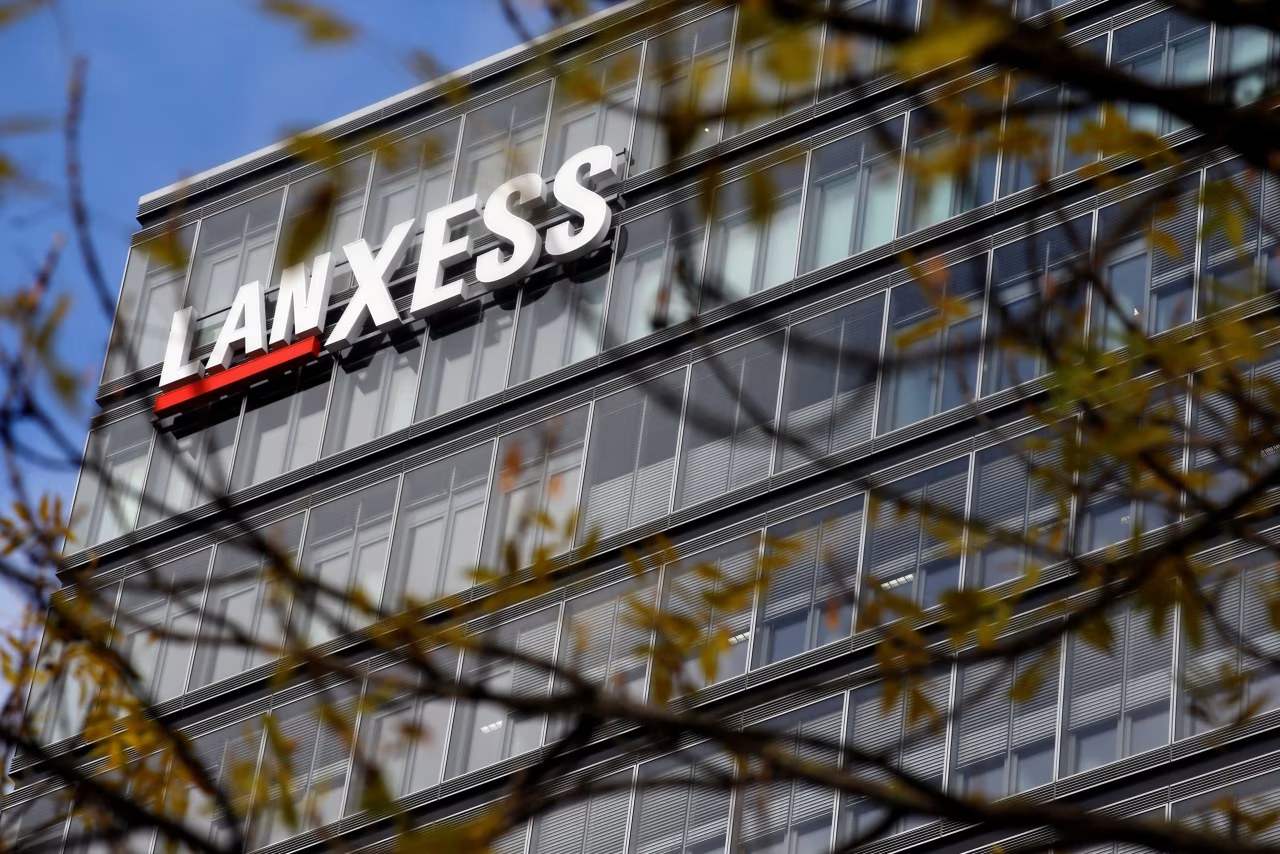
Lanxess Tumbles 6.4% After Predicting No Rebound Until H2 as 2024 Sales Drop 11%
- Lanxess stock slid 6.4% in Frankfurt after executives said no recovery is expected before H2 2025.
- Full-year 2024 revenue fell 11% to €5.67B while adjusted EBITDA dropped 17% to €510M.
- Profit margin compressed to 9.0% from 9.6% as European chemical makers grapple with weak demand and elevated energy costs.
- Management cited mounting challenges across Europe’s chemicals sector and offered no near-term catalysts.
Specialty-chemicals investors hoping for a swift rebound have been told to brace for at least two more lean quarters.
LANXESS—Specialty-chemicals group Lanxess became the latest German industrial bellwether to quash recovery hopes, warning investors on Thursday that it does not foresee any uptick in volumes or pricing until the second half of 2025. The cautious outlook sent Frankfurt-listed shares down 6.4% in morning trading, extending a bruising 12-month decline that has wiped more than a third off the company’s market value.
The guidance came as Lanxess reported a 17% plunge in adjusted EBITDA to €510 million for 2024, while sales retreated 11% to €5.67 billion. The profit-margin contraction—from 9.6% to 9.0%—underscores how Europe’s chemical producers remain squeezed between feeble demand from automakers and construction groups, and natural-gas prices that are still double pre-2021 levels.
Chief Executive Matthias Zachert told analysts that destocking by customers has largely run its course, but fresh order momentum is “noticeably absent” across Lanxess’s core segments: specialty additives, advanced intermediates and consumer-protection chemicals. Without a rebound in China’s property sector or a sustained fall in German gas prices, executives see little scope for margin recovery before the summer.
The Numbers Behind the Selloff: How 2024 Earnings Cracked Investor Confidence
Lanxess closed the books on 2024 with an 11% top-line retreat to €5.67 billion, the lowest annual revenue figure since 2017 when the company was still digesting the Chemtura acquisition. The 17% EBITDA decline to €510 million marked the third consecutive year of shrinking operating profits, according to company filings reviewed by analysts at Baader Helvea.
Margin compression was most pronounced in the Specialty Additives unit, where EBITDA tumbled 24% to €215 million on 8% lower sales. Advanced Intermediates fared only marginally better, posting a 14% profit drop as customers from agrochemical formulators to coatings producers curtailed inventories. The Consumer Protection division—home to disinfectants and water-treatment chemistries—was the lone bright spot, eking out a 3% EBITDA gain on the back of pandemic-era hygiene demand.
Energy costs provided another headwind. Lanxess’s 2024 gas bill rose 6% year-on-year to €420 million, equivalent to 7.4% of sales, according to CFO Michael Pontzen. That is more than double the 3% share recorded in 2020, eroding what historically has been a dependable cost advantage for German chemical producers. With European gas futures still trading at $35–$40 per megawatt-hour—roughly triple U.S. Henry Hub prices—analysts at UBS see limited scope for margin reflation in 2025.
Balance-sheet resilience under scrutiny
Net debt stood at €2.9 billion at year-end, translating to a leverage ratio of 2.8× EBITDA, inside the company’s self-imposed ceiling of 3.5× but above the 1.5× average for German mid-cap chemical peers such as Evonik and Covestro. Moody’s placed Lanxess’s Baa3 rating on review for downgrade in January, citing “prolonged weakness in cash-generation capacity.” Management responded by slashing 2025 capital expenditure guidance to €350 million, 30% below the prior-year level, and suspending share-buybacks until leverage falls below 2×.
Investors punished the stock immediately: by noon in Frankfurt more than 4.2 million shares had changed hands, triple the 30-day average, pushing market capitalisation down to €3.1 billion. The 6.4% intraday fall outpaced losses of 2.1% in the German DAX chemicals sub-index, signalling company-specific disappointment rather than sector-wide contagion.
Why Europe’s Chemical Sector Is Stuck in a Low-Growth Trap
Lanxess’s grim outlook mirrors a broader malaise across Europe’s €650 billion chemical landscape. Since the autumn of 2022 the region has lost an estimated 15% of its global market share as producers grapple with structurally higher energy costs and sluggish domestic demand, according to trade body Cefic. Output volumes contracted 5.1% in 2024, the steepest fall outside the 2009 financial crisis.
Germany, once the powerhouse, is now the weak link. BASF, Evonik, Covestro and Lanxess have collectively announced 12,000 job cuts in the past 18 months, while BASF is shifting a €10 billion petrochemicals complex to China. “The industrial exodus is accelerating,” says Sebastian Bleschke, managing director of the German Chemical Industry Association (VCI), citing average industrial electricity prices of €140 per megawatt-hour—four times those along the U.S. Gulf Coast.
Demand destruction has been most acute in automotive and construction, which together account for roughly 40% of Lanxess’s end-market exposure. European car registrations fell 2% last year, while German building permits plummeted 22%, translating into lower offtake for plastics additives, flame retardants and synthetic lubricants. Analysts at Jefferies estimate that every 1% decline in European auto production knocks 0.4% off Lanxess’s organic growth rate.
China’s self-reliance adds pressure
Compounding the problem is Beijing’s push for chemical self-sufficiency. China’s 14th Five-Year Plan earmarked $150 billion for specialty-chemical capacity additions through 2025, eroding a traditional export avenue for European producers. Lanxess derived 18% of sales from China in 2019; that share slipped to 14% last year as local competitors such as Wanhua Chemical and Bluestar expanded phenolic antioxidants and plasticizers plants. “The days of European players enjoying double-digit growth in China are over,” says Jenny Yang, senior chemicals economist at Wood Mackenzie.
Logistics bottlenecks further tilt the playing field. Shipping a 20-foot container of antioxidants from Antwerp to Shanghai now costs $1,200, up from $600 pre-pandemic, according to Freightos data, making European exports less competitive just as Chinese buyers favour domestic suppliers. With no imminent catalyst for European gas prices to fall below $30/MWh—and Chinese producers enjoying coal-based ethylene costs below $400/tonne—the outlook for export-oriented German chemical firms remains bleak.
Can Lanxess Cut Its Way Back to Profit Growth?
Management’s answer to the downturn is a sweeping €150 million cost-savings programme unveiled alongside earnings. Roughly 40% of the savings will come from supply-chain efficiencies—consolidating raw-material purchases and renegotiating logistics contracts—while the remainder targets headcount and site optimisation. Lanxess plans to shutter a smaller pigments plant in Leverkusen by mid-2025, eliminating 220 positions and shifting production to its larger Krefeld-Uerdingen complex.
Union officials have already signalled resistance. “We will not accept another social bloodbath,” says Jörg Heyer, chemicals spokesman for IG BCE, which represents Lanxess workers. The union points out that the company reduced German staff by 8% between 2020 and 2023 yet still saw EBITDA margins erode, suggesting cost cuts alone cannot offset weak pricing power.
analysts at Goldman Sachs estimate the programme could add 70 basis points to EBITDA margin if fully implemented, but caution that €60 million of the savings are back-loaded into 2026. “In the absence of top-line growth, margin expansion hinges on execution,” says Goldman’s Sebastian Satz. Past programmes delivered only 75% of targeted savings, according to a Baader Helvea review of management guidance between 2018 and 2023.
Portfolio pruning on the agenda
CEO Zachert has not ruled out divestments. The company’s Flavors & Fragrances unit, with €450 million in annual sales, has been earmarked as non-core since 2022. Private-equity suitors including Cinven and Bain Capital reportedly circled the asset last summer, valuing it at 8–9× EBITDA, or roughly €360–400 million. A disposal at the midpoint would trim debt by €380 million and shave 0.4× off the leverage ratio, according to Morgan Stanley calculations.
Yet buyer appetite has cooled. High-yield spreads have widened 150 basis points since January, pushing financing costs for leveraged buyouts above 8%. Lanxess may instead pursue a smaller carve-out of its upstream phthalic-anhydride plant in Belgium, which analysts value at €120 million. Either way, management pledged that proceeds will be earmarked exclusively for debt reduction, ruling out special dividends or growth acquisitions until leverage falls below 2×.
What’s Next for Investors Waiting on a Chemicals Rebound?
With no volume recovery priced before H2 2025, the investment debate has shifted to downside protection and balance-sheet optionality. Berenberg analysts argue the stock’s 0.45× price-to-sales ratio—half the 10-year median—already discounts an extended trough, while the 6.8% dividend yield appears safe given forecast free-cash-flow coverage of 1.4×. Others warn that consensus still pencils in a 12% EBITDA rebound for 2025, leaving room for further estimate cuts if Chinese competition intensifies.
Sentiment could inflect on three catalysts. First, a sustained drop in European gas prices below $25/MWh would restore cost competitiveness and could lift sector multiples. Second, any Chinese stimulus targeting property or autos would trickle into export orders; Lanxess estimates every 10% rise in Chinese light-vehicle output adds €30 million to EBITDA. Third, successful conclusion of EU carbon-border-adjustment tariffs could curb low-cost imports, though analysts say implementation before 2027 is unlikely.
Until then, management is guiding investors to expect flat sales and a 50–100 basis-point EBITDA margin improvement in 2025, contingent on the savings programme. “We are not banking on a heroic macro recovery,” CFO Pontzen told reporters, stressing that guidance assumes GDP growth of just 0.8% in Europe and 4.5% in China, both below current IMF forecasts.
Equity upside skewed to 2026
Most analysts have parked their optimism in 2026, when Lanxess’s new high-performance plastics plant in Krefeld is slated to start up, adding €200 million in revenue at projected margins above 15%. Coupled with full delivery of cost savings and a normalisation of destocking, consensus sees EBITDA rebounding to €700 million, implying a 2026 EV/EBITDA multiple of 6.8× versus the current 9.2×. For a sector that has historically traded at 8–10×, patient value investors could be rewarded—provided Europe’s chemical industry avoids another energy shock.
Frequently Asked Questions
Q: Why did Lanxess shares fall 6.4%?
Lanxess warned investors it does not expect any business uptick until at least the second half of the year, triggering a 6.4% drop in Frankfurt trading as the guidance dashed hopes for an earlier chemicals-sector rebound.
Q: How did Lanxess perform in 2024?
Full-year sales declined 11% to €5.67 billion while adjusted EBITDA fell 17% to €510 million, cutting the profit margin from 9.6% to 9.0% as weak demand and high energy costs continued to squeeze European chemical producers.
Q: When does Lanxess expect a recovery?
Management explicitly stated no improvement is anticipated before the second half of 2025, leaving at least two more quarters of subdued volumes and pricing across its specialty-chemicals portfolio.
