42-Cent Gasoline Spike: Iran War Sends Oil Markets into Worst Crisis Since 1970s
- U.S. gasoline up 42¢ to $3.89/gal in one week—fastest surge since Katrina 2005.
- Strait of Hormuz traffic down 86%—18 million b/d of oil flow erased.
- Brent crude rockets from $77 to $97/bbl; futures point to $115 by December.
- Trump’s borrowing costs rise 30 bps as investors dump Treasuries on inflation fear.
A seven-day military campaign has paralyzed the world’s most important oil chokepoint and reignited 1970s-style energy trauma.
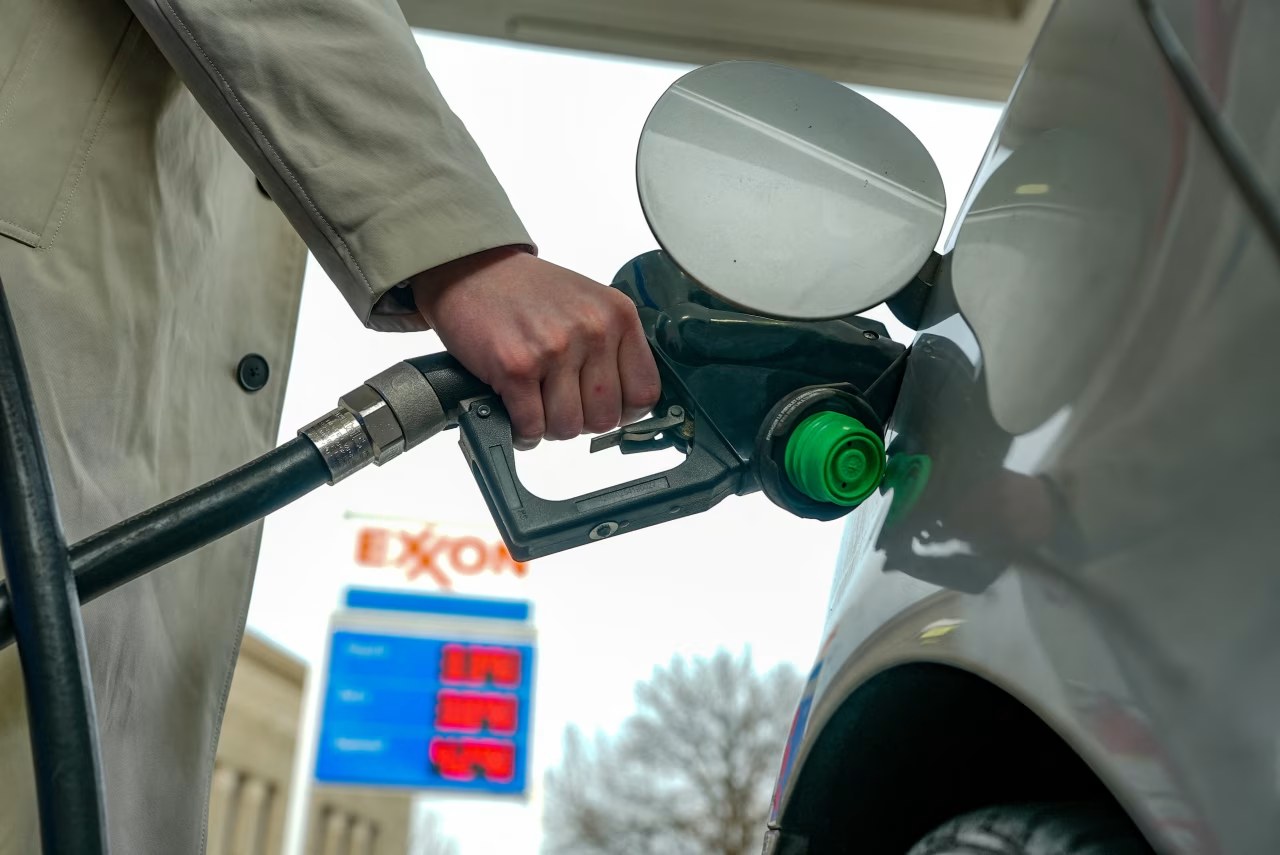
STRAIT OF HORMUZ—One week after President Donald Trump ordered strikes on Iran, the economic shock is no longer hypothetical. Satellite imagery shows tanker traffic through the 21-mile-wide Strait of Hormuz has fallen 86 percent, removing roughly 18 million barrels per day (mb/d) from global supply chains. The national average for regular-grade gasoline leapt 42 cents to $3.89 per gallon between April 8 and April 15, the steepest seven-day climb since Hurricane Katrina in 2005, AAA data show.
Futures markets are pricing Brent crude at $115 per barrel for December delivery, a trajectory that would add roughly half a percentage point to U.S. consumer-price inflation by year-end, according to the Federal Reserve Bank of Dallas. Yields on 10-year Treasury notes have jumped 30 basis points in five trading sessions as investors demand higher compensation for inflation risk, raising the U.S. government’s borrowing costs and endangering the administration’s pledge to extend the 2017 tax cuts.
Below, five chapters unpack the numbers behind the crisis—and what could come next.
How the Strait of Hormuz Shut Down in Seven Days
Before sunrise on April 8, U.S. Navy destroyers fired Tomahawk missiles at radar installations on the Iranian islands of Abu Musa and Sirri. Within 24 hours, the Islamic Revolutionary Guard Corps (IRGC) responded by laying sea mines and positioning fast attack craft at the Hormuz chokepoint. Lloyd’s List Intelligence reports that laden tanker transits fell from 54 vessels on April 7 to just 8 on April 14, effectively taking 18 mb/d of crude, condensate and clean products off the water.
A 21-mile-wide funnel that carries one-fifth of global oil supply
The strait’s geography is unforgiving: two shipping lanes each barely two miles wide. When insurers at the London market slapped war-risk premiums of $600,000 per voyage on Very Large Crude Carriers (VLCCs), owners opted to idle ships rather than gamble. By April 15, the U.S. Energy Information Administration (EIA) estimated commercial petroleum inventories in OECD countries would draw down at 2.3 mb/d for the next three months—triple the rate seen during the 1979 Iranian revolution.
Energy Aspects, a London consultancy, calculates that every week of closure cuts global supply by 126 million barrels—roughly equal to the entire U.S. Strategic Petroleum Reserve (SPR). The Biden administration released 30 million barrels after the Ukraine war; analysts at Goldman Sachs now say Trump may have to tap 60–90 million barrels to calm markets before the November mid-terms. The political irony is not lost on traders: a president who campaigned on “energy dominance” is confronting the fastest inventory liquidation in modern history.
Forward curves show the strain. Brent for May 2025 delivery trades at a $9 premium to May 2024—an extreme contango that signals physical shortage. European refiners told Argus Media they are already cutting run rates because Urals crude arriving from Baltic ports cannot replace the 1.4 mb/d of Iranian heavy grades used for bitumen and marine fuel. The cascading effect: Rotterdam’s complex margins have collapsed from $9.20/bbl in March to $2.80/bbl, jeopardizing diesel output just as Europe heads into summer driving season.
What $97 Crude Means for Pump Prices and Inflation
The rule of thumb used by the Dallas Fed is elegant: every $10 increase in Brent adds roughly 25–30 cents to U.S. retail gasoline within six weeks. With Brent up $20 since April 7, analysts now see a national average of $4.20–4.40/gal by Memorial Day, surpassing the 2022 Ukraine-war peak of $4.33. Diesel is moving even faster; Gulf Coast ultra-low-sulfur futures rose 52 cents to $3.47/gal, translating to record-high truck-stop prices that will ripple through food distribution networks.
Core inflation could rise 0.5 ppt, forcing the Fed to pause
Energy carries a 7.3 percent weight in the U.S. consumer-price index, but its volatility infects “super-core” services such as airfares and delivery costs. J.P. Morgan now projects headline CPI at 3.8 percent year-over-year by September, well above the Fed’s 2 percent goal. Chair Jerome Powell signaled on April 11 that an extended supply shock could delay the much-telegraphed June rate cut, pushing two-year Treasury yields to 4.95 percent—levels last seen during the regional-bank crisis of March 2023.
European households face an even steeper hit. The eurozone imports 96 percent of its crude, and the single currency has slid 4 percent against the dollar since the strikes, amplifying dollar-denominated oil costs. Berenberg Bank estimates the average German household will spend €2,400 on motor fuel this year, up from €1,850 in 2023, eroding real disposable income by 1.2 percent. That drag comes just as the European Central Bank prepares to cut rates to revive stagnant growth, creating a policy dilemma ECB President Christine Lagarde privately called “the worst of both worlds” in a April 13 briefing.
Emerging markets are not immune. India, the world’s third-largest oil importer, buys 1.5 mb/d from the Middle East. Every $1 rise in Brent widens India’s current-account deficit by $1.4 billion, according to the Reserve Bank of India. Delhi has already hiked gasoline excise taxes twice since January to fund pre-election giveaways; further increases risk street protests reminiscent of 2018. Indonesia cut fuel subsidies in March; Jakarta now faces the prospect of another 15 percent subsidy hike that could add 0.6 ppt to CPI, forcing Bank Indonesia to raise rates into a slowing economy.
Could Trump Tap the SPR Fast Enough to Matter?
Created after the 1973 Arab embargo, the SPR currently holds 363 million barrels across four Gulf Coast caverns—down from a 2010 peak of 727 million after Congress ordered sales to fund deficits. The maximum drawdown rate is 4.4 mb/d for 90 days, but pipeline bottlenecks and Jones-Act tanker shortages cut effective deliveries to about 2 mb/d. At that pace, a 60-million-barrel sale would last one month and lower Brent by an estimated $6–8, according to ClearView Energy Partners.
Political optics clash with physical limits
Trump floated a 100-million-barrel release on Truth Social April 12, but Energy Secretary Dan Brouillette privately warned the White House that commercial crude stocks are already 5 percent below the five-year average, limiting buffer capacity. Moreover, SPR oil is overwhelmingly sour (high sulfur), whereas European refiners need light-sweet grades to replace lost Iranian barrels. Traders note that swapping SPR sour for U.S. shale sweet would require 35–40 days of Jones-Act voyages, by which time Hormuz could reopen—or remain closed, leaving the SPR 30 percent smaller.
Congress is divided. House Republicans from Texas argue an SPR sale would undercut domestic producers already facing $45 breakevens in the Permian. Democrats want legislation to ban exports of SPR oil to China, a move that lengthened refill timelines after the 2022 Ukraine release. Meanwhile, the Department of Energy is quietly negotiating with ExxonMobil and Trafigura for a 1 mb/d “exchange” that would return barrels by 2026, effectively turning the SPR into a revolving inventory for traders. The proposal, if announced, could trigger lawsuits from independent refiners claiming preferential treatment.
Market signals are flashing caution. Brent’s prompt-month futures spread flipped from contango to backwardation—an indicator of immediate shortage—while the U.S. five-year inflation breakeven rose 40 basis points to 2.7 percent, its highest since 2011. Analysts at Goldman Sachs now assign a 35 percent probability that Brent exceeds $120/bbl for at least one week this summer, a threshold that would erase all of Trump’s projected GDP growth in 2025. The White House economic team, led by Stephen Miran, is modeling a scenario where gasoline above $5/gal cuts consumer spending by $80 billion, enough to swing the electoral map in key Midwestern states.
Is Global Recession Now Inevitable?
Oil shocks preceded five of the last six U.S. recessions. The Federal Reserve’s rule-of-thumb: a sustained $20 increase in Brent shaves 0.4 ppt off GDP growth after one year. With Brent up $20 in seven days, Oxford Economics now sees global GDP at 1.9 percent in 2025 versus 2.8 percent baseline. The eurozone, already flirting with stagnation, is most exposed; a 2.5 percent contraction in German industrial output is penciled in for Q3 if Brent stays above $110.
Corporate earnings face a 6 percent haircut
S&P 500 energy analysts have slashed 2025 EPS expectations by 6 percent in two weeks, led by airlines and chemicals. Delta Air Lines said April 14 that jet-fuel at $3.20/gal would add $3.2 billion in costs, erasing its projected $2.8 billion free cash flow. FedEx warned that diesel at $4/gal forces a 7 percent fuel surcharge on ground parcels, enough to push e-commerce margins negative for Amazon’s third-party sellers. Small-cap indexes, where transport costs weigh heavily, have underperformed the S&P 500 by 500 basis points since the strikes.
Emerging markets face a triple whammy: stronger dollar, higher import bills, and capital flight. The Institute of International Finance estimates non-resident portfolio outflows of $18 billion from EM debt since April 8, the fastest since March 2020. Turkey, which imports 93 percent of its energy, saw the lira weaken 9 percent against the dollar, forcing the central bank to burn $4 billion of reserves defending the currency. South Africa’s rand hit a record low of 19.42 per dollar; Eskom announced stage-8 power cuts because diesel-fired peaking plants are too expensive to run. Moody’s warned that sustained $100 oil could push five frontier economies—Pakistan, Sri Lanka, Ghana, Tunisia, and Bolivia—into default within 12 months.
Recession probability models are flashing red. JPMorgan’s global PMI diffusion index fell to 48.1 in April, below the 50 expansion threshold. Chief economist Bruce Kasman now assigns a 55 percent chance of world recession by Q1 2025, up from 25 percent in March. The silver lining: shale producers could ramp U.S. output by 1 mb/d within 18 months if WTI stays above $80, but that is cold comfort for consumers facing $4 gasoline at the pump this summer.
What Happens Next? Four Scenarios to Watch
Energy Aspects modeled four pathways through year-end. Scenario A: Hormuz reopens within 30 days under a cease-fire; Brent falls to $75, gasoline retreats to $3.40, and U.S. CPI peaks at 3.2 percent. Scenario B: closure lasts 90 days; Brent averages $105, GDP growth drops 0.6 ppt, and Trump authorizes a 90-million-barrel SPR sale. Scenario C: regional escalation hits Saudi export facilities; Brent spikes to $150, forcing global rationing and a 2025 recession. Scenario D: diplomatic breakthrough plus 1 mb/d extra U.S. shale brings Brent back to $65 by December.
Markets are pricing a 45 percent chance of Scenario B
Futures options imply a 25 percent probability Brent touches $120 before October. The so-called “war premium” is now $15–20 embedded in forward curves, compared with $5 before April 8. Investors are crowding into energy ETFs: the Energy Select Sector SPDR attracted $2.3 billion in net inflows last week, its biggest since 2016. Meanwhile, airlines and shipping firms are racing to hedge; CME ultra-low-sulfur diesel call volume hit a record 180,000 contracts April 12, equivalent to 180 million barrels of notional exposure.
Policy levers are narrowing. The EU is debating a 200-million-barrel joint procurement program, but internal documents seen by Argus show that legal drafting could take six months. Japan has signaled readiness to share 10 million barrels from private inventories, yet those stocks are already 10 percent below last year. China, holder of 900 million barrels of strategic and commercial crude, has stayed silent; traders in Qingdao say Beijing is happy to let prices rise to punish rival consumers and shrink U.S. soft-power influence. With the U.S. presidential election six months away, Trump’s calculus may hinge on whether $4 gasoline outweighs the optics of appearing tough on Tehran.
The wildcard: shale. Permian frack fleets are 93 percent utilized, but sand and labor shortages persist. Pioneer Natural Resources says it could add 200,000 b/d by Q4 if WTI holds $85, yet equipment suppliers want 18-month contracts at premium day-rates. That timeline lands after Election Day, leaving consumers hostage to geopolitics for the summer. The next milestone arrives April 22, when EU foreign ministers meet in Brussels to decide on an Iranian oil embargo. If passed, the measure would remove another 1 mb/d of distressed cargoes from the market, pushing Brent toward the $120 ceiling—and recession from possible to probable.
Frequently Asked Questions
Q: How much has gasoline risen since the Iran war began?
Average U.S. regular-grade gasoline jumped 42¢ to $3.89/gal in seven days, according to AAA—its fastest weekly climb since Hurricane Katrina in 2005.
Q: Why is the Strait of Hormuz so critical for oil prices?
One-fifth of global oil supply—about 21 million barrels/day—normally transits the 21-mile-wide waterway; virtual closure removes roughly 18 mb/d from markets.
Q: Could oil keep rising under Trump’s Iran strategy?
Futures curves already price Brent at $115/bbl for December; every sustained $10/bbl uptick adds ~0.3 ppt to U.S. CPI, pressuring the Fed to delay rate cuts.
