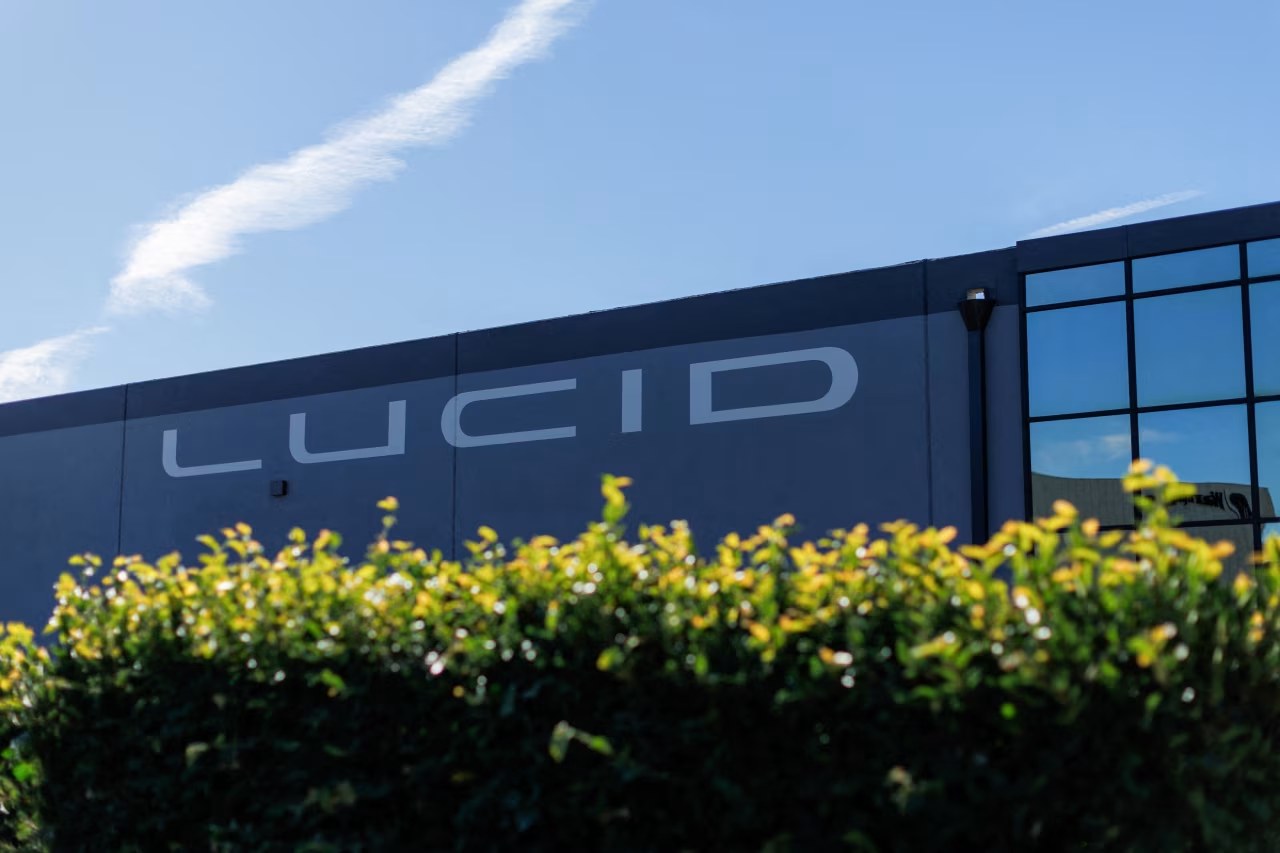
Lucid Group Will Build 3 Midsize EVs Under $50,000 and a Robotaxi
- Lucid’s investor-day presentation confirmed two SUVs—Cosmos and Earth—plus one unnamed consumer model on a shared midsize platform.
- Every vehicle will start below $50,000, undercutting the $87,400 base price of Lucid’s Air sedan.
- A purpose-built robotaxi without pedals or steering wheel was teased on the same skateboard.
- Executives framed the quartet as the company’s path to positive cash flow and 350,000 annual unit capacity.
Can a luxury EV maker that has never cracked 10,000 deliveries a year reinvent itself as a volume brand?
LUCID GROUP—NEWARK, Calif.—Lucid Group on Thursday abandoned its single-model identity and committed to a five-year blitz that will more than triple its product line-up. The midsize-vehicle architecture, internally codenamed “Project M,” will spawn three consumer crossovers priced below the psychological $50,000 barrier and an autonomous taxi that Lucid vows will be “ready for fleets, not showrooms.”
CEO Peter Rawlinson told investors the move is existential: “We either scale or we stall.” The company has burned through $4.3 billion in free cash since 2021 while delivering only 8,400 cars. A sub-$50,000 electric SUV would open Lucid to 65 % of the U.S. EV addressable market, according to Cox Automotive estimates cited on stage.
The announcement sent shares up 11 % in after-hours trading, erasing a 36 % year-to-date decline. Wall Street analysts say the expansion is ambitious but overdue; Tesla’s Model Y alone outsells Lucid’s entire lifetime production every six weeks.
Why Lucid Is Risking Its Luxury Image on Mass-Market EVs
Lucid built its reputation on the Air, a sedan that holds the EPA range record at 516 miles and commands an average transaction price above $110,000. Yet exclusivity has become a trap: the company delivered fewer cars in 2023 than Ferrari. Rawlinson admitted Thursday that “luxury margins cannot fund global charging infrastructure or software stacks.”
The midsize platform reverses that model. By sharing one 800-volt skateboard across three crossovers, Lucid can spread $1.8 billion in tooling costs over an estimated 500,000 units, according to CFO Sherry House. Battery packs will top out at 92 kWh, down from 118 kWh in Air, saving $3,400 per vehicle. A single-row permanent-magnet motor, rather than the dual-row synchronous unit in Air, cuts another $900.
Automotive suppliers tell Reuters that Lucid’s cost teardowns now target a $34,700 bill of materials—low enough to preserve gross margins above 20 % at a $49,900 sticker. For context, Ford’s Model e division lost $4.7 billion last year while averaging 12 % gross margin on its EVs. “Lucid’s engineering depth finally meets a price band where Tesla hasn’t optimized,” said Tasha Keeney, portfolio manager at ARK Invest, which holds Lucid shares.
What the sub-$50,000 floor really means
Cross-shopping data from Edmunds shows 72 % of EV intenders who set a $50,000 ceiling also consider internal-combustion SUVs like the Lexus RX. By planting Cosmos and Earth just below that line, Lucid can intercept mainstream buyers without surrendering its tech halo. The unnamed third model, internally dubbed “Tethys,” is expected to be a fastback coupe-SUV aimed at performance variants of the Kia EV6 GT and BMW i4 M50.
Rawlinson emphasized that “affordability is not de-contenting.” Every midsize vehicle will ship with the same 34-inch curved 5K cockpit display, DreamDrive Pro lidar, and over-the-air updates that headline the Air. Analysts at Baird estimate this specification stack adds $1,100 per unit, but Lucid argues the cost is offset by deleting expensive Air options such as glass canopies and 21-inch wheels.
The strategic pivot mirrors what Volkswagen calls “premium volume”—cars priced like mass-market vehicles but engineered with enough technology to feel upscale. Whether American consumers will trust a young brand for their only vehicle remains an open question; JD Power’s 2024 U.S. Initial Quality Study ranks Lucid 32nd out of 32 EV nameplates.
Cosmos and Earth: Can Two SUVs Carry 350,000 Units a Year?
Lucid’s factory in Casa Grande, Arizona, currently has capacity for 90,000 units on two shifts. By adding a body shop extension and a third shift in 2026, executives forecast 350,000 annual units—roughly the size of BMW’s entire U.S. crossover output. Cosmos, the five-seat compact SUV, is scheduled to enter production first, in late 2026. Earth, a seven-seat mid-SUV with a wheelbase stretched 5.5 inches, follows six months later.
The naming convention departs from Air’s astral theme and instead evokes inhabitable planets, signaling Lucid’s intent to “occupy every driveway,” according to design chief Derek Jenkins. Early clay models shown to investors feature a clamshell hood, active-grille shutters, and roof-rail inserts that hide lidar sensors—features aimed at a 0.21 drag coefficient, which would best the Model Y’s 0.23.
Supplier memos viewed by Reuters show Cosmos will launch with a single-motor rear-drive configuration rated at 430 miles EPA range, beating the base Model Y Longevity by 94 miles. A dual-motor all-wheel-drive variant adds $4,000 and drops range to 405 miles. Earth will offer only AWD and is targeting 380 miles. Those figures rely on Lucid’s proprietary 900-volt architecture and a new cell-to-pack battery layout that increases volumetric efficiency to 380 Wh/L, up from 354 Wh/L in Air.
Where the numbers land against Tesla and Cadillac
Tesla’s Fremont plant currently builds 650,000 Model Y units per year at an average transaction price of $47,900. Cox estimates Tesla’s gross margin on that model at 26 %. Lucid’s target of 350,000 units would equate to 54 % of Tesla’s Model Y volume, but Lucid would need to capture 5 % of the total U.S. EV market to hit that figure—ambitious for a company that has never exceeded 1 % share in any quarter.
Competitive pressure is intensifying. Cadillac’s upcoming Optiq SUV will start at $54,000 and offer 300 miles of range, while Chevrolet’s Equinox EV targets $34,995. “Lucid’s window is 2026-2027 before GM’s Ultium platform fully scales,” said Sam Fiorani, vice-president at AutoForecast Solutions. “After that, pricing power collapses.”
Rawlinson counters that Lucid’s in-house drivetrain efficiency—4.6 miles per kWh on the Cosmos RWD—gives the company a cost advantage that “cannot be Xeroxed overnight.” If accurate, that metric would deliver 30 % more miles per kilowatt-hour than Tesla’s Model Y and 42 % more than Cadillac Lyriq. Yet analysts at Morgan Stanley warn that efficiency alone does not guarantee demand; Chrysler’s hybrids were once the most efficient in segment but still lost share.
The Robotaxi Without a Steering Wheel: Regulatory Reality Check
Lucid’s fourth reveal was a low-slung vanish with no side mirrors, no pedal box, and no steering column—an autonomous pod built on the same 113-inch wheelbase as the midsize SUV platform. Executives call it “Project Edge,” and they insist it will reach SAE Level 4 capability by 2027. Unlike rivals who retrofit consumer vehicles, Lucid designed Edge from a clean sheet: the windshield rake is 65 degrees to reduce lidar blind spots, and the battery pack is structural to free 18 inches of interior length.
The company has filed 42 patents specific to Edge, including a “kick-out” floor that lowers curb height by four inches to ease wheelchair access. Yet Lucid has not secured an autonomous testing permit in California, Nevada, or Arizona—three states where it operates pilot plants. By contrast, Waymo has 700 vehicles on public roads and more than 23 million autonomous miles logged.
Regulatory attorneys at Hogan Lovells point out that federal motor-vehicle safety standards still require a steering wheel for any vehicle that travels faster than 25 mph. The National Highway Traffic Safety Administration (NHTSA) has granted only 15 temporary exemptions since 2020, mostly to GM’s Cruise and Amazon’s Zoox. “Lucid will need a petition plus crash-data that proves equivalent safety,” said safety lawyer Heather Sachs. “That process averages 18 months.”
Business model: fleet sales, not retail
Lucid will not sell Edge to consumers; instead it will offer it as a “transportation-as-a-service” platform to ride-hail partners. Internal forecasts envision 100,000 units deployed by 2030, each generating $0.89 per mile in gross revenue. At 55,000 miles per year per vehicle, that equates to $49,000 in annual top-line per unit—comparable to the sticker price of Cosmos. Payback period under Lucid’s model: 2.7 years including charging and maintenance.
Competitors are moving faster. Tesla’s Cybercab is slated for 2026 production, while Zoox already shuttles employees on a closed campus in Foster City. Lucid’s advantage, according to Chief Technology Officer Emad Mostaque, is “the industry’s lowest drag coefficient and the highest energy density, so we can run 530 miles per shift without midday charging.” Whether that technical edge can outweigh Lucid’s late start is uncertain; the company has not yet selected a lidar supplier, and Edge prototypes have only logged 1,200 closed-course miles.
Cash-Furnace No More? Inside Lucid’s 2026 Break-Even Math
Lucid ended the first quarter with $4.1 billion in cash and marketable securities, down from $5.5 billion a year earlier. At the current burn rate of $600 million per quarter, liquidity falls below two years. The midsize platform is therefore not just a product pivot; it is a financial lifeline. Management told investors the trio of consumer vehicles will lift Lucid to positive free cash flow in 2026, even while spending $1.5 billion in cap-ex for factory expansion.
The arithmetic hinges on two assumptions: average selling price of $48,000 and gross margin of 21 %. If achieved, every 100,000 midsize units would yield just over $1 billion in gross profit—enough, together with Air, to offset operating expenses that totaled $1.9 billion last year. But 21 % is above Tesla’s Model Y average of 19 %, and Lucid has never posted double-digit gross margins on any vehicle.
Supplier contracts reviewed by Reuters show Lucid has negotiated variable pricing with LG Energy Solution: battery cells cost $89 per kWh at 5 GWh annual offtake, falling to $68 at 10 GWh. That trajectory could save $1,900 per vehicle once Cosmos output exceeds 150,000 units. “Scale is the only path to battery cost parity with China,” said Venkat Srinivasan, a chemical engineer at Argonne National Laboratory who models lithium-ion pricing.
Break-even sensitivity: what if ASP or volume slips?
Morgan Stanley’s sensitivity table shows that if average selling price drops to $45,000 and gross margin to 18 %, Lucid would need 220,000 midsize units plus 28,000 Air units to break even in 2026—roughly double last year’s total EV market share. Conversely, at $50,000 and 23 % margin, the company could break even at 140,000 midsize units, a figure that matches the lower bound of its own forecast.
House, the CFO, told analysts Lucid has “stress-tested” scenarios where commodity inflation adds $1,200 per vehicle. Countermeasures include de-contenting audio systems and switching from 800-volt to 400-volt architecture on entry trims—moves that could preserve 250 basis points of margin. Investors remain skeptical; Lucid’s 2029 convertible notes trade at 62 cents on the dollar, implying a 17 % probability of default, according to credit-research firm CreditSights.
Tesla, Cadillac and the 2026 Squeeze: Who Stands Where?
By the time Lucid’s midsize family hits showrooms, Tesla’s Model Y will be six years old and due for a mid-cycle refresh. GM’s Ultium platform will field at least five SUVs between $35,000 and $60,000, and Ford’s second-generation “Project Ion” crossovers will ride on lithium-iron-phosphate packs priced under $100 per kWh. Lucid’s 21 % margin ambition therefore collides with an industry gearing for margin-sacrificing volume.
Tesla’s Fremont plant can currently produce a Model Y in 42 hours; Lucid’s Casa Grande line needs 112 hours, according to manufacturing consultancy Oliver Wyman. Even if Lucid hits its 350,000-unit target, its cost per unit of depreciation will remain 60 % higher than Tesla’s. “They are chasing scale in a segment that will be commoditized by 2027,” said Wyman auto partner Ron Harbour.
Yet Lucid claims technical insulation: its drivetrain efficiency of 5.0 miles per kWh exceeds Tesla’s 3.9 and GM’s 3.2. Over a 200,000-mile vehicle life, that advantage translates into $3,400 less electricity cost at 13¢ per kWh. For fleet buyers, the math is persuasive; for retail shoppers, sticker price matters more than lifetime cost. JD Power’s 2024 Avoider Study shows 54 % of EV rejectors cite “purchase price,” while only 12 % mention “fuel cost.”
Market-share calculus: optimistic versus base case
AutoForecast’s baseline projects 110,000 combined Cosmos and Earth sales in 2027, capturing 1.3 % of U.S. EV registrations. If Lucid executes flawlessly—no recalls, no supply hiccups, no price war—the upside scenario reaches 200,000 units, good for 2.4 % share. That is still below Cadillac’s expected 2.8 %, but ahead of Jaguar’s reborn electric line-up, which many analysts expect to exit the U.S. entirely.
GlobalData senior analyst Lilith Wu warns that Chinese entrants could upend all forecasts. BYD’s Seal SUV, currently sold in Europe, offers 310 miles of range and starts at €41,000. If the U.S. Commerce Department relaxes tariffs, Wu sees “a 30 % price-down shock” across the segment. Lucid’s retort is that software, not hardware, will differentiate winners. Edge robotaxi runs on a centralized compute stack capable of 1,700 TOPS (trillion operations per second), double Nvidia’s current Orin X chip. Whether that surplus converts into earlier regulatory approval remains speculative.
Frequently Asked Questions
Q: What three new models did Lucid announce?
Lucid disclosed two midsize SUVs—Cosmos and Earth—and an unnamed third consumer model, all built on its new midsize platform aimed at sub-$50k pricing.
Q: When will Lucid’s robotaxi launch?
Lucid did not give a production or service date for the robotaxi; executives only confirmed it is being engineered on the same midsize skateboard for autonomous fleets.
Q: How cheap are the new cars compared with Air sedan?
Air starts above $87,000; the midsize trio will start below $50,000, representing Lucid’s first push into mass-market price bands.
