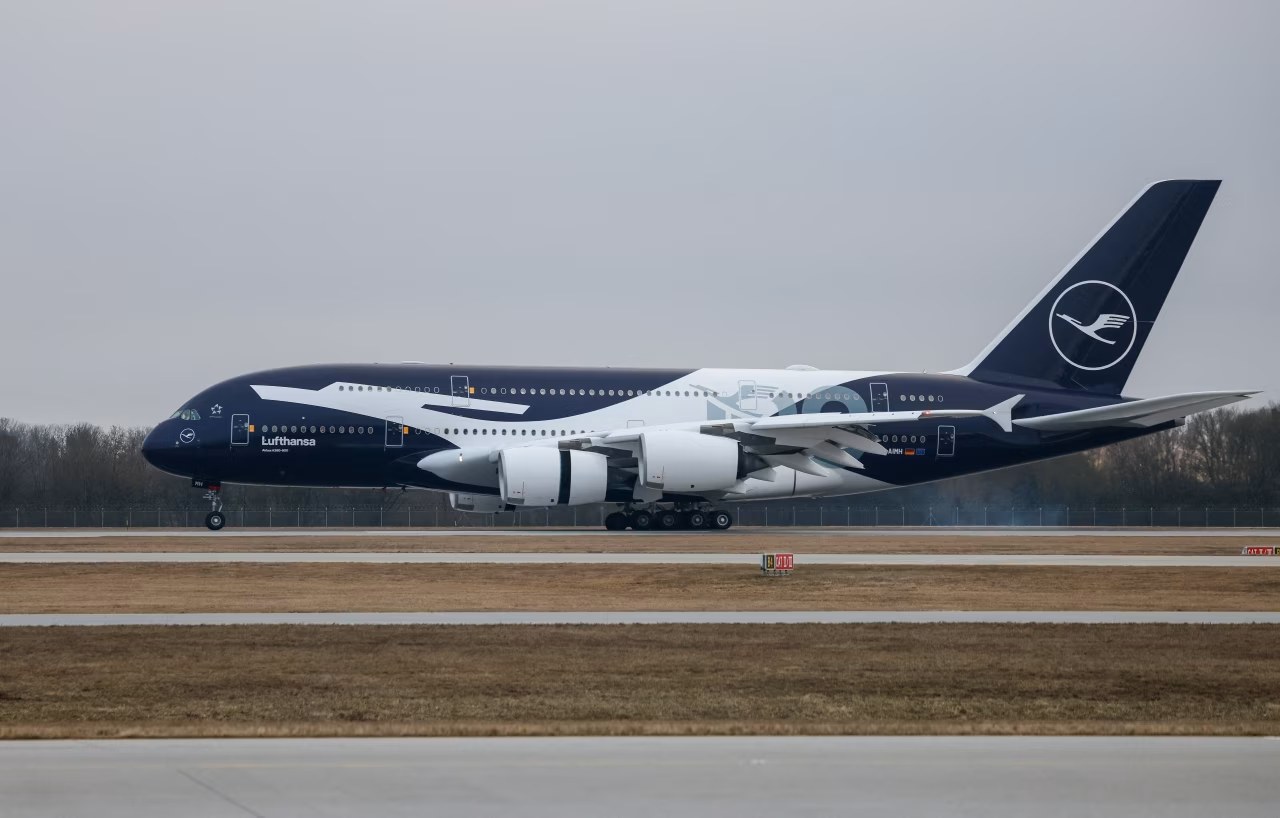
Lufthansa to Operate Over 50% of Schedule as 3,000-Plus Pilots Walk Out
- Lufthansa Group says 60% of long-haul and 80% of cargo flights will proceed during Thursday-Friday strike.
- Vereinigung Cockpit targets Lufthansa Classic, Cargo and CityLine in pension-plan dispute.
- Board member Michael Niggemann insists current offer already provides a “high level” of retirement security.
- Carriers within group such as Eurowings, Swiss, Austrian and Brussels Airlines remain unaffected.
Walkout tests airline’s contingency fleet and passenger re-booking systems during peak summer prep.
LUFTHANSA—Deutsche Lufthansa faces its largest pilot work stoppage since 2016 after union Vereinigung Cockpit (VC) ordered members off the job for 48 hours starting Thursday morning, yet the airline insists more than half of its 1,600-daily-flight network will stay airborne by tapping reserve aircraft, substitute crews and wet-lease partners.
The stoppage, centred on a proposed switch from a defined-benefit pension to a defined-contribution scheme, will hit Lufthansa Classic, Lufthansa Cargo and—on day one only—regional feeder Lufthansa CityLine. Long-haul passengers gained some relief when the carrier pledged 60% of intercontinental departures would lift off, while freight forwarders were told to expect at least 80% of cargo capacity.
Lufthansa board member Michael Niggemann said the existing pension deal already gives employees “an above-average level of retirement provision,” signalling little room for concession. With no fresh talks scheduled, travellers and investors are bracing for further disruption ahead of the July-August peak.
Why the Cockpit Union Called a Rare Two-Day Strike
Vereinigung Cockpit, representing roughly 5,000 Lufthansa Group pilots, last staged a full-network walkout seven years ago. The union’s decision to resume strike action this week traces to a single clause in a proposed collective labour agreement: the replacement of the airline’s defined-benefit pension with a defined-contribution plan tied to capital-market returns.
Under the current scheme, pilots accrue a guaranteed pension equal to 60% of final salary after 30 years of service, according to cockpit sources quoted in previous rounds of bargaining. Management’s offer would cap the company’s future obligation, shifting investment risk to employees and, VC argues, cutting average retirement payouts by up to 30%.
Union president Marcel Gröls told members the proposal “undermines one of the pillars that makes commercial aviation attractive as a lifetime career,” noting that rivals such as Air France-KLM and British Airways already reversed similar cuts after pilot shortages emerged post-pandemic. Lufthansa counters that its pension liabilities, estimated at €12 billion across the group, must be contained to keep balance-sheet ratios within credit-rating targets.
Legal backdrop
German labour law allows “warning strikes” of up to 24 hours with minimal notice; by extending to 48 hours VC signals escalation permissible under the same framework that enabled a 2014 pilot strike costing Lufthansa an estimated €170 million in operating profit.
The union must also navigate internal pressure from younger first officers who, unlike senior captains, gain little from legacy pension guarantees and favour higher cash wages instead. VC’s ballot in May secured 97% support for industrial action, a threshold that gives leadership latitude to widen or narrow strikes depending on negotiation progress.
So far, no federal mediator has been appointed. Industry observers say the stand-off could stretch into the busy July travel season unless Lufthansa restores a hybrid model blending guaranteed floor benefits with performance-linked top-ups.
Inside the Numbers: Which Flights Fly and Which Stay Grounded
Lufthansa’s operations centre in Frankfurt activated its “Plan-B” timetable within minutes of VC’s strike call, reallocating 33 wide-body aircraft from short-haul turns to long-haul routes and drafting 210 volunteer pilots from supervisory, training and management ranks. The carrier’s public pledge: 60% of intercontinental flights will depart on schedule, while CityLine regional services will drop to roughly 40% on Thursday and rebound to 55% on Friday once the smaller carrier’s crews return.
Passenger protection rules
Under European Union regulation EC261, travellers bumped or delayed more than three hours by strike are entitled to re-routing or refunds plus cash compensation up to €600 depending on distance. Lufthansa has pre-emptively waived re-booking fees and laid on extra staff at Frankfurt and Munich hubs, yet consumer-rights portal FlightRight says claims still spike an average 240% during pilot strikes.
Cargo shippers face slimmer odds of delay. Lufthansa Cargo, which controls 9% of global air-freight capacity, expects to operate 82% of scheduled tonnage by substituting passenger-belly capacity on flights that do fly and leasing three Atlas Air 747-8 freighters for 48 hours. Pharmaceutical customers moving temperature-controlled shipments were advised to prioritise Wednesday-night cut-offs to avoid backlogs.
Investors took comfort: Lufthansa shares closed down only 1.4% versus a 1.1% decline in the Stoxx Europe 600 Travel & Leisure index, suggesting traders view the action as a short-term cost rather than a structural threat. Berenberg analyst Adrian Pehl puts the strike’s earnings impact at €25-30 million per day—painful but manageable against consensus 2024 EBIT guidance of €2.8 billion.
How Pension Costs Became Lufthansa’s Balance-Sheet Battle
Lufthansa’s 2023 annual report shows €11.9 billion in net defined-benefit obligations, equal to 42% of the company’s market capitalisation and far above the €7.4 billion carried by rival International Airlines Group. Rating agency Scope has warned that any rise above €13 billion could trigger a one-notch downgrade, raising annual interest expense by an estimated €40 million.
Chief Financial Officer Remco Steenbergen told investors the proposed pension shift would cut cash contribution requirements by €300 million annually starting 2025, freeing resources for fleet renewal and debt pay-down. VC disputes the figure, arguing actuarial assumptions understate future wage growth and overstate investment returns.
Peer comparison
Air France-KLM switched to defined-contribution plans in 2011 but reversed course in 2018 after pilot attrition reached 9% a year. Similarly, British Airways parent IAG introduced a hybrid career-average model in 2022 that caps employer risk while guaranteeing 70% of final salary, a template Lufthansa pilots say management refuses to study.
Aviation labour economist Dr. Gerhard Heilmann of Munich’s School of Management notes: “Pension friction is the new wage inflation. Legacy airlines can’t match low-cost rivals on unit cost if retirement promises remain frozen in the 1990s, yet skilled cockpit shortages give unions unprecedented leverage.”
With no resolution in sight, Moody’s has placed Lufthansa’s Baa3 rating on review for negative outlook, citing “social unrest risk” as a key variable in 2024 free-cash-flow forecasts.
Could Summer Travel Survive a Prolonged Stoppage?
History shows Lufthansa strikes rarely stay short. The 2014 pilot action lasted seven days, wiping out 4,700 flights and pushing 540,000 passengers to rebook. A repeat this July, when European air-traffic control is already forecasting 8% more flights than 2019, would ripple through hubs at Frankfurt, Munich and Zurich, where Lufthansa Group carries 40% of all passengers.
Airport coordinator ACI Europe warns that a five-day walkout could cost German airports €190 million in retail and landing-fee revenue alone. Tour operator TUI has pre-blocked 15,000 hotel contingency nights in Majorca and Rhodes, anticipating spill-over from rebooked long-haul passengers.
Fleet flexibility
Lufthansa’s acquisition of Italian rival ITA Airways and stakes in Brussels Airlines give the group capacity outside German unions, yet only 12 aircraft can be swapped without wet-lease rules that add €10,000 per flight hour. Analysts say a two-week strike would erode second-quarter EBIT by an estimated 12%, forcing guidance cuts ahead of the July 31 half-year report.
Consumer-price portal Check24 reports average Lufthansa fares on Germany-Spain routes have already risen 18% week-on-week as travellers book away from strike uncertainty. If stoppages stretch into late July, Germany’s inflation basket could see air-travel costs add 0.3 percentage points to July CPI, according to Bundesbank modelling.
What’s Next? Mediation, Arbitration or More Walkouts?
Neither side shows willingness to blink. VC says it will announce “further escalation points” on Friday unless Lufthansa withdraws pension changes; management insists the reform is “non-negotiable” for cost competitiveness. Germany’s transport minister has offered to host non-binding talks, yet Lufthansa CEO Carsten Spohr argues government mediation would “politicise a labour issue.”
Legal options are limited. German courts can ban strikes only on safety grounds, and VC’s dispute fund totals €70 million, enough to sustain six weeks of full stoppage pay. Conversely, Lufthansa can lock out workers, but such a move would trigger public backlash and risk European Union state-aid scrutiny if cancellations spread.
Timeline pressure
The current collective agreement expires on August 31. If no pension deal emerges by then, VC could embed the pension demand into broader pay talks, multiplying leverage. Lufthansa’s summer peak runs July 15-August 31, when daily cash burn rises to €3 million per cancelled flying day, according to Berenberg estimates.
Independent arbitrator Prof. Wolfgang Däubler, who settled the 2015 Deutsche Bahn strike, recommends splitting the difference: keep defined-benefit pensions for existing staff and introduce defined-contribution for new hires, a model adopted by Delta Air Lines in 2012. Whether Lufthansa’s board risks union fury by forcing a two-tier workforce will determine if Europe’s largest airline enters the peak season intact or grounded.
Frequently Asked Questions
Q: How many Lufthansa flights will run during the strike?
The carrier says more than half of its published schedule will fly, including 60% of long-haul services and over 80% of Lufthansa Cargo freighters, after standby aircraft and wet-lease crews were activated.
Q: Which Lufthansa units are affected by the walkout?
Vereinigung Cockpit called strikes at Lufthansa Classic, Lufthansa Cargo on both days, plus Lufthansa CityLine on Thursday only, leaving Eurowings, Austrian, Swiss and Brussels Airlines untouched.
Q: What do pilots want?
The union rejects a shift from the current defined-benefit pension to a defined-contribution plan, arguing it cuts guaranteed retirement income; management says the change is needed to keep labour costs competitive.
