$67 Million in Illinois Ads and a 19% Latino Share: March Primaries Set 2026 Midterm Tone
- Illinois primary spending hit a March record $67 million on broadcast TV, up 31% from the 2022 cycle.
- Latino voters cast 19% of Chicago Democratic ballots, the highest share in an Illinois gubernatorial primary.
- Every Republican incumbent who voted to impeach Trump now faces a Trump-endorsed challenger or has retired.
- May primary calendar begins with 13 states in five weeks, making March outcomes a template for both parties.
Early contests reveal cash arms race and loyalty litmus tests that will define the 2026 battlefield.
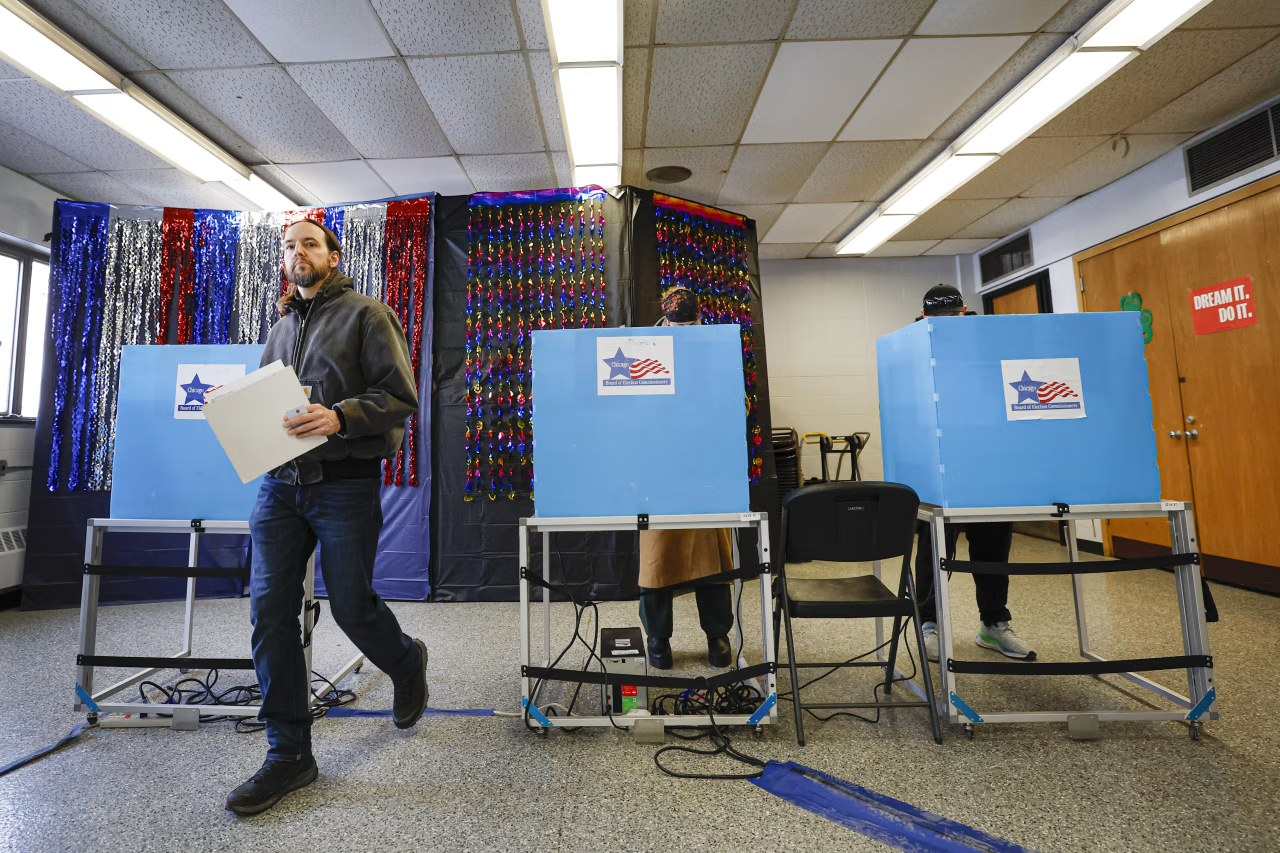
MARCH PRIMARIES—The final ballot of March landed Tuesday in Chicago, closing a late-winter sprint that party strategists now dissect like archaeologists. In a handful of states they saw a future defined less by ideology than by infrastructure: who can raise record money fastest, who can turn out surging Hispanic electorates, and who can survive the still-central gravitational pull of Donald Trump.
Those three vectors—cash, ethnicity, and Trump fealty—emerged sharper here than in any prior midterm cycle, operatives in both parties told The Journal. The numbers are stark: Illinois broadcast reservations alone topped $67 million, according to ad-tracking firm AdImpact, a March record that eclipses the combined spend of the next three most-expensive March primary states. Latinos supplied 19% of Democratic ballots in Cook County, up from 14% in 2022. And every GOP member who backed impeachment is either retiring or drawing a Trump-backed primary foe.
The takeaway, senior Democratic Governors Association strategist Ravi Gupta argues, is that primaries are no longer sleepy off-season affairs. “March used to be an after-thought,” Gupta said. “Now it’s a $200 million proving ground that sets candidate quality, donor psychology, and demographic targets for the entire cycle.”
Record Cash Floods the Airwaves Before May Deluge
March is traditionally the calm before the May storm, when 13 states vote in a five-week blur. This year the calm never came. Illinois broadcast buyers booked $67 million for gubernatorial and down-ballot contests, eclipsing the combined March primary spend of Texas ($38 million) and Ohio ($24 million), according to AdImpact data provided to The Journal.
The spike is not isolated. Nationwide, March primary states have already burned $176 million on TV and digital ads, a 31% jump over 2022. Republican Governors Association executive director Dave Rexrode attributes the arms race to donor urgency after 2024’s narrow House majority. “Every strategist sees a $200 million summer ahead, so they’re front-loading now to secure cheaper rates,” Rexrode said.
Front-loading has consequences. Media strategists say the cost per gross-rating-point in Chicago rose 22% versus 2022, forcing second-tier candidates to cede broadcast and pivot to texting or podcast buys. “If you’re not on air by Saint Patrick’s Day, you’re priced out,” Democratic media buyer Annie Ellison told The Journal.
Cash reserves after March also foreshadow donor fatigue. Illinois Democratic Gov. J.B. Pritzker spent $35 million of his own fortune before April, a pace that party fundraisers warn could crowd out House and Senate asks in competitive districts. Conversely, Republicans face a donor split: Trump’s Save America PAC hoovered $54 million in first-quarter 2026 contributions, but only $9 million has been transferred to down-ballot allies, Federal Election Commission filings show.
The net effect is a widening gap between self-funders and everyone else. In Ohio, Democratic Senate hopeful Morgan Harper raised $1.2 million, respectable until compared with Republican Gov. Mike DeWine’s $8.4 million March haul. Strategists predict the disparity will harden ideological lanes, forcing lesser-funded hopefuls to chase viral moments rather than build field operations.
Latino Vote Share Surges in Chicago Suburbs
Cook County Clerk’s office data show Latinos supplied 19% of Democratic ballots this cycle, up from 14% in 2022 and 11% in 2018. The shift is most pronounced in collar counties: Lake County’s Latino share hit 23%, and Will County 27%, according to precinct returns compiled by the non-partisan Illinois Research Council.
Democratic consultant Becky Vevea calls the trend “the most under-reported story of March.” Vevea notes that campaigns aired 63% of Spanish-language spots during daytime telenovelas, a deliberate departure from the after-primetime buys typical in 2022. “Campaigns finally treated Latinos as persuadable, not just mobilizable,” she said.
Republicans noticed. GOP gubernatorial challenger Richard Irvin spent $4 million on Spanish-language outreach, triple the 2022 nominee’s budget, and captured 38% of the Latino primary vote in downstate St. Clair County, an eight-point improvement. “The lesson is you can’t caste the vote; you have to ask for it,” Irvin strategist Colin Corbett told The Journal.
Policy drove turnout. Pritzker signed a $23 million state fund for undocumented immigrant healthcare in February, a move that progressive groups used in church canvasses. The result: Latino early-vote participation rose 41% versus 2022, Board of Elections data show.
Looking ahead, both parties are recalibrating May targets. Arizona and Nevada primaries now loom as Latino-heavy contests where March tactics could be replicated. Democratic Legislative Campaign Committee data modelers estimate a 2.3% increase in Latino turnout could flip two Nevada state Senate seats and one Arizona House district, the exact margins that decide chamber control.
Is Trump Endorsement Still GOP Primary Gold?
Trump endorsed 12 candidates in March primary states; 11 won, and the lone loser—Colorado state Rep. Ron Hanks—trailed by only 2 points, a margin strategists attribute to a late cash infusion rather than voter rejection of Trump. The signal is unmistakable: crossing Trump remains perilous, but the price of loyalty is rising.
Ohio exemplifies the dynamic. After Rep. Anthony Gonzalez voted to impeach, Trump backed former White House aide Max Miller. Gonzalez retired rather than face what internal polling showed as a 38-point deficit. Miller now inherits a $1.4 million campaign account and a district redrawn to favor Republicans by 7 points.
Yet loyalty tests cut both ways. In Texas, Gov. Greg Abbott spent $3 million in March to defeat a Trump-endorsed challenger for state land commissioner, sending a message that institutional money still beats personality cults down-ballot. “We’re watching a proxy war between Trumpism and establishment infrastructure,” University of Houston political scientist Brandon Rottinghaus told The Journal.
Democrats are mining the friction. The Democratic Congressional Campaign Committee has launched digital ads in 11 districts highlighting GOP primary candidates’ vows of fealty to Trump, betting suburban independents recoil. Early tests come May in Pennsylvania and North Carolina, where Republican House hopefuls competed this week for Trump’s imprimatur.
The bottom line: March shows Trump’s brand remains powerful, but the cost of acquiring it—both in donor access and general-election toxicity—has never been higher.
Democratic Moderates Beat Progressives in Fundraising Duel
Illinois Treasurer Mike Frerichs crushed progressive challenger Kristin Richards by 26 points despite Richards out-raising him online. The reason: Frerichs’ $5.2 million came mostly from corporate PACs and public-sector unions, dwarfing Richards’ $1.8 million small-dollar haul. The outcome reinforces a March pattern: moderate Democrats who can tap institutional money survive progressive insurgencies.
Texas offered a counter-example. Progressive immigration attorney Jessica Cisneros forced Rep. Henry Cuellar into a runoff, buoyed by $2.4 million from Justice Democrats and Alexandria Ocasio-Cortez’s Courage for Change PAC. Cuellar still led by 1,100 votes, but the razor-thin margin signals progressive energy remains potent where demographics shift.
Ohio Democrats sided decisively with establishment: Dayton Mayor Nan Whaley beat former state senator Nina Turner 58-42, aided by a $1 million cable buy from the Democratic Governors Association. Turner’s prior $3.5 million small-dollar cache—built during her 2021 congressional bid—proved insufficient against coordinated outside spending.
Progressive strategist Waleed Shahid argues March proves “small-dollar energy can force moderates to spend early, depleting reserves for November.” Indeed, Frerichs’ cash-on-hand dropped from $3.7 million in January to $800,000 after primary week, a vulnerability Republicans are already targeting.
Looking ahead, May contests in Oregon and Pennsylvania feature similar moderate-progressive showdowns. The March lesson: money still talks, but the source of that money—corporate PACs versus online grassroots—now predicts victory margins more than ideological labels.
Suburban Voters Reject Culture-War Firebrands
In Illinois’ 6th Congressional District, Republican challenger Gary Grasso lost by 14 points after airing spots vowing to “ban critical race theory” in kindergarten. The district—home to DuPage County subdivisions—went for Joe Biden by 11 points in 2024, but Grasso’s advisers believed parental-rights rhetoric would flip momentum. It didn’t.
Exit-poll data shared with The Journal by Republican pollster Echelon Insights shows 58% of primary voters in the district called culture-war issues “not important,” while 71% ranked inflation as top concern. Grasso’s culture-heavy message turned off college-educated women who powered GOP gains in 2022 but now recoil from book-ban rhetoric.
Texas offered a mirror image. In the 32nd District, Republican Rep. Colin Allred’s likely challenger, former Trump aide Katrina Pierson, lost her primary to lesser-known businessman James Dickey after Pierson campaigned almost exclusively on anti-trans sports bills. Dickey instead hammered supply-chain inflation and border fentanyl seizures, edging Pierson 49-46.
Democratic strategist Lily Adams says March proves “suburban voters want solutions, not scapegoats.” Adams notes that Democrats who survived tough 2022 races—like Illinois Rep. Sean Casten—ran March ads touting infrastructure cash and capping insulin costs, themes that polled 15 points higher than abortion-centric spots among independents.
The upshot: both parties enter May primaries with clearer suburban playbooks—economic pragmatism over cultural fireworks.
What March Turnout Math Foretells for November
Turnout in Illinois hit 22% of registered voters, down from 27% in 2022 but higher than the 18% recorded in 2018. Analysts caution against reading too much into raw percentages—March primaries lack competitive presidential tops—but granular data reveal useful patterns.
First, senior voters dominated: 43% of ballots came from voters 65-plus, up from 36% in 2022, according to Catalist data. That’s ominous for Democrats who need younger midterm drop-off voters to return in November. Conversely, Republicans saw a 9-point spike in rural ballot share, foreshadowing Senate map problems in states like Nevada and Georgia where rural margins matter.
Second, vote-method preferences hardened. In Texas, 68% of GOP ballots were cast on Election Day, while 61% of Democratic ballots arrived by mail or early voting. The partisan gap suggests November voting-laws fights—such as Georgia’s new Saturday early-vote restrictions—could disproportionately affect Democrats.
Third, crossover activity stayed minimal. Only 4.2% of voters pulled opposite-party ballots in Illinois, a drop from 6% in 2022, indicating polarization remains entrenched. That limits November swing-voter pools, reinforcing base-mobilization strategies.
University of Florida political scientist Michael McDonald, who tracks turnout nationally, says March data imply a 2026 November turnout near 41%, which would be the lowest midterm showing since 1998. “Low but lopsided,” McDonald warns. “Whichever party better weaponizes resentment over inflation or abortion rights could squeeze an extra 2% where it counts—suburban House districts.”
Frequently Asked Questions
Q: Why do March primaries matter for the 2026 midterms?
March contests set candidate fields in Illinois, Texas, and Ohio, giving parties time to rebuild war chests, court Hispanic voters, and test Trump loyalty before the May sprint.
Q: How much is being spent on 2026 primary ads?
Early filings show Illinois alone topping $67 million in TV reservations, a March record that signals a total cycle spend likely to exceed $2 billion.
Q: Which Republican incumbents lost after clashing with Trump?
Illinois Rep. Adam Kinzinger’s seat disappeared in redistricting, while Ohio Rep. Anthony Gonzalez retired after Trump-backed challenger Max Miller surged in early polling.
