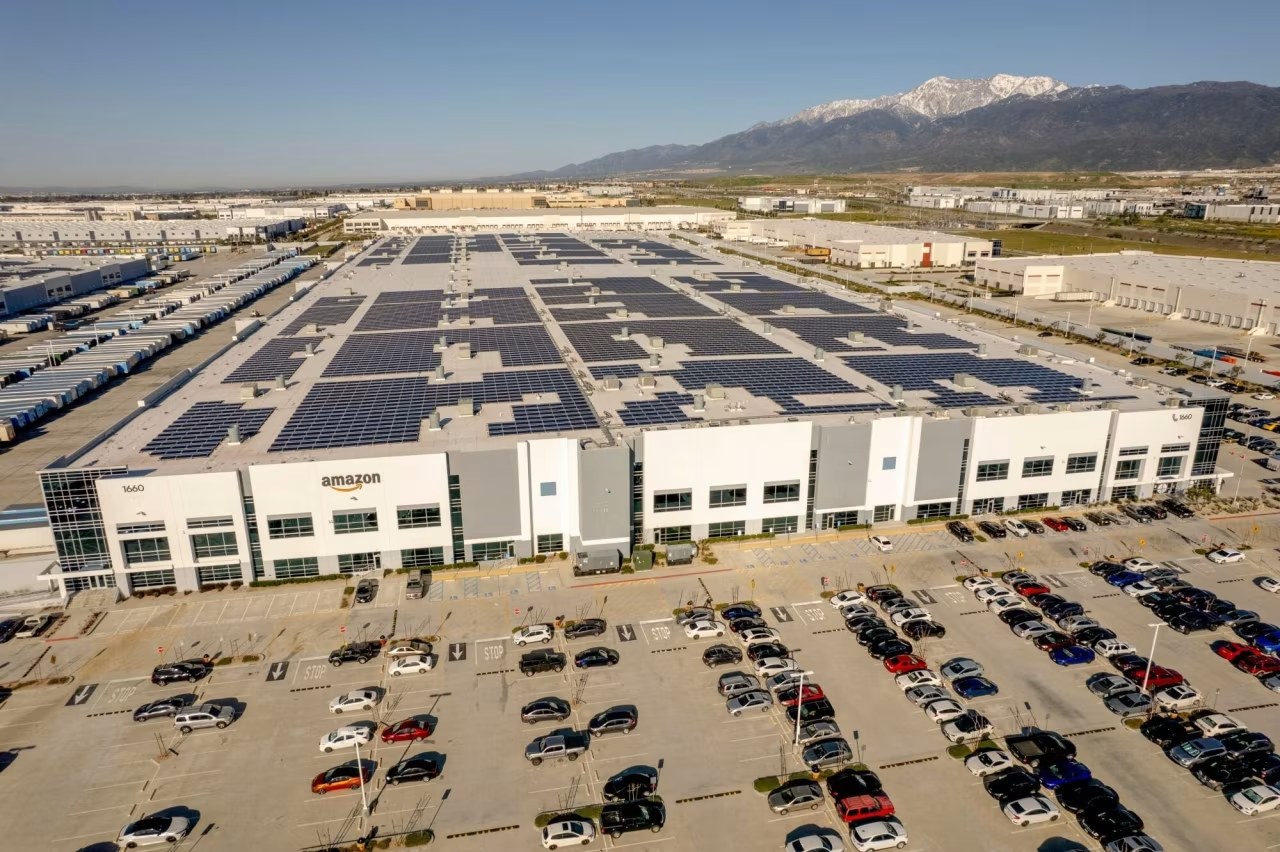
146 Mega-Leases: Big Warehouses Surge 31% to Highest Level Since 2022
- 146 U.S. leases for warehouses over 500,000 sq ft were signed last year, up 31% YoY.
- 42 of those deals closed in Q4 2023—the busiest quarter since Q3 2022.
- Cushman & Wakefield data mark the first sustained rebound after two sluggish years.
- E-commerce restocking and near-shoring fuel demand for regional distribution hubs.
Industrial giants are betting that consumer spending will hold—and they need space close to major metros to prove it.
AMAZON—After a prolonged lull, America’s biggest logistics landlords are again fielding a flood of calls from tenants hunting for cavernous footprints. Real-estate services firm Cushman & Wakefield tracked 146 leases signed nationwide last year for single buildings larger than 500,000 square feet, a 31% jump from the prior 12 months and the highest annual tally since the post-pandemic peak of 2022.
The fourth quarter alone contributed 42 of those transactions, the most in any three-month period since the third quarter of 2022. The resurgence signals that corporate America is done “wait-and-see” warehousing and is now racing to secure land and buildings before land scarcity and rising construction costs push rents even higher.
For investors, the numbers reverse a two-year narrative of excess capacity and frozen expansion budgets. For supply-chain executives, they confirm a strategic pivot: stock inventory closer to customers, even if that means paying a premium for mega-sheds that can swallow dozens of football fields under one roof.
From Glut to Grab: Why 2023 Flipped the Warehouse Script
Industrial real estate entered 2023 under a cloud. After a pandemic-driven building spree, vacancy in big-box markets such as the Inland Empire, Dallas-Fort Worth and Pennsylvania’s I-78/I-81 corridor had vaulted above 5%, according to Cushman & Wakefield research. Rents, which jumped more than 30% in 2021 and 2022, flattened. Several e-commerce giants, most visibly Amazon, put expansion plans on ice, sub-letting millions of square feet and spooking developers.
Yet by mid-year the tone shifted. Container imports through Los Angeles and Long Beach rebounded, retail inventories relative to sales fell back toward pre-COVID norms, and consumer spending defied recession forecasts. Tenants that had deferred decisions in 2021-22 suddenly confronted a harsh reality: the best sites were still available, but not for long.
“We saw a clear inflection point last summer,” said John Morris, president of Cushman’s industrial brokerage in the Americas. “Companies moved from portfolio reviews to pen-on-paper leases in a matter of weeks, not quarters.” Morris’s team counted 42 fourth-quarter transactions exceeding half-a-million square feet, triple the 14 signed in Q4 2022 and the strongest quarterly figure since the 48 leases of Q3 2022.
What changed tenant psychology?
Three forces converged. First, interest-rate hikes peaked, giving CFOs confidence that occupancy costs would not be eroded by further rate-driven rent inflation. Second, on-shoring of Asian manufacturing—especially in auto, semiconductors and medical devices—required U.S. parts depots within a one-day truck drive of new assembly plants. Third, retailers recalibrated e-commerce growth from hyper-growth to steady 8-10% annually, still enough to exhaust existing fulfillment centers.
Together these vectors converted cautious tenants into aggressive occupiers. The 146 mega-leases of 2023 represent 73 million square feet of new absorption, enough to dent national vacancy by roughly 60 basis points, according to Cushman models. For developers who survived the 2021-22 capital-markets squeeze, the surge is a lifeline: construction lenders again pre-lease assets before breaking ground, a practice that had all but disappeared in 2022.
Looking ahead, analysts warn the window could narrow quickly. A pipeline of 450 million square feet of new industrial space remains under construction nationally, but two-thirds is speculative, and material costs are again rising. If consumer spending cools, today’s leasing momentum could stall. For now, however, big-box landlords are enjoying pricing power they feared was gone for good.
Inside the Q4 Sprint: 42 Deals in 90 Days
The fourth-quarter burst was not merely a timing quirk; it reflected a strategic rush to lock in 2024 occupancy before base rents reset higher. Tenants signed 42 leases for 500,000-plus square-foot buildings between October and December, eclipsing every quarter since the 48 deals of Q3 2022. Cushman notes that 14 of those transactions exceeded one million square feet, including a 1.2 million sq ft renewal-expansion by an automotive supplier in Spartanburg, South Carolina, and a 1.05 million sq ft pre-lease by a home-improvement retailer in Phoenix.
“Speed mattered,” observed Mehtab Randhawa, global head of industrial research at Cushman. “Landlords were willing to trade modest concessions for swift execution, but only if the tenant’s balance sheet was investment-grade.” That selectivity kept overall vacancy in big-box facilities below 4.2% nationwide, even as new supply delivered.
What sectors led the charge?
Third-party logistics providers (3PLs) inked 38% of Q4 mega-leases, followed by general retailers (24%) and pure-play e-commerce (18%). Automotive and grocery each claimed about 7%. Geographically, the largest concentration landed in the Pennsylvania I-81 corridor, which captured 11 of the 42 deals, thanks to its overnight reach to 40% of the U.S. population. Dallas-Fort Worth absorbed eight deals, while the Inland Empire east of Los Angeles booked six, reversing earlier fears that California out-migration would crater demand.
Lease terms also lengthened. Where 2021-22 saw a spike in short, three-year deals to preserve optionality, the average tenure in Q4 2023 stretched to 8.6 years, the longest since 2016. Longer commitments give tenants rent certainty and landlords the collateral needed to secure construction debt at today’s elevated rates.
The momentum is spilling into 2024. Cushman’s early tally shows another 11 mega-leases already signed in January, putting the market on pace for a repeat of last year’s total. Yet analysts caution that a resurgence in speculative building could oversupply select sub-markets by late 2025, especially if consumer spending flags or interest rates climb anew.
Will Rent Spikes Follow the Leasing Frenzy?
History shows that when net absorption outpaces new supply for two consecutive quarters, rents accelerate within 12 months. That pattern emerged in 2021, when average big-box asking rents leapt 11.8% nationally, and it is poised to repeat, according to logistics real-estate economist Matthew Dolly of Jones Lang LaSalle. “Landlords are already quoting 6-8% annual escalations on five-year renewals, double the rate of 2019,” Dolly said.
Cushman’s fourth-quarter statistics back him up. Even though 68 million square feet of new industrial space delivered in Q4, only 42% was pre-leased, the lowest ratio since 2020. The imbalance allowed owners of existing mega-facilities to push asking rents up 2.3% quarter-over-quarter, the fastest clip in two years. Markets with land constraints—Los Angeles, New Jersey, Seattle—saw spikes above 5%.
Can tenants push back?
For now, tenants retain some leverage. Construction lenders require 30-50% pre-leasing before funding new projects, so developers are offering five months of free rent and $10-per-square-foot tenant-improvement allowances, incentives not seen since 2013. Yet those concessions shrink each month that availability tightens. If the national vacancy rate dips below 3.5%, effective rents could jump 10-12% in 2024, according to both JLL and Cushman forecasts.
Supply-chain executives are hedging by locking in longer terms and expanding in secondary markets such as Columbus, Ohio and Fort Wayne, Indiana, where land is cheaper and municipalities dangle tax abatements. Whether that dispersion is enough to keep rent growth below the inflation rate remains the industry’s critical question for the next 18 months.
What’s Next for the Big-Box Boom?
The revival of mega-warehouse demand is colliding with a sobering reality: there is a finite amount of land zoned for 500,000-plus square-foot structures within a 60-minute drive of major population centers. New environmental regulations in California, New Jersey and Illinois are adding 12-18 months to entitlement timelines, while local opposition—so-called warehouse moratoria—has spread to at least 42 municipalities nationwide, according to the NAIOP Research Foundation.
That regulatory friction keeps development pipelines in check, which in turn supports rent growth but also risks throttling logistics efficiency. “We’re approaching a structural shortage of big-box space in coastal markets by 2026,” predicted Barbara Byrne Denham, senior economist at Oxford Economics. Her baseline forecast shows demand for mega-facilities rising 2.8% annually through 2027, while compliant land supply grows only 1.1%.
Will reshoring amplify the crunch?
Semiconductor and battery manufacturers are scouting 800-acre campuses that require 2-3 million sq ft of adjacent parts warehouses. Federal CHIPS and Inflation Reduction Act subsidies could accelerate such projects, intensifying competition for the same labor pool that big-box distribution centers rely on. Average warehouse wages have already climbed 18% since 2020, to $22.90 per hour, Bureau of Labor Statistics data show.
Technology may partially offset space scarcity. Automated high-bay warehouses can store 40% more pallets per square foot, allowing tenants to lease smaller footprints. Yet retrofitting existing 32-foot-clear buildings to 55-foot robotic cranes costs $70-$90 per square foot, a capital outlay many 3PLs are reluctant to shoulder unless lease terms exceed 12 years.
Bottom line: expect the big-box rebound to persist through 2024, with rent growth outpacing inflation in land-constrained markets and development shifting to Sun Belt exurbs where zoning remains permissive. If consumer spending weakens, vacancy could rise modestly, but structural land shortages make a 2021-style glut unlikely. For occupiers, the strategic imperative is clear—secure space now or pay more later.
Frequently Asked Questions
Q: How many U.S. mega-warehouse leases were signed last year?
Companies signed 146 leases for warehouses larger than 500,000 square feet in 2023, a 31% increase from the prior year and the highest annual total since 2022, according to Cushman & Wakefield.
Q: What drove the fourth-quarter surge in big-box warehouse deals?
Forty-two of those 146 leases were inked in Q4 2023 alone—the busiest quarter since Q3 2022—as retailers and 3PLs raced to lock up space before rents rose further and vacancy tightened.
Q: Why are 500k+ sq ft warehouses rebounding now?
After two years of cautious expansion, e-commerce giants and logistics firms need regional fulfillment hubs closer to consumers; the 31% lease spike signals renewed confidence in consumer demand and supply-chain reshoring.
