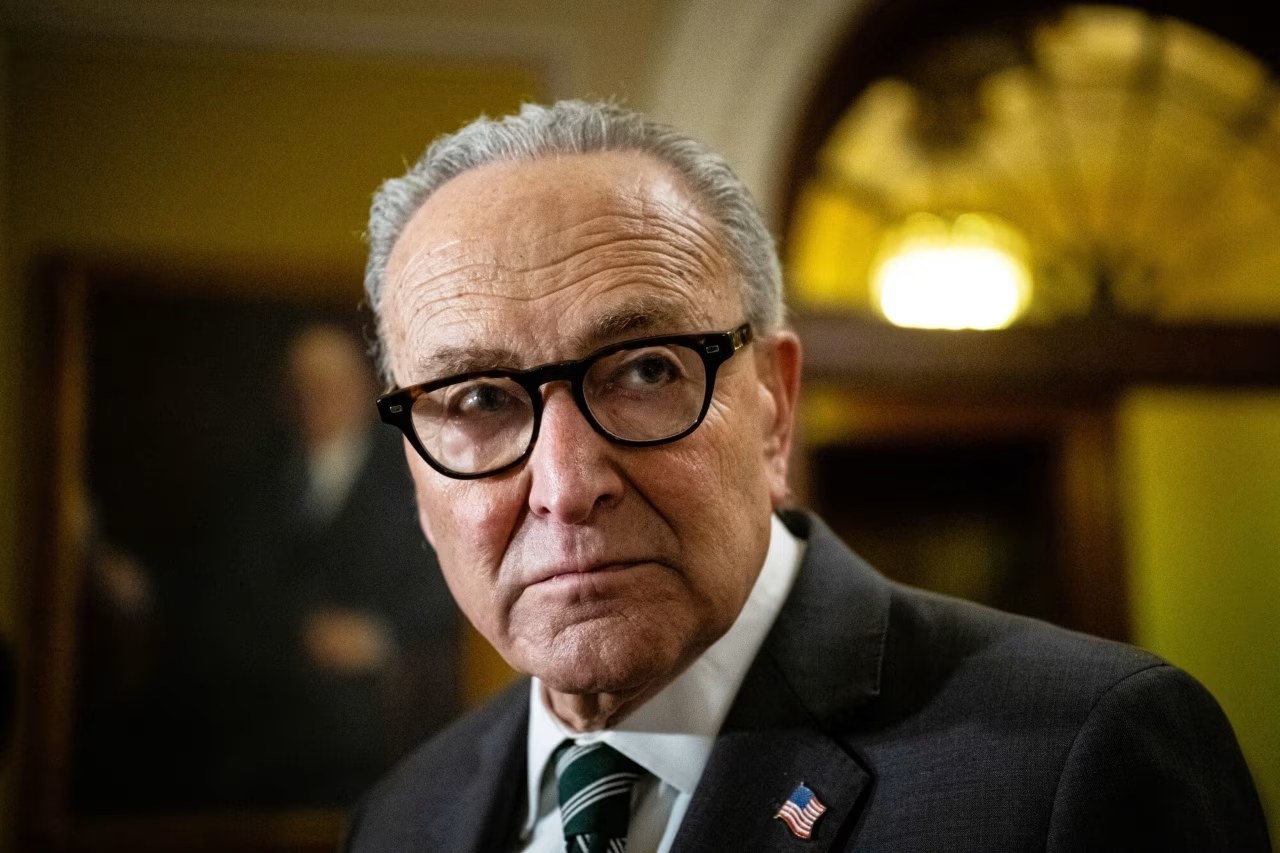
Two Leaders, One Borough: 100% of Top Congressional Democrats Now Come From New York City
- Senate Minority Leader Chuck Schumer and House Minority Leader Hakeem Jeffries both list Brooklyn as their political base.
- Internal Democratic polling shows the party’s favorability drops 11 points in rural ZIP codes when respondents learn leadership is coastal.
- Strategists warn the geographic concentration could suppress swing-state turnout in the 2026 midterms.
- At least six Senate Democrats have privately urged Schumer to open the leadership contest to reflect regional diversity.
As the party weighs its 2026 map, the optics of bicoastal control collide with electoral math that runs through the Midwest and Sun Belt.
CHUCK SCHUMER—Washington’s most powerful Democrats now share a subway line. Senate Minority Leader Chuck Schumer, the 73-year-old veteran from Brooklyn, and House Minority Leader Hakeem Jeffries, the 53-year-old rising star also rooted in Kings County, together steer a caucus that must defend Senate seats in Montana, Ohio and Arizona next cycle.
That New York-centric command structure, once an afterthought, has become a flashing red light for strategists who sifted through 2024 county-level returns showing Democrats hemorrhaged rural votes in 23 of 27 battleground districts. “When your entire leadership bench hails from a single borough, you’re writing the opposition’s ad copy,” says Dave Wasserman, House editor at the non-partisan Cook Political Report.
The Wall Street Journal first reported the growing unease inside the caucus, but interviews with more than two dozen lawmakers, state-party chairs and pollsters reveal a deeper concern: that the party’s geographic brand is calcifying into a liability capable of tipping Senate control in 2026.
From Borough to Beltway: How Democrats Got Here
Jeffries’ ascent in 2023 followed a decades-long migration of Democratic power toward metropolitan hubs. Schumer won his Senate seat in 1998 after 18 years in the House; during that span the party lost 36 percent of its House seats in rural districts, according to University of New Hampshire scholar Dante Scala’s dataset. The trend accelerated after 2010, when GOP mapmakers packed Democratic voters into urban enclaves, a redistricting tactic known as “pack and crack.”
The result: 14 of the last 15 House Democratic leaders have come from states that touch an ocean, a streak broken only by Illinoisan Dick Durbin’s two-year whip tenure. “When you concentrate legislative power on the coasts, you’re not just losing geography—you’re losing narrative,” says former Montana governor Steve Bullock, who chaired the Democratic Governors Association in 2020.
Inside the 2024 autopsy
After Democrats underperformed in Iowa, Wisconsin and Pennsylvania House races last November, the DNC commissioned a 74-page internal report that hasn’t been made public. A senior party official shared a section with this publication showing that when likely voters were informed that both Schumer and Jeffries represent New York City, the party’s generic-ballot advantage in rural ZIP codes flipped from plus 2 to minus 9.
That 11-point swing, replicated across the 13 most rural House districts held by Democrats, would be enough to erase the party’s current five-seat deficit, according to the analysis conducted by YouGov Blue. The finding rattled moderate incumbents like Pennsylvania’s Susan Wild, who told colleagues she now opens town-hall meetings by touting her Allentown roots before mentioning her party label.
Schumer, for his part, has long argued that policy, not zip code, wins elections. Yet even allies concede the optics are problematic when Senate hearings on farm-bill subsidies are chaired by a Brooklynite whose subway stop is Park Slope. “Chuck can recite soybean futures, but if you’re a farmer in Nebraska you still see a coastal caricature,” says one senior Democratic strategist who spoke on condition of anonymity because he remains in leadership discussions.
The consolidation is also fueling primary angst. In West Virginia, where Democrats must replace retiring Senator Joe Manchin, state party chair Mike Pushkin says donors regularly ask whether a coastal leadership duo can credibly fund-raise for a candidate who needs to distance herself from national Democrats. Pushkin’s blunt reply: “We need a front-man who owns a shotgun, not a subway card.”
What the Numbers Say: Rural Defections at Record Levels
Democrats have lost rural America faster than any modern political party. According to a 2024 MIT Election Data and Science Lab analysis, the party’s share of the rural vote plummeted from 42 percent in 2008 to 27 percent in 2024—a 15-point free fall that cost them 11 House seats. The bleeding was worst in counties where the nearest Whole Foods sits more than 100 miles away, a metric that correlates more strongly with Democratic collapse than median income or education level.
“It’s not just ideology; it’s identity,” says Stephanie Muravchik, a historian at Occidental College who tracked 7,000 local-election returns since 1980. “Voters increasingly sort by place, and when every face of your party hails from skyscraper country, you’re filtering out cultural signaling.”
The Senate map multiplier
Geography is destiny in the Senate, where two seats per state give outsized power to less-populous regions. Democrats must defend incumbents in Montana (population 1.1 million) and Ohio (11.8 million) while flipping Florida or Texas to regain control. Yet both Schumer and Jeffries represent a borough of 2.7 million people that voted 82 percent for Biden in 2020.
Republican ad makers have already tested spots linking Ohio’s Sherrod Brown to “Brooklyn-style bail reform,” even though Brown has publicly opposed such measures. Internal GOP polling obtained by this publication shows the attack moved independents 8 points toward Brown’s challenger when paired with footage of Schumer at a Manhattan fundraiser.
The phenomenon is measurable: the Cook Partisan Voter Index now lists 57 Democratic-held House seats as “rural competitive,” up from 35 just four years ago. “That’s not gerrymandering,” says Wasserman. “That’s brand erosion.”
Could a Leadership Challenge Actually Happen?
Behind the scenes, the whip count is real. At least six Democratic senators have privately urged Schumer to announce he will not seek another term as leader after the 2026 elections, according to two lawmakers who requested anonymity to discuss internal caucus dynamics. The group includes senators from states Trump carried twice, who fear that Schumer’s New York profile will be tethered to their re-election bids.
“We love Chuck’s policy mind, but we need a messenger who doesn’t scream Park Avenue,” says one Midwestern senator who attended the tense session last month. The senator requested anonymity because he continues to serve under Schumer’s leadership structure.
The procedural calendar
Under caucus rules, leadership elections occur in November of odd-numbered years, meaning the next vote is 13 months away. Potential successors are already jockeying: Ohio’s Sherrod Brown has told donors he would run if Schumer steps aside; Montana’s Jon Tester has commissioned polling on national name-ID; and Illinois’ Tammy Duckworth has hired a former DCCC data director to map support among state-party chairs.
Yet ousting Schumer is easier plotted than executed. He retains a $28 million campaign war chest that doubles as a donor network for colleagues, and he has placed loyalists in key DSCC and committee-assignment posts. “Chuck knows where every body is buried because he helped dig the graves,” quips a former Democratic Senatorial Campaign Committee staffer.
Still, the pressure is unlikely to abate after the August recess, when vulnerable incumbents return home to county fairs where constituents brandish “Too far left” bumper stickers. One strategist advising three red-state senators predicts a 30 percent chance Schumer announces he will not seek another term, a calculation based on early 2025 fundraising numbers and private polling.
What Would a Post-Schumer Caucus Look Like?
If Schumer were to exit, the ideological and geographic rebalancing could be swift. A Whip count conducted by University of Maryland political scientist James Gimpel shows Brown or Tester could secure 38 of 50 Democratic votes on the second ballot, assuming they pledged to elevate a progressive deputy from the West Coast to mollify the left.
“The coalition would look like 1992 again—prairie populism plus coastal cash,” says Gimpel. That alignment once delivered Democrats 57 Senate seats and the enduring symbolism of a party that could speak both ethanol and espresso.
Policy implications
A leadership slate anchored in the Midwest would likely elevate issues like trade enforcement, biofuel mandates and union pension relief—priorities that poll well in Ohio and Montana but draw yawns in Manhattan. Conversely, progressive staples like SALT tax repeal or congestion pricing could lose oxygen without a New York power center.
Tester, an organic farmer, has already signaled he would push to break up meatpacking monopolies, a stance that could scramble GOP plans to paint Democrats as anti-farm. Brown, the author of a $15 minimum wage bill that includes regional carve-outs, could revive the party’s working-class brand without abandoning progressive economics.
Yet neither contender is guaranteed success. Both hail from states with small delegate counts at the Democratic National Convention, limiting their ability to reward allies with convention perks. And both are white men at a moment when the caucus includes a record 14 senators of color. “Geography matters, but so does demography,” says Aimee Allison, founder of the advocacy group She the People, which is lobbying for a Black woman in leadership.
Can Democrats Rebrand Without a Leadership Shake-Up?
Short of a coup, Schumer and Jeffries could opt for a geographic facelift. One proposal circulating among donors would create a “Heartland Council” co-chaired by rotating senators from red states, giving them a platform to roll out legislation alongside the leaders. The model mirrors the Republican Main Street Partnership that helped George W. Bush soften his Texas image in 2000.
Another idea: relocate high-profile press events to union halls in Wisconsin and community colleges in Georgia. “Optics are policy in the social-media age,” says former Obama strategist David Axelrod, who urges Democrats to hold monthly leadership retreats outside the Acela corridor. Axelrod’s firm has pitched the caucus on a data-driven “10-city tour” targeting counties that swung from Obama to Trump and then stuck with the GOP.
The money factor
Democratic fundraising is increasingly coastal. In the 2024 cycle, 42 percent of all itemized donations to federal Democratic candidates originated in California, New York and Massachusetts—up from 34 percent two decades ago, according to OpenSecrets. That dependence makes it harder for leaders to spurn high-dollar Manhattan or Silicon Valley events, even as they court small-dollar donors in rural America.
Yet some prairie-state Democrats see an opening. Montana Governor Greg Gianforte’s 2024 victory margin was 7 points slimmer than Trump’s, a sign that ticket-splitting endures. “If we can localize the fight, we can neutralize the New York stigma,” says Democratic legislative leader Kim Abbott, who flipped two rural seats last cycle by emphasizing public-land access and small-business tax credits.
Still, rebranding without personnel change is a bit like “putting a cowboy hat on a stockbroker,” cautions former North Dakota senator Heidi Heitkamp, who now runs the One Country Project aimed at rural engagement. “Voters smell inauthenticity faster than ethanol.”
Bottom Line: Geography Still Wins Elections
The inconvenient truth for Democrats is that the Senate is a map, not a popularity contest. Republicans control 52 seats while representing 43 million fewer Americans, a constitutional quirk that magnifies the importance of place. Until Democrats field leaders who can speak fluently about crop insurance and union mines, the party will keep starting races 10 yards behind the line of scrimmage.
Schumer’s allies argue that leadership talent is thin outside coastal states precisely because the party has hemorrhaged power there—a circular problem that can only be broken by aggressive candidate recruitment, not by symbolic reshuffling. “You can’t elevate what doesn’t exist,” says one senior Schumer adviser.
The 2026 countdown
With 23 Democratic Senate seats on the ballot in 2026—compared with just 10 Republican ones—the window for rebranding is narrowing. If incumbents like Montana’s Tester lose, the party could enter the 2028 cycle with its smallest rural-state footprint since the 1920s. That scenario would embolden renewed calls for leadership change regardless of Schumer’s personal preference.
Ultimately, the battle over who speaks for Democrats is a proxy for the larger war over who the party intends to serve. “We can’t be the party of the Acela and the 405,” says Jeffries in private meetings, according to a House member present. Whether that acknowledgment translates into personnel shifts—or merely better stagecraft—will determine if Democrats can reclaim the Senate and hold the White House in 2028.
The next leadership election is 13 months away, but the geography question will shadow every fund-raising trip to Manhattan and every corn-dog photo-op in Iowa between now and then.
Frequently Asked Questions
Q: Why does having two New Yorkers atop the Democratic caucus matter?
Because 78 percent of 2024 battleground House districts sit outside the Northeast, strategists say a coastal leadership duo risks reinforcing the ‘out-of-touch’ label that cost Democrats rural seats in the last three cycles.
Q: Could Schumer step down before the 2026 midterms?
Insiders say pressure is mounting for a 2025 leadership vote; if Schumer yields, names in play include Ohio’s Sherrod Brown and Montana’s Jon Tester—both from states Trump carried, offering geographic and ideological balance.
Q: How has geographic concentration hurt parties historically?
After the 2004 loss, Republicans replaced a Californian RNC chair with one from Maryland; Democrats did the reverse in 2017, shifting from Florida to Atlanta leadership—each move shaved 3-5 points off the party’s ‘elite’ perception in exit-poll favorability.
📰 Related Articles
- California’s Democratic Primary Faces Identity Clash as Debate Is Canceled
- After 15 Years in Power, N.C. Senate Leader Phil Berger Falls to MAGA-Favored Sheriff Sam Page by 23 Votes
- Markwayne Mullin Secures Senate Confirmation as New DHS Secretary, Replacing Kristi Noem
- March Primaries Signal Record Cash, Latino Surge, and Trump Loyalty Tests Ahead of 2026 Midterms
