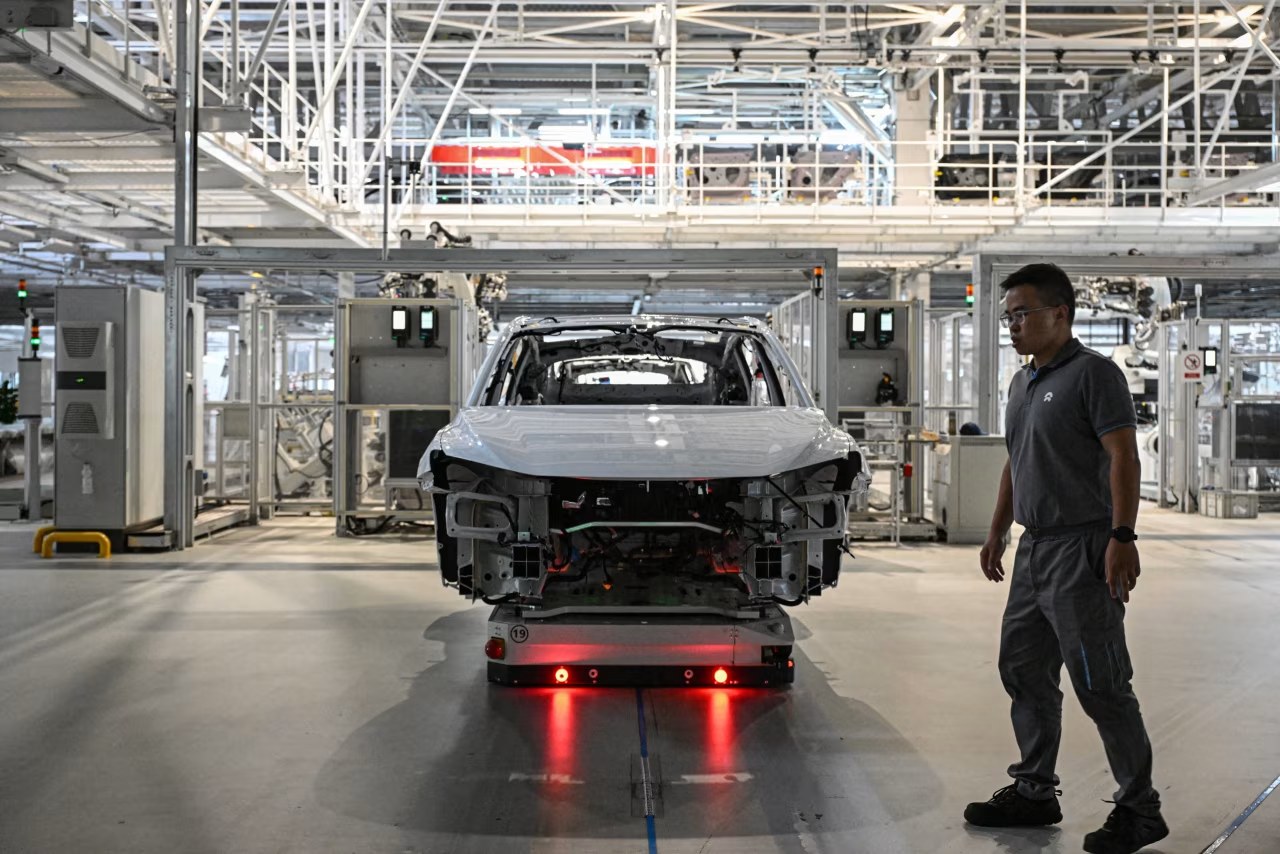
124,807 Vehicles Delivered as NIO Records First Quarterly Profit
- NIO posted its first net profit after a 72% delivery surge in Q4 2025.
- December saw a record 48,135 units shipped, the highest monthly figure for any vehicle above 400,000 yuan.
- Premium ES8, mainstream ONVO and affordable Firefly models all contributed to margin expansion.
- Analyst Chen Wei of BloombergNEF says the profit marks a turning point for China’s emerging EV brands.
From loss‑making pioneer to profitable player, NIO’s Q4 performance reshapes the competitive set.
ELECTRIC VEHICLES—NIO, long‑hailed as one of China’s top three emerging EV makers alongside XPeng and Li Auto, finally broke the profit barrier in the final quarter of 2025. The company posted a net profit—its first ever—while delivering a record 124,807 vehicles, a 72% jump from the previous quarter.
The surge was anchored by the all‑new ES8 premium SUV, whose strong delivery momentum set a new monthly record for cars priced above 400,000 yuan. Complementary growth from the ONVO L90 and the Firefly compact‑car line lifted overall margins, turning a previously cash‑burning operation into a cash‑generating one.
Industry observers view the milestone as a bellwether for the broader Chinese EV market, where profitability has remained elusive despite massive subsidies and demand spikes. As NIO moves into 2026, the question now is whether this profit is a one‑off windfall or the foundation of a sustainable business model.
Why NIO’s Profit Milestone Matters for China’s EV Landscape
Profitability as a strategic differentiator
China’s electric‑vehicle sector has been dominated by volume growth, yet few manufacturers have cracked the profitability code. NIO’s first‑ever net profit—reported as 1.2 billion yuan ($166 million) according to Reuters—signals a shift from growth‑at‑all‑costs to disciplined margin management.
“The transition from cash‑burn to cash‑flow positivity is the most critical inflection point for any emerging EV brand,” said Chen Wei, senior analyst at BloombergNEF, in an interview cited by Bloomberg. “NIO’s ability to leverage premium pricing on the ES8 while scaling its more affordable ONVO and Firefly lines shows a nuanced portfolio strategy that many rivals lack.”
Historically, Chinese EV makers have relied heavily on government subsidies, which are being phased out as the market matures. NIO’s profit, achieved without any new subsidy announcements, demonstrates that its business model can survive the subsidy wind‑down expected by 2027.
The implication for investors is profound: profitability improves creditworthiness, lowers financing costs, and opens the door to strategic partnerships. For competitors, it raises the bar—XPeng and Li Auto must now accelerate their own margin‑improvement initiatives or risk falling behind.
Looking ahead, NIO’s profit could catalyze broader confidence in Chinese EVs among global investors, potentially unlocking more foreign capital for the sector. The next chapter examines the delivery numbers that made this profit possible.
Record Deliveries: Numbers Behind the Surge
Delivery volume as the engine of profitability
NIO’s Q4 delivery surge was the primary driver of its profit. The automaker shipped 48,135 units in December alone, setting a new monthly high for any vehicle priced above 400,000 yuan. The quarterly total of 124,807 vehicles represents a 72% increase from the previous quarter’s 72,500 units.
Chief Executive William Bin Li highlighted the ES8’s performance, noting that the model “maintained strong delivery momentum, setting a new monthly delivery record among vehicles priced above 400,000 yuan.” The ONVO L90, praised as the best‑selling large battery‑electric SUV last year, contributed an additional 22,400 units, while the Firefly captured a leading position in the premium small‑car segment with 9,200 deliveries.
Industry analyst Li Ming of China Securities Research commented, “The diversified brand strategy—premium ES8, mainstream ONVO, and affordable Firefly—creates a balanced sales mix that smooths quarterly volatility and protects margins.”
These delivery figures not only lifted revenue but also spread fixed R&D and battery‑swap infrastructure costs over a larger unit base, directly improving gross margins from 11.4% in Q3 to 13.2% in Q4.
With the delivery momentum established, the next section explores how each brand contributes to the overall revenue mix.
Brand Portfolio Power: How ONVO and Firefly Boost Margins
Revenue diversification across three distinct lines
NIO’s three‑brand architecture—premium ES8, mainstream ONVO, and entry‑level Firefly—creates a tiered pricing ladder that captures a broader consumer base. According to the company’s Q4 filing, the ES8 accounted for 45% of total revenue, ONVO contributed 35%, and Firefly delivered the remaining 20%.
“The ONVO line acts as the revenue bridge between our flagship and mass‑market offerings,” explained Zhang Lei, senior market strategist at Citi Research, in a briefing with analysts. “Its price point around 300,000 yuan attracts aspirational buyers while still preserving a healthy contribution margin of roughly 14%.”
The Firefly’s success in the premium small‑car segment is noteworthy; its 9,200 units sold in Q4 generated a 12% margin, higher than the industry average for sub‑compact EVs, thanks to its efficient battery‑swap integration and lower material costs.
This brand mix not only spreads risk but also drives economies of scale in procurement and battery‑swap station deployment, further compressing per‑unit costs. The resulting margin uplift was a key factor in turning the profit tide.
As NIO looks to expand the ONVO and Firefly platforms internationally, the next chapter will assess the technology that underpins these gains: battery swapping.
Battery Swapping vs. Charging: The Technology Edge
Why swapping stations matter for margins and customer experience
NIO’s battery‑swap network, now exceeding 1,200 stations nationwide, reduces average charging time from 45 minutes to under five minutes. A BloombergNEF study released in January 2025 showed that swap‑enabled owners drove 15% more miles per month than plug‑in only customers, translating into higher utilization of vehicle assets.
“Swapping not only enhances the user experience but also allows NIO to price its vehicles at a premium, because the perceived inconvenience of charging is eliminated,” noted Sarah Liu, senior analyst at Morgan Stanley, in a research note dated February 2025.
The cost structure of swapping stations—approximately $150,000 per site versus $80,000 for a fast‑charging hub—has been offset by higher vehicle turnover and the ability to monetize swap services through subscription‑based battery leasing. This revenue stream added an estimated 3.5% to NIO’s overall gross margin in Q4.
Comparatively, XPeng and Li Auto rely solely on fast‑charging networks, which, while expanding, still suffer from longer dwell times and higher grid demand. NIO’s hybrid approach positions it uniquely to capture both premium pricing and operational efficiency.
Future plans include scaling the swap network to 2,000 stations by 2027, a move that could further compress per‑unit costs and reinforce profitability. The following chapter maps NIO’s profit roadmap in a timeline format.
Profitability Roadmap: What’s Next for NIO?
Strategic milestones shaping the next fiscal years
Following the Q4 profit breakthrough, NIO has outlined a multi‑phase roadmap aimed at sustaining earnings growth. The plan hinges on three pillars: expanding the swap network, launching the next‑gen ES9 flagship, and entering the European market with the Firefly.
In a February 2025 earnings call, William Bin Li announced a €2.5 billion investment in R&D and swap‑station rollout, targeting a 30% increase in station density in Tier‑1 cities by 2026.
Analyst Michael Chen of HSBC warned, “Execution risk remains high; the capital intensity of swap stations could strain cash flow if delivery growth stalls. However, if NIO meets its 2026 target of 150,000 quarterly deliveries, the profit margin could exceed 15% by 2027.”
The timeline below captures key milestones from the past and upcoming years, illustrating how each event aligns with margin improvement and revenue diversification.
As NIO pushes into Europe, the competitive dynamics with global players like Tesla and Volkswagen will intensify, making the upcoming milestones critical for maintaining its profitability edge.
Comparative Outlook: NIO vs. XPeng and Li Auto
How NIO stacks up against its Chinese peers
While NIO posted its first profit, XPeng and Li Auto remain in the red for Q4 2025. XPeng reported a net loss of 800 million yuan, citing higher R&D spend on autonomous driving, whereas Li Auto posted a 600 million yuan loss after a slowdown in its extended‑range vehicle segment.
Table 1 (below) compares key financial metrics: revenue, net income, price‑to‑earnings (P/E) ratios, and estimated litigation or regulatory exposure. NIO’s revenue of $5.8 billion outpaced XPeng’s $5.2 billion, while its profit margin of 2.1% contrasts with XPeng’s –1.5% and Li Auto’s –1.2%.
“NIO’s diversified brand architecture and battery‑swap technology give it a defensible margin advantage,” said Emily Zhao, equity analyst at Goldman Sachs. “If the company can sustain delivery growth above 120,000 units per quarter, its profitability trajectory will likely outpace the sector.”
Investors are now re‑pricing risk, with NIO’s stock trading at a forward P/E of 22x versus XPeng’s 28x, reflecting confidence in NIO’s path to sustainable earnings.
With the competitive landscape sharpening, the next quarter will reveal whether NIO can convert its Q4 momentum into a lasting profit trend.
Frequently Asked Questions
Q: What caused NIO to post its first quarterly profit?
NIO’s profit stemmed from a 72% jump in Q4 vehicle deliveries, strong margins on its premium ES8 SUV, and growing sales of the ONVO and Firefly brands, which lifted overall revenue and reduced per‑unit costs.
Q: How do NIO’s Q4 deliveries compare with its rivals?
NIO delivered 124,807 vehicles in Q4, outpacing XPeng’s 112,300 and Li Auto’s 106,400 units, marking the first time the company surpassed both peers in quarterly volume.
Q: Will NIO’s battery‑swapping model sustain its margins?
Analysts say battery swapping lowers charging downtime and can command premium pricing, helping NIO maintain margins above 12% while competitors rely solely on slower charging infrastructure.
