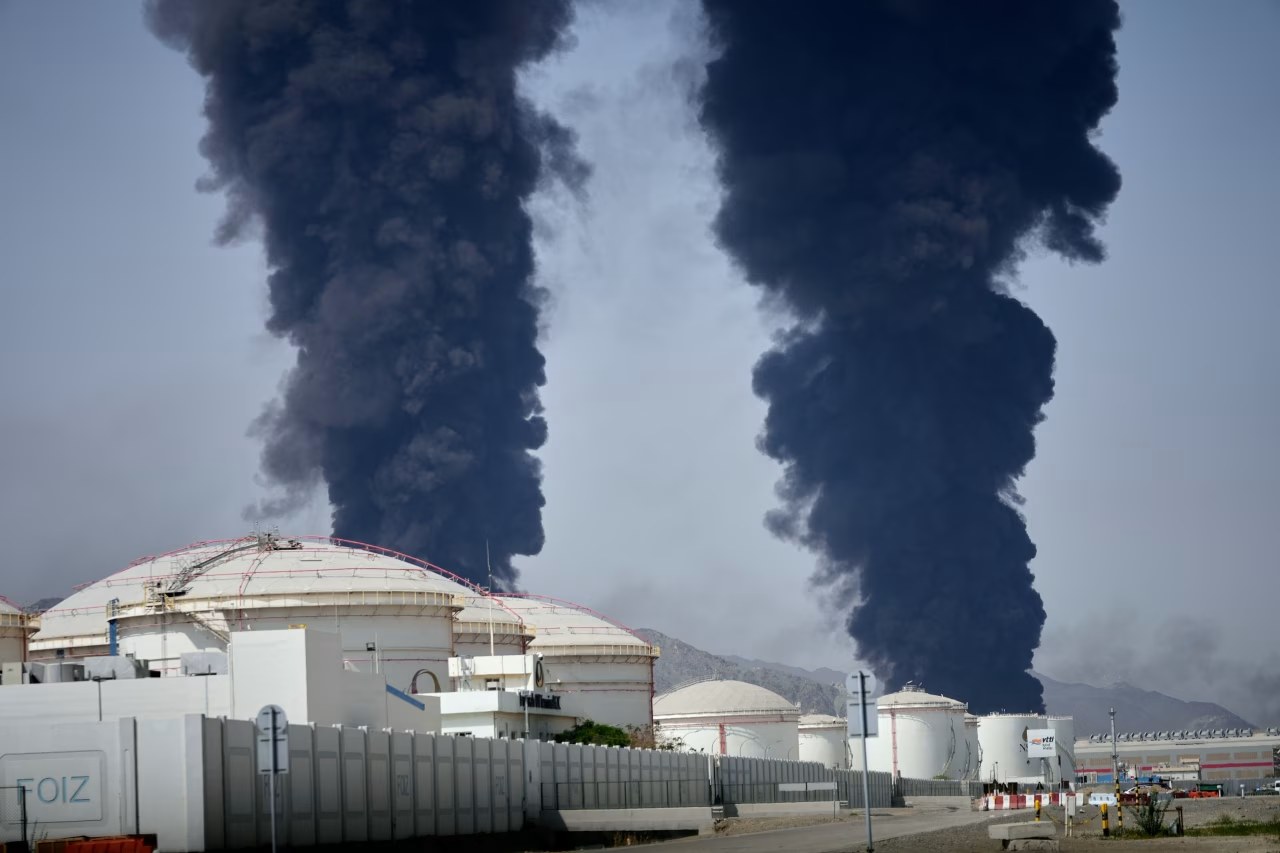
Battle Damage Assessments Replace Inventories as Oil’s Key Price Driver
- Iranian strikes on Persian Gulf energy plants triggered double-digit intraday crude swings.
- Traders lack reliable outage figures, forcing the market to price a worst-case supply shock.
- Natural-gas benchmarks TTF and JKM jumped 18 % and 16 % respectively on Asian buyers’ scramble.
- Refiners accelerate spot purchases, lifting Brent prompt spreads to the steepest since 2022.
Without fast, credible damage reports, volatility will eclipse fundamentals.
PERSIAN GULF—Global crude and gas prices no longer move on inventory spreadsheets—they lurch with each satellite photo and unverified social-media clip. Iranian missiles and drones have introduced a pricing variable military analysts call the “fog-of-war premium,” a risk layer that can’t be modelled by conventional supply-demand software because the data set literally burns or smokes on the ground.
Energy desks from Geneva to Houston spent Thursday chasing rumours: Is Iran’s largest gas condensate splitter offline? Did a single rocket pierce a storage dome at Saudi Arabia’s 550,000-barrel-per-day Abqaiq stabilisation plant? Answers were scarce, so algorithmic traders widened bid-ask spreads and options desks priced 30-day implied volatility on Brent at 52 %, its highest since the Ukraine invasion.
“It’s a nightmare,” a Singapore-based West-to-East arbitrage trader told the Wall Street Journal. “We can’t hedge what we can’t quantify.” The episode underscores a structural shift: in modern conflict, battlefield momentum now outruns the market’s capacity for price discovery—leaving investors trading blind.
When Outage Rumours Replace Tanker Data
Before the first Gulf War, energy analysts relied on Lloyd’s List tanker tracking and weekly American Petroleum Institute statistics; today, they refresh Telegram channels and Planet Labs satellite dashboards every ten minutes. The change sounds incremental until a geopolitical shock, like Iran’s overnight salvo, proves that physical supply can be disrupted faster than the information needed to trade it.
“Markets hate ambiguity more than bad news,” says Dr. Carole Nakhle, director of London-based consultancy Crystol Energy. “When traders can’t distinguish between a 200,000-barrel-per-day hiccup and a 2 million-barrel structural loss, they default to the extreme.” Nakhle notes that Brent’s 13 % intraday spike Thursday matched the magnitude of the 1990 Kuwait invasion, yet physical stocks are far higher now, proving sentiment—not inventory—is driving price action.
The phenomenon is amplified by the concentration of export capacity inside the Strait of Hormuz. Roughly 21 million barrels of crude, condensate and petroleum products pass through the 21-mile-wide channel daily—equivalent to 21 % of global consumption. U.S. Energy Information Administration mapping shows eight onshore processing complexes within 50 kilometres of Iranian territory, each a potential bullseye.
Without accurate battle damage assessments (BDAs), hedge funds fall back on worst-case scenario pricing. A widely circulated brokerage note assumed Abqaiq shut for 60 days; the assumption alone lifted the front-month Brent contract by $7.40 per barrel, adding roughly $75 million to the nominal value of a standard 1-million-barrel cargo. When Saudi officials later released infrared imagery showing only minor shrapnel scarring, prices eased—but not before refiners from South Korea to Poland sprinted into spot tenders, tightening an already backwardated curve.
The episode illustrates how BDAs have morphed from military jargon into the single most important fundamental in energy pricing. Until engineers can physically inspect cracked distillation columns or measure hydrogen sulphide leaks, paper barrels will continue gyrating on rumours alone.
Why Satellite Pictures No Longer Tell the Whole Story
Commercial satellite firms launched dozens of micro-satellites promising real-time transparency, yet Thursday’s volatility proves imagery is only as useful as the analyst interpreting it. Cloud cover, angle of capture, and classification of military targets create blind spots that algorithms can’t arbitrage away.
“People think a 30-centimetre resolution photo equals certainty,” says Dr. Omar Al-Ubaydli, director of research at the Bahrain-based Derasat think-tank. “But you still need ground-truth verification—engineers climbing tanks, measuring thermal stress on steel, collecting residue samples. That takes days, sometimes weeks.” Al-Ubaydli warns that overreliance on open-source intelligence has created a false sense of precision; markets now react to pixels rather than verified metallurgy.
Compounding the problem, both state and non-state actors actively seed disinformation. Within three hours of the Iranian strike, a doctored image claiming a massive plume over Qatar’s Ras Laffan LNG terminal circulated on Twitter; Asian spot LNG prices leapt $1.80 per million British thermal units before traders flagged the photo as a 2015 cyclone file. The incident underscores how easily a single manipulated JPEG can move billion-dollar paper positions.
Refiners, meanwhile, accelerate spot purchases as insurance. Indian state-processor HPCL tendered for two Very Large Crude Carriers loading in mid-month, paying a $2.30-per-barrel premium to Monday’s assessed price. Traders describe the buying as “panic cover”—a pre-emptive move to guarantee throughput even if actual barrels are plentiful. The behaviour feeds a self-reinforcing loop: fear of shortage triggers real shortage as inventory is hoarded.
Until independent surveyors such as SGS or Intertek gain physical access to damaged sites, expect satellite-driven volatility to remain elevated. History suggests the lag between strike and survey averages five trading sessions—long enough for options straddles to more than double in value.
How Much Lost Output Triggers an IEA Stock Release?
The International Energy Agency’s 31 industrialised members hold 1.5 billion barrels of public and industry stocks, enough to cover 90 days of net imports. Yet the Paris-based body has only authorised coordinated releases four times since 1991, proof of the political sensitivity surrounding strategic petroleum reserves (SPRs).
Under current rules, a formal release requires a 7 % shortfall in daily supply—roughly 7.6 million barrels per day—to be deemed “severe.” Thursday’s still-unverified losses sit at an estimated 1.8 million barrels per day, below the threshold but above the 1.4 million that pushed the IEA into action after Libya’s 2011 civil war, according to energy economist Phil Verleger.
“The IEA won’t move on rumours,” says Verleger, who helped design the agency’s 1974 charter. “They need satellite corroboration plus national submissions showing at least a 5 % supply disruption sustained for ten days.” With U.S. mid-term elections looming, Washington is particularly reluctant to drain its SPR unless absolutely necessary; the Biden administration tapped 180 million barrels in 2022 and wants inventories above 350 million barrels heading into winter.
Japan and South Korea, both IEA members, privately favour a release to cap prices above $100 per barrel, but EU states are split. Germany argues hoarding expensive barrels now could leave Europe short if Russia further weaponises gas this winter. The stalemate keeps the burden of balancing the market on price rather than policy, explaining Brent’s persistent backwardation.
Forward curves imply traders assign a 40 % probability to a 60-million-barrel IEA release within 30 days, according to a JPMorgan note. Until clarity emerges, every rumour of fresh strikes will send front-month futures limit-up as algorithms price the tail-risk of an SPR-less deficit.
Could Asian Spot LNG Replace Lost Gulf Feedgas?
Liquefied natural gas markets face a parallel dilemma: Qatar and Iran jointly own the world’s largest gas field, North Dome/South Pars, feeding 77 million tonnes per annum of LNG liquefaction trains at Ras Laffan. Any indication of upstream damage ricochets through Asian spot markets where Japan, Korea and China buy incremental winter cargoes.
Traders initially feared Iran’s missiles had struck compression platforms inside North Dome, a scenario that could curtail 12 % of global LNG supply. By Friday morning, Qatari officials privately told buyers that upstream flow rates were unchanged, yet spot prices remained 14 % above pre-attack levels because buyers scrambled to replace term volumes with short-term cover.
“Asian buyers remember Fukushima and the 2021 Texas freeze,” says Alex Siow, senior LNG analyst at Poten & Partners in Singapore. “They’ll pay a risk premium even if fundamentals look soft.” Indeed, storage across the top five Asian importers is 57 % full, 11 percentage points above the five-year average, according to Kpler shipping data. Still, spot deals for January delivery changed hands at $15.80 per million Btu, up from $13.30 a week earlier.
The price signal is pulling Atlantic Basin cargoes eastward. At least four U.S. LNG vessels diverted from Europe to Asia after the strikes, lengthening voyage duration by 18 days and tightening the trans-Atlantic arbitrage. Shipping brokers estimate the diversion adds $1.20 per million Btu to landed cost, inflation European utilities hoped to avoid amid already record power prices.
Until pipeline flow data from Qatar Petroleum and National Iranian Oil Co. are published next month, traders will price LNG as if gas is the next domino, not the last. The standoff cements Asia’s spot premium and keeps European storage injections running above seasonal norms, despite mild weather.
Will Hedgers or Hedge Funds Set the Next Benchmark?
Commitment of Traders data from the U.S. CFTC shows money managers raised net-long Brent and WTI positions by 61,000 contracts in the week ended Tuesday—before the Iranian strike. The buying wave lifted bullish bets to a 16-month high, positioning that now looks vulnerable if physical damage proves limited.
Yet producers aren’t taking the other side. U.S. shale executives, burned by hedging losses in 2021, have layered only 28 % of expected 2024 output, well below the 10-year average of 48 %, according to Barclays energy equity analyst Terry Lutz. “Boards want optionality above $90, not collars at $75,” Lutz says, explaining why call skew remains elevated.
The asymmetry creates reflexive volatility: if BDAs show modest outages, hedge funds unwind length into thin holiday markets, accelerating a $10 downside move. Conversely, confirmation of prolonged outages forces shorts to cover, propelling prices toward triple digits. Either way, open interest expansions indicate the next $15 swing may occur faster than the 2014 crash.
Options markets telegraph the angst. Brent 25-delta risk reversals—the premium of calls over puts—spiked to 8.2 % in favour of calls, the highest since the Ukraine invasion. Traders seeking tail-risk protection paid record implied volatilities for $120 call options expiring in February, strikes that traded at 42 cents last month now commanding $2.10.
With positioning so lopsided, the stage is set for a violent repricing once verifiable field data emerges. Whether that repricing lands at $85 or $115 depends less on OPEC and more on engineers walking tank farms with handheld gas detectors—an inversion of the traditional hierarchy that governs energy markets.
Frequently Asked Questions
Q: Why are oil prices swinging so hard after the latest Gulf strikes?
Prices surged because Iran targeted critical energy infrastructure and traders lack real-time data on how much capacity is offline. Until satellite imagery and engineering reports quantify damage, the market prices in a worst-case outage premium.
Q: What exactly is a battle-damage assessment (BDA)?
A BDA is the military and commercial process of determining what was hit, how badly, and how long repairs will take. For energy investors, BDAs decide whether a 5 % supply shock is hours or months long, making them the single most important variable in current price discovery.
Q: How long can Gulf markets trade ‘blind’ before inventories ease the risk?
IEA data show OECD crude stocks at 28-day forward cover. If lost output exceeds 1.5 million bbl/day for more than three weeks, inventory cushions evaporate and Brent could spike past $110/bbl, according to Rystad Energy modelling.
📰 Related Articles
- Fertilizer Shares Surge as Mideast Crisis Chokes 20% of Global Supply
- Crude Caps 11% Weekly Surge as Hormuz Tanker Routes Remain Paralyzed
- Steel, Chemicals and Aluminum Face Crossroads as Costs, Breakup Calls and Supply Risks Collide
- IEA’s 400-Million-Barrel Release Fails to Dent Brent at $91 as Hormuz Risks Dominate
