Oil Spikes 31% to $119.50 Then Crashes Back to $90 in One Wild Day
- U.S. oil futures leapt from $92 Friday to $119.50 Sunday night—a 31% gain—on Iran war panic oil prices
- Benchmark crude ended Monday at $94.77, up only 4.3% after President Trump told CBS the war is “very complete” 4.3% higher
- Strait of Hormuz shipping remains shut, keeping upside risk alive
- More than 1,200 Iranians and seven U.S. service members have been killed death toll
Overnight panic evaporates as traders parse Trump comments and G7 talks
OIL PRICES—Oil markets lived up to their volatile reputation Sunday night as U.S. crude futures rocketed from Friday’s $92 close to $119.50 in electronic trade, then collapsed back toward $90 by Monday afternoon. The 31% round-trip swing—one of the wildest in modern history—was driven by Iran’s vow to shut the Strait of Hormuz and reversed after President Trump told CBS News the conflict is “very complete, pretty much.”
Benchmark West Texas Intermediate ended the day at $94.77, up just 4.3%, leaving traders to reassess how much of the war premium belongs in the price.
How the Strait of Hormuz Lit the Fuse
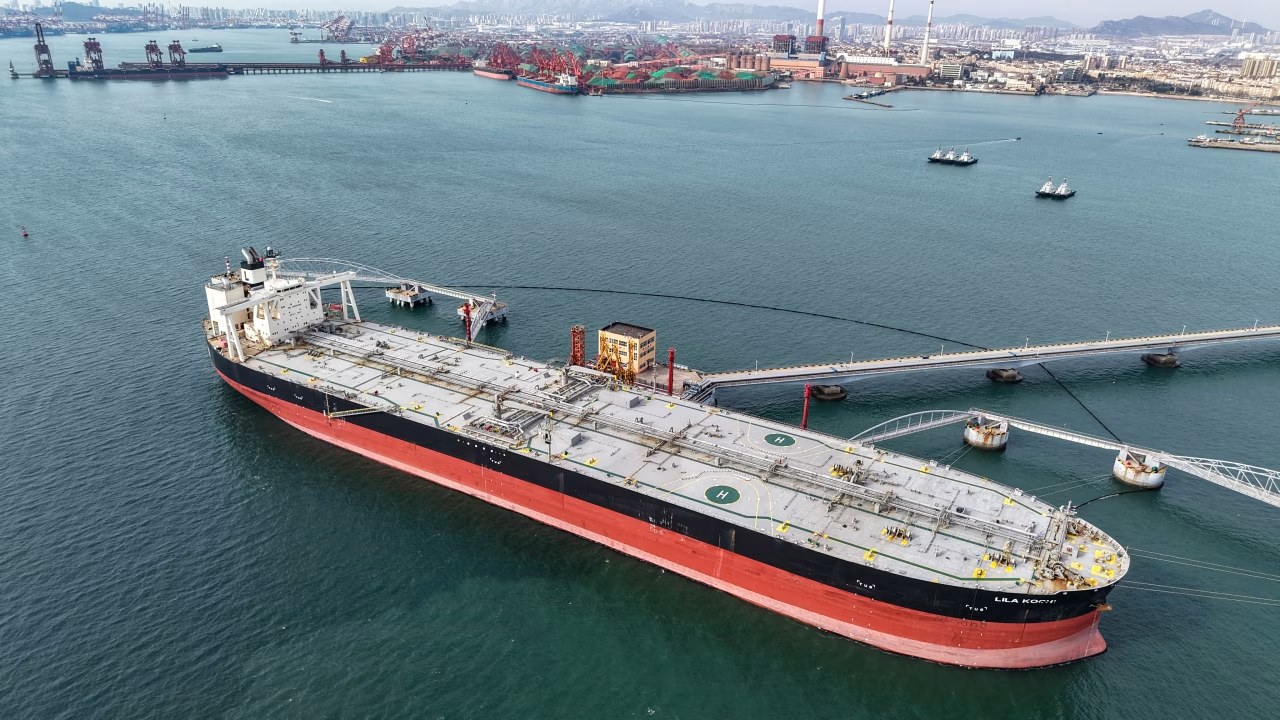
Iran’s threat to attack any tanker choked the world’s most important chokepoint
For more than a week after the initial U.S.–Israel strikes on Iran, crude barely budged. Prices ticked up only modestly even as bombs fell across the region. The calm broke when Tehran announced it would target any vessel attempting to transit the Strait of Hormuz, through which a fifth of global supply flows. By Sunday evening panic had set in. Traders bid futures up in thin electronic trade, pushing the front-month contract from $92 to within cents of $120 before the White House offered a calming headline.
The strait is the only sea passage from the Persian Gulf to the open ocean, making it the single most critical artery for oil exports from Saudi Arabia, Iraq, the UAE and Kuwait. Roughly 21 million barrels a day move through the 21-mile-wide channel, so even the perception of a blockage triggers reflex buying. Iran’s Revolutionary Guards have previously mined the waterway and seized tankers, but this weekend’s threat was the first time the government explicitly warned every ship risked being targeted.
Energy desks spent Sunday re-running war-game scenarios. Some stressed-test models assuming a complete 30-day closure, which would remove about 630 million barrels from global trade—roughly equal to the entire combined strategic reserves of the U.S., Europe and Japan. Those runs generated headline prices above $150, encouraging algorithmic funds to buy first and ask questions later. By 11 p.m. Eastern, the front-month WTI contract had posted the largest overnight percentage gain since futures began trading in 1983.
Physical traders, however, noted that no tankers had actually been hit by Sunday night. Satellite images showed a handful of Very Large Crude Carriers (VLCCs) anchored inside the strait, but not burning. That distinction—threat versus action—became the key pivot once President Trump spoke after midnight.
Oil’s 24-Hour Round Trip
Fri 4 p.m.
Sun 8 p.m.
Mon 12 a.m.
Mon 3 a.m.
Mon 2:30 p.m.
Source: WSJ market data
What Trump Said to Reverse the Rally
President calls Iran war “very complete,” then vows to push on
Shortly after midnight, President Trump told CBS the war is “very complete, pretty much,” a phrase markets interpreted as hinting at an imminent cease-fire. Crude promptly peeled off its highs. Hours later Trump flipped, telling reporters “we haven’t won enough” and vowing to press ahead. The conflicting signals kept volatility elevated but left prices well below the overnight peak. Traders say the erratic messaging has become typical: “As long as shipping is stopped the pain point remains,” Atlantic Council economist Josh Lipsky said.
The interview, taped in the Oval Office, aired in part at 12:30 a.m. Eastern. Within minutes, electronic trading platforms lit up with sell orders. Algorithms keyed on the word “complete” dumped long positions, pushing WTI back below $110. By 3 a.m., the contract had surrendered half its gain. European desks arriving at their desks labeled the move a “headline unwind,” noting that volume was thin and spreads wide.
Yet the calm proved temporary. At 7:15 a.m., the White House press pool reported Trump had left the door open to further strikes. “We haven’t won enough,” he said. “We go forward, more determined than ever to achieve ultimate victory.” Futures immediately bounced $4, but the upward momentum lacked conviction. By the open of New York trading at 9 a.m., crude was back below $100.
Traders have grown accustomed to such whipsaws. Josh Lipsky notes that markets now process Trump’s foreign-policy pronouncements more slowly than in 2017, suggesting investors view them as tactical rather than strategic. Still, the overnight reversal underscored how much headline risk is embedded in current prices. “As long as shipping is stopped, the pain point remains,” Lipsky told the Atlantic, implying that even dovish rhetoric cannot fully offset a physical disruption.
The conflicting messages also complicate efforts by the G7 to coordinate a response. Energy ministers were scheduled to meet Tuesday to discuss potential releases from strategic reserves, but officials privately say they need clarity on U.S. policy before committing barrels. The uncertainty kept implied volatility on WTI options above 60%—a level last seen during the 2008 financial crisis.
Peak vs Close
Overnight high
119.5$/bbl
Monday close
94.77$/bbl
▼ 20.7%
decrease
Source: WSJ
Is the War Premium Gone?
Traders weigh odds of further escalation after G7 talks
Despite the violent reversal, analysts warn the market has not fully priced the risk of a prolonged conflict. Israel reportedly struck oil facilities in Tehran and Alborz province over the weekend, and Iran’s foreign minister has rejected cease-fire calls. More than 1,200 Iranian and seven American military deaths have been confirmed. With the strait still closed to tanker traffic, many desks model a $10–$15 geopolitical premium in Brent and WTI, implying limited downside unless shipping lanes reopen.
Derivatives markets signal lingering anxiety. Call options that pay off if WTI hits $130 by April expiry changed hands at $1.60 Monday, up from $0.35 Friday. Volume in $150 calls—effectively a bet on total strait closure—spiked to 12,000 contracts, the highest on record. Simultaneously, put spreads at $85 and $80 saw heavy buying, indicating traders hedging for a quick diplomatic breakthrough. The net result is a steep volatility smile skewed to the upside, a pattern common when tail-risk odds rise.
Physical-market data also point to tightness. Brent’s prompt-timespread—the gap between the first- and second-month contracts—flipped to a $1.90 backwardation Monday, the steepest since 2022. A backwardated structure encourages inventory draws because barrels tomorrow are priced above barrels today, reinforcing upside momentum if supply fears intensify.
Yet some analysts argue the strait’s closure has already been priced in. Pierre Andurand, head of the eponymous commodities fund, told clients that current fundamentals justify $82 crude, implying a $12 risk premium. “Unless we see actual hits on tankers or a U.S. naval escort, the market will remain in a $90–$100 straddle,” he wrote. Commerzbank echoes that view, noting that OPEC has 5 million barrels a day of spare capacity that could be shipped via the Saudi East-West pipeline to the Red Sea, blunting the impact.
The wildcard is diplomatic. Iran’s newly appointed supreme leader, a son of the late Ali Khamenei, signaled defiance in his first public remarks, vowing “resistance until victory.” Concurrently, France floated a 48-hour cease-fire proposal at the U.N., but Tehran rejected it. Until one side blinks, traders say the fair-value band is $90–$110, with the edges defined by headlines rather than inventories.
What Happens Next?
Focus stays on Hormuz flows and any diplomatic breakthrough
Energy watchers say the next catalyst is concrete news on strait reopening or further military escalation. G7 energy ministers are scheduled to meet Tuesday to discuss coordinated releases from strategic reserves if the blockade persists. Until then, options markets imply a 30% probability of another $10 move in either direction within the week. For consumers, the whipsaw leaves gasoline prices flat for now, but stations typically lag crude by several days, meaning pump volatility could arrive just as spring driving season begins.
The U.S. Department of Energy declined to confirm whether it will tap the Strategic Petroleum Reserve, but officials note the stockpile stands at 365 million barrels, enough to cover a 120-day Hormuz outage at current import levels. Japan and South Korea hold another 520 million barrels combined, giving the allies roughly 90 days of cover. Analysts reckon a coordinated release of 60 million barrels could knock $10 off futures, but only if the strait remains navigable; otherwise, prices would likely rebound.
Shipping insurers are also watching closely. The Baltic Exchange’s war-risk premium for Middle-East voyages jumped to $180,000 a day Monday from $45,000 Friday, effectively pricing smaller traders out of the region. If underwriters widen exclusions to the entire Arabian Sea, freight rates for clean products like gasoline could double, amplifying the pass-through to U.S. drivers just as refiners ramp up for summer blends.
Meanwhile, the White House continues to send mixed signals. National-Security Adviser Mike Waltz told Fox that “all options remain on the table,” language markets interpret as leaving room for either a cease-fire or deeper strikes. Trump’s own messaging has oscillated between triumphant and hawkish within hours, reinforcing the sense that policy is being made in real time.
All of this leaves forecasters reluctant to lock in a path. Bank of America still targets $85 WTI for year-end, but caveats that any forecast is “subject to removal” if the strait stays shut. Goldman Sachs raised its 3-month Brent target to $105 but left a 25% probability of $130 if diplomacy fails. For now, traders are positioned for more two-way volatility rather than a directional drift, keeping the VIX-style oil-vol index above 50 for the first time since 2022.
The ultimate arbiter will be tanker movements. Satellite firm TankerTrackers reports 17 VLCCs idling outside the strait, their AIS transponders dark. If even one is cleared through, expect algorithms to cover shorts quickly. Until then, the market remains in headline limbo, with $90–$100 the new tactical range and tail-risk tails stretching to $150.
Frequently Asked Questions
Q: Why did oil spike 31% in one day?
Iran’s threat to attack any ship using the Strait of Hormuz triggered panic buying Sunday night, pushing U.S. futures from $92 to $119.50 before Trump’s ‘very complete’ comment reversed the move.
Q: Where did oil prices finally settle?
After touching $119.50 overnight, benchmark U.S. futures closed Monday at $94.77, up 4.3% on the day but well below the panic high.
Q: Is the Strait of Hormuz still blocked?
Sources confirm shipping through the strait has stopped; traders say as long as tankers stay idle the upside risk to prices remains.
Sources & References
- Primary SourceThe 24 Hours When Oil Markets Went Wildwsj.com
- Supporting SourceThe Wild 24-Hour Rise and Fall of Oil PricesMar 09, 2026bing.com
- Supporting SourceThe Wild 24-Hour Rise and Fall of Oil PricesMar 09, 2026bing.com
