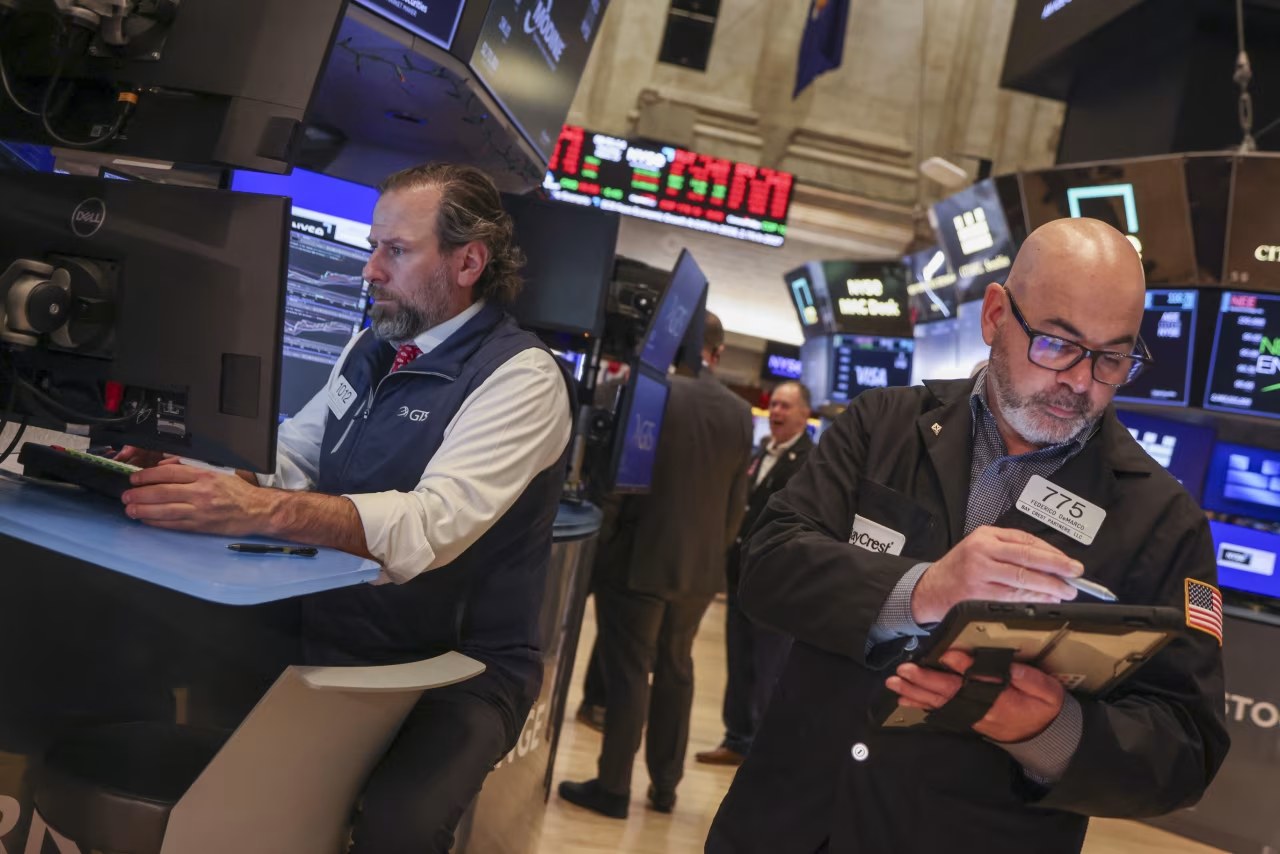
S&P 500 Drops 1.3% as Oil-Supply Shock and Hot CPI Erase Three Expected Fed Cuts
- S&P 500 falls 1.3%, its third straight daily loss, as crude spikes 4% after fresh strikes on Middle-East energy sites.
- Cboe VIX closes above 20 for the first time in six weeks, reflecting repricing of rate-cut bets.
- Fed-funds futures now price in only one 25-basis-point cut by December, down from three a month ago.
- Energy stocks gain 2.4%, but tech and discretionary shares lead broad declines.
Investors dump equities as geopolitical risk collides with sticky inflation data
FEDERAL RESERVE—Major U.S. indexes extended their slide Thursday after a fresh round of drone attacks targeted oil-and-gas installations in the Persian Gulf, sending Brent crude up more than $3 to settle at an eight-week high. The strikes, which followed an earlier assault on shipping lanes, stoked fears that a wider regional conflict could disrupt global energy supplies and keep inflation elevated—just as consumer-price data surprised to the upside for the second consecutive month.
The S&P 500 dropped 1.3%, bringing its three-day decline to 2.7%, while the Nasdaq Composite fell 1.6% and the Dow Jones Industrial Average shed 430 points. The Cboe Volatility Index, Wall Street’s “fear gauge,” closed at 20.4, its highest level since late March, as traders scrambled to price out earlier expectations for as many as three Federal Reserve rate cuts this year.
“Markets were already on edge after this week’s CPI and PPI prints came in hotter than forecast,” said Liz Ann Sonders, chief investment strategist at Charles Schwab. “Add a geopolitical supply shock and you get a classic risk-off move—energy stocks up, everything else down.”
Energy Markets React Instantly to Gulf Strikes
Front-month Brent futures leapt $3.12, or 4%, to $81.74 a barrel, the highest close since early March, after the Houthis claimed responsibility for drone raids on two Saudi Aramco facilities and a Kuwaiti refinery. U.S. West Texas Intermediate crude gained 3.9% to $77.05. Brent’s 14-day relative-strength index jumped above 70, a technical signal that the commodity is overbought.
Spare capacity cushion is thinner than in previous crises
“The market is repricing geopolitical risk because spare OPEC capacity is only 3.4 million barrels a day, the lowest since 2018,” said Helima Croft, head of global commodity strategy at RBC Capital Markets. “Any outage now has an outsized impact on futures curves already in steep backwardation.”
Energy shares were the lone bright spot in equities: the S&P 500 Energy sector rose 2.4%, led by Marathon Oil (+4.1%) and Schlumberger (+3.7%). Defensive utilities also eked out a 0.3% gain, while all other S&P sectors closed in the red. Technology and consumer-discretionary names, whose valuations are most sensitive to higher discount rates, fell 1.9% and 2.2%, respectively.
Meanwhile, the U.S. 10-year Treasury yield climbed five basis points to 4.55%, extending its weekly rise to 18 basis points. The yield on two-year notes touched 4.97%, the highest since early November, reflecting diminished appetite for fixed-income assets as inflation expectations tick up.
With oil futures surging and bond yields rising, the dollar index advanced 0.4% against a basket of peers, pressuring emerging-market equities and gold, which slipped 0.6% to $2,328 an ounce after hitting a record high earlier in the week.
The next flashpoint traders are watching is whether the U.S. or its allies respond militarily to the strikes, a scenario that could push Brent toward the $90 level analysts at Goldman Sachs have flagged as a trigger for demand destruction.
Sticky CPI and PPI Force Traders to Unwind Rate-Cut Bets
Wednesday’s consumer-price index rose 0.4% month-over-month, double the consensus forecast, while core services inflation excluding shelter accelerated to 5.4% annually. Producer prices added 0.5%, the fastest pace since September. The surprise repricing of inflation risk drove two-year Treasury yields up 22 basis points this week alone.
Fed-funds futures now imply only 35 basis points of easing in 2024
“Markets went from pricing three cuts to one in six trading sessions,” said Michael Gapen, U.S. economist at Bank of America Securities. “The speed of the unwind is reminiscent of the 2022 bond tantrum, when energy-driven inflation forced the Fed to hike by 75 basis points per meeting.”
According to CME’s FedWatch tool, the probability of a September cut dropped to 42% from 68% a week earlier. December 2024 fed-funds futures now imply a terminal rate of 4.90%, compared with 4.20% at the start of the month.
Higher-for-longer rate expectations hammered rate-sensitive corners of the market. The Nasdaq Golden Dragon China Index fell 3.2%, while unprofitable tech names like Rivian and Plug Power slid more than 5%. Home-builder ETF SPDR S&P Homebuilders declined 2.8% as the average 30-year mortgage rate rose to 7.12%, its highest level since November.
Currency markets also reflected the shift: the euro slipped below $1.07 for the first time in three months, and the Japanese yen weakened past ¥156 per dollar, prompting verbal intervention warnings from Tokyo.
Looking ahead, traders will scrutinize next week’s Fed minutes and a speech by Chair Jerome Powell at the Economic Club of New York for any hint that policymakers are reconsidering their patient stance amid the renewed inflation impulse.
What History Says About Oil Shocks and Equity Drawdowns
Since 1970, there have been 12 episodes where oil prices spiked more than 10% within a month on geopolitical events. In those instances, the S&P 500 fell an average of 4.2% over the following three months, according to DataTrek Research. Energy shares outperformed the broader index by 15 percentage points on average, while consumer-discretionary lagged by 9 points.
1973, 1990 and 2003 shocks offer playbook for today
“The common denominator is that equities don’t bottom until oil stops rising and inflation expectations stabilize,” said Nicholas Colas, co-founder of DataTrek. “In 1990, stocks fell 20% peak-to-trough as Brent doubled during the Gulf War, but rebounded 25% once a cease-fire was reached and CPI rolled over.”
Current valuations add another layer of vulnerability. The S&P 500 trades at 19.8 times next-twelve-month earnings, a 14% premium to its 20-year average, according to FactSet. Tech giants, which account for 32% of index weight, are priced at 27 times forward earnings, leaving little room for disappointment if discount rates move higher.
Corporate buybacks—historically a buffer during selloffs—are also slowing. Goldman Sachs estimates S&P 500 gross buybacks will total $850 billion in 2024, down from $930 billion last year, as elevated rates make funding repurchases more expensive.
Still, some strategists argue that the U.S. economy’s reduced energy intensity compared with prior decades limits the downside. “It now takes 60% less oil to generate a dollar of GDP than in 1980, so the macro hit is smaller,” said Ed Yardeni, president of Yardeni Research. “The bigger risk is a 1970s-style wage-price spiral if workers demand higher pay to offset headline inflation.”
History suggests volatility will persist until either diplomatic channels cool the Middle-East temperature or data confirm inflation is returning toward the Fed’s 2% target.
Where Do Markets Go From Here?
Implied volatility on one-week S&P 500 options rose to 24%, the highest since March, indicating traders are positioning for further swings. The put-call skew—a measure of downside protection demand—hit its most extreme level since the regional-bank stress in May 2023, according to Susquehanna Financial.
Some investors see opportunity in oversold conditions
“If you believe the Fed is data-dependent and not geopolitics-dependent, every spike in oil is a chance to buy high-quality growth at a discount,” said Tony DeSpirito, BlackRock’s global chief investment officer of fundamental equities. “We added to mega-cap tech on Thursday, betting that forward earnings are intact even if multiples compress short-term.”
Others prefer to wait for confirmation that core inflation is rolling over. “We need to see at least two consecutive months of sub-0.2% core CPI before declaring victory,” said Kristina Hooper, chief global market strategist at Invesco. “Until then, cash yielding 5.4% in money-market funds looks attractive versus equities with an earnings yield of 5.1%.”
Technical analysts note that the S&P 500’s 50-day moving average is flattening, a development that preceded 5–7% corrections in both 2022 and 2023. Support is seen around 4,950, the March swing low, with resistance at the record close of 5,255.
Earnings season, which kicks off in two weeks, could provide the next catalyst. Consensus expects S&P 500 profits to grow 9.2% year-over-year, but guidance has been trending lower, with 76 companies issuing negative pre-announcements versus 32 positive ones, the most negative ratio since late 2022, according to FactSet.
Ultimately, the trajectory of both inflation and geopolitics remains fluid, leaving markets prone to headline-driven swings until clearer signals emerge from either the Fed or the Middle East.
Frequently Asked Questions
Q: Why did stocks fall after the latest Middle-East attacks?
Crude benchmarks jumped 4% on Thursday after drone strikes hit oil-and-gas sites in the Persian Gulf, reviving fears of supply shocks that could push global inflation higher and force the Fed to keep rates elevated.
Q: How much did the S&P 500 drop and what does the VIX show?
The S&P 500 fell 1.3%, its third straight daily decline, while the Cboe Volatility Index closed above 20 for the first time in six weeks, signalling that investors are pricing in larger near-term price swings.
Q: Are Fed rate cuts still expected this year?
Futures now imply only one 25-basis-point cut by December, down from three cuts priced a month ago, after stronger CPI and PPI readings and geopolitical risks to energy prices.
📰 Related Articles
- Crude Slips Below $95 as Mid-East Supply Fears Cool and Asia Stocks Split
- Vincorion IPO Surges 15% on Frankfurt Debut Amid Europe’s Defense Spending Boom
- Dow Notches First Four-Week Losing Streak Since 2023 as Nasdaq Nears 10% Correction
- Investors Brace for Iran Conflict as Financial Firms Push War-Driven Pitches
