OPEC Keeps 2025 Demand Growth at 1.34 mb/d Even as Hormuz Disruption Erases 1 mb/d of Supply
- OPEC’s July monthly report leaves 2025 oil-demand growth unchanged at 1.34 million barrels a day despite the Strait of Hormuz effectively closing.
- Brent crude whipsawed from a spike near $120 to $91 in three trading sessions as Kuwait and others began cutting output.
- Cartel offers no direct comment on the Middle East conflict but warns ‘trade-related and geopolitical dynamics require close monitoring’.
- 2026 demand growth revised marginally higher to 1.38 mb/d, implying a softening trajectory rather than an outright collapse.
With 20 % of global seaborne crude at risk, OPEC’s steady forecast signals confidence that economies can absorb the shock—if the chokepoint reopens soon.
OPEC—VIENNA—OPEC’s latest monthly oil-market report, released Wednesday, carries the same headline number as last month: global demand is expected to rise by 1.34 million barrels a day in 2025. Yet the context could not be more different. Over the past week Iran-linked clashes have closed the Strait of Hormuz, Kuwait has begun trimming production, and Brent futures have swung in a 30 % range that peaked just shy of $120.
The cartel’s refusal to revise the figure downward—2026 growth was nudged up to 1.38 mb/d—suggests either quiet confidence that shipping lanes will reopen or a reluctance to telegraph alarm to already-jittery consumers. “Several factors are anticipated to support the global economic growth dynamic,” the report states, listing resilient U.S. payrolls, rebounding Chinese manufacturing and euro-zone stimulus without mentioning the war that has paralysed the Gulf.
Analysts say the forecast stability is less a prediction than a messaging device. “OPEC is signalling that, on paper, the world can live without Hormuz for a few weeks,” says Amrita Sen of Energy Aspects. “But if the strait is still shut in August, the numbers will have to move fast.”
Why OPEC’s Unchanged Forecast Masks a 1 mb/d Supply Hole
The arithmetic is brutal: roughly 21 million barrels a day of crude, condensate and refined products normally transit the Strait of Hormuz, according to the U.S. Energy Information Administration. With the channel now described by shippers as ‘effectively closed’, tanker trackers Kpler estimate that Gulf exporters have slashed liftings by just over 1 mb/d within seven days.
Kuwait Petroleum Corp. has shut in 180 kbd from the 270 kbd Al Ahmadi gathering centre, a company spokesman confirmed, while Iraq’s Basrah Oil Co. trimmed 250 kbd and Saudi Aramco quietly lowered allocations to term buyers by 300 kbd. Add in smaller curbs from Qatar and the UAE, and the voluntary cuts already exceed the 1 mb/d mark—more than the 900 kpd surplus OPEC had expected for the whole of 2025.
Yet the cartel’s July report keeps the demand curve untouched. “They are treating the disruption as temporary,” says Martijn Rats, chief commodities strategist at Morgan Stanley. “If you embed a supply shock into the baseline, you essentially admit structural shortage, and that invites political pressure to pump more.”
OPEC’s own secondary-source data show the group produced 26.73 mb/d in June, down 120 kpd from May. Saudi output at 8.98 mb/d is already 550 kpd below its nominal 10.48 mb/d ceiling, giving Riyadh room to lift volumes quickly should Hormuz reopen. The report also flags that OECD commercial inventories rose 15.8 million barrels in May, the first monthly build this year, providing a thin cushion against further outages.
The forecast gamble rests on two assumptions: that the strait reopens within weeks, and that global GDP growth of 3.1 % in 2025 can withstand $90-plus crude. Both are increasingly questioned. Oxford Economics reckons every sustained $10 price rise shaves 0.2 percentage points off world output after 12 months; at $120, the hit doubles. “OPEC is betting on a diplomatic off-ramp before the demand damage becomes visible,” says Rats.
From $120 to $91: Decoding Brent’s Three-Day Rollercoaster
Monday’s spike to $119.95—Brent’s highest intraday print since 2008—was driven by algorithmic momentum, not physical shortage, exchange data show. CFTC weekly figures released Friday revealed managed-money net-long positions had already hit a 31-month high of 432 000 contracts, amplifying the rally when headlines crossed that Kuwaiti crude depots were operating at reduced rates.
The reversal began after UAE energy minister Suhail al-Mazrouei told Bloomberg that the Emirates can export 1.5 mb/d through the Indian Ocean port of Fujairah even if Hormuz stays shut. Saudi officials privately briefed traders that 3 mb/d of Red Sea capacity remains available, calming fears of a 5 mb/d logistical vacuum. By Wednesday afternoon Brent had surrendered 24 % of its peak, settling at $91.04.
Implied volatility on the front-month contract jumped to 68 %, triple the five-year average, while the prompt-to-six-month backwardation widened to $7.80, signalling immediate scarcity. Yet the curve beyond 12 months barely moved, a sign traders expect geopolitical risk to fade. “The market is pricing a short, sharp disruption,” says Giovanni Staunovo, commodity analyst at UBS Wealth Management. “If we are still here in September, $120 will look cheap.”
Refiners are already adjusting. Indian state-run processors, which import 60 % of their crude via Hormuz, have trimmed runs by 200 kpd and drawn down onshore stocks for the first time since 2020. Europe’s diesel crack spread surged $6 to $31 a barrel, reflecting fears of reduced Middle East distillate exports. Physical differentials for CPC Blend and Basrah Light flipped to discounts against dated Brent for August loading, evidence that barrels are struggling to find buyers.
Kuwait’s 180 kbd Cut Offers a Glimpse Into Gulf Output Curbs
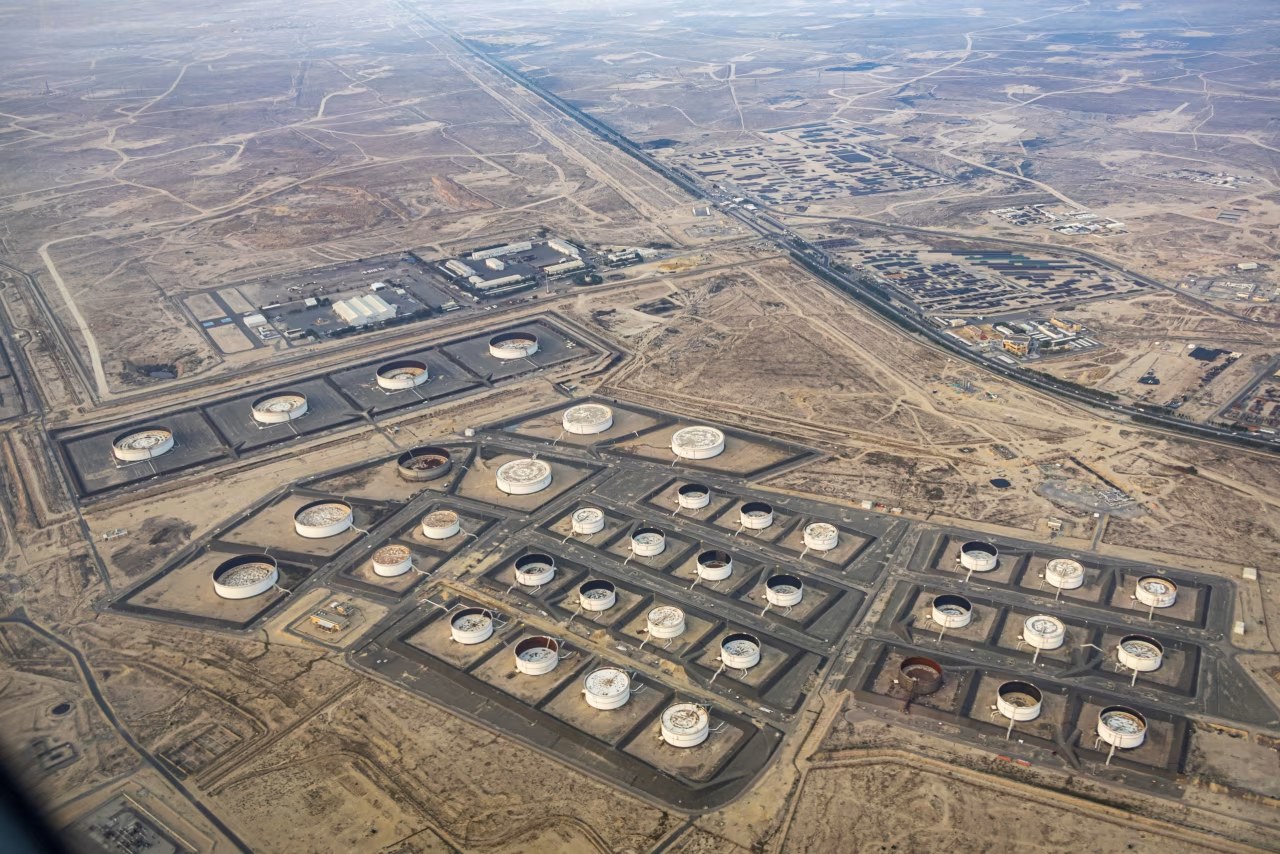
Kuwait’s decision to shut the Al Ahmadi gathering centre is modest compared with its 2.7 mb/d nameplate capacity, yet it carries outsized symbolism. The field produces medium-sour crude prized by South Korean and Chinese refiners for its high diesel yield; losing those cargoes tightens the sour-crude segment that underpins global bunker fuel prices.
National refiner KPC has already deferred two 500 kbl August cargoes to GS Caltex and S-Oil, traders say, replacing them with partials from storage in Sidi Kerir, Egypt. The move underscores how Gulf producers are scrambling to keep supply chains intact even as export routes narrow.
Across the region, similar curbs are unfolding. Iraq’s Basrah Oil Co. trimmed 250 kpd by shutting three degassing stations, while QatarEnergy deferred start-up of a 100 kpd condensate splitter. Saudi Arabia, which can ship 3 mb/d via Yanbu on the Red Sea, has quietly reduced allocations to European term buyers by 10 %, according to refinery sources.
The coordinated restraint is voluntary—no formal OPEC+ pact exists for Hormuz-related cuts—but it mirrors the group’s 2020 playbook of pre-emptive action to avert a price collapse. “They remember April 2020 when the world ran out of storage,” says Sen. “This time they are cutting before the barrels hit the water.”
Is the 2025 Demand Baseline Now Too Optimistic?
OPEC’s July report projects world oil demand at 106.21 mb/d by 2026, up from 104.83 mb/d in 2025. The implied 1.34 mb/d growth next year is only 40 kbd below the 2026 pace, a flattening that the cartel attributes to post-pandemic normalisation and efficiency gains rather than macro weakness.
Yet the International Monetary Fund last week trimmed its 2025 global GDP forecast to 3.1 % from 3.2 %, citing trade fragmentation and energy shocks. Every 1 % drop in global growth historically erases 300 kbd of oil demand, according to a regression by the Oxford Institute for Energy Studies. If the Hormuz closure lasts two months and Brent averages $100, Oxford estimates a 0.3 % GDP hit and a 90 kpd demand loss—enough to wipe out two-thirds of OPEC’s projected growth.
China, the engine of incremental consumption, is already showing cracks. July refinery runs are slated to fall 400 kpd from June as teapot plants cut rates amid negative diesel margins. India’s oil import bill has jumped $1.7 billion month-on-month in dollar terms, pressuring the rupee and prompting Delhi to accelerate gasification plans that could displace 200 kpd of oil by 2026.
OPEC economists privately acknowledge downside risk but argue that aviation jet-fuel demand, still 800 kpd below 2019 levels, offers a buffer. “If Chinese tourists take 10 % more international flights, that’s 100 kpd right there,” says a delegate. Still, the cartel’s own 2019 report over-estimated demand by 400 kpd; repeating that error today would flip the market into surplus.
What Happens Next: Three Scenarios for the Strait
Energy Aspects models three paths. A diplomatic cease-fire within two weeks would see Hormuz reopen at 90 % of normal flows, Brent retracing to $82 and OPEC rolling over current cuts through 2025. A protracted three-month closure would force the IEA to release 1.5 mb/d of strategic stocks, pushing prices back to $95 but triggering global demand destruction of 300 kpd. A six-month shutdown—deemed low probability—would fracture the oil market into Atlantic versus Pacific basins, send Brent above $130 and likely prompt U.S. waivers for Iranian exports, upending OPEC’s market-share calculus.
Inside OPEC, delegates are split. Iraqi and Nigerian members privately favour an emergency 500 kpd output hike via Red Sea routes to prevent demand erosion, while Saudis insist any move must be collective and mirrored by non-OPEC partners. The next JMMC meeting is not scheduled until September, but a virtual session could be called within 72 hours if prices reclaim triple digits.
For now, the official line remains stoic. “We have seen $140 before and the world did not end,” the Kuwaiti delegate told reporters. Whether consumers, central banks and fragile emerging-market currencies share that nonchalance will determine if OPEC’s unchanged forecast becomes a footnote—or a historic miscalculation.
Frequently Asked Questions
Q: Why did OPEC leave its 2025 oil-demand forecast unchanged?
The cartel cited a ‘solid global economy’ and expects demand to rise 1.34 million barrels a day, only 40 kbd below 2026, signalling confidence that geopolitical disruptions will not derail longer-term consumption growth.
Q: How has the Strait of Hormuz closure affected Kuwait?
With the waterway effectively shut, Kuwait has joined other Gulf producers in trimming onshore output; the emirate’s 2.7 mb/d of exports normally rely on Hormuz, forcing immediate storage builds and price discounts.
Q: What drove Brent crude from $120 to $91 in days?
Algorithmic funds rushed in when war risk premiums spiked, then liquidated after UAE and Saudi officials signalled spare capacity could be released via Red Sea ports, easing fears of an acute shortage.
