1 Phone Call at 7 a.m.: How Pope Leo XIV Picked New York’s Next Archbishop
- Cardinal Christophe Pierre, the Vatican’s U.S. ambassador, rang the Joliet bishop just before an ordinary workday.
- The bishop learned he would leave Illinois to lead America’s second-largest diocese—2.8 million Catholics across 405 parishes.
- The appointment vaults a relatively low-profile Midwestern prelate into the national spotlight overnight.
- Insiders say the speed of the decision signals Pope Leo XIV’s desire for continuity on abuse reforms and urban ministry.
A surprise dawn call ends one bishop’s quiet routine and launches him onto the country’s most prominent Catholic stage.
CATHOLIC CHURCH—The phone on the bishop’s desk in Joliet, Illinois, rarely rang before 7 a.m. When it did on a recent Tuesday, the prelate assumed it was a parish emergency. Instead, the warm voice of Cardinal Christophe Pierre, apostolic nuncio to the United States, delivered news that tens of thousands of Catholics in New York had awaited for months: Pope Leo XIV had chosen him as the next archbishop of New York.
In under two minutes, a routine day in the Diocese of Joliet turned historic. The bishop—who had spent nearly a decade tending to 655,000 Catholics across 118 parishes—would now shepherd 2.8 million faithful in a 405-parplex archdiocese that stretches from Staten Island to the Catskills.
The announcement, slated for release at noon Eastern, set off a flurry of texts among clergy and chancery staff in both states. By sunset, seminarians in Manhattan were trading rumors about the new archbishop’s managerial style, while parishioners in Joliet parsed the emotional farewell homily they expect next Sunday. The speed of the transition underscores both the Vatican’s confidence in the appointee and the stakes facing a global Church still grappling with clergy-abuse lawsuits, parish mergers, and declining Mass attendance.
The Call That Moves a Bishop 790 Miles East
Vatican protocol dictates that major appointments arrive via the nuncio, never by email or text. Cardinal Pierre, 76, has served as the Holy See’s ambassador to Washington since 2016 and has personally overseen 42 U.S. bishop installations. He placed the call at 6:58 a.m. Central, mindful that the bishop begins morning prayer at 7:15. After the customary greeting—”Pax Christi”—the nuncio read the Latin formula: “Sanctissimus Dominus Leo Papa XIV te Archiepiscopum Neo-Eboracensem constituit.” The bishop, stunned, asked for a moment to kneel in gratitude.
Canon law requires the appointee to accept within 24 hours; he did so verbally within five minutes, followed by a signed letter scanned to the apostolic nunciature by 9 a.m. Eastern. The Vatican press bulletin, embargoed until noon, listed the bishop’s birth year (1964), ordination date (1989), and previous assignments, but omitted any mention of the Joliet-to-New York leap, a detail that quickly dominated Catholic media.
Behind the Scenes of a Secret Terna
Every metropolitan appointment begins with a confidential terna, a list of three names prepared by the nuncio. Sources inside the U.S. Conference of Catholic Bishops say the New York terna was finalized last December after a 14-month consultation that included 92 interviews: 40 priests, 18 deacons, 16 lay leaders, 10 religious-order superiors, plus the outgoing archbishop and his auxiliaries. The Congregation for Bishops vetted the dossiers in March; Pope Leo XIV, elected in May, approved the choice on June 3. Only six people inside Rome knew the name before Tuesday’s call.
The secrecy is deliberate. Leaks can inflame internal factions, especially in New York where ethnic outreach, school finances, and clergy-abuse settlements make headlines. In 2000, a premature leak of Cardinal Edward Egan’s appointment angered Hispanic leaders who favored an auxiliary with Puerto-Rican roots. This time, the silence held until Cardinal Pierre’s greeting echoed across the Joliet chancery.
From Joliet to the Nation’s Media Capital: What Changes?
The Diocese of Joliet covers 2,955 square miles of cornfields and Chicago exurbs; the Archdiocese of New York spans just 4,400 square miles yet contains the nation’s largest urban school system outside Catholicism and a communications bullhorn heard worldwide. The bishop arrives with a budget of $52 million; he inherits a $215 million operation that includes 129 Catholic schools, 16 hospitals, and 9 nursing homes. More importantly, he steps into a role once dubbed “America’s Parish Priest” by TIME magazine.
Staffing and Scale
Joliet’s chancery employs 47 people; New York’s archdiocesan staff numbers 312. The incoming archbishop will oversee 19 auxiliaries and deans compared with four in Illinois. Parish collections in Joliet averaged $7.2 million annually over the past five years; New York’s offertory topped $162 million in 2023, but that figure has fallen 11% since 2019, according to the archdiocesan financial report.
Translation needs multiply: Joliet’s Hispanics make up 38% of parishioners, but New York’s Catholics speak 167 languages. The archbishop-elect, fluent in Spanish and Polish, must now prepare homilies for Korean, Tagalog, and Haitian-Creole Masses televised on Time-Warner Cable’s local news channel.
How Do Archbishops of New York Get Picked?
The last four transitions in New York followed a pattern: the sitting archbishop submits his resignation at 75, the nuncio opens a consultation, and Rome names a successor within 18 months. This time the vacancy lasted only nine months, the shortest since 1967. Cardinal Pierre accelerated the process after Pope Leo XIV signaled he wanted a sitting U.S. bishop rather than a Vatican diplomat, a break from the 1980s when Rome sent two consecutive curial cardinals to New York.
Key Criteria in 2024
A 42-page questionnaire sent to stakeholders asked about the candidate’s track record on abuse prevention, parish mergers, school closures, and ethnic ministry. The bishop of Joliet earned high marks for implementing a 2019 policy that removed 11 priests from ministry within 48 hours of credible abuse claims, a response praised by the Illinois attorney general. He also oversaw a $13 million capital campaign that kept three inner-city grade schools open in Aurora and Joliet, a credential that resonated with New York’s struggling urban academies.
Yet the deciding factor may have been media savvy. The bishop hosts a weekly Spanish-language radio show heard in 22 states; clips on YouTube average 38,000 views. Vatican officials believe that fluency with digital platforms is essential for evangelizing in the post-pandemic era.
What History Says About Outsiders Taking Over America’s Flagship See
New York has welcomed outsiders before: Cardinal O’Connor arrived from military chaplaincy in 1984 and became a national moral voice; Cardinal Egan came from Bridgeport in 2000 and navigated 9/11 funerals. Yet no sitting Midwestern diocesan bishop has jumped directly to New York since 1926 when Bishop Patrick Hayes moved from the military ordinariate. Historians note that outsiders often face a steep learning curve: parish trustees, an entrenched chancery bureaucracy, and media scrutiny unmatched in any other U.S. diocese.
Lessons from 1984
O’Connor’s first year saw a 12% drop in collections as he closed 22 parishes to fund Catholic schools. By 1987, however, Sunday attendance rose 7% after he launched televised Masses and a radio Q&A. The new archbishop may replicate that playbook: insiders say he has already booked interviews on both MSNBC and FOX News, aiming to reach polarized Catholics.
One vulnerability remains finances. The archdiocese carries $215 million in outstanding bonds, largely for school renovations. Moody’s downgraded the debt to A3 in 2022, citing enrollment declines. The bishop’s Joliet campaign experience—raising $13 million in 14 months—will be tested against New York’s scale.
Will the New Archbishop Keep New York’s Conservative Course?
The outgoing archbishop built a reputation as a culture-warrior, opposing same-sex marriage and defending religious-freedom exemptions. The bishop of Joliet, by contrast, signed a 2021 statement urging civility in political discourse and avoided high-profile protests. That moderate tone aligns with Pope Leo XIV, who has called for a “culture of encounter” rather than confrontation.
Liturgy and Doctrine
He celebrates both the ordinary and extraordinary forms of the Mass, a flexibility prized by traditionalists, yet he barred a Joliet parish from advertising a Latin-only Sunday liturgy in its bulletin, angering some. On clergy abuse, he supports the Dallas Charter but told the Joliet Herald-News that “zero-tolerance must be paired with zero-gossip,” a line that irked victims’ advocates.
New York’s 450,000 immigrant Catholics will test his diplomatic skills. He helped create a Spanish-language St. Juan Diego parish in Joliet, yet the New York archdiocese runs 38 ethnic apostolates, from Ghanaian to Korean. His first listening tour is scheduled for the South Bronx, where parish mergers loom over Haitian and Mexican congregations.
What’s Next? Installation, Priorities, and Early Flashpoints
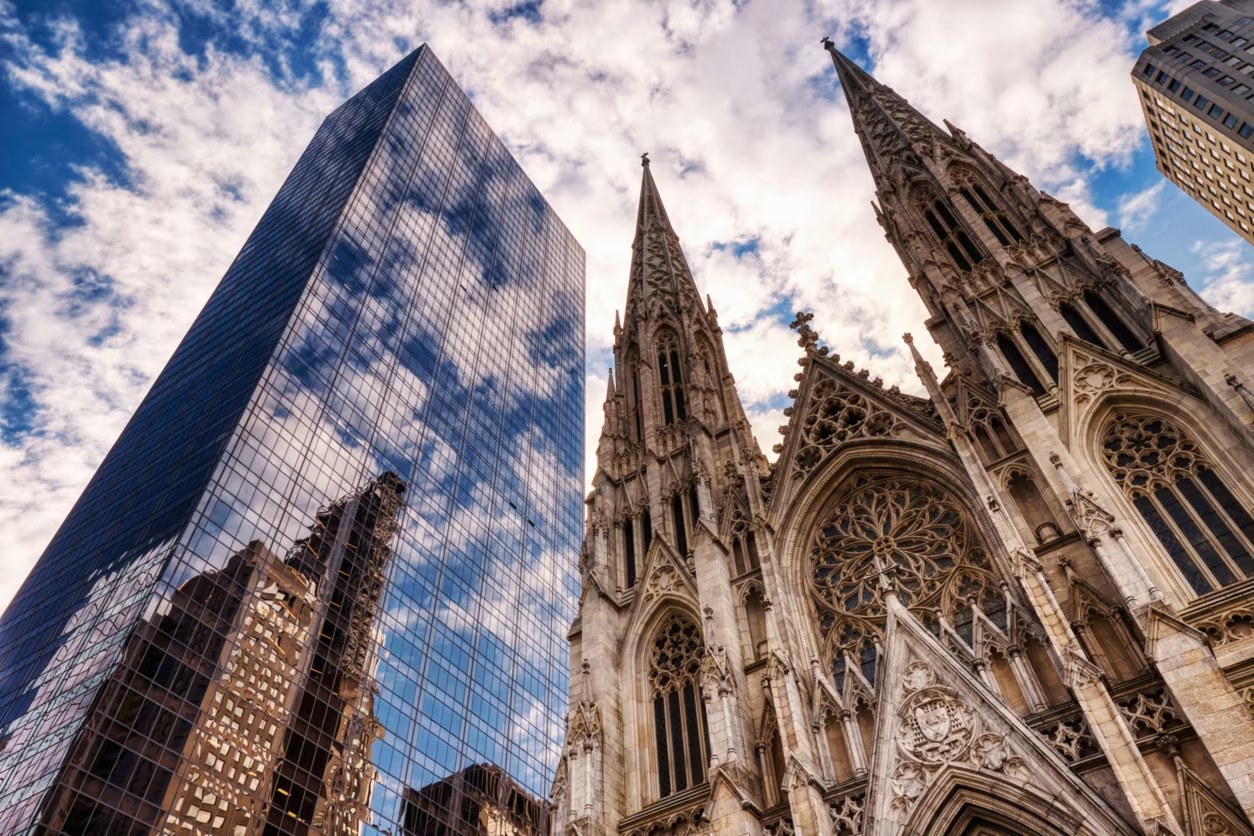
The installation Mass is set for late August at St. Patrick’s Cathedral, with Cardinal Pierre presiding and at least 12 U.S. bishops attending. Expect 2,000 invited guests and 1,000 ticketed parishioners. His first official act will likely be a pastoral letter on parish collaboration, signaling whether he will continue the archdiocese’s clustering plan that has reduced 331 parishes to 296 since 2015.
Hot-Button Issues
Two flashpoints await: school vouchers and church closures. New York’s Catholic schools lost 5,700 students last year; Albany lawmakers are debating a tax-credit scholarship that could funnel $150 million to private education. The archbishop-elect has lobbied for similar programs in Illinois, but New York’s teachers’ unions are stronger. Meanwhile, a consultant’s report recommends merging 21 parishes in Brooklyn and Queens by 2026, a move that could spark protests reminiscent of 2007’s “church occupation” movement.
His Joliet experience may guide him: he closed five parishes there but allowed each to keep its building open for weddings and funerals, a compromise that reduced backlash. Whether New York’s feisty parish trustees accept such nuance remains to be seen.
By Christmas, observers predict, his approval rating will either mirror Dolan’s 68% or slide toward Egan’s 42%. The difference may hinge on how well he learns the subway map—and how fast he masters the art of the unreturned phone call.
Frequently Asked Questions
Q: Who is the new archbishop of New York?
Pope Leo XIV appointed the sitting bishop of Joliet, Illinois, to become the 11th archbishop of New York after a 7 a.m. call from Vatican ambassador Cardinal Christophe Pierre.
Q: How are Catholic archbishops chosen?
The nuncio—here, Cardinal Christophe Pierre—gathers terna names, the Congregation for Bishops vets them, and the Pope makes the final appointment, usually by phone.
Q: Why is the New York archbishopric so influential?
With 2.8 million Catholics, 405 parishes, and a media capital pulpit, the New York archbishop often becomes a national voice on faith, politics, and social issues.
