22 Democratic AGs Invoke Milton Friedman to Block Trump’s 15% Section 122 Tariffs After Supreme Court Rebuke
- 22 Democratic Attorneys General filed suit Thursday, quoting free-market icon Milton Friedman.
- Section 122 caps emergency tariffs at 15% for 150 days; Trump reimposed them after the Supreme Court struck down broader emergency levies.
- The President cites a $1.2 trillion goods-trade deficit, but plaintiffs argue the statute targets currency crises, not chronic gaps.
- Legal scholars warn the case could redefine the balance between presidential trade powers and Congress’s Article I authority.
A sleeper statute from 1974 becomes the newest constitutional flashpoint in the trade wars.
SECTION 122 TARIFFS—When President Donald Trump dusted off Section 122 of the Trade Act last month to slap 15% duties on key trading partners, he did so only after the Supreme Court blocked his sweeping emergency tariffs. The rarely used provision—written for balance-of-payments shocks, not persistent deficits—now faces its most serious courtroom test.
Within days, a coalition of 22 Democratic state Attorneys General marched into federal court brandishing an unlikely weapon: Nobel laureate Milton Friedman’s treatises on free trade. Their message? Even conservative economic saints opposed permanent border taxes that bypass Congress.
At stake is whether a 1970s-era escape hatch can be stretched to cover a $1.2 trillion annual goods-trade gap without violating the Constitution’s Assignment Clause or the statute’s own 150-day clock.
The Sleeping Giant: How Section 122 Went from Obscurity to Center Stage
Section 122 was never meant to dominate headlines. Buried in the Trade Act of 1974, it empowers the President to impose temporary import surcharges—capped at 15% and limited to 150 days—when the Treasury certifies a “large and serious” balance-of-payments deficit. Lawmakers envisioned currency runs, not chronic trade gaps.
Between 1975 and 2023 the clause was invoked exactly twice: once by Gerald Ford during the 1975 current-account crisis, and once by Bill Clinton in 1995 to deter Japanese auto imports. Both episodes ended within the statutory five-month window with bipartisan congressional notification.
Enter 2024. After the Supreme Court’s June ruling in Biden v. Nebraska curtailed emergency tariff powers, Trump’s legal team scoured the U.S. Code for alternatives. Section 122 surfaced as the path of least resistance: no national-security finding required, no congressional vote, and a modest rate ceiling that could nonetheless rake in billions on the $3.1 trillion in targeted goods.
Legal scholars note the textual tension. The statute’s preamble references “short-term imbalances,” yet the White House order cites a structural deficit decades in the making. “Duration is the Achilles heel,” says Georgetown trade professor Jennifer Hillman, a former WTO appellate member. “One-hundred-fifty days is hard-wired; anything longer needs Congress.”
The administration counters that serial 150-day tranches—each preceded by a fresh Treasury certification—comply with the letter of the law. Democratic AGs call that an end-run. Their complaint, filed in the Northern District of California, seeks an injunction barring any renewal beyond day 150 without explicit Capitol Hill assent.
The $1.2 Trillion Deficit: Structural Gap or Currency Crisis?
Trump’s tariff proclamation leans heavily on one eye-watering figure: a $1.2 trillion U.S. goods-trade deficit for fiscal 2024. That marks a 14% jump from 2023 and the widest gap on record. The President argues the imbalance drains factories, fuels off-shoring, and justifies emergency action.
Economists split on whether the number signals a crisis fit for Section 122. “A deficit isn’t inherently evil,” says Michael Boskin, former Council of Economic Advisers chair under George H.W. Bush. “It reflects investment opportunities and dollar strength, not a run on the pound.”
The Treasury’s own June 2024 Report on Macroeconomic and Foreign Exchange Policies finds no currency manipulation by major partners, undercutting a key Section 122 trigger. Meanwhile, the current-account deficit—broader than goods alone—shrank to 2.9% of GDP in Q2, below the 3.0% average since 1980.
Plaintiffs seize on that nuance. Their complaint displays a line-chart plotting goods, services, and income balances since 2000 to show the gap is structural, not cyclical. “Section 122 was written for 1970s-style current-account hemorrhaging,” notes Ohio State law professor Chris Walker. “Not for a services-surplus economy with a strong dollar.”
The administration counters that statute text mentions only “balance-of-payments deficits,” without distinguishing between current-account components. District Judge Edward Chen has set an October 4 hearing on the definitional question—an early clue to which side finds a sympathetic ear.
Inside the Complaint: Why Democratic AGs Quote Milton Friedman
The 92-page complaint opens with an unlikely epigraph: “Underlying most arguments against the free market is a lack of belief in freedom itself—Milton Friedman, 1978.” The choice is tactical, signaling that opposition to Section 122 tariffs spans ideologies.
Lead author California AG Rob Bonta argues the citation rebuts claims that the lawsuit is partisan. “Friedman warned against executive overreach in trade,” Bonta told reporters. “Quoting him shows we’re defending rules-based commerce, not partisan politics.”
The brief leans on three pillars: statutory text, constitutional separation of powers, and economic consensus against permanent executive tariffs. It notes the 150-day ceiling appears five times in Section 122, calling it “unambiguous.”
On Article I, the suit echoes Justice Robert Jackson’s Youngstown Sheet & Tube concurrence: when Congress has spoken directly, presidential power is at its “lowest ebb.” The AGs contend the Trade Act’s sunset provision is that explicit limit.
Finally, the economic section cites a 2023 Peterson Institute study estimating the 15% levy could trim U.S. GDP by 0.4% and raise consumer prices 1.1%. By invoking Friedman, the plaintiffs aim to inoculate themselves against “anti-business” labels ahead of the 2024 elections.
Could the Supreme Court Strike Down Section 122 Itself?
Constitutional scholars see multiple pathways for the high court to narrow—or invalidate—Section 122. The first is non-delegation: Congress cannot cede its taxing power without an “intelligible principle.” Five conservative justices have hinted at reviving that doctrine.
A second route is the Assignment Clause. Georgetown’s Randy Barnett argues that imposing duties is “exclusively legislative,” echoing the 1996 Clinton v. City of New York line-item veto decision. A ruling here could require Congress to reclaim tariff-setting authority.
The third is procedural: Section 122 requires Treasury certification, yet the July order predates any formal finding. Plaintiffs seek to void the tariff on administrative-law grounds without reaching constitutional questions—a tactic that could sidestep a sweeping precedent.
All eyes are on the Fifth Circuit, which consolidated parallel challenges from Texas businesses. If that court issues a split opinion, Supreme Court review is likely by spring 2025. A decision narrowing Section 122 could restore congressional leverage over trade for the first time since the Smoot-Hawley era.
What Happens to Business If the Tariffs Stay—or Go?
Corporate America is gaming two scenarios. If the 15% tariff survives, import-dependent retailers like Walmart and Target estimate an $8.4 billion annual cost hike, according to NRF projections. Automakers face a $2,100 per-vehicle increase on Mexican-assembled models, per JD Power.
Conversely, a court-ordered rollback would restore tariff-free sourcing but could reignite supply-chain volatility. “We need predictability more than zero duties,” says Nike CFO Matt Friend, whose firm sources 75% of footwear from Vietnam, a tariff target.
Steel producers stand to lose most if duties disappear. U.S. Steel’s Fairfield plant reopened on the expectation of sustained price protection; shares slid 11% the day the AGs filed. “A swift reversal could idle furnaces we just reignited,” warns CEO David Burritt.
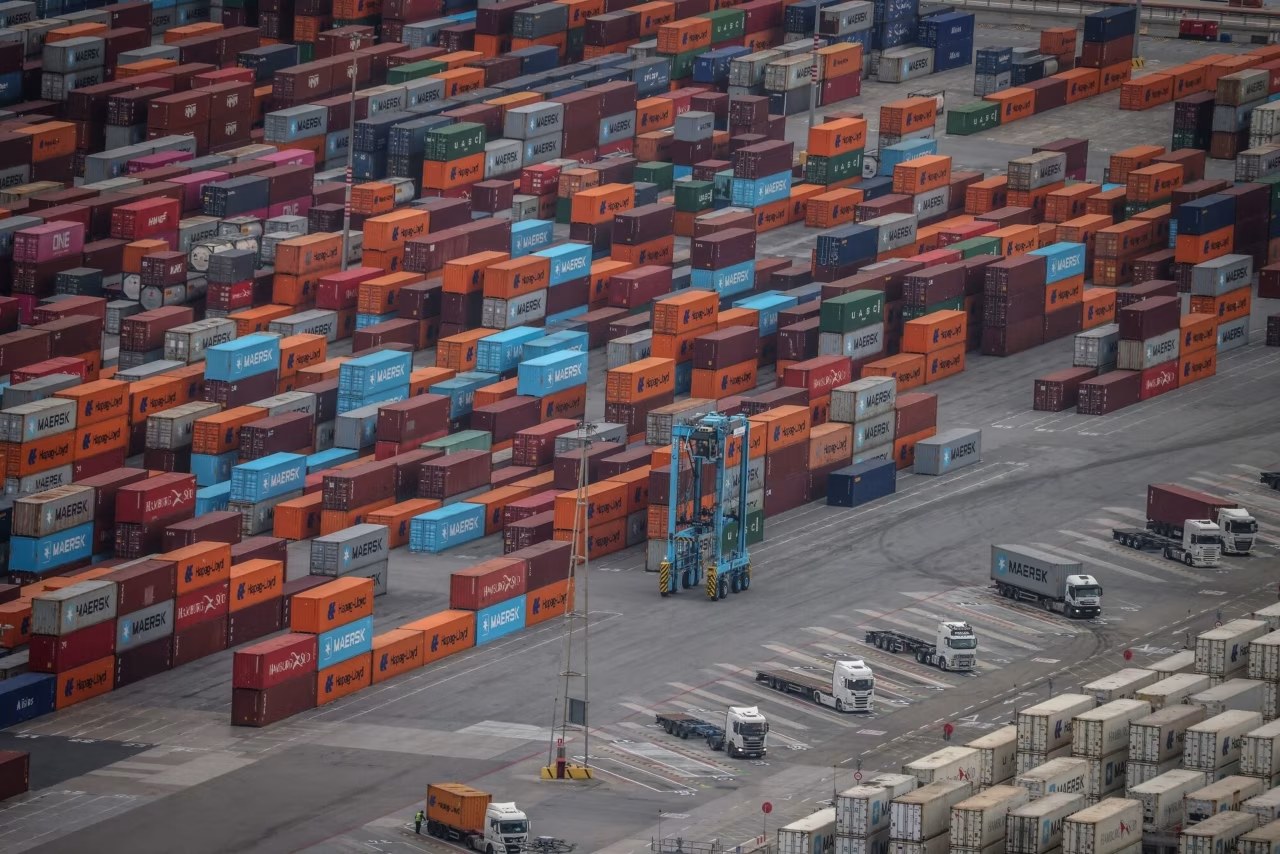
Logistics firms echo that sentiment. The Port of Los Angeles reports a 19% spike in October container volume as importers front-load before the December 150-day cliff. An injunction could strand thousands of containers at sea, triggering demurrage fees exceeding $200 million, according to Harbor Trucking Association data.
Global Ripple: How Allies Are Preparing Retaliation
America’s trading partners are not waiting for a U.S. court. The EU has circulated a 173-page retaliation list targeting Harley-Davidson motorcycles, bourbon, and cranberries—products chosen to pressure GOP Speaker Mike Johnson’s home state of Louisiana and Senate minority leader Mitch McConnell’s Kentucky.
Japan, shut out of the initial carve-outs granted to Canada and Mexico under USMCA, is weighing WTO dispute settlement. A Geneva filing could come within 60 days, reviving a body the U.S. has paralyzed by blocking appellate appointments.
Meanwhile, Vietnam’s textile lobby warns 1.2 million jobs are at risk if the 15% duty sticks. Deputy Trade Minister Do Thang Hai told reporters Hanoi could slap 18% counter-duties on American agricultural goods, complicating the Biden administration’s efforts to deepen Indo-Pacific ties.
China, already facing separate levies, sees an opening. “Section 122 litigation gives Beijing propaganda fodder,” says former USTR official Jamieson Greer. Expect Asian exporters to diversify into the EU and Regional Comprehensive Economic Partnership, eroding U.S. market share long after any judicial resolution.
Bottom Line: Will Congress Reclaim the Tariff Power?
Whatever the courts decide, momentum is building on Capitol Hill to claw back tariff authority. A bipartisan bill sponsored by Sens. Mike Lee (R-UT) and Tammy Baldwin (D-WI) would repeal Section 122 and require congressional approval for any duties above 5% that last longer than 60 days.
The proposal faces headwinds. Senate Finance Chair Ron Wyden (D-OR) wants to preserve flexibility for genuine currency emergencies, while House progressives fear losing leverage over labor standards. Still, 14 Republicans have signaled openness, enough to clear a filibuster if paired with a must-pass omnibus.
Corporate America is lobbying hard for reform. The National Association of Manufacturers ran a July poll showing 68% of members want trade authority returned to Congress. “We’re not anti-tariff,” says NAM president Jay Timmons. “We’re pro-certainty.”
Trade lawyers see a narrow window: if the Supreme Court grants cert and signals skepticism, expect a legislative deal by summer 2025. The upshot: Section 122 may join the line-item veto in the constitutional graveyard, forcing future presidents to negotiate with Congress rather than govern by emergency edict.
Frequently Asked Questions
Q: What exactly are Section 122 tariffs?
Section 122 of the Trade Act of 1974 lets a President impose temporary tariffs up to 15% for 150 days if the Treasury finds a “large and serious” balance-of-payments deficit. The statute was designed for currency crises, not chronic trade gaps.
Q: Why are 22 Democratic AGs suing over them?
The AGs argue the tariffs violate the 150-day hard cap, exceed the statute’s emergency intent, and usurp Congress’s Article I power to set duties. They also cite conservative economist Milton Friedman to stress bipartisan free-market concerns.
Q: How big is the trade deficit Trump cites?
The U.S. goods-trade deficit hit $1.2 trillion in 2024, a record high, but critics say Section 122 was never meant to fix structural deficits that span decades.
