U.S. LNG Exports Jumped 40% in 2024, Cementing America’s Role as the World’s Top Supplier After a Decade-Long Boom
- America shipped ~15 Bcf/d from eight terminals in 2024—enough to heat 80 million homes—after starting from zero in 2015.
- Cheniere’s first export cargo in February 2016 flipped the U.S. from net importer to net exporter within a year.
- A 40% surge last year buffered global prices when Qatar’s output was hit by an Iranian drone strike.
- Capacity is projected to double by 2031 as the Trump administration accelerates permit approvals.
America’s quiet energy revolution is now the first line of defense against overseas supply shocks.
LNG EXPORTS—When Qatar’s liquefaction trains went dark after Monday’s drone attack, traders braced for a price spiral. It never came. Instead, European and Asian spot LNG benchmarks rose only modestly, a calm traders attribute to a flood of U.S. cargoes that left Louisiana and Texas docks at a record pace.
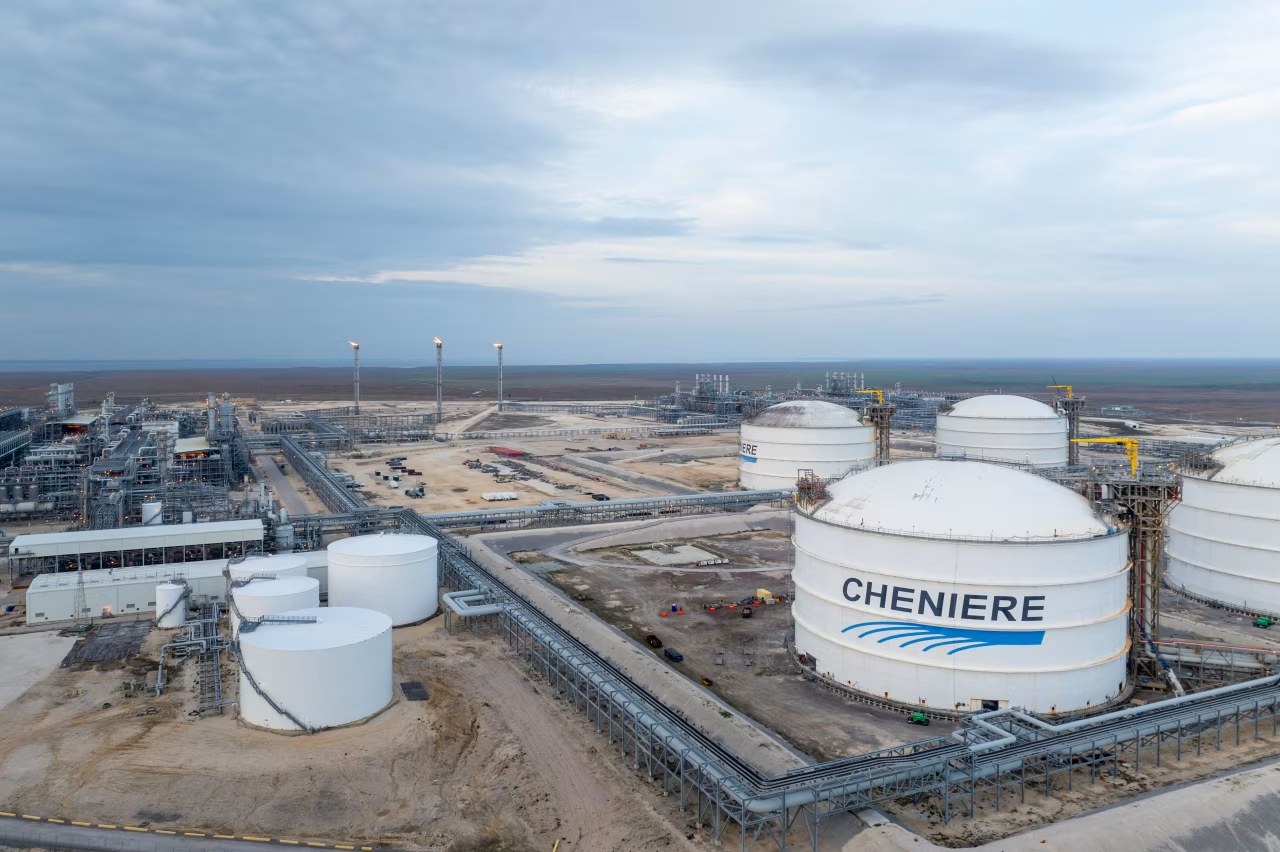
The episode captures a geopolitical shift that unfolded with little fanfare: the United States, a net importer of natural gas as recently as 2015, now exports more LNG than Qatar, Australia or Russia combined did a decade ago. The pivot began when Cheniere Energy bet almost $20 billion on reverse-engineering an import terminal at Sabine Pass, Louisiana, for export service—an investment that delivered its first cargo in February 2016 and has since mushroomed into an eight-terminal network.
Washington policy whiplash—Biden’s 2024 permitting pause followed by Trump’s rapid restart—has not derailed the underlying momentum. With the Energy Information Administration (EIA) forecasting a doubling of export capacity by 2031, analysts say the boom is entering a second act that could determine whether allies keep the lights on during the next foreign supply shock.
From Importer to Exporter in 1,900 Days
Before 2015 the U.S. imported more natural gas than it exported, relying on pipeline deliveries from Canada and LNG cargoes from Trinidad. That dependency flipped in less than five years, a timeline energy historians compare with the construction of the Transcontinental Railroad for speed and consequence.
The catalyst was the shale-fracking revolution that began in the Barnett and Marcellus basins during the mid-2000s. By 2010 dry-gas output had jumped 25% in five years, depressing Henry Hub prices below $3 per million Btu and stranding import infrastructure. Cheniere Energy, which had built Sabine Pass as an import terminal, saw the glut and reversed course, spending $18 billion to add liquefaction trains.
The first export cargo—destined for Brazil—left Louisiana on February 24, 2016. Within 12 months the U.S. was a net exporter on an annual basis, the first time since the Eisenhower administration. By 2024 eight terminals operated along the Gulf Coast and Chesapeake Bay, with combined name-plate capacity of 13.6 Bcf/d and peak flows hitting 15 Bcf/d, according to EIA data released last month.
Named example: Cameron LNG in Hackberry, Louisiana, sanctioned in 2014 and began producing in 2019, now ships 3.3 Bcf/d—equal to the daily gas demand of South Korea. The facility added a fourth train last year, adding 1.5 Bcf/d and pushing total U.S. export capability past that of Qatar’s 12.1 Bcf/d base-load fleet.
Implication: Because LNG cargoes can be diverted mid-ocean, U.S. volumes act as a shock absorber. When Qatar halted production Monday, European TTF futures rose 9% intraday but settled only 4% higher as traders priced in 15 U.S. cargoes scheduled to arrive in Rotterdam within two weeks.
Expert context
“The speed of the U.S. ramp-up is unprecedented in LNG history,” says Giles Farrer, head of global LNG research at Wood Mackenzie. “Qatar took two decades to reach 10 Bcf/d; the U.S. matched that in eight years.”
Consequence: Europe now sources 52% of its LNG from the United States, up from 27% in 2021, reducing Moscow’s leverage after Ukraine-invasion supply cuts.
Looking ahead: Three more terminals—Golden Pass, Plaquemines and Rio Grande—are under construction and scheduled to start between 2025 and 2027, adding another 9.2 Bcf/d of capacity that analysts say will keep Atlantic basin prices range-bound even if Middle-East tensions escalate.
How Qatar’s Outage Tested American Reliability
Monday’s drone strike on Qatar’s Ras Laffan complex knocked 6.2 Bcf/d of liquefaction capacity offline—equal to 8% of global supply—sending Asian spot prices to a three-month high of $14.80 per million Btu. Yet European futures rose only modestly, a restraint traders credit to U.S. swing supply.
Within hours, at least six laden tankers diverted from the Atlantic basin to Asia, a maneuver possible only because U.S. export terminals operate under flexible destination clauses. By Wednesday Qatar announced partial restart, but market panic had already subsided.
Case study: The 174,000-cbm LNG carrier Marvel Falcon loaded at Corpus Christi on Sunday, originally bound for Turkey. After the attack it was rerouted to Japan, arriving Friday at a premium of 60¢ per million Btu, a margin that still undercut competing Qatari supply by 90¢ because of shorter voyage time through the Panama Canal.
Data point: U.S. terminals exported 43 cargoes during the week of the outage, up from a 38-cargo average in January, according to vessel-tracking firm Kpler.
Implication: Analysts say the episode validates America’s role as the marginal supplier. “Without those extra U.S. cargoes, Asian prices would have shot past $16,” says Olumide Ajayi, senior LNG analyst at Refinitiv. “Europe would have scrambled, and coal burn would have risen.”
Price impact
Front-month TTF futures settled at €11.20 per MWh, up 4% week-over-week, far below the 15% spike that followed Russia’s 2022 Nord Stream shutdown. Dutch gas storage remains 62% full, compared with 38% at the same time in 2022, cushioning volatility.
Consequence: European policymakers are rewriting security-of-supply rules to prioritize long-term contracts with U.S. portfolio players, a shift that could lock in American volumes through 2040.
Forward-looking: If Iran repeats the tactic, traders say the market response will hinge on how quickly U.S. Gulf Coast terminals can ramp to name-plate capacity; most plants can add 10% within 48 hours by deferring maintenance.
Policy Whiplash: Pause, Resume, Accelerate
In January 2024 the Biden administration froze new LNG export permits to non-free-trade-agreement countries, citing climate concerns and the need to update economic-analysis models. The move affected 16 proposed projects totaling 21 Bcf/d of capacity and sent developers scrambling for alternative financing.
Benchmarking firm ClearView Energy Partners estimated the pause shaved $30 billion off the forward value of U.S. LNG infrastructure. Venture Global, developer of the 20-mtpa CP2 project in Louisiana, delayed final investment decision (FID) twice, while Germany’s Securing Energy for Europe GmbH reopened talks with Qatar for long-term supply.
Shift: On his first day in office President Trump rescinded the freeze, instructing the Department of Energy to approve permits within 90 days. Last week Energy Secretary Chris Wright signed off on Phase 3 expansion of the Corpus Christi plant, adding 1.4 Bcf/d and 550 construction jobs.
Named example: NextDecade’s Rio Grande LNG in Brownsville, Texas, received its non-FTA permit on March 15, clearing the way for a $5.6 billion FID slated for summer 2025. The facility will ship 27 mtpa—equivalent to 3.6 Bcf/d—primarily to buyers in Japan and Poland under 20-year contracts indexed to Henry Hub plus 115%.
Data point: Since the restart, the Department of Energy has issued six final authorizations covering 8.7 Bcf/d, triple the monthly average of 2023.
Implication: Analysts at Goldman Sachs now forecast U.S. LNG capacity will reach 26 Bcf/d by 2031, double today’s level, and account for 35% of global supply versus 22% now.
Regulatory timeline
Federal law requires environmental review under the National Environmental Policy Act, but the Trump administration is invoking a 2019 rule that allows categorical exclusions for expansions within existing footprints, cutting approval time to 45 days from 18 months.
Consequence: Environmental groups vow to sue, arguing expanded exports will lock in fossil-fuel demand. A coalition led by the Sierra Club filed suit in D.C. Circuit Court on March 20, seeking to reinstate the pause.
Looking forward: If courts uphold rapid permitting, the U.S. could add 60 mtpa of new capacity by 2030, an amount equal to today’s combined output of Qatar and Australia.
Can U.S. LNG Stay Competitive Beyond 2030?
Even as export volumes soar, questions linger over cost inflation, carbon policy and rival supply. The global LNG market is set to tighten after 2028 as China and India accelerate coal-to-gas switching, while new low-cost projects emerge in Qatar (North Field East) and Mozambique Rovuma.
Cost curve: U.S. brownfield expansions average $650 per metric ton of capacity, below Qatar’s $750 but above Mozambique’s $550, according to WoodMac. Yet U.S. projects benefit from brownfield port infrastructure and deep capital markets that cut financing costs to 6-7% versus 9-11% for African greenfields.
Carbon risk: The EU’s Carbon Border Adjustment Mechanism (CBAM) will start phasing in Scope-1 emissions penalties for LNG in 2026. U.S. exporters counter by signing renewable power purchase agreements (PPAs) for liquefaction trains and investing in carbon-capture projects. Cheniere has pledged to provide cargo-level emissions data starting 2025, a move that helped it secure a 15-year deal with Singapore’s Pavilion Energy.
Named case: Sempra’s Port Arthur LNG will run on 90% renewable electricity via a 1.2 GW solar-plus-storage PPA, cutting lifecycle emissions 40% versus coal and meeting Germany’s future import standard.
Data point: If all proposed U.S. projects reach FID, the country’s share of seaborne gas could hit 35% by 2031, up from 22% today, according to EIA’s January 2025 outlook.
Implication: Sustaining that dominance will hinge on keeping Henry Hub near $3/MMBtu, a level that requires continued Permian and Marcellus drilling efficiency gains.
Competitor watch
Qatar’s North Field expansion will add 33 mtpa by 2028 at a breakeven of $4.20/MMBtu delivered to Asia, still above U.S. all-in costs of $3.90/MMBtu after shipping. Meanwhile, China’s domestic shale gas output rose 12% last year, potentially trimming import demand growth to 4% annually versus 8% projected three years ago.
Consequence: Analysts say the window for new U.S. greenfield projects may close after 2027 unless developers secure long-term offtake tied to European decarbonization goals.
Forward-looking: The next wave of innovation—autonomous drilling, modular liquefaction and methane-leak detection via satellite—could shave another 10% off U.S. supply costs, keeping American cargoes competitive even if Asian spot prices fall below $8/MMBtu.
What Does the Boom Mean for Climate Goals?
Environmental groups argue that locking in decades of LNG exports undermines the U.S. commitment to net-zero by 2050. Yet the International Energy Agency (IEA) estimates that every 1% of coal displaced by gas in power generation cuts CO₂ emissions 0.3% globally, a trade-off that favors U.S. LNG in markets such as Germany and Vietnam.
Lifecycle analysis: A 2024 Princeton study found that U.S. LNG shipped to Europe emits 45% less greenhouse gas than regional coal when measured from wellhead to power plant, even after accounting for 0.5% methane leakage. If leakage is cut to 0.2%—a target set by the Oil & Gas Climate Initiative—emissions savings rise to 54%.
Policy lever: The Inflation Reduction Act’s methane fee, starting at $900 per ton in 2026, is expected to accelerate detection-and-repair programs. Pipeline operator Kinder Morgan already flies drones equipped with infrared cameras over its Permian gathering network, cutting leak rates 30% year-over-year.
Named example: Venture Global’s Calcasieu Pass plant earned a provisional A- rating from investor-backed Transition Pathway Initiative by committing to continuous emissions monitoring and purchasing nature-based offsets for residual CO₂.
Data point: If global LNG trade doubles to 1,000 mtpa by 2040 and replaces coal, the IEA projects a net 1.2 gigaton annual reduction in CO₂—equal to the current output of Japan.
Equity dimension
Export terminals create high-paying union jobs: the Plaquemines project under construction in Louisiana employs 1,400 boilermakers at $38 per hour, a wage that lifts household income above the parish median of $52,000.
Consequence: Balancing climate ambition with energy security will require enforceable methane standards, not export bans, say researchers at Columbia’s Center on Global Energy Policy.
Looking ahead: A forthcoming EPA rule could require quarterly leak detection for all export terminals, adding an estimated 3¢ per MMBtu to operating costs—insufficient, analysts say, to erode U.S. competitiveness but enough to push industry toward best-in-class technology.
Frequently Asked Questions
Q: When did U.S. LNG exports start?
The first cargo from the lower-48 states left Cheniere Energy’s Sabine Pass terminal in February 2016, turning the U.S. from a net importer into a net exporter of LNG.
Q: How much LNG does the U.S. export daily?
Roughly 15 billion cubic feet per day—enough gas to heat 80 million homes in winter—shipped from eight operating export terminals.
Q: Why did global gas prices spike after Qatar’s outage?
A drone attack from Iran forced Qatar to halt LNG production; prices rose but were cushioned by a 40% surge in U.S. export volumes during 2024.
