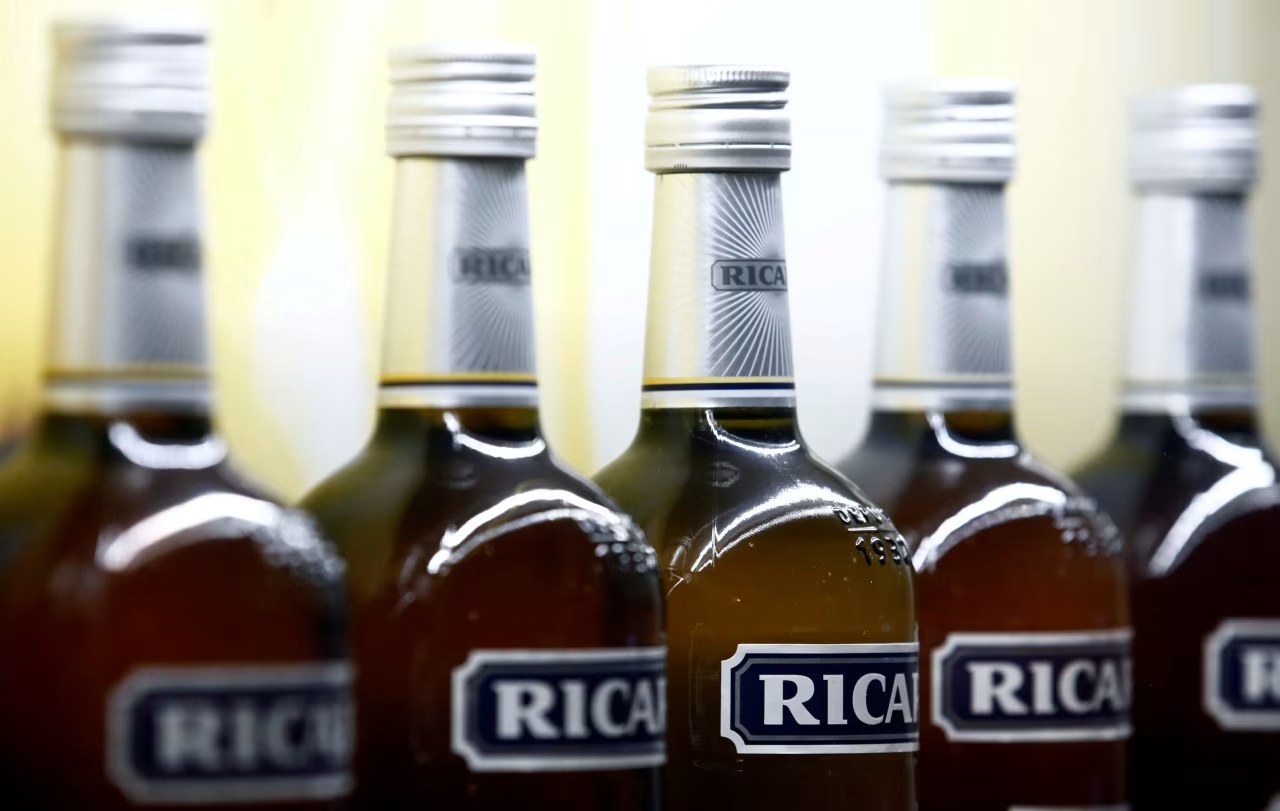
Pernod Ricard’s $30.4 Billion Brown-Forman Merger Gambit Erases 5.7% Share Slump in 24 Hours
- Paris-listed Pernod closed 5.7% lower at €59.94 after initial Bloomberg report, then rebounded 3.1% once both firms confirmed talks.
- A deal would fuse Absolut vodka and Jameson Irish whiskey with Jack Daniel’s, creating a spirits titan valued at $30.4 billion.
- Investors warmed to potential U.S. distribution muscle and cost synergies despite sector-wide volume declines in America and China.
- Combined entity would leapfrog China’s Kweichow Moutai to become world’s second-largest distiller by market cap.
Can a trans-Atlantic spirits marriage offset slowing Western thirst?
PERNOD RICARD—Pernod Ricard’s abrupt share-price whiplash on 12 June tells the story of an industry in flux. By noon in Paris, the French distiller’s stock had sunk to €59.94, down 5.7%, as traders digested Bloomberg’s report that Pernod was exploring a takeover of Kentucky-based Brown-Forman. Within 18 hours the narrative flipped: both companies issued overnight statements acknowledging “preliminary discussions,” and Pernod’s share price clawed back 3.1% in early deals.
The market’s change of heart reflects a simple math. A combined Pernod–Brown-Forman would wield a market capitalisation of roughly $30.38 billion, instantly leap-frogging China’s Kweichow Moutai to rank second globally behind Diageo. More importantly, it would marry Absolut, Jameson, and Martell with Jack Daniel’s, Woodford Reserve, and Finlandia—creating a portfolio that spans vodka, Irish and American whiskey, cognac, and tequila.
Yet the rebound also underscores investor desperation for growth antidotes. Global alcohol volumes have contracted for four straight quarters, according to IWSR data, with the U.S. and China—responsible for 54% of Pernod’s operating profit—posting the steepest slides. A transformational deal may be the only lever left for a sector whose organic top-line growth has flat-lined at 1% since 2022.
From Hangover to Honeymoon: Why Traders Forgave Pernod in One Session
Equity analysts at Barclays called the intraday reversal “textbook risk-repricing.” When Bloomberg’s headline crossed the terminal at 09:43 CET, algorithmic sell programs targeted French consumer staples, pushing Pernod to an intraday low of €58.70. By the closing auction, however, human fund managers had re-entered, narrowing the loss to 5.7% at €59.94. The overnight confirmation of talks triggered a 3.1% bounce the next morning, trimming the two-day net decline to just 2.7%.
What changed investor psychology?
First, scarcity value. There are only a handful of global spirits assets with brand equity durable enough to command pricing power. Brown-Forman’s flagship Jack Daniel’s has raised U.S. shelf prices 4.3% annually over the past decade, Nielsen data show, outpacing the 2.9% category average. Second, synergy arithmetic. Bernstein analyst Trevor Stirling estimates €550 million in annual cost savings—equal to 1.8% of combined sales—primarily by folding Brown-Forman’s international distribution into Pernod’s existing network in Europe and Asia.
Third, balance-sheet capacity. Pernod exited March with net debt at 2.4× EBITDA, below its self-imposed 3× ceiling. Even after funding a 30% premium—common in recent drinks deals—the French group could still keep leverage under 3.5×, according to Morgan Stanley’s base case. That headroom reassured credit-rating agencies, which placed Pernod’s A- grade on “developing” watch rather than immediate review for downgrade.
Finally, strategic desperation. IWSR forecasts a 2% volume CAGR decline for American whiskey in its core U.S. market through 2027. Without a deal, Pernod risks becoming a mid-tier player in the world’s most profitable spirits segment. Investors concluded that short-term dilution beats long-term irrelevance.
The rebound also reflected positioning. Short interest had risen to 1.9% of free-float ahead of the leak—double the 2021 level—creating fuel for a squeeze once sentiment turned. By Friday’s close, borrow availability in Paris had tightened to 0.4% fee, the highest cost since January.
Could a $30 Billion Spirits Marriage Survive U.S. and China Headwinds?
The numbers are stark. Americans bought 3.1% less spirits in the 12 months to March, while Chinese baijiu volumes slid 5.4%, according to IWSR. Those two markets deliver 38% of Pernod’s revenue and 54% of its profit, making any sustained downturn an existential threat. Brown-Forman is even more exposed: the U.S. accounts for 48% of its net sales, and Greater China another 9%.
What makes scale the only antidote?
Fixed costs. Global brand campaigns for Absolut or Jack Daniel’s require upfront media outlays north of $100 million before a single bottle ships. A merged entity could pool media buying, negotiate better shelf slots with retailers such as Walmart and Carrefour, and amortise innovation spend across a wider volume base. Euromonitor calculates that the top three global drinks firms spend 18% of revenue on marketing—double the mid-tier average—yet earn 2.3× the gross margin.
Distribution overlap offers another lever. Brown-Forman currently relies on third-party distributors in 17 European markets, paying away 12–14% gross-to-net. Pernod’s self-distribution network could save an estimated €180 million annually, according to RBC Capital, while giving Jack Daniel’s immediate access to 60,000 on-premise accounts across Spain, Germany, and Poland where Pernod holds number-one share.
Portfolio gaps would also close. Pernod lacks a leading American whiskey; its Woodford Reserve distribution contract expires in 2026. Brown-Forman has no cognac, leaving it vulnerable to premiumisation trends in Asia. A tie-up would plug both holes overnight, creating a full-spectrum luxury portfolio from $30 bourbon to $3,000 Martell crème du centenaire.
Yet execution risk looms. The last mega-merger—Bacardi’s $5 billion acquisition of Patrón in 2018—took 18 months to integrate back-office systems and bled 2 percentage points of organic growth during transition. A Pernod–Brown-Forman deal would be six times larger, requiring antitrust clearances in Brussels and Washington, and union negotiations in Kentucky where 1,200 workers distill Jack Daniel’s.
Still, with organic top-line growth stuck below inflation, investors see few alternatives. ‘In a zero-growth world, M&A is the only lever left,’ says Nadine Sarwat, beverages analyst at Redburn Atlantic.
What Antitrust Hurdles Await a Trans-Atlantic Distiller Merger?
Any deal would face parallel reviews by the European Commission and the U.S. Federal Trade Commission. The critical question: does a combined 22% share of global premium spirits constitute a monopoly? The answer hinges on market definition. If regulators segment by country and category, overlaps appear modest: in American whiskey, Brown-Forman holds 42% of U.S. sales, while Pernod’s share is negligible. In vodka, Pernod’s Absolut commands 18% of European retail, Brown-Forman’s Finlandia just 2%.
Where could remedies bite?
The biggest flashpoint is travel retail. In duty-free channels, the two brands together supply 38% of premium whiskey and 29% of vodka, according to Generation Research. Regulators could demand divestitures of smaller labels—think Early Times or Wyborowa—to preserve price competition in airports, a key profit engine where price elasticity is 30% lower than domestic markets.
Another risk: U.S. grandstanding. Senators from Kentucky and Tennessee may lobby to protect local jobs, while French lawmakers could push for guarantees that cognac production remains in Charente. The 2021 Aérospatiale uproar—when Paris threatened to veto a deal that moved aerospace jobs overseas—shows industrial sovereignty still matters.
Timing is also sensitive. The FTC under Chair Lina Khan has blocked vertical deals such as Microsoft-Activision, let alone horizontal consolidation. Spirits have escaped scrutiny so far, but a $30 billion transaction would test whether Washington views alcohol as a necessity subject to stricter oversight. Historical precedent offers mixed signals: regulators approved Bacardi-Patrón in 2018 without remedies, yet scuppered AB InBev’s proposed SABMiller vodka divestitures in 2016.
Legal advisors are already gaming scenarios. Shearman & Sterling’s antitrust partner Matthew Hall expects a Phase II review in Brussels lasting 90 working days, with potential fix-it undertakings worth up to 5% of combined revenue. ‘The key is to offer upfront concessions before the Statement of Objections lands,’ Hall says. That strategy shaved six months off the Vodafone-Liberty Global cable merger in 2019.
For now, both companies have hired fresh counsel: Pernod tapped Cleary Gottlieb, Brown-Forman hired Skadden. The clock starts only once a formal notification is filed, but early engagement is critical. ‘Pre-notification chats with the Commission can last three months,’ notes a Brussels competition official who requested anonymity. ‘Fail to prepare, prepare to fail.’
Who Wins, Who Loses If the Deal Goes Through?
Shareholders of both firms stand to gain if promised synergies materialise. Bernstein values cost savings at €550 million annually, equivalent to 6% of Brown-Forman’s FY23 revenue. Taxed and capitalised at 10×, those savings add €5.5 billion of equity value—enough to cover a 30% takeover premium without destroying value. Pernod investors would also benefit from enhanced U.S. exposure: the dollar zone would rise from 23% to 34% of pro-forma sales, hedging euro volatility.
Which stakeholders face pain?
Independent distributors top the list. In Germany, family-owned Henkell-Fiessinger has distributed Jack Daniel’s since 1962, generating €180 million in annual revenue. A merger would likely internalise that relationship, erasing 35% of the distributor’s turnover overnight. Similar shake-ups await partners in Belgium, Greece, and Poland, where third-party contracts roll off between 2025 and 2027.
Employees may also feel the squeeze. Brown-Forman operates three distilleries in Kentucky and Tennessee employing 1,700 people. Pernod has already flagged ‘optimisation opportunities’ in overlapping back-office roles, code for potential layoffs. The United Food & Commercial Workers union has requested an information-sharing agreement, citing the 2022 job losses when Pernod restructured its Irish operations.
Competitors could be squeezed. Campari lacks a leading American whiskey; a fortified Pernod would gain shelf space at the expense of Campari’s Wild Turkey. Meanwhile, Diageo’s Bulleit brand would face a dual-front battle in bourbon and vodka. Analysts estimate Diageo could lose 40 basis points of global share, worth $180 million in gross profit, if the merger secures distribution synergies.
Finally, consumers may pay more. A study by the American Antitrust Institute found that spirits mergers raised shelf prices 2.4% on average within 18 months, even after controlling for excise-tax changes. With inflation already eroding purchasing power, another price bump could accelerate downtrading to beer or RTDs.
Yet the biggest winner might be Brown’s founding family. The Brown family controls 67% of Brown-Forman’s voting stock via a dual-class structure. A cash-and-shares deal at a 30% premium would crystallise $7.8 billion for the clan, while still letting them swap part of their stake for Pernod shares to defer capital-gains tax. ‘It’s a monetisation event that keeps on giving,’ says a portfolio manager at Artisan Partners, a top-10 shareholder.
What Happens Next: Timeline for a Deal That Could Reshape Liquor Shelves
People close to the talks say structure is still fluid: all-cash, all-shares, or a mix. What is clear is sequencing. Both boards must approve a non-binding term sheet before 31 July to announce ahead of Brown-Forman’s annual meeting in September. That leaves an eight-week window for due diligence on Brown’s $1.2 billion pension liability, asbestos claims at its Kentucky cooperage, and a whistle-blower suit in Mexico alleging tax evasion on Herradura tequila.
Key milestones ahead
Week 1–2: Financing. Pernod has lined up BNP Paribas and JPMorgan for bridge loans, but Moody’s warns that net debt above 3.5× EBITDA could trigger a one-notch downgrade. Any cash component above 50% will likely require a €4 billion rights issue, pressuring the share price.
Week 3–6: Antitrust filings. Brussels and Washington must receive preliminary notifications. Expect early feedback on whether divestitures of smaller brands suffice or if large disposals—say, Finlandia—are required. Parallel filings in China are unlikely to block the deal; MOFCOM has approved every drinks merger since 2015.
Week 7–8: Shareholder lock-ups. The Brown family must decide whether to accept restricted shares with a 12-month lock-up or take liquid stock they can sell immediately. French institutional investors—Amundi, DNCA, CM-CIC—own 18% of Pernod and want assyms that the deal is EPS-accretive within 24 months.
If talks collapse, fallout is asymmetric. Brown-Forman’s share price, up 9.6% on the leak, could retreat 7–8%, analysts say. Pernod’s downside is limited: shares already trade at 16× 2025 EPS, a 20% discount to Diageo, implying limited takeover premium baked in. Either way, the sector’s consolidation clock is ticking. As one London-based portfolio manager puts it, ‘In a no-growth world, you either buy or get bought.’ Expect more deal flow before the year is out.
Frequently Asked Questions
Q: Why did Pernod Ricard shares rebound after initial losses?
Investors first sold on fears of an overpriced bid, but reversed course when both companies confirmed talks, betting that cost savings and U.S. distribution gains could outweigh the $30 billion price tag.
Q: How big would a combined Pernod-Brown-Forman be?
The merged group would command a market capitalisation of roughly $30.4 billion, vaulting it past Diageo as the world’s second-largest spirits player by equity value.
Q: What challenges face the global spirits sector right now?
Volume declines in the U.S. and China—two profit engines—have squeezed margins, making scale, portfolio breadth, and distribution leverage critical for future growth.
📰 Related Articles
- Renewable Energy Transition Fuels Global Power Crisis, Experts Warn
- Justice Department Targets NewYork-Presbyterian in Antitrust Fight Over Hospital Contracts
- Absolut Owner Pernod Ricard Explores Merger With Jack Daniel’s Parent Brown-Forman in $17 Billion Deal Talks
- BRP’s Forecast Fuels Auto‑Transport Optimism Amid Retail Tailwinds
