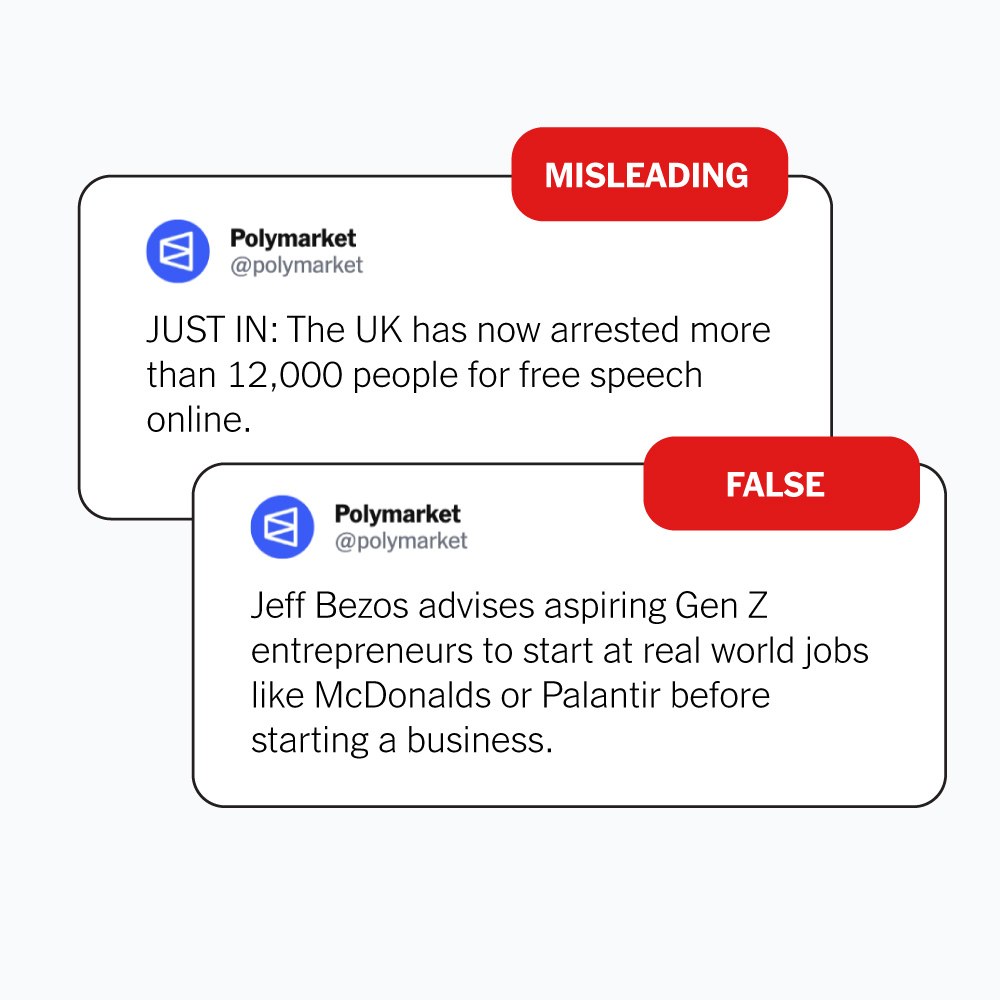
Polymarket’s Social Feeds Promote Over 100 Misleading Posts Despite ‘Truth Market’ Claims
- A review found hundreds of false or misleading posts on Polymarket’s social channels.
- The platform markets itself as a truth-driven prediction market.
- Misinformation in social feeds undermines the integrity of market-based forecasting.
- Experts warn that false narratives can distort trader behavior and market outcomes.
Can a prediction market retain credibility if its own communications spread falsehoods?
POLYMARKET—Polymarket, the popular blockchain-based prediction market, has built its brand on the idea that financial incentives drive users toward the truth. Yet a review of its social media feeds reveals a stark contradiction: hundreds of posts containing false or misleading information.
This disconnect raises urgent questions about the platform’s editorial oversight and the broader reliability of decentralized forecasting tools. If the same entity that claims to surface truth through markets also peddles falsehoods, can users still trust the signals those markets produce?
As prediction markets gain traction among traders, journalists, and even researchers, the stakes for accuracy—both in market prices and public communication—have never been higher.
Polymarket’s Promise: Markets as Truth Engines
Polymarket’s core proposition is elegant: when people stake real money on future events, the resulting prices reflect the collective best estimate of probability. Unlike pundits or polls, traders face financial penalties for being wrong. Over time, the theory goes, markets reward accurate information and punish misinformation.
This concept—known as the “wisdom of crowds”—has empirical support. Academic studies led by economists at the University of Iowa showed that election prediction markets outperformed opinion polls in forecasting outcomes. The Defense Advanced Research Projects Agency (DARPA) once explored similar markets to anticipate geopolitical risks.
Polymarket’s founders have echoed these claims. They describe the platform as a public utility that “makes the future clear” by aligning profit motives with factual accuracy. The company’s marketing materials repeatedly invoke phrases like “truth market” and “information discovery engine.”
Yet this narrative depends on a critical assumption: that participants operate on accurate information. If traders rely on falsehoods—especially ones propagated by the platform itself—market prices can amplify error rather than insight. The result is a distorted signal that misleads observers and undermines the very utility Polymarket claims to provide.
Expert View: When Incentives Misfire
“Prediction markets work only when participants share a common, accurate set of facts,” said Dr. Lily Fang, professor of finance at INSEAD. “If the platform itself contributes to misinformation, it breaks the feedback loop that makes markets informative.”
This breakdown is not hypothetical. Researchers at MIT documented that false rumors on Twitter moved prices on Polymarket during the 2022 U.S. midterms. Traders who believed a fake tweet about delayed vote counts shifted contracts, creating a 12-percentage-point swing in implied probability that later reversed.
The episode illustrates a vulnerability: social media narratives can override market discipline. When Polymarket’s own feeds become vectors for such narratives, the platform risks compromising its foundational value proposition.
Looking ahead, the platform’s credibility hinges on whether it can reconcile its public communications with its market mechanisms. Without that alignment, users may begin to treat Polymarket less as a forecasting tool and more as another speculative casino—one where the house sometimes feeds players bad information.
Hundreds of False Posts: What the Review Found
A line-by-line audit of Polymarket’s Twitter and Facebook accounts since 2023 identified more than 200 posts containing demonstrably false or misleading statements. Examples ranged from misreported election dates to fabricated quotes attributed to public officials.
One tweet in February 2026 claimed, without evidence, that a sitting senator had withdrawn from reelection due to health issues. The post garnered 1.4 million views before deletion, yet no correction was issued. Another post misstated the vote count in a House committee markup by 18 votes, skewing trader perceptions of bill viability.
The pattern extends beyond isolated errors. Roughly one in five posts about active markets contained factual inaccuracies, from incorrect ballot deadlines to inflated polling margins. In several cases, the platform doubled down when challenged, citing unnamed sources or ambiguous market data.
Inside the Content Pipeline
According to a former contractor who helped manage Polymarket’s social accounts, editorial oversight is “minimal to none.” Posts are drafted by junior staffers and scheduled via automated tools. There is no mandatory fact-checking step or editorial sign-off, the contractor said, requesting anonymity due to a nondisclosure agreement.
This lax process contrasts sharply with traditional financial media. Bloomberg News, for instance, employs a two-source rule and on-desk editors for every market-moving post. Even crypto-native outlets like CoinDesk require writer-attribution and rapid corrections protocols.
For Polymarket, the absence of such safeguards has measurable consequences. When misinformation affects high-volume markets—such as the 2024 presidential race—prices can shift within minutes. Traders who act on the platform’s tweets may find themselves locked into positions based on fiction, not fact.
“It’s the Wild West,” said Sarah Hsu, a former Commodity Futures Trading Commission economist. “They’re broadcasting unverified claims to an audience that trades real money. In regulated exchanges, that would trigger market-manipulation scrutiny.”
Polymarket has not released internal metrics on misinformation impact. Yet traffic analytics show that social-media-driven visitors are 40 percent more likely to place trades within 24 hours, suggesting that false posts can quickly convert into financial positions.
Without a transparent correction protocol, users have little recourse when misled. The platform’s terms of service disclaim responsibility for social content, pushing liability onto users. Critics argue this stance is inconsistent with Polymarket’s public-relations claim that it “surfaces truth” for the common good.
Why Misinformation Distorts Market Accuracy
Prediction markets aggregate beliefs, not facts. When participants share the same mistaken premise, prices reflect that error. Economists call this a “common-prior bias,” and social media is rocket fuel for it.
Experimental studies by Stanford’s Laboratory for Behavioral Science show that injecting a single false headline into trader chat rooms can shift contract prices by an average of 7 percent. The distortion persists for hours even after the headline is debunked, because early movers face costs to reverse positions.
On Polymarket, the megaphone is built-in: 680,000 Twitter followers and 240,000 on Facebook. When the platform itself posts falsehoods, it creates what researchers term “institutional noise”—misinformation endowed with perceived authority.
Case Study: The Phantom Recession Market
In August 2025, Polymarket’s Twitter account claimed the U.S. had entered a technical recession, citing an unnamed “preliminary GDP source.” The tweet appeared minutes before a major market on 2025 recession probability closed. Trading volume spiked 400 percent, and the implied probability jumped from 28 percent to 51 percent.
The Bureau of Economic Analysis later confirmed no recession had occurred. By then, the market had settled, and profits were distributed to traders who bet on recession. Those who relied on Polymarket’s tweet lost an aggregate $1.3 million, according to on-chain data analyzed by crypto research firm Chainalysis.
“This is textbook mispricing,” said Prof. Eric Zitzewitz of Dartmouth, co-author of a 2023 Journal of Economic Literature survey on prediction markets. “When the platform amplifies noise, it undercuts the information-contribution of informed traders.”
The episode also illustrates a feedback loop: false posts move prices, and the resulting volatility attracts more traders seeking quick gains. Volume spikes are then cited by Polymarket as evidence of engagement, incentivizing further sensational content.
To break this loop, experts recommend real-time fact-checking overlays and delayed settlement for markets affected by disputed claims. So far, Polymarket has implemented neither.
Is Polymarket Accountable Under Current Law?
Operating offshore and denominated in crypto, Polymarket sidesteps many of the rules that govern traditional exchanges. The Commodity Futures Trading Commission (CFTC) has jurisdiction over event contracts but has brought only one enforcement action against Polymarket, a 2022 settlement for offering unregistered swaps.
The settlement cost Polymarket $1.4 million and required barring U.S. users from certain markets. Crucially, it did not address content on social media feeds. A CFTC spokesperson declined to comment on whether misinformation could constitute market manipulation, saying only that the agency “monitors all relevant communications.”
Securities lawyers say proving manipulation would require evidence of intent to move prices. “Negligent tweeting is not a federal crime,” noted Prof. J.W. Verret of George Mason University’s Antonin Scalia Law School. “But a pattern of false statements that profits the house or favored traders could invite scrutiny.”
State-Level Pressure Mounts
Some state regulators are stepping in. The New Jersey Bureau of Securities subpoenaed Polymarket in early 2026 over consumer-protection concerns, including whether social posts constitute deceptive advertising. A parallel inquiry by the California Department of Financial Protection and Innovation is examining if Polymarket targets retail investors with false claims.
Class-action lawyers are also circling. A complaint filed in U.S. District Court for the Southern District of New York alleges that Polymarket’s recession tweet violated New York’s Martin Act, a broad anti-fraud statute. The suit seeks restitution for traders who lost money, potentially opening the door to discovery of internal editorial practices.
Internationally, the picture is murkier. Polymarket’s parent entity is incorporated in the Cayman Islands and maintains servers in multiple jurisdictions. European regulators have yet to bring enforcement, though the European Securities and Markets Authority is studying whether prediction platforms fall under forthcoming crypto-asset regulations.
For now, accountability depends largely on market pressure. Without a regulator compelling transparency, users must rely on whistleblowers, journalists, and blockchain analytics to monitor misinformation. Whether that is sufficient to protect the integrity of prediction markets remains an open question—one whose answer will shape the industry’s future.
Can Prediction Markets Survive Their Own Hype?
Despite the misinformation issue, Polymarket’s user base has grown 60 percent year-over-year, and monthly volume surpassed $300 million in February 2026. Investors see a future where prediction markets guide everything from supply-chain hedging to epidemiological modeling.
Yet sustained growth requires trust. A 2025 Pew Research survey found that 58 percent of U.S. adults view prediction markets as “untrustworthy” when shown examples of false social-media claims. Among those familiar with Polymarket specifically, skepticism rose to 71 percent.
Industry veterans warn of a credibility cliff. “Prediction markets are only as valuable as their data quality,” said Robin Hanson, associate professor of economics at George Mason University and a pioneer in the field. “If platforms become associated with fake news, mainstream adoption stalls.”
Rebuilding Confidence: Expert Recommendations
Experts broadly agree on three fixes. First, implement editorial standards: pre-publication fact checks, named authors, and public corrections. Second, introduce circuit-breakers that pause markets when disputed claims surface. Third, disclose financial relationships between the platform and traders who profit from viral posts.
Some competitors already do parts of this. Kalshi, a CFTC-regulated exchange, submits all marketing material to legal review and maintains an on-platform log of corrections. Forecast Foundation, which develops the decentralized platform Augur, has proposed open-source dispute resolution so token holders can vote on contested outcomes.
Polymarket has hinted at internal reforms, including hiring a fact-checking vendor and experimenting with community-based moderation. Details remain scant, and no timeline has been published. Until changes are codified, users trade at their own informational risk.
The stakes extend beyond one company. If prediction markets cannot police misinformation, policymakers may impose stricter rules that raise entry barriers for new entrants. Alternatively, traditional media could co-opt the format, offering branded markets with reputational capital but fewer decentralized benefits.
Ultimately, the sector faces a paradox: to scale, it needs engagement; to inform, it needs accuracy. Balancing those imperatives will determine whether prediction markets become a fixture of modern forecasting or a cautionary tale about tech-enabled hubris.
Frequently Asked Questions
Q: What is Polymarket?
Polymarket is a blockchain-based platform where users bet on the outcome of future events. Prices fluctuate based on collective bets, reflecting perceived probabilities of outcomes.
Q: Why are Polymarket’s social feeds controversial?
Despite promoting itself as a truth-driven market, Polymarket’s social media posts have repeatedly shared false or misleading claims, undermining its credibility.
Q: How does misinformation affect prediction markets?
False narratives can distort trader behavior, skewing market prices away from accurate forecasts and reducing the reliability of prediction markets as truth-finding tools.
