Pop Mart Profits Leap 350% in Two Years Fueled by Labubu Collectibles
- Net profit surged roughly 350% in 24 months, according to company filings cited by the Wall Street Journal.
- Global revenue reached approximately $1.35 billion in 2023, driven by blind-box collectibles.
- Overseas sales jumped 245%, cementing Pop Mart as China’s largest toy exporter by value.
- Shares have climbed 350% since 2021, though recent months show some cooling momentum.
The Beijing-based firm turned quirky plushies into a high-margin empire that now stretches from Tokyo to Los Angeles.
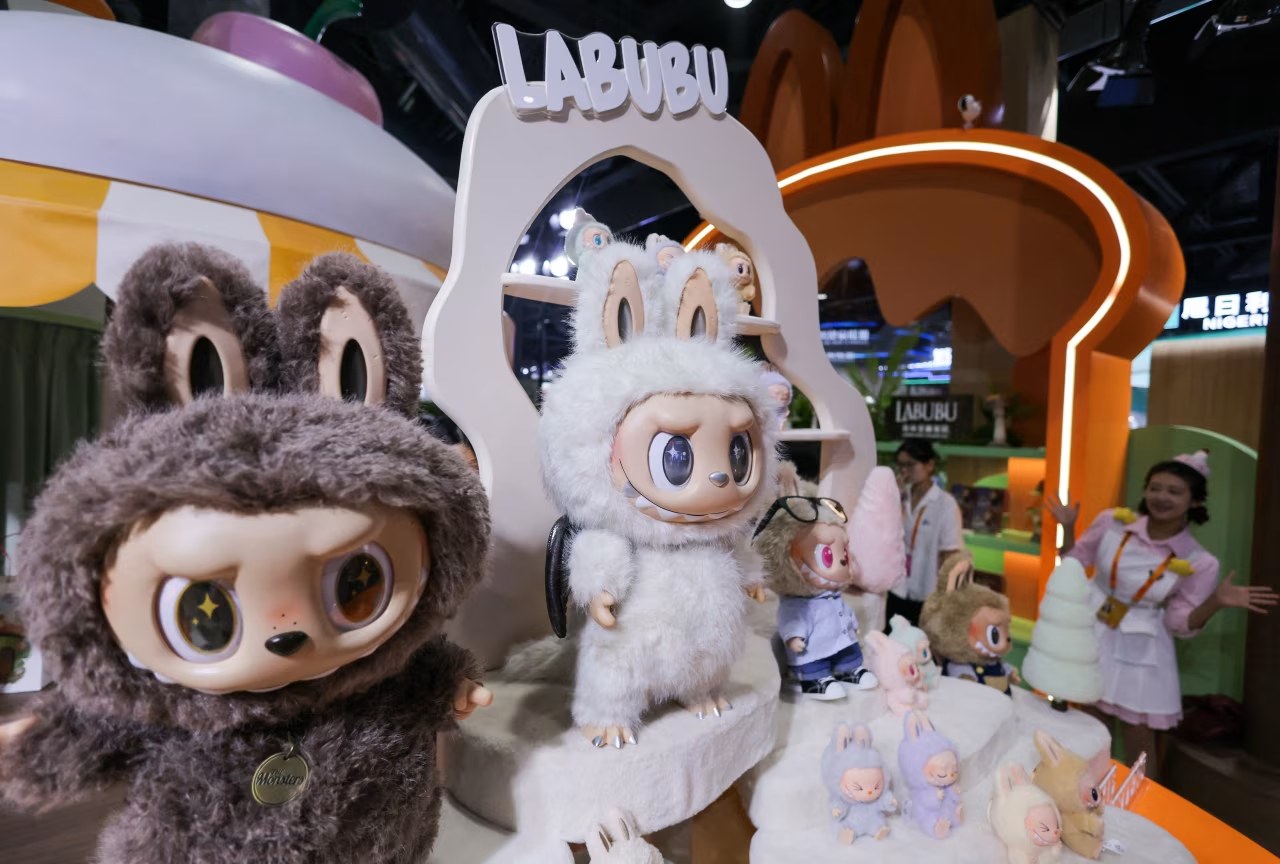
POP MART—Pop Mart International Group Ltd., the company behind the gap-toothed Labubu dolls taking over TikTok feeds, reported blockbuster earnings that underscore why investors are treating plush toys like high-margin tech gadgets. Net profit has rocketed about 350% in two years, a trajectory rarely seen in the traditional toy aisle.
The phenomenon rests on a simple formula: design characters that straddle the line between grotesque and adorable, package them in opaque blind boxes, and release limited editions that can fetch ten times retail on secondary markets. Executives told analysts the model delivers gross margins north of 60%, outstripping even premium apparel brands.
Yet the same buzz that inflated Pop Mart’s market capitalisation above $9 billion has also drawn copycats and regulatory scrutiny. As the company accelerates store openings in Europe and North America, maintaining scarcity without alienating fans will determine whether today’s earnings spike becomes tomorrow’s baseline.
From Beijing Booth to Global Craze: The Labubu Origin Story
Labubu began life in 2019 as a sketch by Hong Kong artist Kasing Lung, reimagining Nordic elves as wide-eyed imps with razor-sharp teeth. Pop Mart licensed the character the same year, betting that its mischievous grin would resonate with Gen-Z consumers fatigued by kawaii culture. The wager paid off: within 18 months the creature became the firm’s top-selling IP, spawning nine series and generating more than 30 million unit sales.
How a single character rewrote China’s toy export playbook
Unlike traditional action figures anchored to movie franchises, Labubu’s narrative is deliberately sparse, allowing buyers to project personalities onto the dolls. This open-ended storytelling, combined with hidden-ratio “secret” figures inserted at 1:144 odds, created a frenzied resale ecosystem. On China’s Xianyu marketplace, a first-edition hidden Labubu recently changed hands for 28,000 yuan ($3,900), roughly 130 times its 199 yuan sticker price.
Pop Mart’s production runs are intentionally limited; once a series sells out, molds are retired, hardening scarcity. Chief Marketing Officer Vivian Kwok told investors this scarcity engine “turns toys into tradable assets,” a dynamic that helped push 2023 domestic revenue to 8.7 billion yuan ($1.2 billion), up 36% year-on-year. Overseas, the company shipped 24 million Labubu units last year, equal to the combined sales of its next three IPs.
The lesson for legacy toymakers: intellectual property need not be cinematic to be lucrative—it must merely trigger emotional attachment and social currency. With Labubu stickers now plastered on Tokyo subway cards and Los Angeles skateboards, Pop Mart has proved that Chinese characters can leap cultural boundaries when packaged as collectible art rather than commodities.
Unpacking the Economics of the Blind-Box Gold Mine
Blind boxes are not a novelty in Japan or Europe, yet Pop Mart refined the concept into a data-driven science. Each 99 yuan ($14) box contains one of twelve standard designs plus a hidden chase variant, encouraging repeat purchases until collectors complete the set. Internal figures show the average Chinese buyer purchases 8.3 boxes per series, effectively paying for the same toy multiple times in pursuit of rarities.
Why gross margins beat those of Apple accessories
This repeat-purchase loop underpins financials that would make a SaaS executive envious: gross margin of 61.6% in 2023, operating margin of 28.4%, and inventory turns of 5.7×, faster than fashion retailers like H&M. CFO Gavin Liu attributes the profitability to vertically controlled design, manufacturing through 28 owned plants in Guangdong, and direct-to-consumer sales that bypass toy distributors who traditionally claim 30–40% mark-ups.
Pop Mart’s pricing power is amplified by social media unboxing videos that rack up billions of views. Douyin data show Labubu-related clips exceeded 14 billion plays last year, equating to free advertising worth an estimated 2.8 billion yuan. Analysts at CICC calculate that every yuan spent on content seeding returns 6.4 yuan in incremental gross profit, a ratio that dwarfs conventional ad spend ROI.
The risk, however, is oversaturation. When too many blind boxes flood the market, resale prices collapse and the perception of exclusivity evaporates. Pop Mart’s Shanghai headquarters monitors secondary-market pricing in real time; when median resale values drop below 1.3× retail for seven consecutive days, the company suspends further shipments to preserve brand equity—a tactic borrowed from luxury handbag makers.
Is Overseas Expansion a Sure Bet or a Margin Trap?
Pop Mart opened its first overseas flagship in Seoul in 2020 and now operates 98 stores outside mainland China, with another 50 slated for 2024. The international push is strategic: domestic toy spending is maturing, whereas Southeast Asian blind-box penetration is only 12% of China’s level. Revenue from abroad hit 1.6 billion yuan ($220 million) in 2023, a 245% jump that management says can triple by 2026.
Balancing local tastes with global scale
Yet expansion is capital-intensive. New stores require 2.2 million yuan in fixtures and initial inventory, and payback periods stretch to 24 months in European cities where rents rival luxury boutiques. Localization costs add up: European Union labelling rules forced a redesign of 38 SKUs, while Thai regulators require Thai-language character bios printed on boxes, raising unit packaging cost by 4%.
Consumer preferences also diverge. Japanese collectors favour smaller 7-cm figures that fit gashapon capsules, whereas U.S. buyers gravitate toward 10-cm plush keychains. Pop Mart’s solution is regional IP collaborations—Tokyo stores get exclusive Godzilla x Labubu figures, London gets a punk-rock Labubu designed by local graffiti artist BO130. These drops command 30% higher retail yet carry 20% lower volume, testing supply-chain agility.
Still, early data suggest the bet is paying off. Same-store sales in Seoul’s Myeongdong district exceed Beijing’s Sanlitun flagship on a yuan-per-square-metre basis, and gross margin in overseas stores is only 3 percentage points below domestic averages, a gap narrowed by higher price points. If Pop Mart hits its 2026 target of 300 overseas stores, international revenue could surpass 4 billion yuan, cushioning the company against any slowdown at home.
What a 350% Profit Surge Means for Investors—and Regulators
Pop Mart’s net profit of 1.28 billion yuan in 2023, up from 285 million two years earlier, translates to a compound annual growth rate of 112%, a figure that places it alongside tech unicorns rather than toy manufacturers. The performance propelled shares listed on the Hong Kong Stock Exchange from HK$38 in early 2021 to a peak of HK$107, though they have since eased to HK$85 amid broader China-consumption fears.
Can valuation premiums survive scrutiny?
At 38× forward earnings, Pop Mart trades at a 70% premium to global peer Hasbro and more than double Japan’s Bandai Namco. Morgan Stanley analyst Angela Zhou argues the multiple is justified by 60%-plus ROE and negative working capital—retailers pay upfront, while Pop Mart negotiates 90-day supplier terms—but warns that any sign of deceleration could trigger a sharp derating.
Regulators are circling. China’s State Administration for Market Regulation in 2023 classified blind-box sales as a form of lottery, requiring odds disclosure and age restrictions. Pop Mart responded by publishing exact probability tables on every box and installing facial-recognition age checks in domestic vending machines, moves that added 12 million yuan in compliance costs yet preserved operating margin by raising prices 5%.
Meanwhile, environmental groups criticise the plastic intensity of blind boxes; each figure is wrapped in three layers of polyvinyl chloride. Pop Mart pledged to cut virgin plastic 30% by 2027 and introduced a take-back scheme in 42 cities, though only 3% of buyers currently return used packaging. Failure to improve sustainability metrics could invite higher taxes under China’s extended producer-responsibility laws, trimming EPS by an estimated 4% according to Citi Research.
Copycats, IP Theft, and the Fight to Stay Unique
Success has bred imitation. Taobao listings for ‘LaaLaa’ and ‘LaBaBa’ dolls—identical imps with slightly altered eyes—sell for 19 yuan, undercutting Pop Mart’s 99 yuan price by 80%. The company filed 1,674 trademark infringement lawsuits in 2023, winning 92% of cases, yet enforcement costs reached 52 million yuan, a 44% increase on the prior year.
Why legal victories don’t end the threat
Counterfeiters exploit loopholes in China’s first-to-file system, registering lookalike names in obscure sub-classes. Even when Pop Mart secures injunctions, factories in Guangdong can re-tool within weeks, pushing new variants onto拼多多(Pinduoduo) livestreams. The problem is morphing: fake retailers now replicate entire Pop Mart store facades, complete with staff uniforms, luring consumers in second-tier cities where official stores are scarce.
Quality scandals hurt brand equity. In 2023, Jiangsu authorities seized 140,000 fake Labubu figures coated with phthalate-laden paint exceeding legal limits by 480%. News of the raid went viral on Weibo, erasing 1.2 billion yuan in market capitalisation within two trading days. Pop Mart responded with QR-code authenticity stickers and blockchain-based provenance for limited editions, technology that adds 0.4 yuan per unit but restores consumer confidence.
Intellectual-property experts say long-term protection lies beyond courts. Pop Mart is accelerating character rotation—retiring older series faster—and investing 180 million yuan annually in original animation shorts that deepen IP storytelling, making copycats feel obsolete. The strategy mirrors Disney’s playbook: fortify characters with narrative so that superficial knock-offs appear hollow.
What’s Next After the Labubu Boom?
Pop Mart’s pipeline includes 42 new IPs in development, ranging from cyber-punk pandas to retro-futuristic astronauts, each tested via online polls reaching 1.5 million users. Management’s target is to reduce reliance on any single character to below 15% of total sales by 2026; Labubu today accounts for 28%, down from 35% a year ago, indicating diversification is underway.
Can the company replicate Labubu’s magic?
Internal data science teams now scan Xiaohongshu and TikTok hashtags to predict emerging aesthetics—‘goblin-core’ and ‘cottage-goth’ are trending—feeding designers real-time briefs. The hit rate has improved: three of the last five internally developed series exceeded 10 million yuan in first-week sales, a milestone that only one in seven achieved in 2021.
Beyond plush, Pop Mart is experimenting with digital collectibles. A beta NFT version of Labubu on Tencent’s Zhibo blockchain sold 80,000 units in 12 minutes, netting 9.6 million yuan with zero plastic. Regulators remain cautious; the Ministry of Commerce has not yet classified NFT rights, leaving resale legality in limbo. Still, the trial suggests virtual extensions could protect margins if physical blind boxes face tougher environmental rules.
Geopolitics adds uncertainty. U.S. lawmakers have proposed examining Chinese consumer imports for potential data-collection risks in connected toys. Pop Mart’s U.S. vending machines currently operate offline, but future plans for app-linked gamification could invite scrutiny. Maintaining growth without antagonising regulators will require the same meticulous balancing act that turned a rebellious little imp into a multibillion-dollar empire.
Frequently Asked Questions
Q: Why are Pop Mart’s Labubu dolls so popular?
Pop Mart’s Labubu dolls blend ‘ugly-cute’ design with blind-box surprise mechanics, triggering repeat purchases and resale markets where rare figures fetch 10× retail prices.
Q: How fast did Pop Mart’s profits grow?
Net profit surged roughly 350% over two years, outpacing the 245% jump in overseas sales and reflecting high-margin collectible economics.
Q: What is a blind box?
A blind box is sealed packaging that hides the toy inside, turning each purchase into a gamble for common or rare variants and fuelling collector trading.
📰 Related Articles
- Trian and General Catalyst Seal $52-a-Share Janus Henderson Deal After Victory Capital Bows Out
- TransAlta Gains Analyst Upgrade as Alberta Power Prices Rebound
- Sinopec Claims Robust Oil Inventory Shields Production from Middle East Turmoil
- Oil Price Surge Still Leaves Global Demand Intact, Says Energy Secretary Wright
