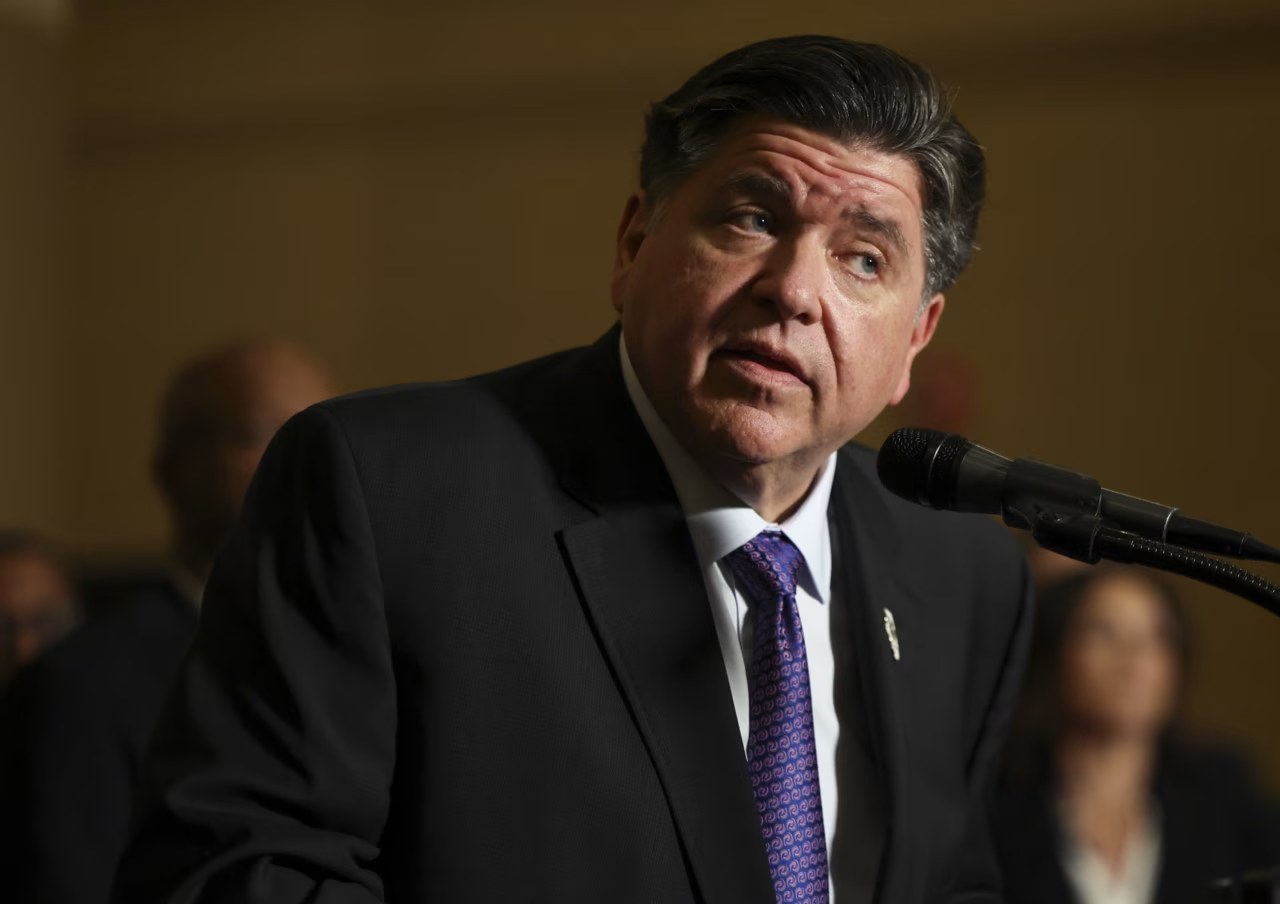
Pritzker Drops $10.2 Million Into Illinois Senate Primary, Stirs 2028 Backlash
- Illinois Gov. JB Pritzker’s personal committee and allied super-PAC have booked $10.2 million in TV, digital and mail spending for Lt. Gov. Juliana Stratton ahead of Tuesday’s Democratic Senate primary.
- Rep. Robin Kelly, Stratton’s main rival, enjoys support from the Congressional Black Caucus; Pritzker’s negative ads against Kelly are angering Black leaders whose 2028 endorsements he may need.
- Since 2017 Pritzker has contributed $35 million to his own campaigns and millions more to the state Democratic Party, giving him unrivaled control over Illinois’ primary machinery.
- Donors in Iowa and New Hampshire warn that heavy-handed spending against a prominent Black congresswoman could complicate Pritzker’s pitch in the first two presidential contests.
Self-funding buys airwaves, but may cost allies
JB PRITZKER—CHICAGO—Gov. JB Pritzker, the Hyatt-heir billionaire who has spent $35 million bankrolling his own Illinois victories, is now pouring eight-figure sums into a contested Democratic Senate primary that could fracture the very coalition any Midwestern governor needs to mount a credible White House bid.
State campaign-finance records show Pritzker’s personal committee and an affiliated super-PAC have placed or reserved at least $10.2 million in broadcast, cable, digital and mail advertising to promote Lt. Gov. Juliana Stratton ahead of Tuesday’s vote. The blitz has funded more than 9,000 gross-rating-point TV buys in Chicago alone—levels typically reserved for presidential battlegrounds.
The gamble is testing whether Pritzker’s money can outweigh his limited sway among national Democratic power brokers. Interviews with 20 state chairs, donors and operatives in early-primary states reveal growing unease that the governor is torching goodwill by underwriting attack ads against Rep. Robin Kelly, a senior Black congresswoman backed by the Congressional Black Caucus PAC.
How Pritzker Built a Money-First Political Machine in Illinois
Pritzker’s political ascent is inseparable from his wallet. Since entering the 2018 gubernatorial race he has written personal checks totaling $35 million—more than any Illinois candidate in history, according to the non-partisan campaign-finance tracker Illinois Sunshine. That figure excludes the $17 million he transferred to the Illinois Democratic Party between 2018 and 2022, money that paid for field offices, data programs and voter-registration drives that doubled as infrastructure for his own re-election.
The cost of a self-funded empire
‘When one person can single-handedly fund the party, loyalty flows to the donor, not the donor to the party,’ says Christopher Mooney, professor emeritus of political science at the University of Illinois Chicago. Mooney’s analysis of state board data shows Pritzker’s contributions represented 38 percent of all Democratic donations in Illinois during the 2022 cycle.
The governor’s largesse has bought fealty in Springfield: of the 73 Democratic state legislators elected in 2022, 67 received contributions from Pritzker or his campaign fund, ranging from $5,000 for freshman representatives to $250,000 for the Senate president’s caucus. That financial grip allowed Pritzker to pass an assault-weapons ban, a $45 billion capital bill and a constitutional amendment enshrining collective-bargaining rights—achievements he now touts as proof of executive competence for 2028.
Yet the same money that delivered legislative super-majorities has created a perception that Illinois primaries are auctions. Stratton’s bid to succeed retiring Sen. Tammy Duckworth—herself once boosted by Pritzker cash—has drawn $2.3 million in direct contributions from the governor’s personal committee, plus $7.9 million from the super-PAC ‘Illinois United for Change,’ whose largest donor is a $5 million transfer from Pritzker.
Rep. Kelly, first elected in 2010, has raised $1.8 million, a tenth of Stratton’s total. The imbalance has prompted the CBC PAC to spend $1.1 million on Kelly’s behalf, framing the race as a test of whether Black political power can survive a billionaire’s checkbook. ‘This isn’t about ideology; it’s about self-determination,’ Kelly told supporters in Matteson last week.
The governor’s allies counter that Stratton—who would become only the second Black woman in the Senate—merits investment. ‘Juliana has been his partner on criminal-justice reform and reproductive rights,’ says senior adviser Alex Herman. ‘The governor is proud to support her with the same intensity he brings to any policy fight.’
Still, the scale of the intervention has startled even seasoned Illinois operatives. Data from AdImpact show Stratton and her allies have aired 14,600 television spots since January, dwarfing the 3,400 purchased by Kelly’s side. The saturation has driven Chicago broadcast rates up 22 percent, forcing down-ballot candidates to cancel buys.
The financial asymmetry recalls Pritzker’s 2018 primary, when he spent $70 million to defeat five opponents combined. The difference now: the audience is national, and memories are longer. ‘Iowa activists don’t forget when you kneecap a CBC member,’ says one veteran Des Moines organizer who requested anonymity to avoid alienating potential donors.
Why Black Caucus Leaders View the Primary as a Hostile Takeover
To outsiders, Stratton versus Kelly looks like a choice between two progressive Black women. Inside the Congressional Black Caucus, it is read as a billionaire governor muscling aside a sitting member who has spent 14 years accruing seniority on powerful committees. Kelly chairs the subcommittee that oversees federal personnel policy; Stratton has never held federal office.
CBC clout on the line
‘You don’t spend $10 million against a Black congresswoman and expect applause in South Carolina,’ says Antjuan Seawright, a CBC-aligned strategist based in Columbia. Seawright points to the 2020 primary, when then-Sen. Kamala Harris withdrew after struggling to raise money against self-funding rivals—a cautionary tale for Pritzker if he needs to court Black women, the most reliable Democratic voting bloc.
The caucus has closed ranks. Reps. Jim Clyburn, Maxine Waters and Bennie Thompson have each headlined virtual fundraisers for Kelly, raising $450,000 in small-dollar donations since February. A letter signed by 27 CBC members warns national donors that undermining Kelly ‘risks silencing Black voices in the Senate at a moment when voting rights and police reform hang in the balance.’
Pritzker’s team notes that Stratton, as lieutenant governor, would bring executive experience the Senate lacks. They circulate a spreadsheet showing Stratton helped shepherd 11 criminal-justice bills, including the nation’s first cash-bail elimination. Yet even some Stratton surrogates concede the optics are perilous. ‘If you’re trying to run for president, you can’t look like you’re buying seats up and down the ballot,’ says a Chicago alderman who endorsed Stratton privately but refuses to appear in ads.
The racial dynamics are especially fraught because Illinois lost a Black member in redistricting. Rep. Bobby Rush retired; Rep. Kelly’s defeat would drop the CBC to 55 members, its smallest cohort since 1993. ‘We’re already fighting to keep seats in Alabama and Louisiana,’ says Rep. Steven Horsford, CBC chair. ‘We didn’t expect to play defense in Chicago.’
Privately, Pritzker’s donors argue that Stratton’s biography—daughter of a public-school principal, first Black woman elected statewide in Illinois—matches the party’s future better than Kelly’s, whose base tilts older and labor-based. But the argument collides with raw math: Black women comprised 61 percent of South Carolina Democratic primary voters in 2020. Alienating them, warns veteran strategist Jehmu Greene, ‘is a fast track to finishing fourth in the Palmetto State.’
The CBC has signaled it will remember. An internal memo circulated last week lists Pritzker’s spending as a ‘red-flag factor’ in 2028 endorsement questionnaires. While the caucus does not endorse in presidential primaries, its members’ individual blessings are coveted. ‘No one wants to be the candidate who spent millions to defeat a sister in the Senate,’ says the memo’s author, a senior CBC aide.
What Iowa and New Hampshire Insiders Fear Most
Pritzker has already toured Iowa twice, keynoted the Des Moines Register’s Political Soapbox and donated $250,000 to the state Democratic Party. Yet conversations with 15 county chairs, donors and activists reveal a consistent worry: heavy spending against a Black congresswoman will be weaponized in the first-in-the-nation caucus state, where African-Americans comprise 4 percent of the electorate but 11 percent of the 2020 Democratic turnout.
Caucus-state memories are long
‘We still judge candidates by how they treated Iowa in 2007,’ says Scott Brennan, former state party chair. Brennan notes that Joe Biden’s fourth-place finish in 2020 was blamed partly on his 1987 opposition to Iowa’s first-in-the-nation status—an ancient vote that caucus-goers recalled. Pritzker’s $10 million anti-Kelly blitz risks becoming a similar liability.
Activists cite parallels to former New York Mayor Michael Bloomberg, who spent $1 billion in 2020 but won only 16 delegates, partly because Black voters nationally punished him for years of stop-and-frisk policies. ‘Bloomberg had money; what he didn’t have was trust,’ says Aimee Allison, founder of the progressive group She the People. Allison’s polling shows 68 percent of Black women in early states view large ad buys against Black incumbents as ‘disrespectful.’
New Hampshire presents its own trapdoors. The state’s Democratic base is whiter, but its primary electorate includes thousands of Massachusetts transplants who track national Black political news. ‘We read the Root, we listen to the Breakfast Club,’ says Portsmouth activist Joelle Kanter. ‘If Pritzker kneecaps Kelly, we’ll hear about it.’
Pritzker’s team has quietly commissioned focus groups in Manchester and Nashua testing messages about electability and Midwestern pragmatism. But the governor’s wealth itself is a hurdle. A February University of New Hampshire poll found 55 percent of likely Democratic primary voters prefer a candidate who raises money from small donors; only 8 percent favor self-funding billionaires.
The governor’s donors counter that Barack Obama once trailed Hillary Clinton among Black voters before winning them over. Yet Obama was never accused of spending millions to defeat a Black congresswoman. ‘There’s a difference between persuasion and demolition,’ says Des Moines strategist Pete D’Alessandro, who ran Bernie Sanders’ 2016 Iowa operation. ‘Pritzker is demolishing.’
Some caucus veterans predict the issue will fade if Pritzker builds authentic relationships. Others warn the damage is structural. ‘You can’t buy authenticity in Iowa,’ says J.D. Scholten, who flipped Woodbury County in 2018. Scholten notes that progressive activists keep spreadsheets tracking every dollar spent against minority incumbents nationwide. ‘That spreadsheet now has Pritzker at the top.’
Could the Fallout Doom a 2028 Bid Before It Starts?
Presidential campaigns are fragile enterprises; one toxic narrative can sink a candidacy before the first debate. Pritzker’s Illinois spending is morphing into a shorthand for billionaire entitlement, a storyline that haunted Bloomberg and Tom Steyer. ‘The question isn’t whether you can self-fund, it’s whether you should,’ says David Axelrod, former Obama strategist. Axelrod notes that Illinois primaries rarely draw national press, but a sitting governor dropping eight figures against a Black congresswoman is ‘a made-for-cable morality play.’
The invisible primary is already underway
Between now and the 2028 Iowa caucus, roughly 800 Democratic super-delegates—elected officials, DNC members and party elders—will signal preferences. More than 200 are Black. ‘Those folks talk,’ says Leah Daughtry, who ran the 2016 and 2020 Democratic conventions. Daughtry’s informal whip count shows 14 CBC members leaning toward pledging early neutrality if Pritzker enters the race, a symbolic snub that could dry up endorsements and talent.
Money, of course, can paper over many wounds. Pritzker’s net worth, estimated by Forbes at $3.6 billion, dwarfs every 2020 Democratic candidate combined. He could self-fund a $500 million campaign without touching principal. Yet history shows cash alone cannot purchase legitimacy. In 1976, Idaho Sen. Frank Church entered late with establishment backing but collapsed after stories surfaced that his campaign had muscled local rivals. The narrative of bullying trumped ideology.
Pritzker’s camp notes that he has built a progressive record: a $15 minimum wage, paid sick leave, assault-weapons ban, reproductive-health shield law. They plan to spotlight that agenda in early states. ‘Voters care about results, not process stories,’ says senior strategist Alexandra De Luca. But process stories can eclipse results if they reinforce a negative archetype. ‘Billionaire buys election’ is a sticky trope in a party whose base increasingly rails against income inequality.
The governor has time to repair relationships—four years, to be exact. But first impressions harden quickly. Aides are debating whether a public apology or a unity rally with Kelly after the primary could tamp down resentment. Kelly, for her part, has not committed to endorsing Stratton if she loses, a warning shot that the rift may linger.
Ultimately, the episode crystallizes a paradox for Pritzker: the very fortune that makes a national run imaginable may be the obstacle he cannot surmount. ‘In Illinois, money is power,’ says Mooney. ‘In Iowa, money is suspicion.’ Bridging that gap will require more than another $10 million ad buy.
Frequently Asked Questions
Q: How much has JB Pritzker spent on the Illinois Senate primary?
State filings show Pritzker’s personal committee and allied super-PAC have placed or reserved at least $10.2 million in TV, digital and mail spending for Juliana Stratton through the March 19 primary.
Q: Why are national Democrats angry about Pritzker’s spending?
Stratton’s main rival, Rep. Robin Kelly, is backed by the Congressional Black Caucus. By bankrolling attack ads against Kelly, Pritzker risks alienating pivotal Black leaders whose endorsements he would need in a 2028 presidential primary.
Q: Does Pritzker’s wealth give him an unfair advantage in Illinois politics?
Pritzker has contributed $35 million to his own campaigns since 2017 and funded much of the state Democratic Party’s infrastructure. Critics say this self-financing allows him to dominate primaries without building the grassroots coalitions essential for national viability.
📰 Related Articles
- Trump’s Iran Dilemma: Will He Order a Fight-to-Win Strategy or Declare Victory and Exit?
- Senate Pushes Historic Housing Bill Forward Amid Growing Political Headwinds
- James Clyburn, 85, Seeks 18th Term, Bucking Democratic Generational Shift
- D.C. Bar Targets Trump Pardon Attorney, Risking a New War Over Lawyer Discipline
