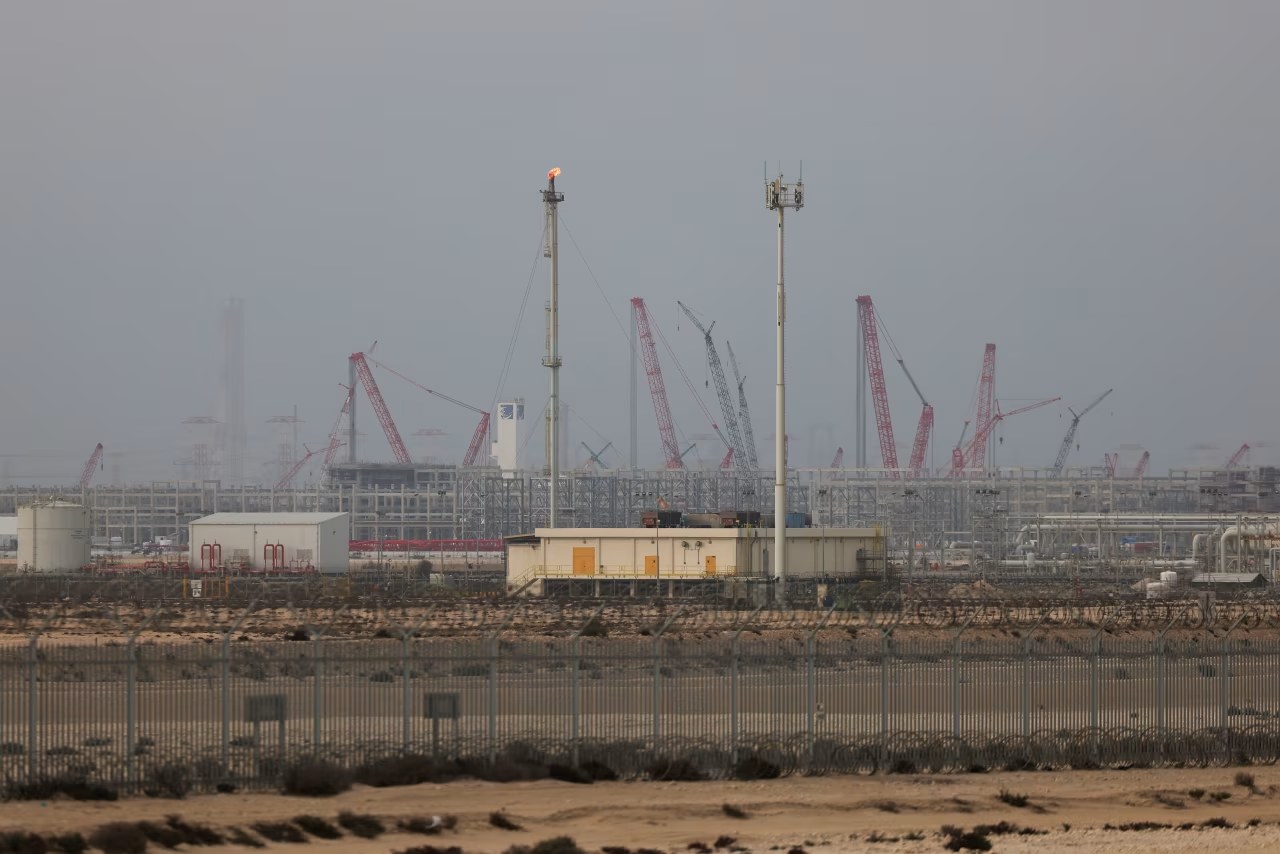
30% of World Helium Gone Overnight as Qatar LNG Plant Hit
- Ras Laffan Train 3 offline after Iranian missile strike, erasing 1.2 Bcf of helium capacity.
- AI chip fabs face EUV cooldown shortage; spot helium jumps 340% to $2,100/mcf.
- TSMC, Samsung, Intel scramble for alternative suppliers in Algeria, Russia, Wyoming.
- MRI clinics postpone scans; SpaceX delays Starlink batch over balloon lift gas.
Semiconductor chillers and medical scanners compete for dwindling helium reserves
AI CHIP MANUFACTURING—The precision required to print a 3-nanometer transistor is so extreme that the mirrors inside an EUV lithography machine must be kept at –269 °C. Achieving that temperature without vibration or thermal drift is only possible with liquid helium, a resource that vanished overnight when Iran-backed forces struck Qatar’s Ras Laffan LNG complex.
With Train 3 now offline, roughly 30% of global helium supply has disappeared, sending spot prices from $470 per thousand cubic feet to $2,100 in three trading days. The strike, part of the wider Iran conflict, has instantly weaponized a gas better known for party balloons than for keeping AI data centers alive.
Industry executives warn the shortage could idle semiconductor fabs from Taoyuan to Phoenix and delay MRI installations already backlogged by two years. “Helium was already on allocation; this is a code-red event,” said Techcet analyst Jon Custer, who tracks specialty-gas supply chains.
How One Missile Strike Unplugged a Third of Global Helium
Before dawn, satellite imagery shows plumes rising above Ras Laffan’s northern fence line where Train 3 processes 8 billion cubic feet of LNG per year. Buried inside that methane stream is 15% of the world’s export-grade helium, separated in a 4.3-kilometer cryogenic train that liquefies gas at –162 °C. Iranian officials claimed the strike targeted “enemy economic assets,” but the payload hit the cold box that distills helium from Qatari North Field gas.
QatarEnergy immediately declared force majeure on helium deliveries, according to a customer notice viewed by The Wall Street Journal. The notice cancels 425 containers scheduled for loading in May, equivalent to 1.2 billion cubic feet of annual capacity. State-run Qatargas has not offered a restart timeline; engineers on site told Reuters the cold box requires six months of repairs because brazed-aluminum heat exchangers cracked under thermal shock.
The outage erases the buffer that kept helium markets balanced. Global demand last year totaled 6.4 billion cubic feet, of which Qatar supplied 1.9 Bcf, the U.S. Bureau of Land Management 1.7 Bcf, and Algeria 0.9 Bcf. “Losing 30% overnight is unprecedented—there is no swing producer,” said Phil Kornbluth, president of Kornbluth Helium Consulting. Helium is a byproduct; no country can simply ramp output without also increasing LNG or methane production, a geopolitical impossibility amid sanctions on Russia and OPEC quotas.
From party trick to chip-making chokepoint
Although helium is the second-most abundant element in the universe, on Earth it is non-renewable, created only by radioactive decay of uranium and thorium. Once released, it escapes gravity forever. That rarity is why the U.S. government stockpiled 1 Bcf in the Federal Helium Reserve under Amarillo, Texas, but Congress mandated privatization in 1996, shrinking strategic inventories. Today only the Cliffside field remains, holding 3.6 Bcf—less than seven months of global demand.
AI fabs consume helium in two ways: as a coolant for superconducting magnets inside EUV machines and as a purge gas to prevent oxygen contamination during chemical-vapor deposition. A single TSMC 3-nm fab uses 28 million cubic feet per year, enough to fill 1,600 Goodyear blimps. With Qatar offline, fabs must now compete against hospitals, rocketry, and welding—sectors that can pay premium prices because lives or launch windows are at stake.
The shortage also exposes a logistics Achilles heel. Helium is shipped in 40-foot ISO containers at –269 °C; rerouting a vessel from Doha to Houston adds 18 days and $1.2 million in charter costs. Container lessor Euro-Collins says every tank in its 1,100-unit fleet is already leased through 2025. Forward prices on the CME helium swap curve show $2,400/mcf for June delivery, a level that would make chip production economically questionable for advanced nodes below 2 nm.
Next chapter explores how semiconductor giants are scrambling to secure alternative helium sources before production lines go cold.
Can U.S. and Russian Fields Replace Qatar’s Lost 1.2 Bcf?
The short answer is no—at least not quickly. America’s helium pipeline is already maxed out. The BLM’s Cliffside plant operated at 98% utilization last quarter, and private operators—Air Products, Linde, Matheson—have no spare cryogenic trains. Expanding the Doe Canyon field in Colorado would take 18 months and $450 million, according to a 2023 engineering study by Poten & Partners. “You can’t just flip a switch and make helium; it’s tied to methane production,” said Rob Peacock, VP of helium at Weil Group Resources.
Russia’s Amur project, designed to supply 1.2 Bcf by 2025, is sanctioned after the Ukraine invasion. Gazprom’s processing plant caught fire in 2022, and only two of six helium trains are operational. Even if sanctions lifted tomorrow, rebuilding compressors would require Siemens Energy turbines currently blocked by export controls. China’s Sinopec is testing small-scale helium extraction from shale gas in Chongqing, but output is 12 million cubic feet per year—0.2% of global demand.
Algerers’s Skikda plant offers the only near-term relief. Sonatrach can boost output 150 million cubic feet within 90 days by reopening idled liquefaction units, according to a tender document seen by Bloomberg. But Algiers insists on long-term offtake contracts priced above $1,800/mcf, triple last year’s average. European buyers, stung by 2022’s natural-gas crisis, are reluctant to lock in 10-year deals. Meanwhile, Japan’s Taiyo Nippon Sanso has chartered a spot cargo at $2,050/mcf to feed TSMC’s Kumamoto fab, setting a new benchmark.
Semiconductor diplomacy in the noble-gas era
The helium crunch is accelerating fab diplomacy. U.S. Commerce Secretary Gina Raimondo flew to Doha in April seeking priority access for American chip makers, offering to expedite $8 billion in LNG export licenses for Qatar’s Golden Pass project. Qatar’s energy minister Saad al-Kaabi declined, citing “existing contractual obligations,” yet hinted Tokyo or Seoul might receive spot cargoes if they invest in Qatari downstream petrochemicals.
Industry insiders say a three-way barter is emerging: South Korea provides cryogenic tankers, Japan offers advanced helium-separation membranes, and the U.S. supplies drilling tech for North Field East. Such techno-diplomacy underscores how a niche gas has become strategic. EUV machines made by ASML cost $200 million apiece and require 12 liters of liquid helium per hour. Without it, Moore’s Law stalls, AI training clusters sit idle, and $500 billion in global semiconductor revenue is at risk.
The next chapter quantifies how high helium prices could push AI chip costs—and why MRI patients are already feeling the chill.
Which AI Fabs Face Production Halts First?
TSMC’s 3-nm fab in Tainan is the canary in the cryogenic coal mine. The facility uses 28 million cubic feet of helium per year, delivered via a dedicated Air Products pipeline that branches from the Linde-Holic complex. With Qatar offline, Linde has cut supply to 80% of contracted volume under force majeure clauses. TSMC is now recycling 95% of its helium through closed-loop reliquefiers, but that still leaves a 1.4 MMcf annual gap. Chairman Mark Liu told investors the company will prioritize 3-nm over 5-nm wafers if rationing deepens.
Samsung’s new Taylor, Texas fab is even more exposed. Designed for 2-nm nodes, the plant requires 35 MMcf/yr—double TSMC—because EUV throughput scales inversely with wavelength. Samsung signed a 10-year supply deal with QatarEnergy in 2022 at $450/mcf; the contract includes a $200 million take-or-pay clause. Legal experts say Samsung must either pay or find replacement molecules, driving the Korean giant to charter a spot cargo from Algeria at $2,100/mcf last week, according to shipping data from Vortexa.
Intel is scrambling to retrofit its Chandler, Arizona site with helium recovery units that capture boil-off gas and recompress it. The $400 million project, code-named Blue Sky, will cut net consumption 60% but won’t start up until 2025. Meanwhile, Intel has idled one of four EUV bays, delaying Meteor Lake qualification and pushing desktop CPU launches into 2025. CFO Dave Zinsner warned investors that every month of helium rationing trims $150 million from data-center revenue.
Spot market madness and contract rewrites
Helium traders describe a Wild West. Middlemen are flipping containers at 300% premiums within hours. German reseller Helium 24 auctioned a 40-foot tank for €2.3 million—equivalent to $2,550/mcf—setting an all-time public record. Buyers now pay 50% upfront in euros to hedge currency risk. Long-term contracts are being rewritten quarterly instead of every three years, with indexation clauses tied to TTF natural-gas futures rather than the historic Bureau of Land Management (BLM) crude-helium auction price.
Smaller AI startups feel the squeeze most. Toronto-based Tenstorrent, developing RISC-V AI accelerators, was quoted $3,100/mcf for a 50,000-cubic-foot mini-tank. CEO Jim Keller tweeted the quote was “more than our next funding round,” forcing the company to delay tape-out of its 2-nm Greedy chip. Industry analysts say such anecdotes foreshadow consolidation: only hyperscalers with balance-sheet depth can afford helium, accelerating a shift toward custom silicon inside Amazon, Google, and Microsoft data centers.
The next chapter examines how hospitals are canceling MRI scans and what governments are doing to prevent a medical helium crisis.
MRI Clinics Delay Scans as Helium Priority Shifts to Chips
Helium’s medical use is older than its semiconductor role—MRI magnets require 1,700 liters of liquid helium to achieve superconductivity at 4.2 Kelvin. The American College of Radiology estimates 45 million scans are performed annually in the U.S.; each litre of helium supports 26 scans. With Qatar offline, hospitals face a triage decision: reserve dwindling helium for oncology patients or risk magnet quench that idles a $3 million scanner.
Cleveland Clinic has postponed 1,200 non-urgent scans since April, according to internal scheduling data. The hospital’s 3-Tesla Siemens Magnetom consumes 52,000 cubic feet per year; supplier Air Products cut deliveries to 70% of normal. Chief imaging officer Dr. Peter Prior says neurology and cardiac MRIs are prioritized, while knee and shoulder scans are deferred to CT. “We’re rationing helium like a battlefield drug,” he told STAT News.
In Britain, the National Health Service has activated its helium mutual-aid protocol. NHS England reallocates 12,000 liters from smaller community hospitals to major trauma centers, a move that triggered protests in Cornwall where local scanners remain dark. The U.K. imports 68% of its helium from Qatar; the Department of Health predicts a £45 million budget overrun if spot purchases continue above £1,800/mcf through September.
Pediatric scans at risk
Children are disproportionately affected. Unlike adults, kids often need sedation for MRI, so rescheduling is complex. Boston Children’s Hospital delayed 300 brain-mapping studies for epilepsy surgery, pushing surgical dates into 2025. Each week of delay increases seizure risk, said neurologist Dr. Annapurna Poduri. The hospital is exploring closed-loop reliquefiers that recover 90% of boil-off, but units cost $750,000 and require six-month lead times for super-insulated piping.
Philips, GE Healthcare, and Siemens Healthineers have jointly petitioned the U.S. Department of Energy for priority access to the Federal Helium Reserve, arguing medical imaging is critical infrastructure. The DOE has temporarily reallocated 60 MMcf to hospitals, enough for six weeks of normal consumption, but warned no further releases are planned after August. Industry lobby AdvaMed is pushing Congress to pass the Medical Imaging Helium Security Act, which would mandate a 180-day strategic stockpile similar to the 1-million-barrel Northeast Home Heating Oil Reserve.
Meanwhile, some entrepreneurs see opportunity. Australian start-up Polarisol is marketing magnetocaloric scanners that use gadolinium alloys and require no helium, but image resolution is 30% lower and scan time doubles. Early adopters include rural Indian hospitals where helium is unavailable at any price. The next chapter explores whether recycling, substitution, or government stockpiles can prevent helium from becoming a permanent chokepoint for both AI and healthcare.
Could Recycling and Substitution End the Helium Age?
Helium is not consumed—it escapes. Theoretically, 95% can be captured and reliquefied, but only 18% of users currently operate recovery systems because up-front capital is prohibitive. A typical MRI recovery unit from Cryomech costs $550,000 and saves 1.2 million cubic feet over ten years, yielding a payback period of four years at pre-crisis prices. With spot helium at $2,100/mcf, payback shrinks to 14 months, prompting a surge in orders that has pushed Cryomech’s lead time to 50 weeks.
Semiconductor fabs are experimenting with closed-loop chillers. ASML’s latest NXE:5000 EUV tool integrates a super-critical helium circuit that recycles 92% of coolant, cutting net demand per scanner from 3.8 MMcf/yr to 0.3 MMcf. Intel and TSMC have committed to deploying 70 such units by 2026, but chip makers must retrofit cleanrooms with 50-foot-high gas storage tanks—an impossible task for older fabs in urban Hsinchu or Chandler.
Substitution is tougher. For MRI, researchers are exploring nitrogen-cooled high-temperature superconductors that operate at 30 Kelvin, but ceramic wire is brittle and magnets generate lower field strength. France’s Iseult project achieved 11.7 Tesla using MgB2 tape, yet image homogeneity remains below clinical standards. Commercialization is “at least a decade away,” said Dr. Lucio Frydman at France’s Atomic Energy Commission.
Government stockpiles and lunar mining dreams
The U.S. Government Accountability Office recommends expanding the Federal Helium Reserve to 3 Bcf—triple current size—at a cost of $1.8 billion. Funding was stripped from last year’s omnibus bill, but Senator John Barrasso (R-Wyo.) plans to attach an amendment to the National Defense Authorization Act, citing helium’s role in rocket launches. A parallel House bill proposes tax credits covering 30% of capital for private helium storage caverns, modeled on the Strategic Petroleum Reserve.
Start-ups are looking skyward. NASA’s Ames Research Center estimates the Moon’s regolith contains 1.2 million tons of helium-3, a fusion-friendly isotope. MoonEx and Interlune aim to harvest 200 kg annually by 2032, but even success would supply only 50 MMcf of helium-4 byproduct—4% of current Earth demand. Fusion reactors that burn helium-3 remain theoretical.
Until technology matures, market signals point to conservation. ASML, TSMC, and Siemens Healthineers formed the Noble Gas Alliance, pledging to share real-time inventory data and charter joint LNG vessels to reduce empty back-hauls. Early results show a 7% reduction in transit losses, equivalent to 180 MMcf/yr—enough to supply every pediatric MRI in Europe. Yet executives admit the fix is partial: without Qatar, the world is living off helium borrowed from the future.
The final chapter forecasts what permanent shortage means for AI progress, space exploration, and medical diagnosis.
What a Permanent Helium Crunch Means for AI, Space, and Medicine
If Qatar’s Train 3 stays offline beyond 2025, analysts at BofA Securities model a structural deficit of 1.4 Bcf per year—enough to idle 25% of EUV lithography capacity and delay AI compute growth by 18 months. Hyperscalers would shift training to older 5-nm nodes that use argon-fluoride lasers instead of helium-cooled EUV, but power efficiency drops 35%, raising data-center electricity demand by 12 TWh annually—equivalent to Denmark’s entire grid.
Geopolitically, helium could become the next rare earths. China controls 11% of global helium after acquiring QatarEnergy’s long-term offtake, and Beijing has hinted at export quotas for “national security reasons.” A 2024 white paper by the European Chips Act warns that helium dependency poses “a systemic threat comparable to 2022’s neon crisis,” referencing the Ukraine war’s disruption of laser gases. Brussels is weighing a 600-million-euro strategic helium reserve carved out of depleted North Sea gas fields.
For space, the impact is immediate. SpaceX’s Starship uses 3.7 million cubic feet of helium for each Super Heavy pressurization cycle; lunar missions require 30% more due to extended tanking operations. With Qatar offline, SpaceX has delayed the Artemis III uncrewed lander demo by four months and is testing hot-staging that replaces helium with autogenous methane pressure. Competitor Blue Origin says its BE-4 engine already eliminates helium, giving it a cost advantage in the lunar lander competition.
Medical rationing becomes permanent
Without policy change, MRI helium allocation may mirror 1980s CT scanner rationing, when hospitals needed certificates of need. The American Hospital Association predicts 15% of rural scanners will shut by 2026, affecting 2.4 million diagnostic procedures annually. Telemedicine cannot resolve the gap; brain tumors still require tissue characterization only MRI provides. AdvaMed is lobbying for a federal helium voucher program modeled on the COVID-19 vaccine distribution, prioritizing pediatric oncology and stroke protocols.
Ultimately, scarcity could accelerate innovation. Venture funding for helium-free imaging start-ups reached $410 million in Q1, triple the prior year. If magnetocaloric or nitrogen-cooled magnets reach clinical-grade resolution, the helium era may end not with abundance but with technological leapfrogging—much like lithium-ion batteries obviated the need for platinum in catalytic converters.
Until then, the world faces a stark choice: inflate fewer balloons or chill fewer chips. In the words of ASML CTO Martin van den Brink, “Moore’s Law was always about economics, not physics. Helium is now the economics.” The invisible gas that lifted party spirits has become the invisible hand that could stall AI progress—and the race to secure it is only beginning.
Frequently Asked Questions
Q: Why is helium critical for AI chip production?
Extreme-ultraviolet lithography machines that print AI chips must be cooled to –269 °C; liquid helium is the only coolant stable enough to keep these EUV tools running without vibration or thermal drift.
Q: How much helium comes from Qatar?
Qatar’s Ras Laffan complex normally supplies 30% of global helium through three LNG trains; the shutdown of Train 3 after Iranian missile strikes erased roughly 1.2 billion cubic feet of annual capacity overnight.
Q: Which tech firms are most exposed?
TSMC, Samsung, and Intel rely on Qatar-origin helium for EUV nodes at 3 nm and below; medical giants Philips, Siemens Healthineers, and GE Healthcare face MRI magnet shortages, while SpaceX and Google’s Project Loon lose high-altitude balloon lift gas.
