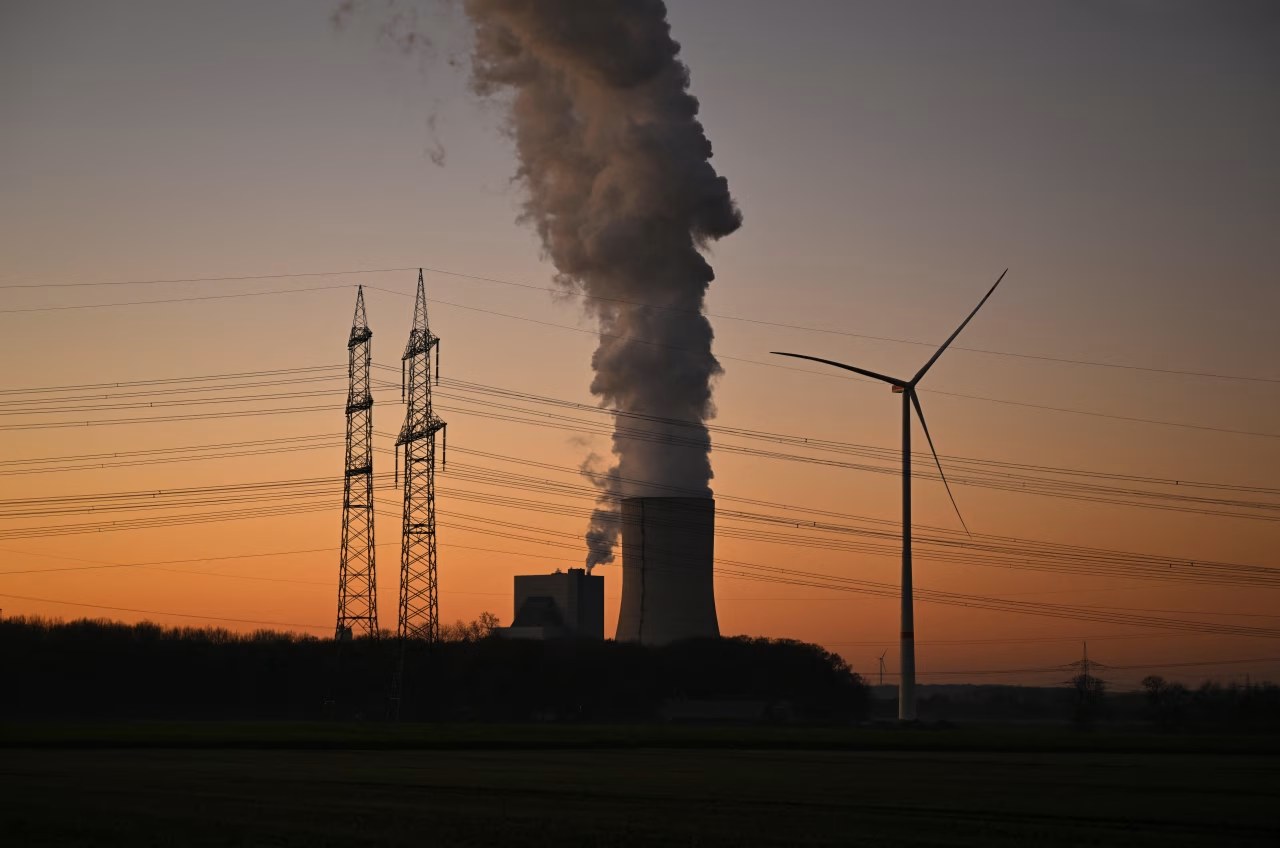
Brent Crude Spikes 5.4% to $113.34 After Second Iranian Strike on Qatar’s Mega-LNG Hub
- QatarEnergy confirms Iranian missiles inflicted “extensive further damage” on Ras Laffan, the world’s largest LNG export site.
- Brent crude surged $5.82 to $113.34 while WTI rose 1.3% to $96.74 within minutes of the 0921 ET alert.
- Rystad Energy warns oil could breach $120 depending on damage severity.
- Canadian small-business confidence tumbled 9.5 pts to 55.8 as 50% now worry about fuel costs.
Missile strikes on a single Qatari complex jolt global prices and expose North American small firms to fresh cost shocks.
QATARENERGY—Two Iranian missile volleys in 48 hours have left Qatar’s Ras Laffan liquefied-natural-gas complex scarred and global crude markets scrambling. State-run QatarEnergy told Dow Jones Newswires at 0921 ET that the second strike caused “extensive further damage,” sending Brent crude up 5.4% to $113.34 a barrel and WTI 1.3% higher to $96.74.
The spike rippled well beyond the Strait of Hormuz. In Canada, the Federation of Independent Business revealed that long-term confidence among small firms dropped 9.5 points to 55.8 in March, with half of respondents now ranking fuel costs as a top worry—up from 36% only a month earlier.
Energy strategists see the twin developments as a stark reminder that physical supply risks, not just geopolitical rhetoric, still set the price floor for oil and gas.
Double Tap on Ras Laffan: Why Two Iranian Strikes Matter More Than One
QatarEnergy’s terse 0921 ET bulletin carried a chilling detail: the second Iranian missile salvo did not merely repeat Wednesday’s attack—it amplified it. Engineers on site report that storage tanks, cryogenic loading arms, and the flagship Train 5 liquefaction unit all sustained fresh impacts, raising the probability of a prolonged outage at the world’s largest LNG export facility.
Energy Aspects analyst Amrita Sen notes that Ras Laffan ships roughly 10% of globally traded LNG. “Any offline capacity there tightens Atlantic and Pacific basin balances simultaneously,” she said. With European buyers still scrambling to replace Russian piped gas, a 3- to 6-week shutdown could add $15-20 per barrel to the Brent curve, according to Rystad Energy.
Insurance underwriters at Lloyd’s have already placed QatarEnergy on a seven-day force-majeure watch, a procedural step that allows cargo cancellations. Spot LNG prices in Asia leapt 12% to $14.80 per million British thermal units, the highest since late February.
The attacks also redraw security calculations for Gulf energy infrastructure. “Ras Laffan was considered a hardened site outside Iran’s immediate retaliation radius,” says Gulf States Analytics CEO Giorgio Cafiero. “That assumption is now shattered.”
Forward curves imply traders are pricing in a 25% probability of a third strike inside two weeks. QatarEnergy has not released repair timelines, but satellite thermal imagery reviewed by Braemar ACM shows heat plumes persisting 18 hours after the second hit—an indicator of continuing fires or flaring.
Market ripple: from crude to chemicals
Beyond oil, the strikes feed into naphtha and petrochemical chains. Qatar’s Ras Laffan condensate splitter, a key feedstock source for Asian plastics makers, is operating at reduced rates, traders told ICIS. That squeezes margins for South Korean ethylene producers who rely on Qatari heavy naphtha.
All told, the double strike has shifted the oil market’s perceived floor. “Brent at $110 is no longer a spike—it’s the new base case,” Rystad senior analyst Jorge León wrote in a client note.
Investors now await a 16:50 ET QatarEnergy briefing that could clarify whether force majeure will be declared on term LNG contracts—a move that would send European TTF gas futures back above €60 per megawatt hour.
Canadian Small Businesses Feel the Squeeze as Fuel-Anxiety Spikes
While missiles flew in the Middle East, a quieter crisis brewed in Canadian inboxes. The Canadian Federation of Independent Business released its monthly barometer at 0850 ET showing long-term confidence plunging 9.5 points to 55.8, erasing six months of gradual gains.
Chief economist Simon Gaudreault attributes the drop to a single variable: fuel. The share of owners listing energy costs as a top worry leapt to 50% from 36% in February, the sharpest one-month jump since Russia’s 2022 invasion of Ukraine. “Small firms run on thin margins; a C$0.10 per litre increase at the pump can wipe out profits for a delivery-heavy enterprise,” Gaudreault said.
Short-term optimism also deteriorated. Businesses expecting better conditions over the next three months fell to 28%, the lowest since August. Adding to the gloom, 57% now cite insufficient demand as a headwind, up from 50% previously.
Yet labour markets remain stubbornly stable. Net staffing intentions stayed positive for a third consecutive month, with 17% planning to hire versus 12% expecting reductions. That divergence—weak confidence but steady employment—suggests firms are hoarding labour after two years of shortages rather than betting on growth.
Transportation and agriculture sectors show the steepest confidence drops. Trucking companies operating cross-border routes face both diesel near CAD $1.60 per litre and the prospect of U.S. freight recessions. In prairie provinces, farmers seeding 2026 crops are budgeting for fertilizer that tracks natural-gas prices now buoyed by Ras Laffan risk premiums.
Policy response: carbon tax pause floated
Opposition Conservatives quickly seized on the data, calling for a three-month pause in the federal carbon-tax backstop that adds C$0.14 per litre to diesel. Energy Minister Jonathan Wilkinson countered that proceeds are rebated to households, but CFIB surveys show only 38% of small firms believe they break even under the current system.
Looking ahead, CFIB’s March read is a warning shot. If Brent holds above $110, fuel-cost anxiety could breach 60% in April, a threshold historically associated with delayed capital spending and hiring freezes among Canada’s 1.2 million small employers.
Why Energy Stocks Are Outpacing Oil—And May Keep Doing So
Conventional wisdom says energy shares track crude. Citi’s Alastair Syme argues that axiom is broken. In a 0707 ET research note he points out that energy equities outperformed falling oil prices by 30% in 2025, a divergence that widened after the Ras Laffan attacks.
Syme’s thesis rests on capital discipline. Unlike the 2011-14 boom, majors today funnel free cash flow to dividends and buybacks rather than megaprojects. The result: equity investors capture margin expansion even when crude flat-lines. Shell’s Q4 2025 buyback alone equaled 6% of its float, while Exxon lifted dividends for a 40th consecutive year.
Valuation metrics reinforce the case. European oil majors trade at 6.2x 2026e EV/EBITDA versus a 10-year average of 8.1x, despite Brent futures backwardation pointing to $80-plus through 2027. “The market still prices these names as if stranded-asset risk dominates cash-flow duration,” Syme told clients.
Transition narratives also create mispricing. Between 2021 and early 2022 investors sold energy shares on ESG concerns while spot crude rallied, creating a performance gap that has only partially closed. Syme believes the gap will shut as funds rebalance toward sectors generating inflation-protected cash.
Upstream independents show the starkest divergence. U.S. shale names like Pioneer Natural Resources have lifted base dividends 200% since 2023 yet trade at 4x free-cash-flow yield, double the S&P 500 median. If crude holds above $90, Syme sees 25% further upside for the S&P Energy Select Index even without multiple expansion.
Refining and LNG: hidden leverage to Ras Laffan
Downstream assets add torque. Ras Laffan outages tighten global LNG supply, lifting long-term contract prices linked to Brent. Refiners with integrated LNG portfolios—such as Shell and TotalEnergies—capture margin on both sides. Citi models a $10 per barrel rise in Brent adding $2.3 billion to Shell’s 2026 cash flow from liquids and $1.1 billion from LNG linkage.
Risk remains: a cease-fire that knocks Brent back to $90 could erase recent outperformance. Yet with Iranian escalation odds rising and OPEC+ spare capacity thinning, Syme’s base case is that energy equities continue to earn a scarcity premium.
Could Brent Hit $120? Futures Curves and Option Flows Say Yes
Rystad Energy’s 0921 ET note was blunt: “Oil markets, already at $110 per barrel, would likely breach $120 in the immediate aftermath, with further upside depending on the severity of the damage sustained.” Within two hours of publication, Brent front-month futures touched $114.17, the highest intraday print since 2013.
Options markets confirm the bias. Weekly $120 call options expiring Friday surged 340% to $2.40 per barrel, implying a 28% probability Brent hits that strike, up from 9% pre-strike. Skew—the premium of out-of-the-money calls over puts—has widened to 5.5 volatility points, a level last seen when Russia invaded Ukraine.
Physical traders point to floating storage. At least four very-large-crude-carriers have been booked this week to store oil off Qatar and the UAE, a classic precursor to $120-plus pricing. Each VLCC can hold 2 million barrels; combined, they represent 8 million barrels removed from prompt supply.
Yet fundamentals argue for caution. U.S. commercial crude inventories rose 3.2 million barrels last week, the seventh consecutive build. Strategic Petroleum Reserve releases totaling 180 million barrels since 2022 have left OECD government stocks 8% below the five-year average, but private storage capacity is ample.
China’s import appetite adds another variable. Refinery runs there hit 14.3 million barrels per day in February, just shy of record highs. If Beijing loosens zero-COVID restrictions further, seasonal demand could add 1 million barrels per day to global balances, easily offsetting Ras Laffan’s lost crude-equivalent of 200,000 barrels per day.
Margin calls and macro feedback loops
A rapid run to $120 would trigger margin calls across commodity indices, forcing algorithmic funds to sell long positions. Citi estimates every $10 Brent rise cuts global GDP growth by 0.2 percentage points within four quarters. With OECD central banks already hiking rates, a supply-shock inflation spike could complicate monetary policy trajectories.
Bottom line: Rystad’s $120 call is plausible, but path dependency matters. If repairs at Ras Laffan exceed six weeks or a third Iranian strike materializes, Brent could overshoot to $125. Conversely, diplomatic détente could send futures back below $105 within days.
What’s Next for Global Supply Chains If Middle East Energy Keeps Escalating?
The back-to-back Iranian strikes on Ras Laffan are more than a regional flashpoint—they are a stress test for global supply chains already stretched by two years of war-related rerouting. Roughly 30% of Europe’s LNG landed at Ras Laffan last year; replacing those volumes means pulling cargoes from Asia, bidding up spot prices, and lengthening voyage distances around the Cape of Good Hope.
Containerized freight markets feel the knock-on effect. LNG carriers command day-rates above $150,000, crowding out availability for ethane and LPG carriers used in plastics manufacturing. That pushes chemical feedstock costs higher for European and North American converters already grappling with inflation-weakened consumer demand.
Aviation fuel is next in line. Jet cracks in Singapore rose to $34 per barrel this week, the widest differential since 2014. Airlines are lifting surcharges on transpacific routes, adding roughly $35 to the cost of shipping a 20-foot container from Shanghai to Los Angeles via airfreight.
Automakers face a subtler hit. High-purity aluminum smelters in Qatar’s Mesaieed Industrial City depend on Ras Laffan’s off-gas for electricity. A prolonged outage could tighten supply of auto-body sheet, reversing recent price declines that helped EV manufacturers control battery-pack costs.
Food security is not immune. Qatar supplies 25% of global urea exports, a key nitrogen fertilizer whose production is gas-intensive. If gas is diverted to priority power generation, urea output could fall 10%, raising input costs for North American corn farmers ahead of spring planting.
Strategic petroleum reserve politics
Washington is watching closely. The U.S. Energy Department has ruled out SPR releases for now, but Senate Energy Committee Chair Joe Manchin urged President Biden to prepare contingency sales of up to 30 million barrels. Such a move would calm gasoline prices heading into summer driving season, yet it would also leave the SPR at its lowest level since 1983, limiting future flexibility.
China, by contrast, is quietly filling commercial caverns. Customs data show crude imports from Iran rose 12% in March, suggesting Beijing is stocking up at discounted prices while geopolitical risk keeps Brent elevated. That strategic buying could tighten prompt markets further, reinforcing the $110-plus price floor.
Frequently Asked Questions
Q: How much did Brent crude rise after the Iranian strikes on Ras Laffan?
Brent crude jumped 5.4% to $113.34 per barrel within hours of QatarEnergy confirming the second Iranian missile strike on the Ras Laffan LNG complex, according to Dow Jones Newswires.
Q: What is Ras Laffan’s role in global LNG supply?
Ras Laffan, operated by state-owned QatarEnergy, is the world’s largest liquefied-natural-gas export facility; any outage there tightens global supply and feeds directly into oil-price risk premiums.
Q: How are Canadian small businesses reacting to higher fuel costs?
The Canadian Federation of Independent Business reports that 50% of small firms now cite fuel costs as a worry, up from 36% in February, pushing long-term confidence down 9.5 points to 55.8.
📰 Related Articles
- Saudi Oil Price Spike Could Surpass $180 per Barrel if Energy Shock Lingers Past April
- BP Offloads German Gelsenkirchen Refinery to Klesch in Quiet Exit
- Russian ESPO Crude Sales to Asia Start Two Months Early as Hormuz Risk Persists
- U.S. Oil Warehouses Swell 6.2 Million Barrels in Biggest Weekly Build Since 2023
