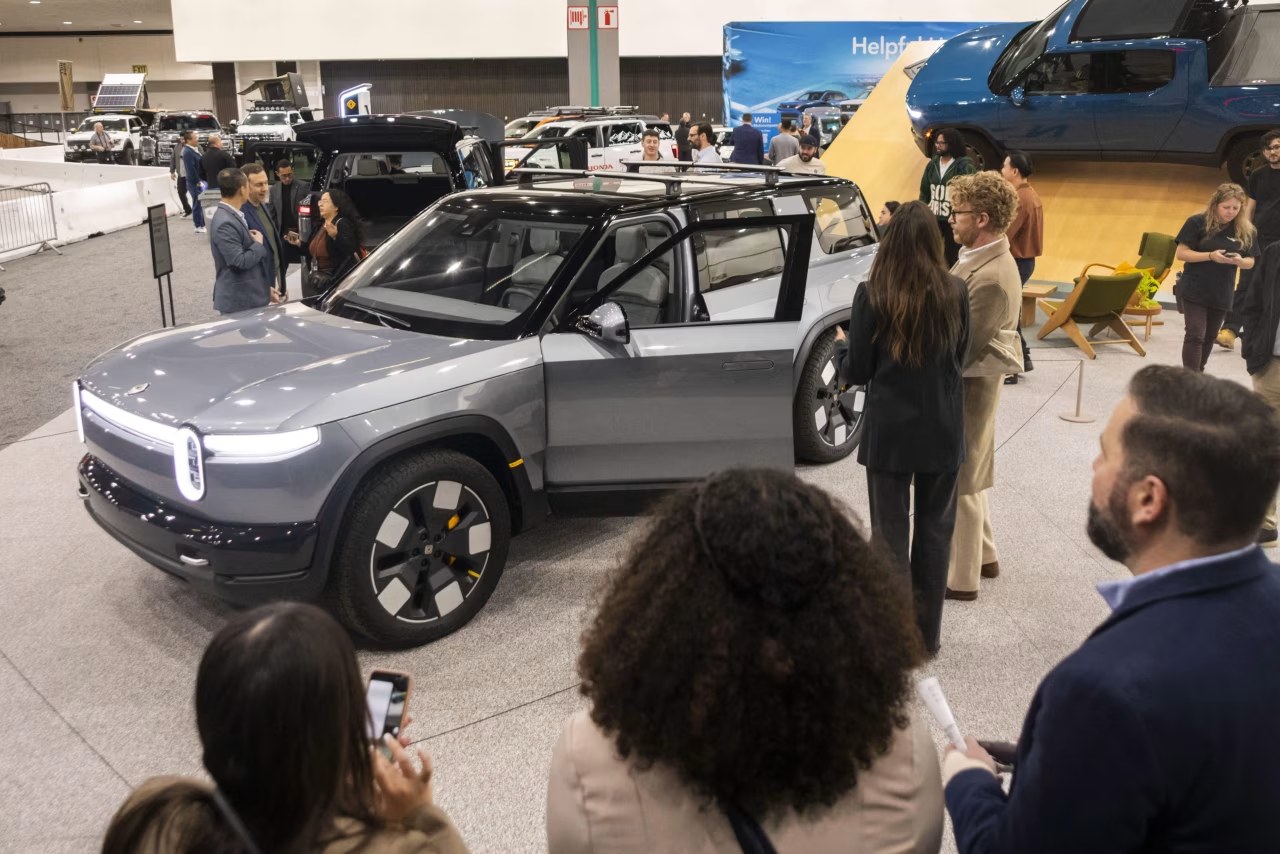
Rivian’s $45,000 R2 SUV Must Triple Sales to Keep the Company Alive
- Rivian will unveil the R2 this spring with a target price of $45,000, roughly half its current lineup.
- CEO RJ Scaringe calls the R2 a “make-or-break product” as the startup burns $1 billion cash per quarter.
- Only 50,122 Rivian vehicles were delivered in 2023; analysts say 200,000 annual R2 sales are needed for break-even.
- The launch arrives amid slowing EV demand, rising interest rates, and price wars triggered by Tesla and Ford.
Can a niche off-road brand crack the mass market before the money runs out?
RIVIAN R2—Rivian Automotive has spent the past three years selling plush electric trucks to Silicon Valley and Aspen. Now, with $9.1 billion in cash left and quarterly losses averaging $1.3 billion, the Irvine, Calif.–based company is racing to reinvent itself as a mainstream automaker. The weapon: a stubby, $45,000 SUV code-named R2, due in 2026.
Chief Executive RJ Scaringe, 40, does not hide the stakes. “The phrase ‘make-or-break product’ has been said, and it is probably true,” he told reporters at November’s Los Angeles Auto Show, where a clay-covered prototype drew lines of camera crews. Rivian’s share price, down 92 % from its 2021 peak, reflects investor skepticism that a startup with one factory and no marketing scale can conquer the most competitive segment in America.
The R2 must triple Rivian’s current sales volume just to cover fixed costs, according to a December Barclays estimate. Yet U.S. EV sales growth slowed to 7 % in the third quarter of 2023, the weakest clip since the pandemic, while average transaction prices have fallen 22 % year-over-year, eroding margins for every manufacturer except Tesla. “Rivian is jumping into a knife fight with a Swiss-army knife,” says Philippe Houchois, auto analyst at Jefferies.
From $80,000 Launch Editions to a $45,000 Mass-Market Gamble
Rivian’s first vehicles—the R1T pickup and R1S SUV—arrived in late 2021 wearing stainless-steel accents and quad-motor powertrains that vaulted the brand into the same wallets that buy Range Rovers. Average transaction prices hovered near $84,000, according to Cox Automotive, and early adopters posted YouTube videos of climbing boulders outside Moab. The glow faded fast. By mid-2023 Rivian had slashed R1 prices twice, laid off 900 workers, and watched Ford’s F-150 Lightning undercut its pickup by $15,000.
Enter the R2: a five-seat, high-riding wagon built on Rivian’s new “mid-platform” architecture that trims battery modules from 7 to 5 and swaps complex adaptive dampers for fixed-rate struts. Engineers removed the air-suspension plumbing entirely, saving 22 pounds and $400 per unit. The result, according to internal documents viewed by The Wall Street Journal, is a bill-of-materials cost 38 % lower than the R1S even before volume discounts kick in.
“We designed R2 to be profitable at 150,000 units a year,” said Nick Kalayjian, Rivian’s executive vice-president of product, during a December media walk-around. That figure is triple the 50,122 vehicles Rivian delivered in 2023 and double the 100,000-plus reservation backlog it has steadily burned through since 2021. “If we only hit 80,000, we’re still in the black,” Kalayjian insisted, though he declined to specify gross-margin targets.
Industry data tell a harsher story. BloombergNEF calculates that an EV with a 75 kWh battery—the R2’s rumored size—needs 180,000 annual sales at a $46,000 price to reach 20 % gross margin, the floor most automakers require to fund future models. Tesla’s Model Y, built in plants that now push out 1.2 million units a year, enjoys margins above 25 %, according to its third-quarter earnings. Rivian’s lone factory in Normal, Ill., is capped at 150,000 units even after a $500 million retooling program announced last August.
The margin math that keeps executives awake
“Volume is destiny in autos,” says Kristin Dziczek, automotive policy adviser at the Federal Reserve Bank of Chicago. “If Rivian can’t get past 200,000 combined R1 and R2 sales by 2027, depreciation on that Normal plant will swamp whatever premium brand equity they think they have.” Rivian’s own investor-day slides forecast 215,000 total deliveries in 2025, but only if the R2 ships on time and the company secures an additional $2 billion in financing—terms that become tougher when cash reserves drop under $6 billion, a threshold Rivian is expected to cross in the second half of 2024.
Yet Scaringe remains publicly bullish. “We’re not trying to out-Tesla Tesla,” he said in November. “We’re trying to build the Swiss Army knife of EVs—something that can climb a trail on Friday and take the kids to hockey practice on Monday.” Whether that versatility is enough to lure mainstream buyers who can now choose between a $47,000 Tesla Model Y, a $49,000 Ford Explorer EV, and a $48,000 Chevrolet Equinox EV will decide Rivian’s survival.
Why 2026 Timing Puts Rivian in the EV Slow Lane
When Rivian began sketching the R2 in 2020, U.S. EV registrations were surging 80 % a year and President Biden’s campaign promised fresh purchase incentives. Today the landscape is unrecognizable. Cox data show EV inventory on dealer lots swelled to 92 days’ supply in October 2023, triple the level of January 2022. Tesla has cut prices six times, eroding residual values across the segment, while Ford paused $12 billion in EV spending and GM delayed its Equinox EV launch twice.
Interest rates compound the pain. The average new-vehicle loan now carries a 7.4 % annual percentage rate, up from 4.2 % in 2021, according to Edmunds. For a $45,000 purchase, that adds $140 to the monthly payment—enough to push marginal shoppers back into a $35,000 internal-combustion Toyota RAV4. “Affordability is the new battleground,” says Jessica Caldwell, executive director of insights at Edmunds. “Brands without scale will be crushed.”
Rivian’s cash timeline amplifies the urgency. Third-quarter filings show the company ended September with $9.1 billion in liquidity, down from $11.2 billion at the start of the year. At the current burn rate of $1.1 billion per quarter, analysts at Baird project Rivian will need fresh capital by late 2025—before the R2 generates meaningful revenue. “They’re launching into a headwind that could last two more years,” says Baird analyst Luke Junk, who has an underweight rating on the stock.
The competitive set R2 must slice through
By 2026 the mid-$40,000 electric crossover segment will include not only refreshed versions of the Model Y and Ford Explorer EV but also the Hyundai Ioniq 6-based SUV and a rumored Subaru crossover built on Toyota’s bZ architecture. Combined, those platforms are expected to exceed 700,000 annual units, according to LMC Automotive forecasts, creating a supply glut that could pressure pricing 5–7 % below today’s levels.
Rivian’s plan to differentiate hinges on software and adventure branding. The R2 will ship with the company’s new “Ascent OS” interface, offering over-the-air updates and a native camping-mode app that controls air-conditioning, exterior lighting, and even an available pull-out kitchen. Early consumer clinics conducted by Rivian showed 68 % of respondents ranked “outdoor features” as a top-three purchase reason, ahead of price, according to a December investor presentation.
Still, history is littered with niche automakers that failed to scale. Fisker delivered 2,450 Karma plug-in hybrids in 2012 before bankruptcy; Saab never sold more than 133,000 cars globally after GM’s partial divestiture. “The graveyard is full of companies that thought 100,000 units was mainstream,” says Dziczek.
Can Rivian Build 200,000 R2s Without Running Out of Cash?
Rivian’s Normal, Ill., plant spans 503 acres and was once home to Mitsubishi. After a $750 million retool in 2022, the facility can theoretically produce 150,000 units annually on three shifts. Adding the R2 will require another $500 million in new stamping dies, body-shop robots, and a battery module line capable of 1.5 GWh—roughly 20,000 packs a month. “We’re not starting from scratch, but we’re close,” said chief operating officer Frank Klein on a November earnings call.
The capital expenditure comes just as Rivian’s liquidity tightens. Free cash flow in the third quarter was negative $1.2 billion, wider than the $1 billion loss a year earlier. Supply-chain inflation added $8,000 in cost per R1 vehicle, wiping out the company’s gross profit and forcing it to renegotiate contracts with 42 suppliers, according to chief financial officer Claire McDonough. Rivian has already tapped $1.7 billion in green-bond proceeds and $1.3 billion in a convertible offering last May, leaving fewer untrained investors willing to fund another round.
“They need to show a credible path to positive cash flow before the cash balance drops below $5 billion,” says Chris McNally, auto analyst at Evercore ISI. “Below that, the cost of capital jumps 200 basis points overnight.” Using internal projections that R2 will contribute positive gross margin within two quarters of launch, Rivian forecasts break-even free cash flow in the second half of 2026—provided it hits 200,000 combined R1 and R2 deliveries that year.
Inside the Normal plant’s 200-step ramp plan
Rivian engineers have mapped 200 discrete milestones to reach 200,000 units, including qualifying 17 new Tier-1 suppliers and installing 52 additional autonomous guided vehicles on the assembly line. Each week of delay costs the company 1,500 lost units and roughly $75 million in revenue, according to internal metrics shared with journalists. Historical precedent is sobering: Tesla needed 42 months to push Model 3 past 200,000 annual units; Volkswagen’s ID.4 took 30 months to reach 100,000.
Labor adds another wildcard. Normal workers voted against union representation in 2022, but the United Auto Workers is staging new organizing drives across EV startups. A successful campaign could raise direct labor costs $550 per vehicle, according to the Center for Automotive Research, squeezing R2’s already thin margin. Rivian’s workaround: automate 30 % more body-shop tasks and move battery-pack production to a new $275 million Georgia joint venture that qualifies for Inflation Reduction Act credits.
Whether the timeline survives contact with reality will determine if Rivian joins Tesla and BYD in the black, or follows Lordstown Motors into Chapter 11. “We have 18 months to prove we’re Ford, not Fisker,” Klein told suppliers at a December conference in Nashville.
What Happens If the R2 Flops?
Few scenarios end well for Rivian if the R2 misses its 2026 volume target. Debt covenants on $2.45 billion in convertible notes begin to tighten once cash falls under $4 billion, triggering restrictions on additional borrowing and forcing the company to pledge intellectual property as collateral. “You’re looking at a fire-sale of assets,” says Thomas Hayes, chairman of hedge fund Great Hill Capital. Rivian’s most valuable asset—its 7 % share of the fast-growing commercial-van joint venture with Amazon—could be sold separately, but analysts value the stake at only $1.8 billion, less than two quarters of operating expenses.
A strategic buyout is possible, yet suitors are scarce. Amazon, which ordered 100,000 Rivian delivery vans, has already written down $7.6 billion of its equity stake and is developing its own last-mile vehicle with Stellantis. Ford, which once owned 12 % of Rivian, sold the remainder in 2023 and has since doubled down on its in-house Lightning platform. Chinese giants such as BYD or Geely could provide capital, but political scrutiny over technology transfer would complicate any deal.
Bankruptcy would leave thousands of reservation holders in limbo. Unlike traditional automakers, Rivian’s service network is company-owned; a Chapter 11 filing could strand owners of 80,000-plus vehicles in need of proprietary parts and software updates. “The ecosystem risk is real,” says Karl Brauer, executive analyst at iSeeCars. “Rivian owners are betting the company survives long enough to honor eight-year battery warranties.”
Rescue paths that remain credible
The most frequently cited lifeline is a licensing deal for Rivian’s skateboard chassis and battery management software. Construction giant Caterpillar has explored licensing EV drivetrains for off-road equipment, according to two people familiar with the talks. Rivian could also spin off its fleet-management software, which tracks charging, routing and payload for commercial customers, into a SaaS business valued at $2–3 billion in private markets.
Even under a best-case rescue, equity investors face steep dilution. Convertible-note holders are first in line for any recovery, followed by new strategic partners. “Public shareholders are last,” warns McNally. “If you’re buying Rivian today, you’re buying an option on a 2026 product cycle that has to go perfectly.”
Which brings the story back to the R2’s spring unveiling. If reservation numbers top 300,000 within three months—Tesla Model 3 hit 455,000 in 2017—Rivian can likely raise fresh equity on favorable terms. Anything less and the clock starts ticking louder. “We need a line-out-the-door moment,” Scaringe admitted in Los Angeles. For a company that has never posted a profit, that moment may be the only thing standing between survival and a spot in the EV graveyard.
Frequently Asked Questions
Q: When will the Rivian R2 be available to buy?
Rivian says customer deliveries of the R2 will begin in 2026, with pre-orders opening this spring. The company has not specified an exact month, citing supply-chain and factory-ramp risks.
Q: How much will the Rivian R2 cost?
The base R2 SUV will start around $45,000 before federal and state EV incentives, positioning it $25,000 below Rivian’s current cheapest model and squarely against the Tesla Model Y.
Q: Why is the R2 considered Rivian’s make-or-break vehicle?
Rivian burns roughly $1 billion in cash per quarter and sold only 50,122 vehicles in 2023. Analysts say it must reach 200,000 annual R2 units—triple current volume—to break even by 2027.
