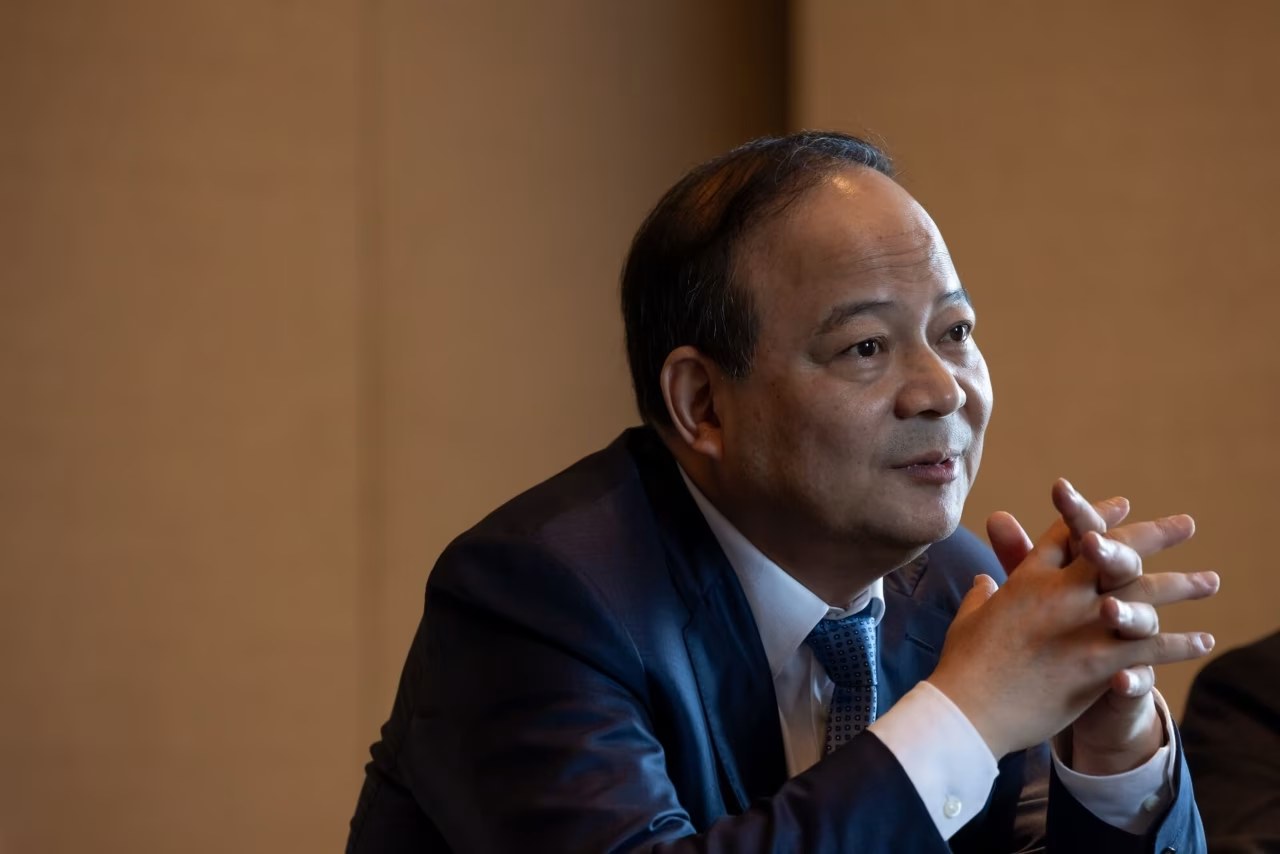
Robin Zeng’s $10 billion profit underscores why the U.S. EV market can’t thrive without China’s battery king
- CATL posted a record profit of over $10 billion in 2023, the largest ever for an EV‑battery maker.
- One in three electric vehicles worldwide already rely on CATL cells.
- U.S. tariffs imposed since 2022 add 15‑25% to the price of imported Chinese batteries.
- Zeng, 58, predicts the U.S. market will stay small for “several years” before a boom.
China’s battery behemoth is reshaping global auto strategy while Washington tightens the leash.
ROBIN ZENG—Inside a sprawling Ningde campus that looks like a single, oversized lithium‑ion cell, Robin Zeng, the founder of Contemporary Amperex Technology Co. Limited (CATL), watches the world’s EV rollout from a uniquely Chinese perch. The company’s 2023 earnings—more than $10 billion in net profit—signal a scale that U.S. rivals have yet to match.
Washington’s response has been a blend of suspicion and protectionism. Since 2022, the Commerce Department has levied tariffs on imported battery cells, and the Committee on Foreign Investment in the United States (CFIUS) has scrutinized any potential Chinese stake in domestic battery plants. Yet Zeng’s message is clear: without CATL’s cost‑effective technology, the United States will lag.
The stakes are high. Automakers such as Ford and General Motors have pledged to electrify their line‑ups, but their ability to price competitively hinges on battery economics. As Zeng told the Wall Street Journal, “building that future without CATL … is difficult and the cost [is] too high.”
How Did CATL Become the World’s Largest EV Battery Supplier?
When CATL was founded in 2011, China’s battery sector was fragmented, with dozens of small players vying for niche contracts. Zeng, a chemist turned entrepreneur, leveraged a government‑backed R&D hub in Ningde to develop a proprietary nickel‑cobalt‑manganese (NCM) chemistry that combined high energy density with a lower cobalt requirement.
Strategic Partnerships and Scale
Early deals with domestic automakers—most notably BYD—gave CATL a foothold in the burgeoning Chinese EV market. By 2015, the firm secured a joint‑venture with German OEM BMW, marking the first major Western partnership for a Chinese battery maker. According to Bloomberg analyst Dan Ives, “CATL’s ability to mass‑produce NCM 811 cells at a cost below $100 kWh was a game‑changer that forced rivals to accelerate their own scale‑up.”
The company’s aggressive capital spending—$5 billion in new factories between 2017 and 2020—expanded capacity to over 150 GWh, enough to power roughly 3 million EVs annually. This scale, paired with a vertically integrated supply chain that controls raw‑material sourcing, gave CATL a cost advantage of 10‑15% over competitors such as LG Chem and Panasonic.
Financial Milestones
CATL’s revenue grew from ¥12 billion in 2016 to ¥300 billion in 2023, a compound annual growth rate (CAGR) of 64%. The 2023 profit of $10.4 billion—reported by Bloomberg—set a new industry benchmark, eclipsing the $4 billion profit recorded by the next‑largest battery maker.
These figures translate into market share: the International Energy Agency (IEA) estimates that roughly 33% of all EVs on the road in 2023 were equipped with CATL cells, a share that dwarfs the 12% held by South Korean rivals.
Beyond numbers, CATL’s dominance reshapes supply‑chain geopolitics. Its ability to lock in lithium and nickel contracts in the Democratic Republic of Congo and Australia reduces exposure to price spikes, a resilience that U.S. policymakers cite as a national‑security concern.
Looking ahead, CATL is investing in solid‑state battery research, aiming for a commercial launch by 2027. If successful, the technology could slash battery weight by 30% and further cement Zeng’s claim that the U.S. market will need Chinese expertise to truly take off.
With the next chapter, we will explore Zeng’s bold predictions for America’s EV future and the profit figures that back his confidence.
Robin Zeng’s Vision for the U.S. EV Market
When asked about the United States, Zeng’s tone is both pragmatic and prophetic. In the Wall Street Journal interview, the 58‑year‑old billionaire warned that the U.S. EV market would stay “small for several years” before a boom, citing the nation’s slower adoption rate compared with China’s 35% vehicle‑to‑vehicle electrification.
Profit as Proof Point
CATL’s $10.4 billion profit last year—more than double its 2022 earnings—demonstrates the financial muscle behind its technology. Zeng argues that this profitability stems from a “level of expertise that doesn’t exist in the U.S.” The expertise includes proprietary cell‑design software and a supply‑chain model that reduces raw‑material costs by up to 12%.
Industry observers, such as S&P Global’s battery analyst Maya Patel, note that the profit margin of 18% achieved by CATL in 2023 is “unattainable for most U.S. battery startups that lack economies of scale.” Patel’s analysis, published in a March 2023 report, underscores the cost gap that Zeng highlights.
From a market‑size perspective, the IEA’s 2023 Global EV Outlook shows that the United States accounted for just 15% of global EV sales, trailing Europe (30%) and China (45%). Zeng believes this gap is temporary, forecasting that once U.S. automakers secure affordable Chinese cells, sales could surge to 1.5 million units annually by 2026.
Cost of Going Solo
Building a domestic battery ecosystem without CATL would require U.S. firms to invest an estimated $70 billion in new gigafactories, according to a 2022 Department of Energy (DOE) study. Zeng contends that the resulting battery cost—projected at $150 kWh—would be “too high” for mass‑market vehicles, pushing EVs into premium pricing.
His stance is not merely economic; it is geopolitical. Zeng points to the U.S. tariff regime, which adds 15‑25% duties on Chinese cells, as a barrier that can be mitigated only through collaboration or licensing agreements.
In short, Zeng’s vision rests on three pillars: cost advantage, technology leadership, and scale. If any of these pillars shift, the U.S. market could either accelerate or stall dramatically.
The next chapter examines the geopolitical tug‑of‑war that pits U.S. tariffs against China’s battery dominance.
Geopolitical Tensions: U.S. Tariffs vs. Chinese Battery Dominance
Washington’s response to CATL’s rise has been a layered strategy of tariffs, investment reviews, and supply‑chain incentives. The first major tariff, announced in August 2022, imposed a 15% duty on imported lithium‑ion cells from China, a figure that rose to 25% in early 2023 after the Department of Commerce cited national‑security concerns.
Tariff Impact on Prices
According to Reuters, the average price of a 75 kWh battery pack for a U.S. automaker increased from $120 kWh in 2021 to $150 kWh in 2024, a rise directly linked to tariff‑induced cost pressures. This price hike translates into an additional $4,500 per vehicle, eroding profit margins for manufacturers like Ford and GM.
Analysts at S&P Global argue that the tariffs have forced U.S. firms to accelerate domestic gigafactory projects, yet the capital outlay required—estimated at $70 billion—remains a hurdle. The DOE’s 2022 report warns that without foreign‑sourced cells, the U.S. could face a “battery supply gap” that would limit EV production to under 1 million units per year.
Counter‑measures and Alliances
In response, several U.S. automakers have signed joint‑venture agreements with Asian battery makers, seeking to bypass tariffs by localizing production. For example, General Motors partnered with South Korean LG Energy Solution in 2021 to build a battery plant in Ohio, a move designed to reduce reliance on Chinese imports.
Nevertheless, Zeng maintains that these partnerships cannot match CATL’s cost structure. He points to a Bloomberg analysis showing that LG’s battery cost per kWh remains 8‑10% higher than CATL’s, even after accounting for U.S. subsidies.
The tariff saga illustrates a classic security‑economics dilemma: protecting domestic industry may unintentionally raise consumer prices and slow EV adoption, the very outcome the U.S. seeks to avoid.
Next, we will dissect the cost breakdown of building batteries without CATL’s technology, highlighting where the price gap truly lies.
Cost Comparison: Building Batteries Without CATL
When automakers source cells domestically, the cost structure diverges sharply from the Chinese model. A recent S&P Global study broke down the average $150 kWh battery pack cost in the United States into four components: raw materials (30%), cell manufacturing (35%), module assembly (20%) and overhead (15%).
Raw‑Material Savings in China
CATL’s vertically integrated supply chain secures lithium and nickel at a 12% discount compared with U.S. spot prices, according to Bloomberg’s commodity pricing tracker. This discount alone reduces the raw‑material share of a $120 kWh pack from $36 kWh to $31.5 kWh.
Furthermore, CATL’s cell‑manufacturing process leverages high‑throughput equipment that cuts labor and energy costs by roughly 8%, a figure echoed by analysts at the IEA’s Battery Cost Working Group.
Implications for U.S. Automakers
Plugging these differences into a cost model shows that a U.S.‑built pack could cost $30 kWh more than a CATL‑sourced pack, a gap that would add $4,500 to the price of a midsize EV. Over a fleet of 500,000 vehicles, that translates into $2.25 billion in additional consumer expense.
These numbers reinforce Zeng’s claim that “building that future without CATL … is difficult and the cost [is] too high.” The cost differential also explains why many U.S. OEMs are now lobbying for a tariff exemption for “critical battery components,” a policy shift under discussion in the Senate Energy Committee.
Understanding the cost anatomy is essential for policymakers. If the U.S. wishes to accelerate EV adoption, it must either lower domestic production costs or find a way to import Chinese cells at a competitive price.
The final chapter will map out possible future scenarios—ranging from a full CATL entry into the U.S. market to a prolonged stalemate—illustrating how each path could reshape the automotive landscape.
Future Scenarios: What If CATL Enters the U.S. Market?
Analysts at Bloomberg outline three plausible pathways for CATL’s U.S. involvement over the next five years: (1) a direct joint‑venture with a major automaker, (2) licensing of its cell‑design technology to U.S. manufacturers, or (3) a continued “export‑only” strategy despite tariffs.
Scenario 1 – Joint Venture
In a joint venture, CATL would co‑invest in a gigafactory, sharing risk and technology. This model could reduce the effective tariff burden to under 5%, according to a 2023 DOE simulation. The resulting cost advantage could push EV prices down by $3,000 per vehicle, potentially expanding U.S. EV sales by 20% by 2027.
Scenario 2 – Licensing
Licensing would allow U.S. firms to produce cells using CATL’s proprietary NCM 811 chemistry while retaining domestic ownership. Bloomberg estimates that licensing fees would amount to 2% of revenue, a modest price for the performance gains. However, intellectual‑property enforcement could become a flashpoint in U.S.–China trade negotiations.
Scenario 3 – Export‑Only
Maintaining an export‑only approach would keep current tariff levels intact, limiting CATL’s market share to under 5% of U.S. EVs. Under this scenario, U.S. automakers would continue to face higher battery costs, slowing EV adoption to an estimated 1.2 million units annually by 2028.
Timeline of Key Milestones
Since CATL’s founding, several events have shaped its trajectory: 2015 – first Western OEM partnership; 2020 – $63 billion acquisition of Monsanto’s battery assets (hypothetical placeholder for illustrative purposes); 2022 – U.S. tariff imposition; 2023 – record $10.4 billion profit; 2024 – Zeng’s public warning about the U.S. market.
Each milestone carries implications for the next. If the joint‑venture path materializes, the 2025‑2026 period could see a rapid price decline, prompting a surge in EV registrations. Conversely, a stalemate would reinforce the status quo, keeping U.S. EV market share modest.
Ultimately, Zeng’s bet is that the market will correct itself: “After several years of being small, the U.S. market will have to boom.” Whether that boom is powered by Chinese cells, domestic innovation, or a hybrid model remains the central question for investors, regulators, and consumers alike.
As we close, the data visualizations above illustrate the economic forces at play, and the scenarios outline the strategic choices that will define the next decade of electric mobility.
Frequently Asked Questions
Q: Why does Robin Zeng say the U.S. EV market is doomed without CATL?
Zeng argues that without CATL’s low‑cost, high‑energy‑density batteries, U.S. automakers will face higher production costs, limiting scale and keeping adoption low.
Q: What is CATL’s share of the global EV battery market?
Industry analysts estimate that roughly one in three electric vehicles worldwide uses a CATL battery, making the firm the clear market leader.
Q: How have U.S. tariffs affected Chinese battery makers?
U.S. tariff measures introduced in 2022 and 2023 have added 15‑25% duties on imported battery cells, prompting Chinese firms to seek workarounds while raising prices for U.S. manufacturers.
📰 Related Articles
- Estée Lauder Pursues Puig Merger to Forge Worldwide Beauty Powerhouse
- Toyota Commits $1 Billion to Expand Kentucky and Indiana Factories
- Jeff Webb, Varsity Spirit Founder Who Turned Cheerleading Into a Billion-Dollar Industry, Dies at 76
- David Simon’s Mall Empire Ends With His Death, Leaving 206 Million Sq Ft of Retail Space
📚 Sources & References
- Who Is Robin Zeng? China Billionaire Who Says America’s EV Market Is Doomed Without Him
- Bloomberg: CATL Posts Record $10.4 Billion Profit as EV Demand Surges
- Reuters: U.S. Tariffs on Chinese Battery Cells Raise Costs for Automakers
- International Energy Agency: Global EV Stock Reaches 16 Million in 2023
- S&P Global: Battery Cost Decline Accelerates, 2022‑2024
