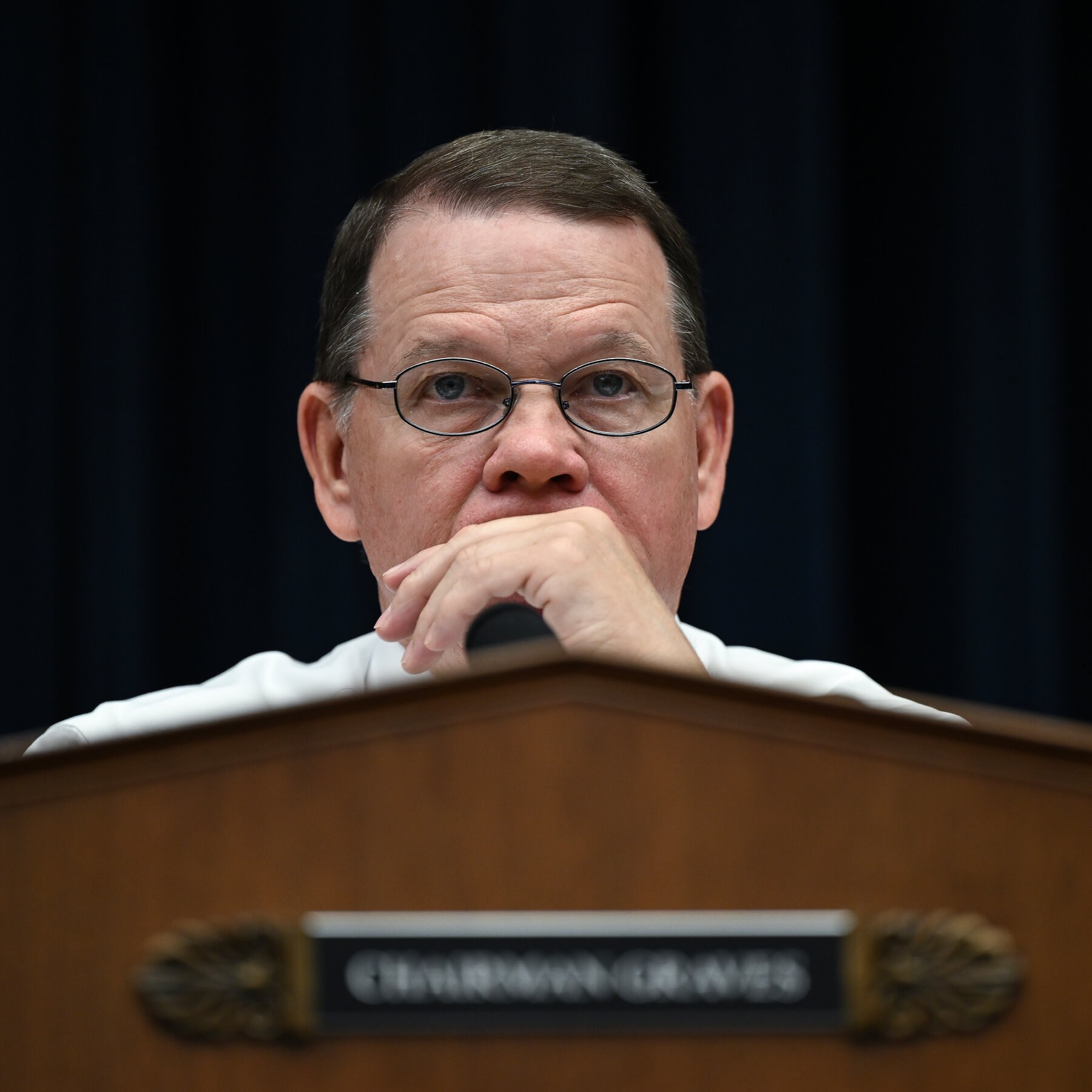
13-Term Missouri Republican Sam Graves to Retire, Raising GOP Midterm Toll to 27 Departures
- Sam Graves, 62, chairs the House Transportation and Infrastructure Committee and will leave in January after 26 years in office.
- His northwest Missouri district is rated Safe Republican, so the seat is unlikely to flip in November.
- Graves led high-profile probes into Boeing 737 Max crashes and last year’s Reagan National midair collision.
- His exit follows a wave of senior GOP retirements as the party braces for potential midterm losses.
Another veteran lawmaker chooses to leave rather than serve in the minority, accelerating generational turnover.
SAM GRAVES—Representative Sam Graves, the longest-serving Republican from Missouri, announced Friday he will not seek re-election, becoming the latest senior House Republican to retire ahead of midterm elections that party strategists fear could strip the GOP of its fragile majority.
In a statement released by his office, Graves, who has wielded the gavel of the Transportation and Infrastructure Committee since 2023, framed his decision as a deliberate hand-off to younger conservatives. “It’s time to pass the torch and allow a new guard of conservative leaders to step forward,” he said, echoing a rationale increasingly cited by departing veterans.
The timing is politically loaded. With the midterm map already tilting against House Republicans, Graves’ departure underscores the depth of an institutional exodus that has now claimed more than two-dozen GOP incumbents. Unlike competitive districts where retirements can swing control, Graves’ stronghold across northwest Missouri is expected to stay in Republican hands. Yet his exit severs decades of accumulated legislative knowledge at a moment when the chamber is struggling to legislate on aviation safety, water infrastructure and surface-transport reauthorization.
From Farm Kid to Transportation Power Broker
Samuel Bruce Graves grew up on a 200-acre grain and livestock farm outside Tarkio, Missouri, a town of 1,500 residents near the Iowa line. He was still in his 20s when, in 1992, he won a seat in the Missouri state senate, becoming at the time the youngest member of that chamber. After two terms he jumped to the U.S. House in a 2000 special election, replacing the late Republican Rep. Steve Danner.
Climbing the committee ladder
Graves quickly aligned himself with transportation policy, a natural fit for a district laced with Interstate 29, U.S. Highway 71 and two major rail freight corridors. By 2003 he had secured a seat on the Transportation and Infrastructure panel, then chaired by fellow GOP veteran Don Young of Alaska. Colleagues remember Graves as a detail-oriented negotiator who memorized obscure Corps of Engineers project numbers and could recite aviation rule-making timelines from memory.
His breakout moment came in 2019 when two fatal crashes of Boeing’s 737 Max killed 346 passengers and crew. As ranking Republican on the committee, Graves demanded troves of internal Boeing emails and FAA inspection reports, laying the groundwork for bipartisan legislation that overhauled aircraft-certification procedures. The bill, signed into law in 2021, created an independent panel to vet safety-critical systems and barred manufacturers from hiding test data from regulators.
“Graves is the rare member who can both grill a CEO in public and quietly cut a deal behind closed doors,” said Jeff Davis, a senior fellow at the Eno Center for Transportation, a non-partisan think tank. “Losing that kind of institutional memory is a bigger blow than most people realize.”
Despite GOP rules that cap committee chairmanships at six years, Graves secured a waiver last Congress to continue leading the panel for another term. That exemption underscored both his fundraising prowess—he has banked more than $4.7 million for his campaign account—and his perceived electoral safety in a district that former President Trump carried by 36 points in the last two White House races.
Yet the prospect of sliding back into the minority after the midterms appears to have dampened his enthusiasm for another stint in Washington. “Serving in the minority is like being a spectator at your own funeral,” one senior GOP aide told reporters Friday, summarizing the mood among veteran lawmakers. Graves’ decision, the aide added, “signals to the conference that even a safe seat can’t compete with the frustration of legislative irrelevance.”
How Graves’ Exit Fits the GOP Retirement Surge
Graves’ announcement pushes the tally of House Republicans not seeking re-election to 27, according to a running tracker maintained by the non-partisan Cook Political Report. That figure already exceeds the 23 GOP retirees in the 2018 cycle, when Democrats captured 41 seats and flipped the chamber. Historical data compiled by the University of Minnesota’s Smart Politics project show that when more than 20 members of the president’s party exit, the opposition has gained an average of 34 seats dating back to 1950.
Why veterans leave
“Retirements cluster when members anticipate either electoral defeat or legislative irrelevance,” said Sarah Binder, a senior fellow at the Brookings Institution who studies congressional behavior. She notes that fundraising fatigue, family considerations and the growing toxicity of public life also factor in, but the dominant driver is the fear of diminished influence. “If you expect to lose your majority—or your chairmanship—why endure another cycle of partisan trench warfare?” Binder said.
Graves fits the profile. With the GOP’s House margin resting at a razor-thin 220-214, political forecasters rate the chamber a Toss-Up. Inside Elections editor Nathan Gonzales projects that if the national environment moves even two points toward Democrats, Republicans could lose between five and 12 seats. That math has prompted a cascade of exits from veteran lawmakers who chair powerful committees: Appropriations (Kay Granger), Energy & Commerce (Cathy McMorris Rodgers), Judiciary (Jim Jordan) and now Transportation.
Compounding the problem, many departing Republicans represent swing districts where their personal brand once insulated them from partisan headwinds. Graves is an exception; his district backed Trump by 36 points in 2024 and has not elected a Democrat to Congress since 1996. Still, party strategists worry that a wave of open-seat contests will force the National Republican Congressional Committee to spend precious resources in ruby-red territory instead of shoring up battleground incumbents.
“Every safe retirement is one less firewall,” said one senior NRCC aide, who requested anonymity to discuss internal strategy. “We now have to defend Graves’ seat, Jordan’s seat, and a half-dozen others that should be layups. That drains money we need for the real fights in Pennsylvania and California.”
Democrats, by contrast, have limited their retirements to nine members, most of whom represent districts President Biden carried comfortably in 2024. The asymmetry has buoyed Democratic hopes of reclaiming the gavel, even as the party faces its own generational divide over leadership age and policy direction.
What Graves’ Departure Means for Transportation Policy
As chairman, Graves shepherded the $1.2 trillion Infrastructure Investment and Jobs Act through a Republican caucus deeply skeptical of new spending. His compromise amendment package—negotiated with ranking member Rick Larsen (D-Wash.)—added $37 billion in GOP priorities, including streamlining of environmental reviews and expanded rural broadband grants, while preserving the bill’s core climate provisions. Industry lobbyists credit Graves with salvaging a deal that now funds 7,400 bridge repairs and 3,800 electric-bus purchases nationwide.
Aviation safety in limbo
The timing of his exit complicates unfinished business. Congress must reauthorize the Federal Aviation Administration by Sept. 30, and Graves had pledged to fold sweeping safety reforms into that bill. Among them: mandatory cockpit-alert standardization, tighter oversight of aircraft-maintenance outsourcing and new whistle-blower protections for FAA engineers. Airlines for America, the industry’s trade group, had already endorsed Graves’ draft, but rival proposals in the Senate threaten to dilute enforcement provisions.
“Losing a chairman who understands both the technical arcana and the politics is a huge setback,” said Paul Lewis, vice-president for policy at the Eno Center. “Staff can carry water only so far; you need a member who can twist arms on the floor at 2 a.m.”
Graves also championed Amtrak’s nascent expansion into rural corridors, securing $2.4 billion in last year’s omnibus for new routes linking Chicago to Madison and Kansas City to St. Louis. Missouri’s congressional delegation had counted on his seniority to protect those earmarks during upcoming appropriations battles. Without Graves, advocates fear the funding could fall victim to deficit hawks eager to claw back unspent pandemic-era transit aid.
Highway safety groups are equally anxious. Graves had scheduled a June markup for legislation requiring automatic emergency-braking systems in all new passenger vehicles by 2029. The bill enjoys bipartisan support but faces fierce opposition from auto manufacturers who warn of cost hikes. “We were counting on Graves’ vote-counting skills to get it across the finish line,” said Cathy Chase, president of Advocates for Highway and Auto Safety. “Now the calendar is in flux.”
Finally, Graves’ retirement deprives Missouri of a powerful conduit for river-dredging funds, lock-and-dam upgrades and disaster-mitigation grants along the Missouri River basin. State officials estimate that Graves has steered more than $1.8 billion in federal dollars to local ports and levees since 2001. Governor Mike Kehoe, a Republican, told reporters Friday that the state will “fight like hell” to replace that clout, but conceded that seniority cannot be replicated overnight.
Could Missouri’s Safe Seat Ever Flip?
Missouri’s 6th Congressional District stretches 300 miles along the Iowa border, encompassing Kansas City’s northern exurbs, the college town of Maryville and the farming communities of Holt and Atchison counties. Trump carried the seat by 36 points in 2024; Republican statewide nominees routinely win by 25–40 points. Yet demographic shifts—an influx of Kansas City commuters and a declining farm population—have nudged the district marginally toward Democrats in recent cycles.
Historic margins
Graves’ closest contest came in 2008 when he defeated Democrat Kay Barnes by 11 points amid a national Democratic wave. Since then his weakest showing was 2020, when he won by 19 points against Democrat Gena Ross, a Kansas City nurse. The absence of a credible Democratic bench, coupled with low union density and high evangelical turnout, has kept the seat safely in GOP hands for a quarter-century.
Still, national Democrats insist that open-seat races can scramble expectations. “Voters evaluate candidates differently when there’s no incumbent,” said Matt Angle, director of the Lone Star Project, which advises Democrats on rural campaigns. Angle cites Oklahoma’s 5th District, where Democrat Kendra Horn flipped a Trump +14 seat in 2018 after GOP incumbent Steve Russell retired. The key, he argues, is recruiting a candidate with local name recognition and a message focused on kitchen-table economics rather than cultural flashpoints.
Missouri Democrats have struggled on that front. The party’s 2024 nominee, businesswoman Angela Kennedy, raised just $312,000 and lost by 29 points. Potential 2026 contenders include former state senator Wes Shoemyer, a farmer from Clarence, and Kansas City councilwoman Melissa Robinson, but neither has signaled interest. The Democratic Congressional Campaign Committee placed the seat in its “Emerging Races” category last cycle yet spent zero dollars on television or field organizing.
Republicans, for their part, are already coalescing around three declared candidates: state senator Tony Luetkemeyer, former Trump administration USDA official Chung (John) Kim, and ex-state representative Sheila Solon. All three pledged to continue Graves’ infrastructure agenda while touting conservative credentials on immigration and federal spending. Luetkemeyer, whose state-senate district overlaps much of the congressional boundaries, holds a commanding early lead in both fundraising and endorsements from Missouri’s GOP establishment.
“The seat is Safe R until proven otherwise,” said Jessica Taylor, Senate and governors editor for the Cook Political Report. “But every open seat forces the party to spend money somewhere that used to be free. In a cycle where margins are tight, that matters.”
What’s Next for the GOP’s Generational Overhaul?
Graves’ retirement is more than a personnel change; it is a data point in a broader generational overhaul inside the Republican conference. When the 119th Congress convenes in January 2027, nearly half of GOP House members will have served four terms or fewer, according to an analysis by the Congressional Management Foundation. That influx of freshmen and sophomore lawmakers will reshape committee hierarchies, policy priorities and the internal balance of power between insurgent and establishment wings.
Policy implications
Younger Republicans—many elected after 2018—tend to prioritize culture-war issues, border security and curbs on federal spending over the bread-and-butter transportation earmarks that defined Graves’ career. A 2025 survey of GOP freshmen by the Heritage Foundation found that 68 percent listed “limiting woke bureaucracy” as a top committee priority, while only 21 percent ranked infrastructure spending in their top three issues. The ideological shift complicates efforts to assemble bipartisan coalitions for large authorizations like highways or water systems.
Leadership elections could also turn volatile. House Republicans impose term limits on committee chairs, but not on the speaker or majority leader. With current Speaker Mike Johnson potentially eyeing a Senate run in 2028, jockeying has begun among a younger cohort that includes Reps. Elise Stefanik (N.Y.), Jim Banks (Ind.) and Byron Donalds (Fla.). All three are decades younger than Graves and have built national brands through cable-news appearances rather than legislative deal-making.
“The party is trading technical expertise for viral moments,” lamented one senior GOP appropriator, who requested anonymity to avoid antagonizing colleagues. “That makes it harder to write complex bills that actually become law.”
Democrats see opportunity in the flux. House Minority Leader Hakeem Jeffries has instructed committee Democrats to identify narrow-issue bills—capping insulin prices, expanding apprenticeship programs, rural broadband grants—that can peel off pragmatic GOP freshmen eager to claim bipartisan wins. Transportation lobbyists predict Graves’ successor, whoever that may be, will face pressure to match Graves’ legislative output to avoid ceding the issue entirely to Democrats.
Whether the next generation can replicate that record remains an open question. “Graves leaves big shoes to fill,” said Missouri Farm Bureau president Garrett Hawkins, whose group has endorsed Luetkemeyer. “The test isn’t keeping the seat red; it’s keeping the federal dollars flowing for Missouri farmers and shippers.”
Frequently Asked Questions
Q: Why is Sam Graves retiring now?
Graves said it is time to pass the torch to a new generation of conservative leaders, choosing to leave at the end of his current term rather than risk serving in a diminished GOP minority.
Q: Will Graves’ retirement shift House control?
Analysts say the seat will stay Republican; his northwest Missouri district is heavily red, so the move affects institutional knowledge more than the partisan balance.
Q: What did Graves oversee as Transportation chair?
He led oversight of Boeing 737 Max crashes, Amtrak route cuts, and new air-safety legislation after the midair collision near Reagan National Airport.
Q: How many senior Republicans are also retiring?
Dozens have exited this cycle; party strategists expect the number to climb as members brace for potential losses that could cost the GOP the House majority.
📰 Related Articles
- Sam Graves Abandons Re‑Election Bid, Ending 13‑Year Congressional Run
- Chicago Voters Push Back as Mayor Johnson’s Wage Mandate Sparks Job Cuts
- Republican Senators Propose Full DHS Funding to Relieve TSA Staffing Crisis and Airport Delays
- Democrats Champion Energy and AI Disarmament as Voter Bills Surge
