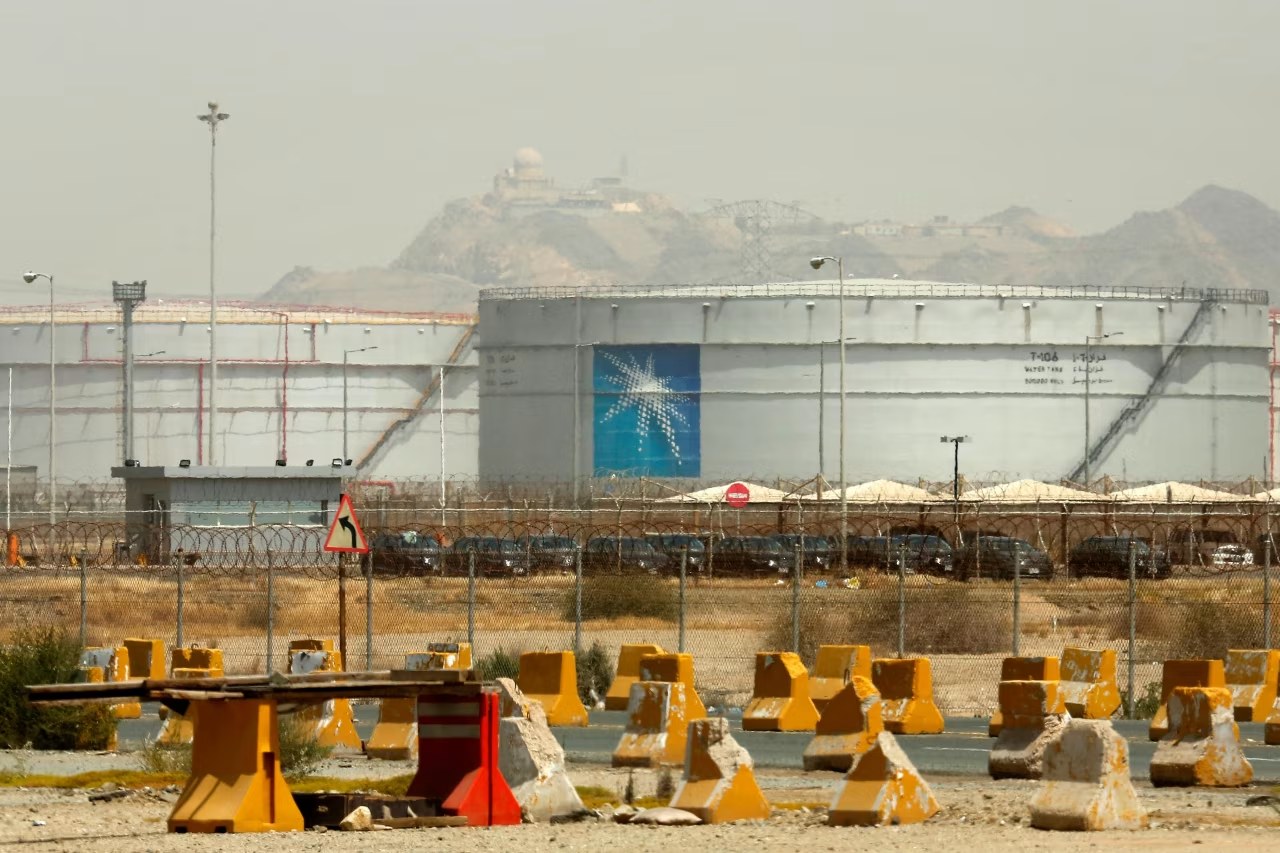
$180 Oil Looms If Mid-East Disruptions Stretch Past April, Saudi Officials Warn
- Saudi planners model Brent rising past $180/bbl if Iran-linked outages persist into late April.
- Kingdom’s base-case removes 3-4 million barrels daily from already tight 101 mb/d global market.
- Futures curve shows 22% jump since January; options open interest at $150 strikes up 9-fold.
- $180 crude could add 2.5 percentage points to global inflation, Oxford Economics estimates.
Riyadh’s internal stress test underscores how quickly the market could flip from balanced to parabolic.
SAUDI ARABIA—Saudi Arabia’s oil officials are quietly projecting a price shock that would dwarf the 2008 record: Brent crude at $180 a barrel if disruptions linked to the Iran conflict extend beyond April. The internal exercise, described by three senior Gulf-based officials, is not a public forecast but a planning benchmark that now guides royal-court deliberations on production, spending and security.
The kingdom’s base-case model assumes 3–4 million barrels per day of regional exports remain sidelined—roughly the volume that transits the Red Sea and the Strait of Hormuz combined. With global commercial inventories already 5% below the five-year average, the officials told The Wall Street Journal, any sustained outage would leave refiners scrambling for cargoes.
Front-month Brent futures have already rallied 22% since January to $95, while open interest in $150 call options has surged nine-fold, exchange data show. “The market is pricing a 15% probability of triple-digit oil by June,” said Michael Tran, global energy strategist at RBC Capital Markets. “If geopolitics cooperates, that tail risk becomes the modal outcome.”
Inside the $180 Model: How Saudi Planners Game the Red Sea Risk
Riyadh’s Energy Ministry and Aramco’s corporate-planning unit built the $180 case in January after a missile strike on a commercial tanker 60 miles northwest of the Yemeni port of Hodeidah. The exercise starts with the assumption that Iran-backed Houthi forces continue to target vessels, forcing insurers to raise war-risk premiums above $700,000 per passage—levels last seen during the 2019 Abqaiq attack.
Under this scenario, daily east-bound Red Sea loadings fall from 6.8 million barrels to 3 million by late April, according to tanker-analytics firm Vortexa. Simultaneously, Tehran’s threat to close the Strait of Hormuz—however rhetorical—prompts shippers to add 14 extra days round-Africa to Asia voyages, soaking up 52 very-large-crude-carriers, or 6% of the global fleet.
The kingdom’s own 3 million barrels per day of spare capacity could theoretically plug the gap, but officials fear that drawing it down to zero would leave the market with no cushion for summer demand. “Once spare capacity is perceived to be gone, the curve goes parabolic,” said Sadad al-Husseini, former senior vice president of Saudi Aramco. “We saw that in 2008 when prices doubled in six months.”
Historical data support the warning. During the 1990 Gulf crisis, Brent surged 120% in nine weeks after 4.3 million barrels per day were disrupted. In 2008, prices hit $147 when OECD stocks covered only 52 days of forward demand—almost exactly today’s coverage ratio, according to the International Energy Agency.
Why $180, not $150 or $200?
The $180 figure emerges from a Monte-Carlo simulation that blends 1,000 supply-demand paths with options-implied volatility, one official said. At that price, U.S. gasoline reaches $5.90 a gallon nationwide, triggering the White House to release 180 million barrels from the Strategic Petroleum Reserve—enough to cap upside momentum. “It’s the level where policy feedback loops kick in,” the official noted.
Yet even a brief spike matters. Every $10 increase in Brent adds an estimated 0.3 percentage points to headline CPI within six months, according to a 2023 Federal Reserve study. At $180, Oxford Economics sees global inflation jumping 2.5 points and GDP growth halving to 1.4%—a stagflationary shock reminiscent of 1979.
The kingdom’s takeaway: if the timeline stretches past April, today’s $95 marker could look cheap. “We are one incident away from triple-digit oil,” the official said, pointing to the narrow Bab el-Mandeb chokepoint that handles 9% of seaborne petroleum.
Spare Capacity on the Brink: Can Aramco Really Pump 13 Million Barrels a Day?
Crown Prince Mohammed bin Salman has repeatedly pledged that Aramco can lift output to 13 million barrels per day “within weeks” if customers request. Yet the $180 scenario hinges on whether that promise is physically credible. Independent analysts are skeptical.
“Saudi Arabia’s sustainable capacity is closer to 12.3 million,” says Martijn Rats, chief commodities strategist at Morgan Stanley. “The last 0.7 million involves older fields like Khurais that require massive water injection and may damage reservoirs if over-produced.”
Aramco’s own prospectus for the 2019 IPO listed maximum sustained capacity at 12.0 million. Since then, the company has spent $5 billion on the Khurais expansion and $7 billion on Dammam redevelopment, lifting nameplate capacity to 13 million. But nameplate and sustainable are not synonyms, engineers caution.
Field-by-field data compiled by Rystad Energy show that maintaining 13 million for more than 90 days would drop reservoir pressure below the threshold needed for gas-oil separation, risking permanent loss of 300,000 barrels per day of long-term output. “It’s the oilfield equivalent of burning the furniture to heat the house,” said Bassam Fattouh, director of the Oxford Institute for Energy Studies.
Water, Workforce and Wells
The kingdom injects 9.8 million barrels per day of treated seawater to keep pressure at Ghawar, the world’s largest field. Raising output by another 1 million would require an extra 2.5 million barrels of water daily—equal to the entire desalination capacity of the Red Sea coast. Aramco would need to commission new reverse-osmosis plants, a 24-month undertaking.
Manpower is another bottleneck. After crude crashed in 2020, Aramco offered 1,500 senior engineers voluntary retirement; 40% accepted. Recruiting replacements takes 12–18 months because Saudi universities graduate only 300 petroleum engineers annually, according to the Ministry of Education.
Finally, rig count matters. Baker Hughes data show the kingdom has 53 active rigs, down from 74 in 2015. Each rig drills 2.5 wells per year at 5,000-barrel-per-day initial rates. Even if every new well added 100% incremental output, Aramco would need 140 additional wells—28 more rigs—to hit 13 million sustainably.
Bottom line: the $180 case assumes no supply response from Riyadh after April. If the kingdom surprises markets by pumping flat-out, prices might stall at $130, according to Goldman Sachs commodity team. But that would come at the cost of reservoir integrity and future revenues—an unpalatable trade-off for a state that still derives 68% of budget revenue from hydrocarbons.
Who Gets Hurt First? Refiners, Airlines and Emerging Markets in the Firing Line
A swift move to $180 would not be felt evenly. Complex refiners in Europe and Asia that upgraded plants to run cheaper heavy crude would see margins evaporate. “At $180, the crack spread on Brent turns negative for 40% of refineries,” says Svetlana Tretyakova, senior analyst at Wood Mackenzie. “We estimate 1.4 million barrels per day of capacity could be idled within 90 days.”
Airlines face an even direr equation. Jet-fuel accounts for 25% of operating costs; every $10 rise in crude adds $1.8 billion to global airline fuel bills, according to the International Air Transport Association. At $180, carriers would burn $320 billion on fuel—twice last year’s level. IATA modelling shows ticket prices would need to rise 27% to pass through the hike, cutting passenger traffic by 8% and tipping several carriers into bankruptcy.
Emerging markets that subsidize fuels would bear the fiscal brunt. India, which imports 87% of oil, would see its import bill swell by $90 billion—3% of GDP—if Brent averages $140 for a year, government officials told parliament last month. Egypt, which has already devalued the pound three times since 2022, would need to spend 18% of budget revenue on petroleum subsidies, reversing IMF-mandated reforms.
Winners and Losers
Oil-exporting economies would enjoy a windfall. Saudi Arabia’s budget breakeven crude price is $78; at $180, Riyadh would net an extra $400 billion annually—enough to fund the entire $1 trillion giga-project pipeline without issuing debt. Norway’s sovereign wealth fund could add $120 billion in hydrocarbon tax receipts, according to Nordea Markets.
Yet the macro math is sobering. A 2022 IMF working paper found that a 50% price spike cuts global GDP growth by 0.8 percentage points after 12 months, with oil-importing developing economies contracting 1.3 points. “The income transfer from consumers to producers is larger than any stimulus governments can deliver,” said Thomas Helbling, deputy director of the IMF research department.
Consumers feel the pain fastest. U.S. retail gasoline would climb to $5.90 a gallon, surpassing the 2022 record. The average American household would spend $3,200 a year on fuel—$1,400 more than today—erasing recent real-wage gains. “It’s the most regressive tax imaginable,” said Claudia Sahm, former Fed economist and founder of Sahm Consulting.
Can Demand Destruction Save the Day Again?
In 2008, oil peaked at $147 because demand collapsed: U.S. gasoline consumption fell 6%, European jet fuel 9%, while China’s diesel exports doubled as factories shuttered. The question is whether today’s economy can replicate that elasticity.
“Structural demand is far less responsive,” said Daan Struyven, head of oil research at Goldman Sachs. “We have 1.2 billion more cars, and emerging-market share of consumption has risen from 35% to 55% since 2008.”
Yet high prices still bite. U.S. gasoline demand dropped 3% during the 2022 spike to $5 a gallon, EIA data show. If prices reach $6, Energy Security Analysis Inc. models a 7% decline—enough to shave 800,000 barrels per day off global consumption. “That’s the safety valve,” said Jim Burkhard, vice-president for oil markets at S&P Global Commodity Insights.
Electric vehicles add a new wrinkle. BNEF estimates EVs displaced 1.5 million barrels per day of oil demand last year; at $180, payback periods on EV purchases fall to 18 months in Europe and 24 months in China, accelerating adoptions. “We could see an extra 2 million barrels of oil displaced by 2026 if prices stay elevated,” said David Doherty, head of oil demand at BloombergNEF.
But the offset is partial. EVs still represent only 3% of the global fleet, and petrochemicals—now 16% of oil demand—are price-inelastic. “Plastic pellets don’t care if naphtha is $600 or $1,000 per ton,” said Alan Gelder, vice-president for refining at Wood Mackenzie. “Demand destruction will slow, not stop, a rally.”
Policy Levers Left
Governments have fewer tools than in 2008. OECD strategic petroleum reserves equal 90 days of imports, but the U.S. has already sold 180 million barrels since 2022. Refilling those caverns requires prices near $70; draining them further risks congressional backlash. China holds 900 million barrels in opaque strategic and commercial tanks, yet Beijing has shown reluctance to coordinate releases with Washington.
Export bans are another blunt instrument. When Indonesia halted palm-oil exports in 2022, vegetable-oil prices doubled. An OECD ban on petroleum product exports would ricochet through global refining, warns the IEA. “Policy intervention could create the very shortage it intends to prevent,” said Keisuke Sadamori, director for energy markets at the agency.
The likeliest outcome is a repeat of 2008: prices spike until consumers balk, then crash. The difference is that shale—once the world’s swing supplier—now grows at 300,000 barrels per year, not the 1.3 million seen in 2018. “This time, the call on demand destruction is louder and earlier,” said Helima Croft, head of commodities strategy at RBC Capital Markets.
Is $180 the New Ceiling, or a Stepping Stone to $200?
The difference between $180 and $200 is psychological, not economic. At $180, the market has already priced in every supply disruption short of a full Hormuz closure. To reach $200, traders need a catalyst: a simultaneous attack on Saudi and UAE export facilities, or an Israeli strike on Iranian nuclear sites that draws retaliatory missiles on Ras Tanura.
“We assign a 10% probability to $200 this year,” said Jeff Currie, global head of commodities at Goldman Sachs. “The pathway is a geopolitical leap, not a gradual tightening.”
Options markets concur. Open interest in $200 Brent calls for December delivery totals 28,000 lots—triple last year but still only 1% of total open interest. Skew—the premium of calls over puts—has risen to 12 vols, the highest since the 2019 Abqaiq attack, CME data show.
Yet even at $200, physical fundamentals impose a ceiling. U.S. shale breakevens in the Permian Basin have fallen to $48 per barrel; at $200, producers would add 1.4 million barrels per day within 18 months, according to Rystad Energy. OPEC+ compliance would crack: Nigeria and Angola have 400,000 barrels of shut-in capacity that could restart within six months. “The cure for high prices is high prices,” said Daniel Yergin, vice chairman of S&P Global.
Demand destruction accelerates above $180. Oxford Economics models global GDP growth falling to 0.9% and inflation rising above 7%, prompting coordinated rate hikes that crush commodity demand. “$200 is unsustainable beyond six weeks,” said Burkhard. “The market would implode under its own weight.”
The Geopolitical Wildcard
The wildcard is policy error. If Washington tightens sanctions on Iranian oil to zero exports—currently 1.4 million barrels per day—and the Houthis hit a VLCC in the Red Sea, insurers could declare the waterway a no-go zone. That alone would remove 6 million barrels per day, enough to push Brent past $200, according to ClearView Energy Partners.
China’s response matters. Beijing imported 11 million barrels per day last year; if state traders front-load purchases to build stockpiles, the demand surge could add another $15–$20 to Brent. “China’s SPR is the elephant in the room,” said Michal Meidan, director of the China Energy Programme at Oxford Institute for Energy Studies.
Ultimately, $180 is the new $110: a level that balances the market through demand rationing rather than supply growth. Whether it becomes $200 depends less on economics and more on diplomats and generals. “Oil traders are now hostage to events they can’t model,” said Croft. “In that world, $180 is just another waypoint.”
Frequently Asked Questions
Q: Why does Saudi Arabia expect oil to reach $180?
Saudi officials modeled a scenario where Iran-linked disruptions persist past April, tightening supply by an estimated 3-4 million barrels a day, which historical data show can push Brent past $180.
Q: How soon could prices hit $180 per barrel?
The kingdom’s base-case model points to late April if Red Sea and Persian Gulf exports remain curtailed; spot Brent already trades near $95, up 22% since January.
Q: What would $180 oil mean for global inflation?
Every $10 rise in crude adds roughly 0.3 percentage points to headline CPI; at $180, Oxford Economics sees global inflation jumping 2.5 points and GDP growth halving to 1.4%.
📰 Related Articles
- U.S. LNG Exporters Poised for Record Windfall as Middle East Strikes Cripple Qatar Supply
- Beyond the Gas Pump: How Petroleum Powers Everyday Products From Toys to Shampoo
- U.S. LNG Exporters Poised to Profit Amid Global Energy Shock
- IEA Tells Commuters to Skip Flights, Share Rides and Stay Home to Tame Record Oil Prices
