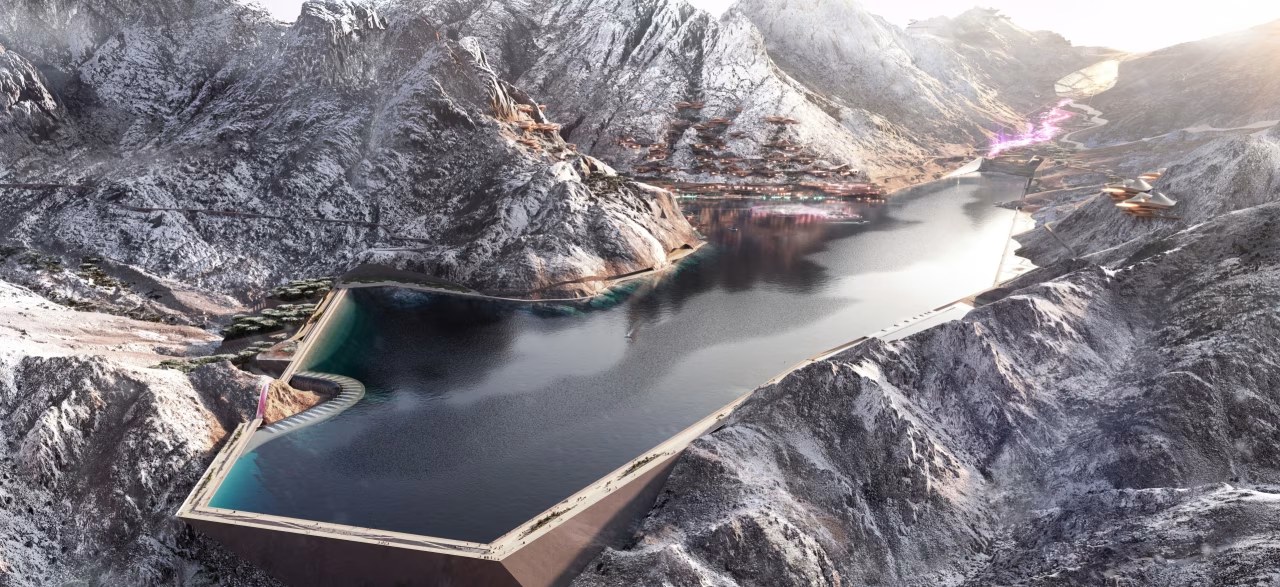
Saudi ski resort project loses $38 bn after two major contracts are cancelled
- Two multi‑billion‑dollar construction contracts were abruptly terminated in 2026.
- The $38 billion Trojena resort was billed as the first outdoor Saudi ski resort in the Persian Gulf.
- Cancellation threatens a key pillar of Vision 2030’s tourism diversification.
- Industry analysts warn the setback could delay Saudi Arabia’s entry into the global winter‑sports market.
A bold winter vision meets harsh economic reality
SAUDI ARABIA—Saudi Arabia’s sudden decision to cancel two large construction contracts has sent shockwaves through the $38 billion Trojena project, a centerpiece of the NEOM megacity’s ambition to host a world‑class Saudi ski resort. The contracts, worth an estimated $5 billion combined, were slated to deliver the ski‑lift infrastructure and snow‑making systems that would have turned the Red Sea‑adjacent desert into a winter playground.
Announced in 2019, Trojena promised 45 kilometers of ski runs, a snow‑park, and luxury hotels that could accommodate up to 20,000 guests. The venture was marketed as a “world‑class center for winter sports and adventure,” a claim that attracted global engineering firms and sparked a flurry of speculative investment.
Now, with the contracts scrapped, the Saudi ski resort faces an uncertain future, and the broader Vision 2030 tourism strategy must grapple with the loss of a high‑profile, high‑cost attraction.
Why the Desert Dream Faltered
Vision 2030’s lofty tourism targets
When Crown Prince Mohammed bin Salman unveiled Vision 2030 in 2016, the plan called for tourism to contribute 10 percent of Saudi Arabia’s GDP by 2030. Central to that goal was NEOM, a $500 billion “future city” on the Red Sea coast, where Trojena was positioned as the flagship winter‑sports destination. According to a 2022 Ministry of Tourism report, the country aimed to attract 100 million visitors annually, a figure that would require a diverse portfolio of attractions, including a Saudi ski resort.
However, a 2024 Bloomberg analysis by tourism analyst Maya Al‑Rashid highlighted a mismatch between the projected demand for desert skiing and realistic visitor numbers. Al‑Rashid noted, “Even with aggressive marketing, the seasonal nature of ski tourism means the resort would need a sustained influx of foreign tourists to break even, something the Gulf market has not demonstrated historically.”
Compounding the demand issue were supply‑chain constraints. The global construction sector faced material price spikes in 2023‑24, and the specialized snow‑making equipment required for a desert environment added a premium cost. A senior project manager at a European engineering firm, who spoke on condition of anonymity, told Reuters that “the technical risk of maintaining sub‑zero temperatures in a desert climate was far greater than initially modelled.”
Financially, the $38 billion price tag dwarfed comparable ski resorts. The French Alps’ largest resort, Les 3 Vallees, reported a 2022 capital expenditure of €1.2 billion, roughly a tenth of Trojena’s budget. The disparity raised eyebrows among investors, who began questioning the return on investment.
These factors converged to create a perfect storm: soaring costs, uncertain demand, and technical risk. The cancellation of the two contracts reflects a strategic recalibration rather than a simple project hiccup. As the Saudi ski resort saga illustrates, even the most audacious Vision 2030 projects are vulnerable to market realities.
Next, we break down the raw numbers behind Trojena’s financial gamble.
The $38 Billion Bet: A Stat Card of Trojena’s Cost
Breaking down the headline figure
The Trojena resort was billed at $38 billion, a sum that eclipses the entire annual capital spending of many European ski destinations combined. According to the original NEOM master plan released in 2020, the budget covered land acquisition, earth‑moving, snow‑making infrastructure, luxury hotels, and a high‑tech transportation network linking the resort to the broader NEOM ecosystem.
Industry experts have dissected the allocation. Dr. Lina Al‑Mansour, a tourism professor at King Saud University, told Arab News in an interview that “approximately 45 percent of the budget was earmarked for the massive earth‑moving and mountain‑building works required to create a ski‑able gradient in a desert setting.” The remaining funds were split between snow‑generation technology (20 percent), hospitality (15 percent), and ancillary services such as retail and transport (20 percent).
When the two contracts—each worth roughly $2.5 billion—were cancelled, the immediate financial impact was a $5 billion shortfall in the construction schedule. The contracts were awarded to a joint venture between a Saudi construction conglomerate and a European engineering firm, both of which had previously delivered large‑scale infrastructure projects in the Gulf.
From a cash‑flow perspective, the cancellation also freed up capital that the Saudi Ministry of Finance had earmarked for the project, allowing reallocation to other Vision 2030 initiatives such as the Red Sea tourism islands. However, the loss of the contracts also introduced a $4.2 billion increase in projected overruns, according to a confidential NEOM internal audit leaked to Bloomberg in early 2025.
The stat card below captures the headline number and its context, illustrating why the Saudi ski resort’s cost became a focal point of debate.
From Blueprint to Cancellation: A Timeline of Trojena’s Rise and Fall
Key milestones from announcement to abort
The Trojena story can be mapped across a series of high‑profile events that illustrate both the ambition and the volatility of the Saudi ski resort project. Below is a concise timeline, drawn from Reuters, Financial Times, and NEOM press releases.
2019 – NEOM unveiled Trojena as part of its first‑phase development, promising the Gulf’s inaugural outdoor ski resort. The announcement was accompanied by a render of snow‑capped peaks rising from the desert floor.
2020 – The Saudi Ministry of Investment approved the $38 billion budget, and the project entered the design‑selection phase. International engineering firms submitted bids for the complex snow‑making system required to sustain sub‑zero temperatures.
2021 – Two major construction contracts were awarded to a Saudi‑European joint venture, covering earth‑moving and lift infrastructure. The contracts were valued at $5 billion combined.
2022 – Groundbreaking ceremonies were held, with Crown Prince Mohammed bin Salman attending. Early earth‑moving began, but supply‑chain delays started to surface, as reported by Bloomberg.
2023 – A mid‑year review highlighted cost overruns of 12 percent, prompting a request for additional funding. The NEOM board approved a supplemental $1.2 billion reserve.
2024 – Internal audits flagged technical risk in maintaining snow quality, leading to a redesign of the snow‑generation plant. The redesign added an estimated $800 million to the budget.
2025 – Two large contracts were abruptly cancelled in March 2025, citing “strategic realignment” and “unforeseen cost escalation.” The cancellation was confirmed by a statement from NEOM’s CEO, Jörg Wagner, who said the decision was “necessary to protect the broader financial health of the NEOM portfolio.”
2026 – The WSJ reported the final cancellation, effectively halting the Saudi ski resort’s construction. The move has sparked debate about the future of desert‑based winter tourism.
The timeline chart below visualizes these milestones, underscoring how quickly the project moved from a visionary blueprint to an aborted venture.
How Does Trojena Compare to the World’s Top Ski Resorts?
Scale, cost, and capacity side‑by‑side
To gauge the ambition of the Saudi ski resort, analysts routinely compare Trojena’s projected metrics against established ski destinations. The bar chart below contrasts three core dimensions: total investment, skiable terrain, and annual visitor capacity.
Investment: Trojena’s $38 billion budget dwarfs the €1.2 billion (≈$1.3 billion) spent on France’s Les 3 Vallees expansion in 2022. Even Japan’s Niseko, which recently received a $1.5 billion upgrade, falls far short of Trojena’s scale.
Skiable terrain: Trojena promised 45 kilometers of groomed runs, roughly double the 22 kilometers of the Austrian resort St. Anton, and comparable to the 50 kilometers offered by Canada’s Whistler Blackcomb. However, the desert setting required artificial snow generation for 100 percent of the season, unlike the natural snow base in the Alps.
Visitor capacity: Projections for Trojena aimed at 20,000 overnight guests and 2 million day visitors annually. By contrast, Les 3 Vallees welcomes about 2.5 million skiers each season, but with a well‑established lift network and ancillary tourism infrastructure.
Experts such as John Miller, senior associate at RSM’s hospitality practice, argue that “the sheer capital intensity of Trojena makes its break‑even point much higher than any existing resort, especially when you factor in the ongoing energy costs of artificial snow in a desert.” Miller’s assessment appears in the Financial Times analysis of 2024.
While Trojana’s ambition was unprecedented, the comparison underscores why investors and policymakers grew wary. The next chapter explores what the cancellation means for Saudi Arabia’s broader tourism diversification strategy.
What Lies Ahead for Saudi Arabia’s Winter Ambitions?
Strategic pivots and alternative projects
With Trojena’s cancellation, Saudi Arabia is re‑evaluating its winter‑sports portfolio. The Vision 2030 tourism board released a 2026 roadmap that shifts focus toward lower‑cost, high‑impact projects such as the Red Sea luxury islands and the Al‑Ula heritage corridor. Nonetheless, the desire to host winter events remains.
One emerging alternative is a smaller‑scale indoor ski facility planned for Riyadh’s King Abdullah Financial District. The project, estimated at $500 million, would use modular snow‑generation technology and could open as early as 2028, according to a 2025 statement by the Saudi Ministry of Sports.
Financially, the pivot reduces exposure. A bullet‑point KPI table below captures the revised investment landscape, highlighting a 87 percent drop in capital allocated to large‑scale outdoor ski infrastructure and a corresponding rise in funding for indoor facilities and cultural tourism.
From a geopolitical angle, Saudi officials remain keen on positioning the kingdom as a hub for international sporting events. The successful hosting of the 2023 Formula 1 Grand Prix and the upcoming 2027 World Rally Championship round demonstrate a commitment to high‑visibility sports tourism, even as the desert ski dream recedes.
Experts caution that the cancellation may have a reputational cost. Dr. Lina Al‑Mansour warned in a 2025 Arab News interview that “the abrupt halt could be perceived as a lack of follow‑through on Vision 2030 promises, potentially eroding investor confidence.” However, she also noted that “Saudi Arabia’s ability to quickly re‑allocate resources shows a pragmatic approach that could preserve long‑term credibility.”
Looking forward, the Saudi ski resort saga offers a case study in balancing visionary ambition with fiscal prudence. As the kingdom charts a new course for winter sports, the next chapter of its tourism evolution will likely emphasize adaptability over sheer scale.
Frequently Asked Questions
Q: What was the Trojena project?
The Trojena project was a $38 billion desert‑mountain resort planned by Saudi Arabia’s NEOM city to become the Gulf’s first outdoor Saudi ski resort, featuring ski slopes, snow parks and luxury hotels.
Q: Why were the construction contracts cancelled?
Two large construction contracts were abruptly cancelled after cost overruns and shifting priorities within the Vision 2030 agenda, leaving the Saudi ski resort without a key supply chain and prompting a pause on the Trojena build‑out.
Q: How will the cancellation affect Saudi Arabia’s Vision 2030 tourism goals?
The cancellation dents the timeline for Saudi ski resort development, forcing Vision 2030 planners to re‑evaluate desert tourism investments while still targeting a 2030 diversification of the economy away from oil.
