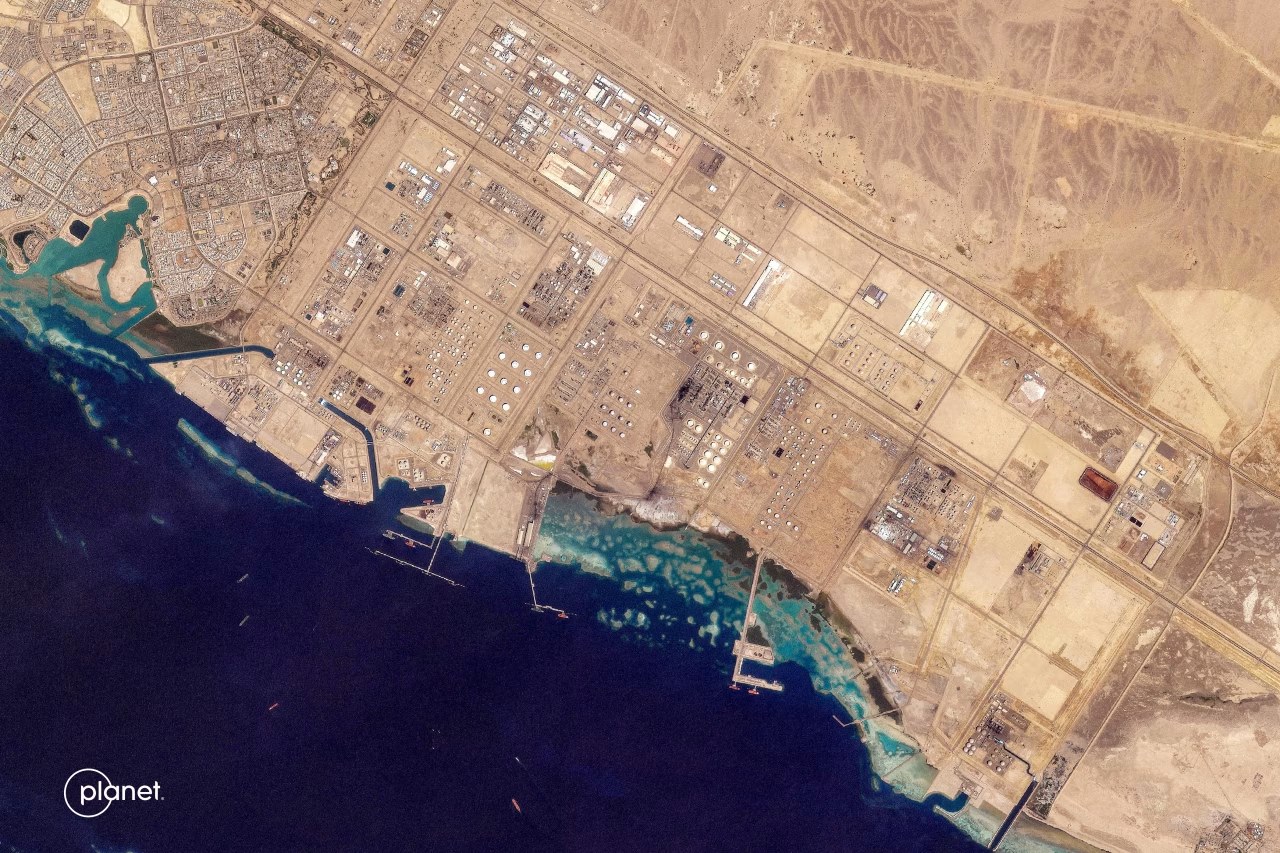
Yanbu Crude Loadings Hit 5 Million Barrels Daily as Saudi Arabia Sidesteps Hormuz
- Yanbu port crude loadings reached 5 million barrels a day on peak days this week, the highest since Kpler began tracking.
- March average exports from Yanbu stand at 3.4 million barrels a day, up sharply from prior months.
- Saudi Arabia is rerouting shipments away from the Strait of Hormuz after four weeks of Middle East conflict.
- Red Sea route via Yanbu offers a safer but longer passage to European and North American markets.
Riyadh’s west-coast pivot signals both tactical caution and strategic leverage in a tightening global market.
SAUDI OIL EXPORTS—Yanbu, the lesser-known western outlet for Saudi crude, is suddenly the busiest port in the kingdom. Kpler ship-tracking data show that loadings through the Red Sea terminal have climbed to around 3.4 million barrels a day so far in March, with daily spikes to 4.5 million and even 5 million barrels—figures never before recorded since the analytics firm began monitoring flows.
The surge is no accident. With missile and drone attacks targeting vessels near the Strait of Hormuz, Saudi Aramco is quietly redirecting customers to lift barrels that never enter the Gulf chokepoint. The move preserves export volumes while reducing geopolitical risk, a calculus that has gained urgency as the regional war stretches into its fourth week.
From Quiet Terminal to Global Lifeline: How Yanbu Became Riyadh’s Insurance Policy
Before this month, Yanbu’s name rarely appeared outside specialist shipping circles. The industrial city 350 km north of Jeddah was built in the late 1970s as part of a twin-port strategy alongside Jubail on the Gulf coast, designed to move refined products and later crude from the kingdom’s westward-facing fields. Its capacity was gradually expanded to 7 million barrels a day, yet utilisation hovered around 40 % for most of the past decade, according to Arab Petroleum Investment Corp. data.
The terminal’s under-use reflected geography: Asia—Saudi Arabia’s largest market—lies east, making Gulf ports the logical loading point. Yanbu’s Red Sea location added roughly 9 days’ sailing time to key Asian buyers and 4 days to northwest Europe, consultancy Energy Aspects estimates. Those extra miles translated into higher freight costs that refiners were unwilling to absorb unless Aramco offered discounts.
That calculus changed overnight. Attacks on commercial tankers inside the Strait of Hormuz have risen sharply since the conflict expanded, prompting insurers to raise war-risk premiums by 25 %, shipbroker Clarksons notes. Rather than absorb the surcharge or risk delays, Aramco instructed customers in mid-February that alternative loading slots were available at Yanbu. The notice, reviewed by The Wall Street Journal, made no mention of force majeure but signalled ‘flexibility in liftings to maintain schedule integrity’.
Traders responded immediately. Kpler data show that by the first week of March, 42 very-large-crude-carriers had booked fresh Yanbu loadings versus 19 during the same window last year. The port’s March average of 3.4 million barrels a day is a 62 % jump over January, effectively turning a back-up outlet into the kingdom’s primary safety valve.
Expert View: A Tactical Masterstroke
‘Rerouting through Yanbu allows the Saudis to keep exports whole while signalling to both markets and adversaries that they can circumvent Hormuz at will,’ says Richard Bronze, head of data analytics at Energy Intelligence. The kingdom already fields the 5-million-barrel East-West Petroline that can shift crude across the peninsula in 10 days, giving Aramco physical optionality unmatched by any other exporter.
Yet the shift is not cost-free. Freight traders say the diversion adds roughly $0.80 per barrel to delivered costs into Asia, enough to erode Saudi market share if prolonged. For now, buyers appear willing to pay the premium for certainty. Indian refiner Nayara Energy, for example, diverted two Suezmax cargoes to Yanbu loadings this month, accepting higher freight rather than risk Hormuz delays, according to trade sources.
The broader implication is strategic: by demonstrating that Yanbu can handle 5 million barrels a day, Riyadh has effectively created a parallel export system immune to Gulf disruptions. Whether the volumes persist will depend on how long insurers and shippers remain skittish about Hormuz, but the capability is now proven.
What Does 5 Million Barrels a Day Mean for Global Supply Tightness?
To grasp the significance of Yanbu’s new throughput, consider that only three countries—the United States, Saudi Arabia and Russia—produce more than 10 million barrels a day of crude. A single port now exporting 5 million barrels is therefore supplying roughly 5 % of global demand, enough to offset outages elsewhere or, if removed, to send Brent prices spiralling past $100, according to Rystad Energy modelling.
The timing matters. OPEC+ already cut output by 1.66 million barrels a day last autumn, and voluntary reductions by Riyadh bring the total curb to 3 million. Against that backdrop, the market interpreted the Yanbu surge as a sign that physical supply could be maintained even if Hormuz faced partial closure. Brent futures slipped $1.42 on the day the 5-million-barrel figure circulated, ending a three-day rally.
Yet traders warn the manoeuvre merely relocates risk, it does not eliminate it. The Red Sea remains a conflict zone: Houthi missiles have targeted tankers near the Bab el-Mandeb chokepoint, and last week a crude carrier on passage from Yanbu to Rotterdam reported a near-miss drone strike 60 miles off Yemen’s coast, according to the UK Maritime Trade Operations office.
Price Impact: Relief, Not Reversal
‘The market is pricing in a temporary geopolitical premium, not a structural surplus,’ says Jorge León, senior oil analyst at Wood Mackenzie. He notes that Yanbu’s record flows are largely a re-export of barrels originally destined for Gulf ports; total Saudi output has not risen, so global inventories will still draw by 1.2 million barrels a day in the second quarter under current OPEC+ quotas.
Still, the psychological effect is powerful. By demonstrating logistical flexibility, Saudi Arabia dampened speculative length in Brent, cutting net-long positions by 11 % in the week ended March 5, exchange data show. The kingdom also reassured Asian refiners that contractual volumes will be met, removing the need for emergency spot purchases that typically inflate differentials.
Forward curves underscore the tightrope: Brent for delivery in December 2025 commands a $5.60 premium over December 2024, a structure known as backwardation that signals perceived scarcity. If Yanbu flows persist above 4 million barrels a day through summer, that spread could narrow by half, León estimates, trimming $8–10 off headline prices.
Hormuz vs Bab el-Mandeb: Which Chokepoint Poses the Greater Threat?
The Strait of Hormuz is the world’s most critical oil artery: roughly 21 million barrels a day—about 21 % of global consumption—pass through the 21-mile-wide channel. Closure scenarios, however unlikely, are etched into contingency planning at every major trading house. By contrast, Bab el-Mandeb at the southern mouth of the Red Sea handles 6.2 million barrels a day, mostly northbound to Europe and the United States.
What makes the current moment unusual is that both chokepoints are under stress simultaneously. Iran’s Revolutionary Guards have seized or harassed at least four tankers inside Hormuz since hostilities escalated, prompting the U.S. Navy to escort flagged vessels. Meanwhile, Yemen’s Houthi movement—backed by Tehran—has launched over 40 anti-ship missiles or drones toward Red Sea shipping lanes since January, according to the Center for Strategic and International Studies.
Insurance underwriters have responded by expanding the Listed Areas for war risk to include the Red Sea’s western approach, not just the Yemeni side. The result is a double premium: tankers loading at Yanbu now pay an additional $485,000 per voyage, calculates Oslo-based marine insurance broker StormGeo. That cost is ultimately baked into the delivered price of crude.
Naval Escorts: A New Normal?
‘Owners are factoring in convoy delays of 24–36 hours through both chokepoints,’ says Tarun Roopchand, head of tanker research at Howe Robinson Partners. The firm’s Suezmax fleet has already switched to slow-steaming to align with U.S. Navy convoy windows, reducing effective capacity by 4 % globally.
Yet the strategic takeaway is asymmetric: Saudi Arabia can bypass Hormuz via Yanbu, but there is no comparable alternative for Bab el-Mandeb without a 4,000-mile detour around the Cape of Good Hope. Riyadh’s own security therefore depends on keeping the Red Sea open, explaining its participation in the U.S.-led Operation Prosperity Guardian naval coalition.
Energy markets have internalised this hierarchy. Brent’s immediate reaction to Houthi attacks is typically a 60–80 cent spike, whereas comparable incidents inside Hormuz prompt $1.50 moves, Goldman Sachs commodity strategists note. The differential underscores that while Yanbu offers a partial hedge, it cannot fully de-risk the kingdom’s export architecture.
Can Aramco Keep Yanbu Running at 5 Million Barrels a Day Through Summer?
Physical limits are starting to surface. Yanbu’s storage farms can hold 15 million barrels—three days of cover at the new throughput rate—leaving little buffer for scheduling hiccups. Aramco has begun hiring additional tugboats and pilot crews, posting 48 new vacancies for marine services at Yanbu in the past fortnight, according to company job boards reviewed by Energy Intelligence.
Corrosion engineers warn that operating the 1,200-km East-West pipeline at sustained rates above 6.5 million barrels a day accelerates internal wear, requiring more frequent smart-pig inspections. Aramco routinely shuts the line for 72 hours every quarter; any extension would immediately curtail Yanbu supply. ‘They are effectively running a just-in-time system,’ says a former Aramco executive who requested anonymity.
Crude quality is another wildcard. Yanbu blends Arabian Medium and Heavy grades pumped from the Ghawar and Khurais fields. Customers in South Korea and Japan have complained of higher sulphur content in recent cargoes, forcing refiners to adjust desulphurisation units. While not a deal-breaker, the tweaks add 30–40 cents per barrel in processing cost, traders say.
Maintenance Windows: A Narrowing Calendar
Aramco’s own schedule shows a planned 10-day partial shutdown of Yanbu’s No. 2 single-point mooring in September, cutting export capacity by 800,000 barrels a day. If regional tensions persist, the company may defer the work, but that risks equipment fatigue. ‘You can push throughput for a few months, not indefinitely,’ says Sadad al-Husseini, a former Aramco senior vice-president.
Seasonal demand adds pressure. Summer air-conditioning lifts Saudi domestic oil burn by 600,000 barrels a day, eating into exportable surplus. To keep Yanbu at 5 million, Riyadh would either have to draw down inventories—currently 258 million barrels, or 23 % of capacity—or raise overall production, breaching its OPEC+ quota of 9.1 million barrels a day.
For now, traders believe the kingdom will prioritise market share over quota discipline if forced to choose. A repeat of the 2020 price war is unlikely, but a quiet increase of 200–300 thousand barrels a day through summer could keep Yanbu flush without triggering formal OPEC+ censure, according to analysts at FGE Energy.
Who Wins and Who Loses in a Prolonged Yanbu-Driven Market?
Refiners with term contracts linked to Arab Medium grade benefit most. Indian state-run processors IOC, BPCL and HPCL have all requested additional Yanbu cargoes for April, lured by stable official selling prices that have risen only 35 cents since January versus a 90-cent jump for Urals, according to pricing agency Argus. The spread equates to $3.5 million savings per Suezmax cargo.
Conversely, shipping companies face higher ballast miles. A tanker loading at Yanbu for China must traverse 11,200 nautical miles versus 7,400 from Ras Tanura, cutting annualised vessel utilisation by 12 %, estimates Cleaves Securities analyst J Mintz. Aframax day-rates from Yanbu to Rotterdam have already climbed to $3.10 per barrel, a three-year high, eroding some of the crude price advantage European refiners hoped to capture.
U.S. Gulf coast exporters also feel the squeeze. With Yanbu barrels displacing North Sea Forties in European refineries, West Texas Intermediate’s discount to Brent has widened to $4.60, the steepest since 2022, encouraging U.S. exports toward Asia and intensifying competition with Middle Eastern grades in the Pacific basin.
Producer Reactions: UAE and Iraq on Watch
The United Arab Emirates has begun studying whether to reactivate the long-dormant Habshan-Fujairah pipeline, which could add 1.5 million barrels a day of bypass capacity. Iraq, lacking a Red Sea coast, is lobbying Jordan to revive a defunct export corridor to Aqaba, but financing remains elusive. For now, Saudi Arabia alone enjoys the luxury of geographic redundancy.
Longer term, a sustained Yanbu strategy could reshape OPEC+ quota negotiations. Riyadh may argue that barrels moved through higher-cost routes deserve quota credit, complicating the arithmetic of any future supply cuts. With Yanbu proving it can handle 5 million barrels a day, the kingdom has not only shielded itself from Hormuz risk—it has gained a potent bargaining chip for the next OPEC+ ministerial round.
Frequently Asked Questions
Q: Why is Saudi Arabia using Yanbu instead of Hormuz?
Yanbu allows Saudi Arabia to export crude without transiting the Strait of Hormuz, reducing exposure to potential shipping disruptions during the ongoing Middle East conflict.
Q: How much oil is Yanbu exporting now?
Kpler data show Yanbu loadings averaged 3.4 million barrels a day in early March, spiking to 5 million on some days—both all-time highs since tracking began.
Q: Is Yanbu a new port?
No. Yanbu has handled crude since the 1980s, but its recent surge to record volumes reflects deliberate rerouting by Saudi Aramco to bypass Hormuz.
📰 Related Articles
- Cyclone Narelle Forces Shutdowns at Chevron’s Gorgon and Wheatstone LNG Plants
- Enagas Surges 27% Year-to-Date After Spain Unveils 2027-32 Hydrogen-Pipeline Incentives
- Soaring LNG Prices Threaten U.S. Export Growth as Global Markets Tighten
- Energy Shock Forecast: Trump Predicts Quick Recovery While CEOs Warn Prolonged Crisis
