Senate Pushes DHS Funding Fix but Leaves 2 Key Agencies in Limbo
- Senate signed off on a stop-gap bill that funds most of DHS yet withholds fresh money for ICE and CBP.
- Both agencies must rely on unspent supplemental cash from last year’s tax measure to keep paychecks flowing.
- Republicans vow to restore ICE and CBP appropriations in a future reconciliation bill, timing uncertain.
- Airport security lines remain federally staffed, but any overtime pullback could lengthen TSA queues at hubs.
Capitol Hill’s punt shifts the showdown to later this year, keeping border staffing in budget limbo.
DEPARTMENT OF HOMELAND SECURITY—Minutes before senators scattered for a two-week recess, Majority Leader Chuck Schumer’s chamber approved a partial Department of Homeland Security funding patch that papers over only half the problem: while the Transportation Security Administration and Coast Guard receive new appropriations, Immigration and Customs Enforcement and Customs and Border Protection must soldier on with surplus money enacted twelve months ago.
The parliamentary maneuver averts an immediate government shutdown, yet it leaves frontline border and interior-enforcement units in a familiar Washington purgatory—authorized to operate but denied the budget certainty that local field offices need to plan overtime, buy fuel, or staff highway checkpoints.
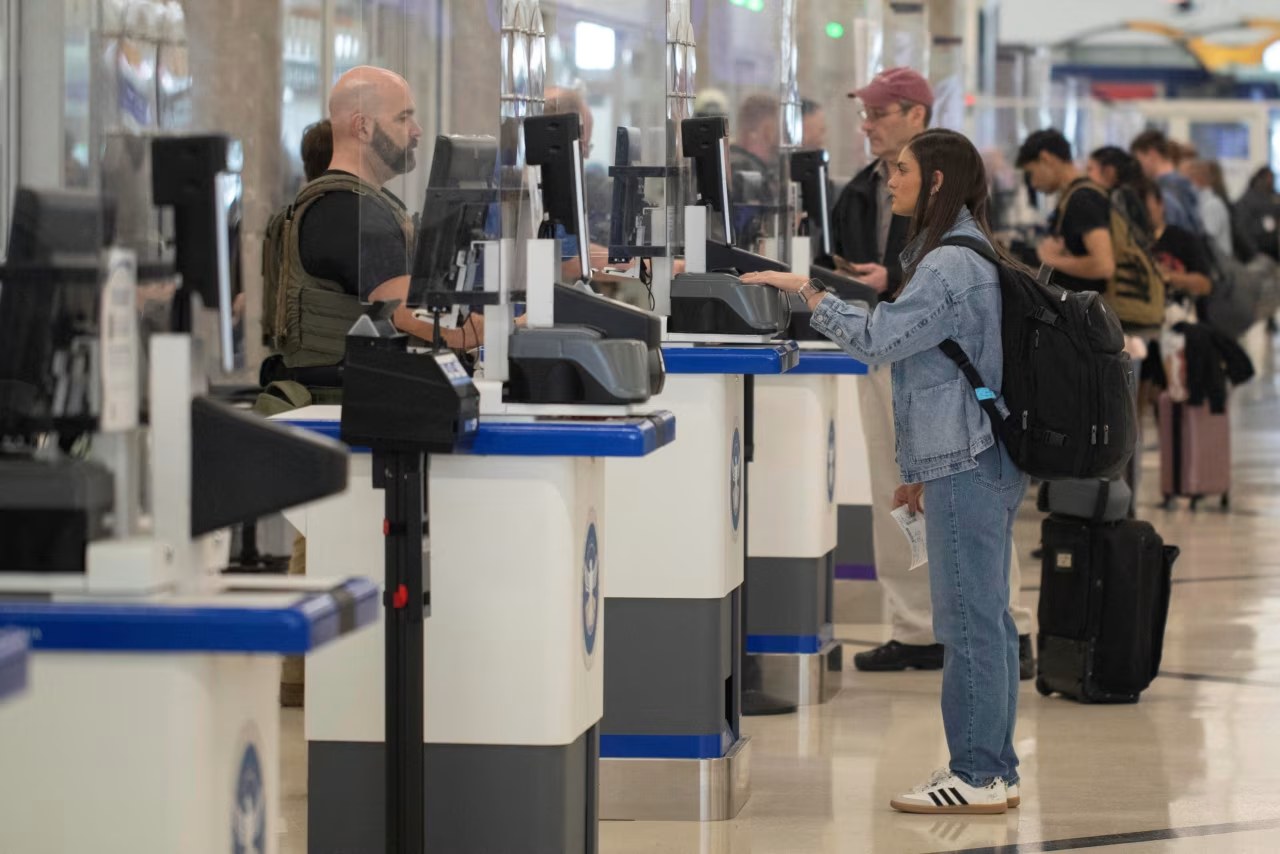
For travelers, the stakes are visible every time they enter an airport security queue. TSA checkpoints stay open because the aviation-security fee—$9.60 per enplaned passenger—flows into a trust fund insulated from annual appropriations fights. Still, any ripple effect from ICE or CBP furloughs could pull federal officers away from joint task forces that back-stop TSA when lines swell at Hartsfield-Jackson or Dallas-Fort Worth.
What the Friday-Night Deal Actually Funds—and What It Doesn’t
The Senate’s pre-dawn vote delivered a mixed ledger for the third-largest federal department. Text released by the Appropriations Committee shows $59.8 billion in new discretionary money for DHS for the current fiscal year, a 3% increase over last year’s freeze level. Within that top-line, the Transportation Security Administration receives $10.2 billion—enough to keep 47,000 screeners on payroll and fund the 1,000 new officers the agency says it needs for summer travel surges.
Yet the bill deliberately zeros out fresh discretionary dollars for two sub-agencies: Immigration and Customs Enforcement, which requested $9.2 billion, and Customs and Border Protection, which sought $18.9 billion. Instead, the legislation carries a proviso that “prior-year supplemental balances shall remain available” through Sept. 30, referring to the $1.9 billion surplus lawmakers tucked into last year’s tax-and-climate bill to help agencies cope with migrant-influx costs.
Senate clerks confirmed that ICE’s detention-and-removal account gets no new obligational authority, meaning field directors must ration beds in the 22,000-bed detention network and postpone contracts for charter flights that return undocumented migrants. CBP faces a similar squeeze: overtime for the 19,500 Border Patrol agents must now compete with maintenance on surveillance towers and boats on the southwest border.
Expert lens: why “anomaly” language matters
Budget analysts at the Bipartisan Policy Center warn that relying on leftover supplemental cash is legally fragile. “Those dollars carry narrow purpose language—humanitarian care, not routine salary,” notes analyst Rachel Snyder. “If ICE re-programs money to pay detention guards, watchdogs could cry foul and invite a GAO ruling that blocks spending mid-year.”
Republicans privately concede the gambit is temporary. Senator John Cornyn of Texas told reporters the leadership will try to attach a fresh $6.4 billion for ICE and CBP to the next reconciliation vehicle, a tactic that bypasses the 60-vote filibuster but can be used only once per fiscal year. Timing hinges on House conservatives, who want deeper policy riders that moderate GOP senators may resist.
The bottom line: travelers may not feel an immediate jolt, yet border commanders must now plan for a summer enforcement season with no new money in the till—an operational gamble that could spill into airport security if joint task forces thin out.
How TSA Keeps Running While Other Agencies Starve
Airport security lines have become the public face of federal budget brinkmanship, yet TSA enjoys a rare budgetary shield. The Aviation and Transportation Security Act of 2001 created a passenger-fee trust fund that collects roughly $4.2 billion annually from ticket surcharges. By law, those fees must be spent on aviation-security operations, and the account is not subject to annual appropriations—meaning TSA officers remain on payroll even when Congress fails to pass a budget.
During the 2018-19 shutdown—the longest in U.S. history—TSA absenteeism at airports like Atlanta peaked at 10%, up from 3.5% normally, according to agency data. Screeners called in sick because they feared mortgage payments without paychecks, not because money ran out. The lesson: liquidity matters more than legal authority for frontline morale.
This time, TSA Administrator David Pekoske told regional directors in a March 2 internal email that “payroll continuity is assured,” yet he warned overtime budgets could tighten if the agency must back-fill CBP officers pulled from joint task forces that police airport perimeters. A TSA spokesperson confirmed the agency has 1,349 active Memoranda of Understanding with CBP covering everything canine sweeps to VIPR (Visible Intermodal Prevention and Response) teams.
Expert lens: why travelers still face risk
“The chokepoint isn’t checkpoints, it’s the back-office coordination,” says Samuel Purcell, a former DHS chief of staff now at the Center for Strategic and International Studies. “When CBP intelligence officers are furloughed, TSA loses real-time threat analysis, and that can slow response to suspicious bags or passenger anomalies.”
Historical data back the concern. In shutdown-affected weeks of January 2019, missed-connection rates at Atlanta rose 2.3 percentage points above the five-year baseline, according to Bureau of Transportation Statistics. The ripple: travelers rebooked on later flights, gate crowding, and cascading delays across the national aviation network.
Looking ahead, summer travel is forecast to hit 271 million enplaned passengers—a post-pandemic record. If ICE or CBP furloughs materialize, TSA may have to divert canine teams from land-border ports to airports, lengthening truck inspection times and raising freight costs. The integrated nature of DHS operations means no agency budget cut stays in its own lane.
Could a Future Reconciliation Bill Plug the ICE-CBP Hole?
Republicans’ plan to rescue ICE and CBP rests on a parliamentary maneuver that allows budget bills to pass the Senate with 51 votes instead of the customary 60. Under the Budget Act, Congress may adopt one reconciliation instruction per fiscal year covering revenue, outlays, and debt limit. The House Budget Committee has already teed up a fiscal 2024 reconciliation package focused on tax extenders, but GOP leaders say DHS money could hitch a ride if offsetting cuts are found.
Senator Cornyn’s target: add $6.4 billion for ICE detention and border technology, plus $3.1 billion for CBP overtime and facility upkeep. To stay within reconciliation rules, the bill must not increase the deficit outside the 10-year budget window, so Republicans are eyeing rescissions from unspent pandemic-relief funds and a 2% across-the-board domestic discretionary trim—proposals that moderate GOP senators like Susan Collins have balked at.
History shows reconciliation is a blunt tool. The 1996 Illegal Immigration Reform and Immigrant Responsibility Act—also passed under reconciliation—stripped legal-aid grants from immigrant nonprofits, triggering a decade-long litigation fight. “Reconciliation is fast, but it invites policy riders that blow up bipartisan coalitions,” notes Molly Reynolds, a governance fellow at Brookings.
Expert lens: the parliamentarian’s gatekeeper role
Senate Parliamentarian Elizabeth MacDonough must certify that every reconciliation provision affects outlays, not policy. She already struck $15 minimum wage language from the 2021 Covid-relief bill, citing budget incidental effects. Immigration hawks want to insert mandatory detention quotas; MacDonough could rule them extraneous, forcing a Byrd bath scrub that delays floor action into summer.
Even if the package survives the Senate, House Freedom Caucus members are demanding policy add-ons—ending catch-and-release, restarting border-wall construction—that could fracture the narrow 219-212 GOP majority. Speaker Mike Johnson can lose only three votes if Democrats stay unified against the bill.
The upshot: reconciliation offers a procedural path, but the politics of immigration remain combustible. If talks collapse, ICE and CBP could face a true funding cliff when the $1.9 billion surplus runs dry—likely in late summer—setting up a September shutdown showdown just weeks before Election Day.
What Happens If the Surplus Runs Dry Before Fall?
Budget veterans warn the $1.9 billion supplemental cushion is already spoken for. ICE’s detention-and-removal account burned through $1.1 billion of that tranche in the final quarter of 2023, according to a DHS financial summary obtained by the Wall Street Journal. CBP has obligated another $470 million for border-wall gate repairs and migrant-processing tents, leaving a residual $330 million pool that agency CFOs describe as “hand-to-mouth.”
If reconciliation collapses, ICE would face an August cash-out. The agency projects weekly detention costs of $134 million at current bed levels, implying a funding gap of roughly $2.8 billion through Sept. 30. Options under a so-called “absence of appropriation” plan, last updated in 2019, include: furloughing 4,800 administrative staff, cutting detention to 16,000 beds, and deferring all international repatriation flights—moves that would ripple into CBP workloads at ports of entry.
CBP’s own cliff arrives sooner. The agency’s overtime budget traditionally peaks in summer when southwest border temperatures exceed 100°F and agents work extra hours rescuing migrants. CFO John Sanders told staff in February that without new money the Border Patrol will institute one mandatory furlough day per pay period starting in July, reducing field strength by an estimated 1,900 agents.
Expert lens: economic spillovers
“Every agent pulled from commercial inspections means longer truck queues at Laredo,” says trade economist Raymond Robertson of Texas A&M. Laredo handles 40% of U.S. truck-borne imports from Mexico; each hour of delay costs shippers $1.2 million in spoiled produce and idle capital, according to Customs broker data.
Air cargo faces knock-on risks. CBP’s 220 canine teams that screen high-risk freight at airports like Memphis and Indianapolis could be grounded, forcing express carriers to reroute packages through secondary hubs and pushing per-kilogram rates up 8–11% during peak shipping season.
Internally, DHS is gaming out a “tiered shutdown” model: first, overtime freezes; second, halt to non-critical training; third, furloughs of headquarters staff while field agents stay on duty under the emergency furlough exception for national security. The plan mimics the 2013 partial shutdown, except ICE did not then exist as a standalone agency, so case law is sparse.
Forward-looking, the department has asked the Office of Management and Budget for a reprogramming letter that would let ICE tap $650 million in FEMA disaster grants—legally possible but politically toxic after Hurricane Idalia. Congressional aides say the request is “dead on arrival” in both chambers.
Bottom line: the surplus runway is shorter than headlines suggest. Without reconciliation or a regular appropriation by midsummer, ICE and CBP face the stark choice of curtailing core enforcement or courting legal jeopardy by shifting money from other disaster accounts—a scenario that guarantees another shutdown saga before the fiscal year ends.
Frequently Asked Questions
Q: Why did the Senate leave ICE and CBP out of the DHS funding deal?
The Senate kept ICE and CBP on a short leash to avoid a partisan floor fight before recess; both agencies can tap leftover supplemental cash from last year’s tax bill for now, but new appropriations will have to wait until lawmakers return.
Q: Could TSA lines get longer if the DHS shutdown resumes?
Yes—TSA officers remain on the job because their salaries come from passenger fees held in a separate aviation trust fund, yet if a prolonged shutdown forces overtime cuts or absenteeism, wait times at hubs like Atlanta could spike.
Q: What happens next for ICE and CBP budgets?
Republican leaders plan to attach fresh ICE and CBP money to a reconciliation package later this year; until then, the agencies must ration last year’s surplus, and any shortfall could trigger furloughs or reduced border operations.
