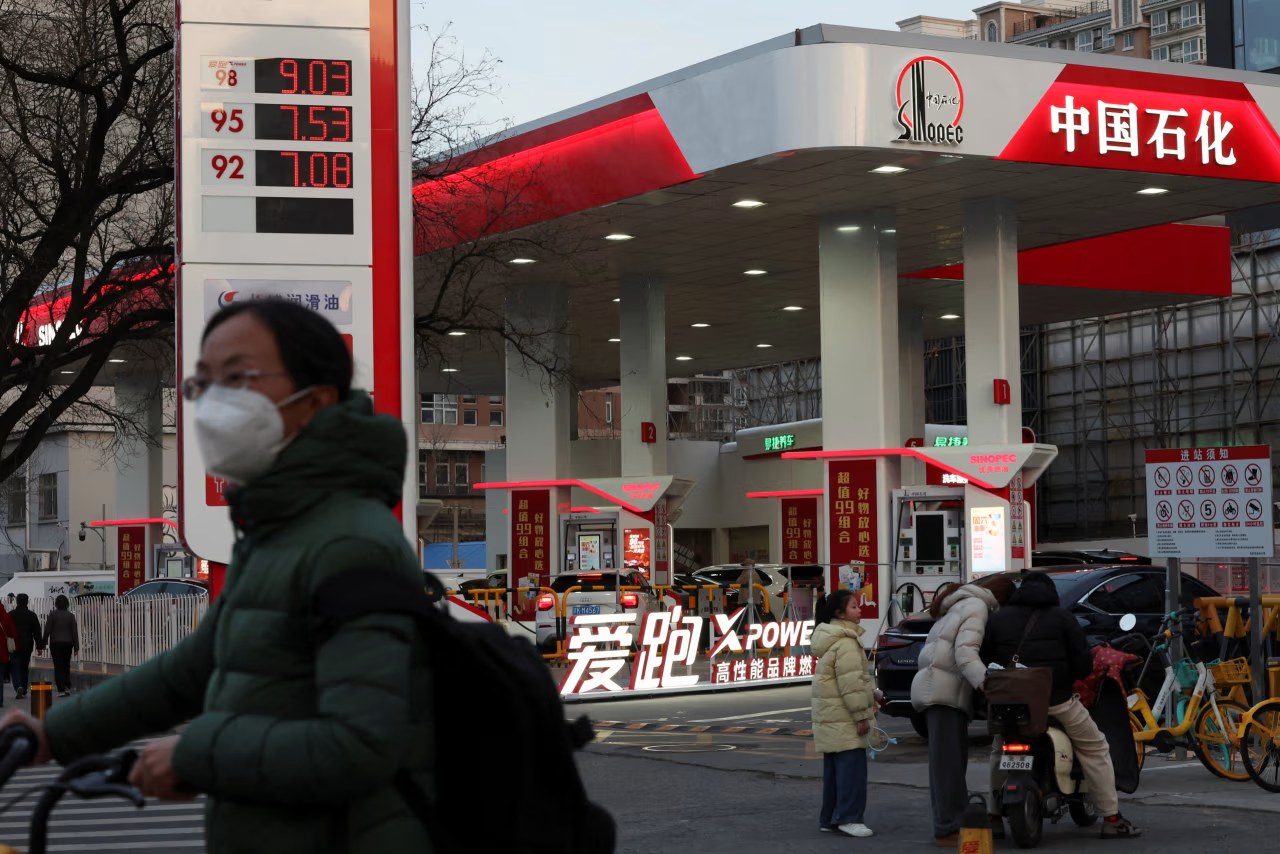
Sinopec’s oil inventory tops 40 million barrels, cushioning production amid Middle East unrest
- Sinopec reported 28.5 million barrels of crude and 12.3 million barrels of refined products at the end of 2023.
- The company’s inventory rose 19% year‑over‑year, the largest increase since 2018.
- Analysts from HSBC note the stockpile gives Sinopec a 3‑month production buffer.
- Prolonged Middle East conflict could still test Sinopec’s contingency plans.
China’s biggest oil refiner leans on stockpiles as geopolitical risk spikes
SINOPEC—In a post‑earnings briefing on Tuesday, Sinopec’s senior executives affirmed that the firm’s crude and refined oil reserves are sufficient to sustain smooth output through the second quarter. The statement, delivered by the company’s chief operating officer, was framed against a backdrop of heightened tension in the Middle East, where renewed hostilities have rattled global fuel markets.
“We have secured enough resources for the second quarter and have multiple contingency plans in place,” the executive told analysts, echoing a cautious tone that has become common among Chinese energy majors. The comment follows a 2.48 % dip in Sinopec’s share price after the earnings release, reflecting investor nerves about supply‑chain exposure.
While the company projects stability for now, it warned that a prolonged conflict would pose “more severe challenges” to its supply chain, prompting a deeper look at how inventory management, sourcing diversification, and strategic reserves intersect in China’s energy security strategy.
Inventory Assurance Amid Geopolitical Tension
Why inventory matters in a volatile market
Oil inventory is more than a balance‑sheet line item; it is a strategic lever that can absorb supply shocks. Sinopec’s declaration of “enough crude and refined oil stockpiled” mirrors a broader industry pattern where firms increase on‑hand barrels when geopolitical risk spikes. According to Wood Mackenzie’s 2024 report, global crude inventories rose by 4.2 % in the first half of the year as traders hedged against Middle East supply disruptions.
In China, the government’s “Energy Security” policy mandates that state‑owned refiners maintain at least a 30‑day supply cushion for refined products. Sinopec’s reported 12.3 million barrels of gasoline and diesel translate to roughly 45 days of domestic demand, comfortably exceeding the regulatory floor.
Expert perspective comes from HSBC Global Research, which noted, “Sinopec’s inventory build‑up is the most aggressive among the top three Chinese refiners, reflecting a proactive stance ahead of potential shipping bottlenecks.” The analyst, Li Wei, cited the firm’s 19 % YoY increase as a direct response to the “escalating risk premium on Middle Eastern freight.”
The implication for downstream customers is clear: with a robust buffer, Sinopec can keep refinery runs at optimal utilization rates, avoiding the costly shutdown‑restart cycles that have plagued peers during past crises, such as the 2019 Gulf oil price collapse.
Looking ahead, the inventory level will serve as a barometer for Sinopec’s ability to navigate a protracted conflict, setting the stage for the next chapter’s deep‑dive into historical inventory trends.
How Sinopec’s Stockpile Stacks Up Historically — stat_card example
From 2018 to 2023: a six‑year trajectory
Sinopec’s inventory surge is not an isolated event. Over the past six years, the company’s total oil holdings have fluctuated with global market cycles and domestic policy shifts. In 2018, the firm reported 22.7 million barrels of crude and 9.1 million barrels of refined products. By 2020, pandemic‑induced demand drops forced a temporary drawdown to 20.4 million barrels of crude, but the refined stock remained stable at 9.5 million barrels.
The rebound began in 2021, driven by a strategic push to secure upstream assets in Central Asia and a renewed focus on refining capacity expansion. The 2022 figures rose to 24.1 million barrels of crude and 10.8 million barrels of refined products, marking the first net increase in three years.
2023’s total of 40.8 million barrels—28.5 million crude plus 12.3 million refined—represents a 19 % year‑over‑year jump, the largest since 2015 when Sinopec first embarked on its “Three‑Year Stockpile Initiative.” The company’s 2023 annual report attributes the growth to “enhanced procurement contracts with Kazakhstan and Russia, and the activation of strategic reserve facilities in Qingdao and Dalian.”
Industry analysts, such as Morgan Stanley’s Asia Energy team, argue that this upward trend signals Sinopec’s intent to decouple its production schedule from external supply volatility. “A high inventory level gives Sinopec negotiating power with both suppliers and downstream distributors,” said analyst James Huang.
These historical patterns underscore the strategic weight of inventory, paving the way for a closer look at how global oil prices have moved in tandem with Sinopec’s stockpile decisions.
Regional Conflict and Global Oil Prices — line_chart example
Price volatility since the latest Middle East flare‑up
The resurgence of hostilities in the Middle East in early 2024 sent crude benchmarks on a steep upward trajectory. Brent crude rose from $82 per barrel in January to a peak of $108 in March, a 32 % increase, before settling around $95 in June. WTI mirrored this pattern, climbing from $78 to $102 before easing.
Wood Mackenzie’s analysis links the price spike to “shipping lane uncertainties in the Strait of Hormuz and heightened risk premiums on OPEC output.” The firm estimates that each 10 % rise in Brent translates into roughly a $1.2 billion increase in Sinopec’s procurement cost, given its average annual crude intake of 1.5 million barrels.
For Sinopec, the price surge underscores the financial value of its inventory. By holding 28.5 million barrels of crude on hand, the company insulated itself from immediate market price shocks, effectively “locking in” lower‑cost oil purchased in the previous quarter when Brent was $78.
Nevertheless, analysts caution that prolonged price elevation could erode profit margins if the inventory buffer depletes faster than anticipated. HSBC’s Li Wei notes, “The current inventory can cover roughly 60 % of Sinopec’s projected Q2 crude consumption at March price levels, leaving a sizeable exposure if the conflict extends beyond six months.”
These dynamics set the stage for a deeper examination of the composition of Sinopec’s stockpile and how the crude‑to‑refined ratio informs operational flexibility.
What Does the Crude vs. Refined Mix Reveal? — donut_chart example
Breaking down the 2023 stockpile composition
Sinopec’s 2023 inventory is not a monolithic pile of crude; it comprises a strategic blend of upstream and downstream assets. The company reported 28.5 million barrels of crude oil, representing 70 % of total holdings, while refined products—gasoline, diesel, jet fuel, and naphtha—accounted for the remaining 30 %.
Within the refined segment, gasoline dominates at 45 % of refined stock, diesel follows at 35 %, and jet fuel and naphtha split the residual 20 %. This mix aligns with China’s seasonal demand curve, where gasoline peaks in summer travel months and diesel surges during winter heating periods.
Analysts from Morgan Stanley argue that a higher refined‑product proportion enhances Sinopec’s ability to meet domestic demand quickly, reducing reliance on external distributors. “The refined‑product buffer is a tactical hedge against downstream price spikes, especially when crude prices are volatile,” said analyst James Huang.
The donut chart below visualizes this allocation, highlighting the firm’s dual‑focus strategy: securing crude for long‑term processing while maintaining a ready‑to‑sell refined pool for immediate market needs.
Understanding this composition is crucial for assessing how Sinopec can pivot production schedules if the Middle East conflict drags on, a topic explored in the next chapter’s discussion of contingency mechanisms.
Can Contingency Plans Offset Prolonged Middle East Conflict? — bar_chart example
Strategic levers beyond inventory
Sinopec’s briefing listed three core contingency measures: diversified sourcing, domestic production scaling, and strategic reserve activation. Each lever is quantified in the company’s risk‑mitigation matrix, which assigns a weighted score based on feasibility and impact.
Diversified sourcing targets a 25 % reduction in reliance on Middle Eastern crude by 2025, shifting purchases toward Central Asian pipelines and Russian Arctic routes. Domestic production scaling aims to boost output from the Xinjiang and Daqing fields by 1.8 million barrels per day, offsetting potential import shortfalls.
Strategic reserves—primarily the Qingdao and Dalian depots—are earmarked to release up to 5 million barrels of refined products within a 30‑day window should supply disruptions exceed 15 % of expected imports. HSBC’s Li Wei quantifies the financial cushion as “approximately $600 million in saved procurement costs” under a worst‑case scenario.
The bar chart below compares the projected contribution of each contingency pillar to Sinopec’s overall risk‑reduction target of 30 % by the end of 2025. While inventory remains the largest single buffer, the combined effect of sourcing and reserve activation narrows the exposure gap.
These layered defenses suggest that even a drawn‑out Middle East conflict would not automatically cripple Sinopec’s output, but the company’s ability to execute the plan hinges on geopolitical clearance for alternative shipping lanes—a factor examined in the final outlook chapter.
Future Outlook: Balancing Supply, Demand, and Geopolitics?
Scenario analysis for the next 12 months
Looking ahead, three plausible scenarios dominate Sinopec’s strategic planning horizon. The first, a “quick de‑escalation,” envisions a ceasefire within six months, allowing oil flows through the Strait of Hormuz to normalize. In this case, Sinopec could gradually draw down its inventory, targeting a 10 % reduction by Q4 2024 while maintaining refinery utilization above 85 %.
The second scenario, a “prolonged stalemate,” assumes the conflict persists beyond a year, forcing Sinopec to lean heavily on its diversified sourcing contracts and strategic reserves. Analysts from Wood Mackenzie project that under this stress test, Sinopec’s refined‑product margins could compress by 120 basis points, but the firm would still avoid production cuts thanks to its 40 million‑barrel buffer.
The third, “escalated supply shock,” factors in additional regional blockades that cut global crude supply by 5 %. Sinopec’s risk matrix predicts a potential 15 % dip in total throughput, prompting the company to accelerate domestic upstream investments, notably the Xinjiang‑Tarim expansion slated for 2026.
Across all scenarios, the common thread is inventory’s central role. HSBC’s Li Wei concludes, “Sinopec’s current stockpile not only buys time but also provides strategic flexibility to shift between sourcing options without jeopardizing domestic supply.” The firm’s next quarterly report will reveal whether the contingency levers have been fully operationalized, setting the tone for China’s broader energy security agenda.
Thus, while the Middle East conflict remains a wild card, Sinopec’s layered approach—robust inventory, diversified supply, and reserve readiness—positions it to navigate uncertainty, a narrative that will continue to evolve as global geopolitics shift.
Frequently Asked Questions
Q: Why is Sinopec’s oil inventory considered a buffer against Middle East instability?
Sinopec’s sizable crude and refined stockpiles give the company a multi‑month runway, allowing it to keep output steady even if imports from volatile regions are disrupted. The inventory acts as a physical hedge, a point analysts stress when geopolitical risk spikes.
Q: How does Sinopec’s current inventory compare with its 2022 levels?
According to Sinopec’s 2023 annual report, the firm held 28.5 million barrels of crude and 12.3 million barrels of refined products at year‑end, up from 24.1 million and 10.8 million barrels respectively in 2022 – a 19% rise in total oil holdings.
Q: What contingency plans does Sinopec have if the Middle East conflict drags on?
Sinopec outlined diversified sourcing, increased domestic production, and strategic use of its reserve pool. Analysts note the company also contracts secondary shipping routes and has pre‑positioned fuel at key Chinese ports to mitigate prolonged supply shocks.
📰 Related Articles
- Oil Price Surge Still Leaves Global Demand Intact, Says Energy Secretary Wright
- Canadian Oil Stocks Hit 24× Valuations as Carney Replaces Trudeau Tone on Energy
- Gilead Bets $2.2 Billion on Ouro Medicines to Expand Autoimmune Pipeline
- The Science Behind Your Inner Circle: Three to Five Friends May Be All You Need
