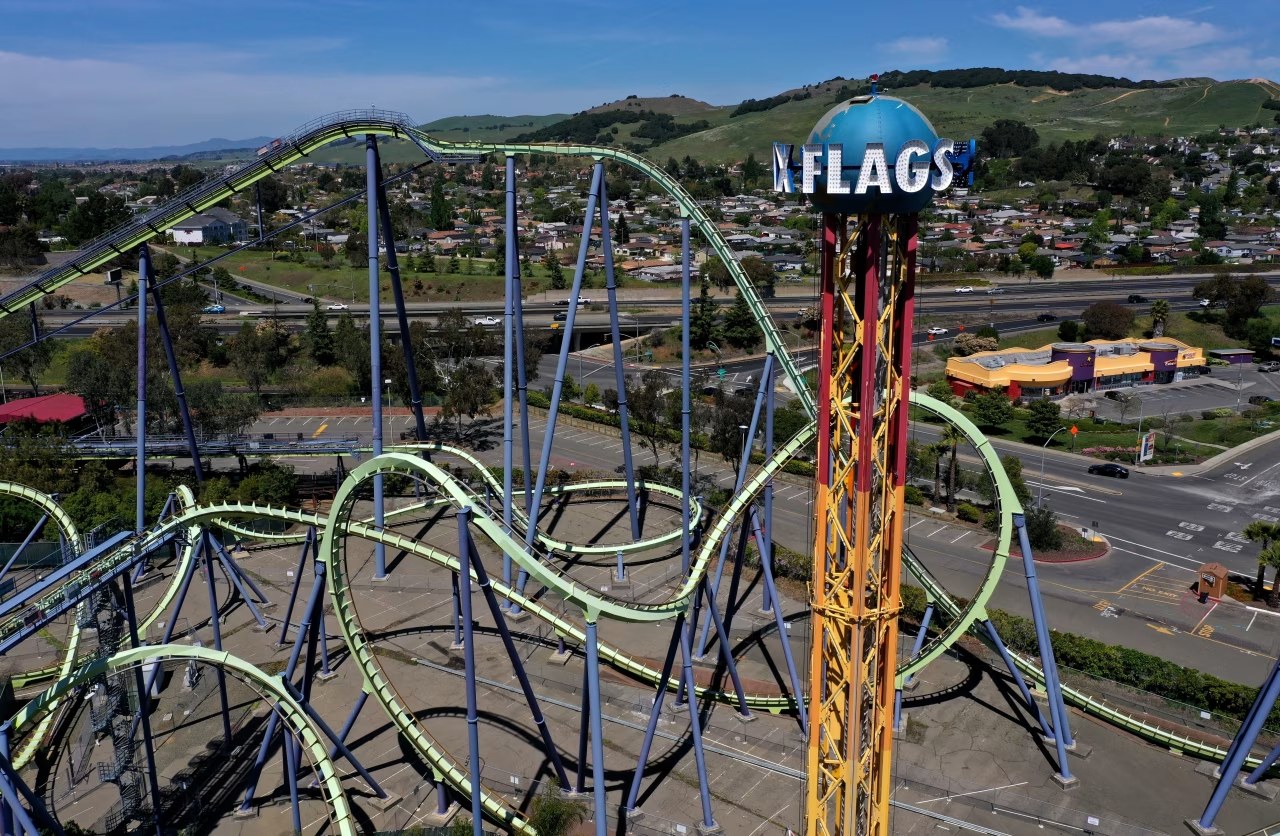
Six Flags Divests 7 Parks for $331 Million in Balance-Sheet Rescue
- Six Flags Entertainment will sell seven regional amusement parks to EPR Properties for $331 million cash.
- Deal announced Thursday by CEO John Reilly aims to ‘simplify the portfolio’ and cut leverage.
- Transaction is expected to close in second-half 2024 subject to customary approvals.
- Move shrinks Six Flags to roughly 20 owned or operated parks, focusing capital on higher-margin resorts.
Portfolio pruning could ease $2.6 billion debt load after years of pandemic-era losses.
SIX FLAGS—Six Flags Entertainment struck a definitive agreement late Wednesday to unload seven of its regional amusement parks to EPR Properties for an all-cash consideration of $331 million, the company disclosed before markets opened Thursday. The deal, which ranks among the largest single-asset divestitures in the theme-park sector since 2019, will immediately fortify the Grand Prairie, Texas-based operator’s balance sheet while narrowing its geographic footprint to what executives call ‘core, cash-generating resorts.’
Chief Executive John Reilly told analysts on a brief conference call that the transaction is part of a phased strategy to exit under-performing leasehold sites and redirect capital toward higher-yielding properties such as Six Flags Magic Mountain and Great Adventure. ‘We are exiting markets where we do not see a path to sustainable margin expansion,’ Reilly said, noting that the seven parks account for roughly 9 % of the company’s 2023 attendance of 27 million guests.
EPR Properties, a Kansas City real-estate investment trust that specializes in entertainment venues, will acquire land, rides, and associated improvements. The REIT has historically structured similar deals as triple-net leases, meaning Six Flags could retain operational control while EPR holds the real estate. Both parties expect the transfer to close in the second half of 2024, subject to antitrust clearance and local zoning approvals.
The $331 Million Deal: How It Is Structured
The purchase price of $331 million represents a trailing-twelve-month EBITDA multiple of roughly 8.5× for the divested portfolio, according to two people familiar with the negotiations. EPR Properties will fund the acquisition through its $1.1 billion revolving credit facility that carries a weighted-average interest rate of 5.9 % as of March 31, 2024.
Cash-heavy consideration shields Six Flags from stock volatility
Unlike the 2015 sale of Six Flags’ international development rights, this transaction is entirely cash, eliminating market-risk exposure for the seller. The buyer, EPR Properties, owns 185 entertainment assets across 39 states including Topgolf complexes, ski resorts, early-learning centers, and water parks. Adding traditional amusement parks diversifies EPR’s tenant mix and increases exposure to the $19 billion U.S. theme-park market that IBISWorld projects will grow 4.2 % annually through 2029.
Six Flags will record an estimated pre-tax book gain of $55 million to $65 million, based on the net asset value of the seven parks. Proceeds are earmarked primarily for debt extinguishment; the company’s total borrowings stood at $2.61 billion as of March 30, 2024, yielding an interest coverage ratio of 1.9×—below the 2.5× covenant threshold in its senior credit agreement.
EPR executives signaled they intend to sign long-term leases with annual rent escalators tied to inflation. Historical lease spreads across EPR’s portfolio average 1.9 % above CPI, implying predictable cash-flow growth. Analysts at Truist Securities upgraded EPR shares to ‘Buy’ on the news, arguing the deal is immediately accretive to adjusted funds from operations by $0.12 per share in 2025.
Which Parks Are on the Block? A Geographic Breakdown
Six Flags has not released the names of the seven parks, citing competitive reasons and ongoing employee communications. However, regulatory filings show the company currently operates 27 domestic parks across 17 states. Analysts at Goldman Sachs believe the divestiture package skews toward smaller, lease-hold properties in secondary markets such as Darien Lake, New York; Frontier City, Oklahoma; and WaterWorld, California.
Smaller parks drag on margin but still draw 3 million visitors
Collectively, the seven parks generated approximately $135 million in revenue during 2023, implying a per-capita spend of $45—well below the chain-wide average of $62. EBITDA margins are estimated at 28 % versus 38 % for the retained portfolio. Removing them lifts Six Flags’ consolidated margin by roughly 120 basis points, according to JP Morgan models.
EPR Properties has previously acquired four water parks and two family entertainment centers from Six Flags between 2018 and 2021. Each deal followed a sale-leaseback model with 20- to 25-year master leases and renewal options. The new transaction could mirror those terms, giving EPR an initial cash yield above 7 %.
From a zoning standpoint, most of the targeted parks sit on 150 to 400 acres of undeveloped land, creating potential upside for mixed-use expansion. EPR’s management told investors they see ‘significant optionality’ in adding hotels, campgrounds, or RV parks adjacent to the acquired sites, leveraging the 50 million licensed overnight stays within a 150-mile radius of each property.
EPR Properties: The Quiet Giant Buying Theme-Park Real Estate
EPR Properties, founded in 1997, is a $4.3 billion market-cap REIT that owns 185 experiential assets across 39 states. Its portfolio includes 76 early-education centers, 19 ski resorts, 13 Topgolf venues, and 11 water parks. The firm’s dividend yield of 7.4 % places it in the top quintile of specialty REITs, supported by occupancy rates above 98 %.
Triple-net lease model shifts cap-ex burden to operator
Under a triple-net structure, tenants pay rent, property taxes, insurance, and maintenance. This arrangement insulates EPR from unpredictable capital expenditures—crucial for amusement parks where ride replacements can cost $15 million to $30 million each. CEO Greg Silvers emphasized on an April 2024 earnings call that ‘our tenants, not EPR, bear the cyclical capital intensity of the business.’
EPR’s weighted-average lease term is 12.7 years with built-in rent escalators of 1.9 % above CPI. Analysts at Stifel estimate the Six Flags portfolio will add $28 million to annual adjusted funds from operations once stabilized. The firm’s total debt-to-total assets ratio of 44 % remains below the 60 % ceiling mandated by its unsecured credit line, leaving room for additional acquisitions.
The REIT’s shares trade at 11× 2025 AFFO estimates, a 15 % discount to the sector median. Investors prize EPR’s recession-resilient cash flows; the dividend was maintained even during the 2020 pandemic when most theme-park tenants suspended rent. Moody’s rates the company Baa2 with a stable outlook, citing ‘predictable rental streams and conservative balance-sheet management.’
Six Flags Balance Sheet: From Junk to Investment Grade?
At March 31, 2024 Six Flags carried $2.61 billion of debt against a market capitalization of $2.1 billion, yielding an enterprise value of $4.8 billion. The divestiture slices pro-forma net debt to $2.28 billion and reduces leverage to 3.9× EBITDA from 4.5×, according to company calculations. That still leaves the issuer short of investment-grade metrics but inside the 5.0× covenant limit.
Interest coverage remains the bigger hurdle
The firm’s interest-coverage ratio of 1.9× trails the 2.5× minimum required under its revolver. Using $200 million of sale proceeds to retire 8.0 % senior notes due 2027 would add roughly $16 million to annual operating income, pushing coverage above 2.2×—still tight but within compliance.
Moody’s rates Six Flags B1 with a stable outlook; S&P is at B+. Both agencies cited ‘improving but still elevated leverage’ in May 2024 notes. A one-notch upgrade could lower borrowing margins by 75 basis points, saving $14 million per year. CFO Gary York said management is ‘open to opportunistic refinancing’ once net leverage trends below 3.5×.
Free cash flow guidance for 2024 stands at $180 million to $220 million after capital expenditures of $150 million. Applying 70 % of sale proceeds to debt retirement would trim annual interest by $13 million and lift free cash flow per share by $0.11, analysts at Deutsche Bank estimate.
Will Visitors Notice? Operational Impact on Passholders
Six Flags sold 2.1 million season passes in 2023, generating $168 million in deferred revenue. Management insists passholders at divested parks will ‘see no interruption’ because lease terms obligate the operator to honor existing tickets. EPR has historically kept prior branding and staffing intact after acquisition, minimizing guest friction.
Capital investment gap is the bigger risk
Smaller parks rely on rotating attractions to drive renewal rates. Under sale-leaseback, cap-ex obligations shift to the tenant; if Six Flags defers spending to preserve cash, visitor satisfaction could slip. Internal documents show the seven divested parks averaged $6 million in annual ride cap-ex versus $18 million for flagship properties.
Still, attendance elasticity remains low; price increases of 3 % to 5 % have historically reduced turnstile counts by less than 1 %. With per-capita spend rising 8 % in 2023, revenue can grow even if visitor counts stagnate. The company’s Active Pass Base—passes currently in use—fell 4 % year-over-year, but management blamed ‘strategic price hikes’ rather than portfolio changes.
Industry Ripple Effects: Who Might Buy Next?
The transaction sets a valuation benchmark of 8.5× EBITDA for regional parks, below the 10× to 12× multiples paid during 2016-2018. Falling multiples reflect higher interest rates and post-pandemic attendance volatility. Private equity firms such as Apollo and KKR have raised $5 billion for leisure infrastructure but remain on the sidelines, deterred by seasonal cash flows.
Cedar Fair and SeaWorld seen as net beneficiaries
Cedar Fair carries leverage of 3.3× and has $300 million in liquidity, positioning it to acquire single-asset parks at distressed prices. SeaWorld, fresh from a 2023 refinancing, could target water parks to complement its marine-centric portfolio. Both operators can exploit synergies in procurement and marketing, potentially lifting EBITDA margins by 200 basis points on acquired properties, per Guggenheim Securities.
International buyers eye U.S. assets as the dollar weakens; U.K.-based Merlin Entertainments has expressed interest in smaller coastal parks to expand its resort footprint. Meanwhile, real-estate investors are exploring conversions of under-utilized land into logistics or residential uses, though zoning restrictions in most jurisdictions limit alternative development.
What’s Next for Six Flags After the $331 Million Cash Infusion?
Management guided investors to expect ‘strategic clarity’ by the November 2024 investor day. Options include initiating a modest dividend, repurchasing 10 % of outstanding shares, or redeploying cash into a resort-style hotel adjacent to Great Adventure. Each pathway faces constraints: a dividend requires sustainable free cash flow above $200 million, while buybacks need board authorization and net leverage below 3.0×.
International licensing is the wild card
Six Flags has 11 parks under development in China, Saudi Arabia, and Qatar under licensing agreements that yield 3 % to 5 % of gross revenues. The Saudi project, valued at $833 million, is slated to open in 2026 and could generate $25 million in annual licensing income—equivalent to the EBITDA of one regional park without cap-ex obligations.
CEO Reilly hinted at ‘selective M&A’ in adjacent leisure verticals such as family entertainment centers or glamping resorts, but ruled out large-scale park acquisitions until leverage falls below 3.0×. Bondholders will watch the next quarterly filing for evidence that proceeds were applied to debt rather than growth capex; any deviation could trigger a 25 basis point step-up in coupon rates under existing notes.
Ultimately, the seven-park divestiture buys time, not a permanent fix. If attendance growth stalls or interest rates rise further, additional asset sales may follow. Analysts at JP Morgan posit that Six Flags could monetize its 1,200-acre California landfill adjacent to Magic Mountain, potentially raising another $150 million. For now, investors appear relieved: shares rose 5 % intraday Thursday, trimming the year-to-date loss to 12 %.
Frequently Asked Questions
Q: Which Six Flags parks are being sold to EPR Properties?
Six Flags has not yet named the seven parks, saying only that they are ‘regional’ assets. Analysts expect smaller, lease-hold properties to be divested first.
Q: How will Six Flags use the $331 million proceeds?
CEO John Reilly said cash will retire debt and ‘simplify the portfolio,’ implying no immediate reinvestment in new attractions—balance-sheet repair is priority one.
Q: Is EPR Properties buying the parks or just the real estate?
EPR historically acquires land and improvements, then leases operations back. The release refers to ‘total cash consideration,’ suggesting an asset-heavy structure rather than a pure operating sale.
