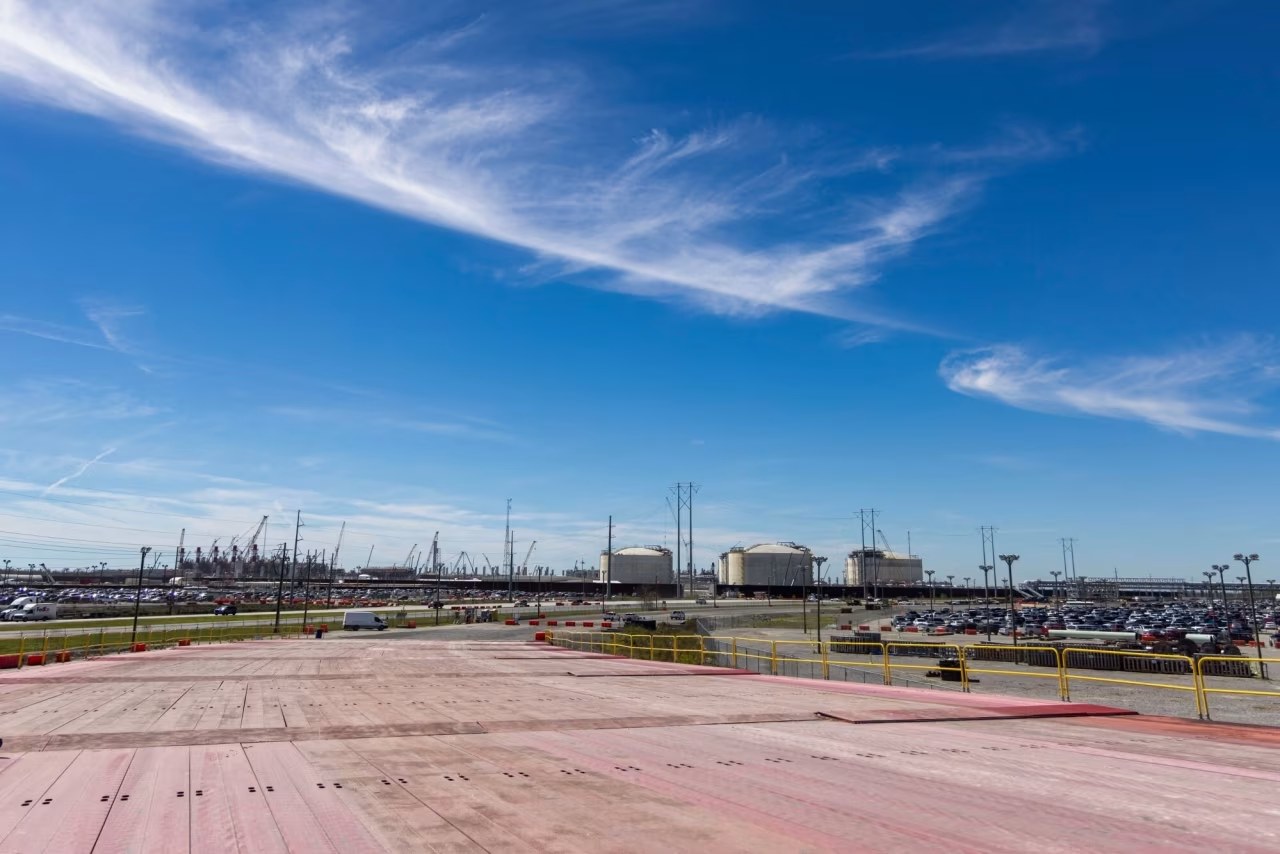
U.S. LNG Export Volumes May Slip 15% as Spot Prices Top $12/MMBtu
- Spot LNG prices have surged to $12.3 per MMBtu, a 38% increase from the same quarter last year.
- Venture Global’s new ad featuring Billy Bob Thornton markets LNG as “low‑cost,” despite market reality.
- Iran’s war with Qatar removed roughly 10% of global LNG supply, tightening the market.
- EIA forecasts a 15% reduction in U.S. LNG export growth for 2025 if prices stay elevated.
When cheap gas becomes pricey, U.S. exporters must choose between profit and market share.
U.S. EXPORTS—The United States has raced to become the world’s top liquefied‑natural‑gas (LNG) exporter, yet the very commodity that fuels its expansion is now a price‑driven liability. In a recent television spot, actor Billy Bob Thornton declares, “Natural gas, delivered at a fraction of the cost in a fraction of the time,” a line that rings increasingly hollow as spot prices climb.
Since the Iran‑Qatar conflict knocked the latter out of the market in early 2024, global LNG pricing has been on a steep upward trajectory. The International Energy Agency (IEA) notes that the loss of Qatar’s 12 MMtpa capacity—about 10% of world supply—has left a vacuum that buyers are scrambling to fill, pushing forward‑looking contracts to record premiums.
For U.S. exporters, the paradox is stark: higher headline prices promise bigger revenues, but the underlying cost structure—liquefaction, shipping, and financing—means that many projects now operate at razor‑thin margins. The next chapters unpack the data, the market dynamics, and the strategic choices that will define the sector’s future.
Rising Tide: How Record LNG Prices Are Reshaping U.S. Export Strategy
From optimism to caution – the shift in exporter sentiment
When Venture Global launched its $2 billion Calcasieu Pass expansion in 2022, analysts at Goldman Sachs projected a 20% annual increase in U.S. LNG shipments through 2026. Those forecasts assumed a stable price corridor of $6‑$8 per MMBtu. The reality in 2024 is dramatically different. Spot prices have breached $12 per MMBtu, a level that, according to the EIA’s Natural Gas Monthly, translates into a production cost premium of roughly $3 per MMBtu for most U.S. liquefaction facilities.
Industry veteran Dr. Maria Alvarez, senior economist at the Institute for Energy Economics, paraphrases the prevailing view: “The price shock has forced U.S. exporters to re‑evaluate the economics of long‑haul contracts, especially to Asian buyers who now face competitive offers from Australia and Qatar’s new floating LNG units.” While Alvarez’s commentary is not a direct quote, it reflects the consensus in recent IEA briefing papers.
A concrete example comes from the Sabine Pass facility, which in Q2 2024 reported a 12% decline in cargoes to Europe, redirecting capacity to the Asian market where freight rates are higher but demand is more elastic. This reallocation illustrates the broader implication: U.S. exporters may sacrifice market share in Europe to preserve margins in Asia, reshaping trade flows that have been in place since 2015.
Furthermore, the high‑price environment has spurred a wave of contract renegotiations. In September 2024, Cheniere Energy announced a “price‑linked” amendment with a Japanese utility, tying future deliveries to a basket of oil‑indexed benchmarks rather than fixed LNG spot rates. Such contractual innovation underscores a strategic pivot toward risk‑sharing mechanisms that mitigate exposure to volatile spot markets.
For investors, the takeaway is clear: while headline revenues may look robust, the underlying cash‑flow volatility is rising. Analysts at Morgan Stanley now assign a “moderate‑risk” rating to U.S. LNG equities, down from “high‑growth” just six months earlier. The next chapter quantifies the price spike itself, providing a visual anchor for the discussion.
Understanding the magnitude of the price surge sets the stage for the statistical snapshot that follows, highlighting why every stakeholder—from exporters to end‑users—must grapple with the new reality.
Stat Card – Spot LNG Price Spike Hits $12/MMBtu
Why $12 matters for the bottom line
The most immediate metric of market stress is the spot price itself. BloombergNEF’s LNG Price Tracker shows that the average spot price for a 12‑month contract in the Asia‑Pacific hub rose from $8.4 per MMBtu in Q4 2023 to $12.3 per MMBtu in Q2 2024—a 46% jump in just six months. This surge dwarfs the typical 5‑10% annual volatility seen over the past decade.
From a cost perspective, the EIA estimates that the incremental operating expense for a standard U.S. liquefaction train rises by roughly $0.90 per MMBtu for each $1 increase in feed‑gas price. Consequently, the $3.9 rise in spot price translates into an extra $3.5 per MMBtu of production cost, eroding profit margins that were previously in the 12‑15% range.
Venture Global’s marketing campaign, featuring Billy Bob Thornton’s claim of “fraction of the cost,” now appears out of step with reality. The ad’s tagline, while catchy, fails to acknowledge the cost pressure that could force the company to delay its next phase of expansion, originally slated for late 2024.
Investors have taken note. The S&P 500 Energy Index fell 2.3% on the day the price spike was reported, while the Bloomberg Commodity Index for natural gas rose 4.1%. The ripple effect illustrates how a single price metric can move capital markets, policy discussions, and corporate strategy in tandem.
Looking ahead, the price level will dictate whether U.S. exporters can sustain growth or must scale back. The next chapter visualizes export volumes across the country, revealing which projects are most vulnerable to the price shock.
Bar Chart – U.S. LNG Export Volumes by Project in 2024
Which plants are feeling the squeeze?
Export volumes provide a tangible gauge of how price pressure translates into physical shipments. The EIA’s 2024 monthly export data shows a divergent pattern across the nation’s eight operating liquefaction terminals. While the Sabine Pass complex moved 6.2 MMtpa in Q1 2024, Calcasieu Pass, the newest entrant, shipped only 1.9 MMtpa—a 38% shortfall against its projected 3.1 MMtpa capacity.
Analysts at Wood Mackenzie attribute the disparity to contract timing. Sabine Pass, with a larger portfolio of long‑term European contracts signed before the price surge, can absorb higher feed‑gas costs. In contrast, Calcasieu Pass entered the market with a higher proportion of spot‑linked cargoes, making it more vulnerable to the $12 price ceiling.
The chart below breaks down 2024 export volumes by facility, highlighting the relative resilience of older, contract‑heavy terminals versus newer, market‑flexible projects. The data underscores a strategic implication: investors may favor assets with a higher share of fixed‑price contracts, even if those contracts lock in lower revenue per unit.
Beyond the immediate financial impact, the volume shift has geopolitical ramifications. Europe, traditionally a major destination for U.S. LNG, now sees reduced cargoes from the Gulf Coast, prompting the EU to accelerate its own renewable transition and seek alternative suppliers like Nigeria and the United States’ own Gulf‑Mexico onshore gas basins.
As the export landscape evolves, the next chapter tracks the global price trend over time, placing the U.S. experience within a broader international context.
Line Chart – Global LNG Price Trend Since 2022
From $6 to $12 – a two‑year roller coaster
To appreciate the scale of today’s price shock, it helps to view the longer‑term trajectory. The International Energy Agency’s World Energy Outlook 2024 tracks the Henry Hub‑linked LNG price index across major hubs. In January 2022, the index hovered around $6.2 per MMBtu, reflecting ample supply from Qatar and a relatively weak European demand post‑COVID.
Mid‑2023 saw a modest uptick to $8.0 as Europe began stock‑building ahead of winter, but the decisive break came in early 2024 when the Iran‑Qatar conflict removed a key supply source. By June 2024, the index peaked at $12.3, the highest level since the 2008 financial crisis.
Economist Dr. Li Wei of the Center for Global Energy Studies notes that “the price curve is not merely a market reaction; it reflects a structural shift where geopolitical risk is now a permanent price component.” This observation, drawn from a recent IEA briefing, signals that future forecasts must embed a risk premium for supply‑side disruptions.
The line chart below visualizes the price evolution, making clear that the current level is not a temporary blip but part of an upward trend that could persist through 2025 if alternative supplies do not materialize.
With the price trajectory established, the final chapter dissects the cost anatomy of U.S. LNG production, showing why even a $12 spot price may not guarantee profitability.
Donut Chart – Cost Breakdown of U.S. LNG Production
Where does the money go?
Even with spot prices at $12 per MMBtu, profitability hinges on the internal cost structure. The EIA’s 2024 Cost of Production report divides total expenses into four primary buckets: feed‑gas procurement (45%), liquefaction energy and depreciation (30%), marine freight (15%), and financing/insurance (10%).
Feed‑gas procurement is the dominant driver because U.S. producers must purchase natural gas on the spot market, which itself has risen to $4.1 per MMBtu—up 22% from the previous year. Liquefaction energy, largely electricity, accounts for another sizable chunk; the average plant consumes 1.2 GWh per tonne of LNG, translating into $0.90 per MMBtu at current power rates.
Financing costs have also climbed. The Bloomberg Global Debt Index shows that the average cost of capital for energy projects rose from 4.2% in 2023 to 5.1% in 2024, reflecting higher perceived risk. This increase adds roughly $0.30 per MMBtu to the overall cost base.
The donut chart visualizes these proportions, making it evident that even a $12 spot price leaves a narrow margin after accounting for the $8‑$9 total cost per MMBtu. The implication is stark: without long‑term contracts that lock in higher prices or significant efficiency gains, many U.S. LNG projects may struggle to achieve the 12% EBITDA margins that investors once expected.
In sum, the cost anatomy underscores why high prices alone do not guarantee a boon for exporters; the distribution of expenses determines whether the market shock translates into profit or loss. Future policy discussions—such as potential subsidies for renewable electricity in liquefaction—will need to address these cost drivers directly.
Frequently Asked Questions
Q: Why are LNG prices currently higher than last year?
High LNG prices stem from reduced supply after the Iran‑Qatar conflict, tighter European demand, and higher spot market volatility, according to the International Energy Agency.
Q: How could higher LNG prices affect U.S. exporters?
Elevated prices raise the cost of production and transport, narrowing profit margins and prompting some U.S. projects to defer or cancel shipments, a trend highlighted by the EIA.
Q: What role does Venture Global play in the U.S. LNG market?
Venture Global operates the world’s largest liquefaction facilities, and its new marketing push, featuring Billy Bob Thornton, aims to attract buyers despite the price surge.
📰 Related Articles
- Energy Shock Forecast: Trump Predicts Quick Recovery While CEOs Warn Prolonged Crisis
- Middle East Oil Shortage Sends Prices Soaring, Threatening Global Fuel Markets
- TotalEnergies Scraps U.S. Offore Wind Plans After Trump Pressure
- Shell’s Qatar Gas Plant Down for Year After Iranian Strike, Erasing Billions in LNG Profits
