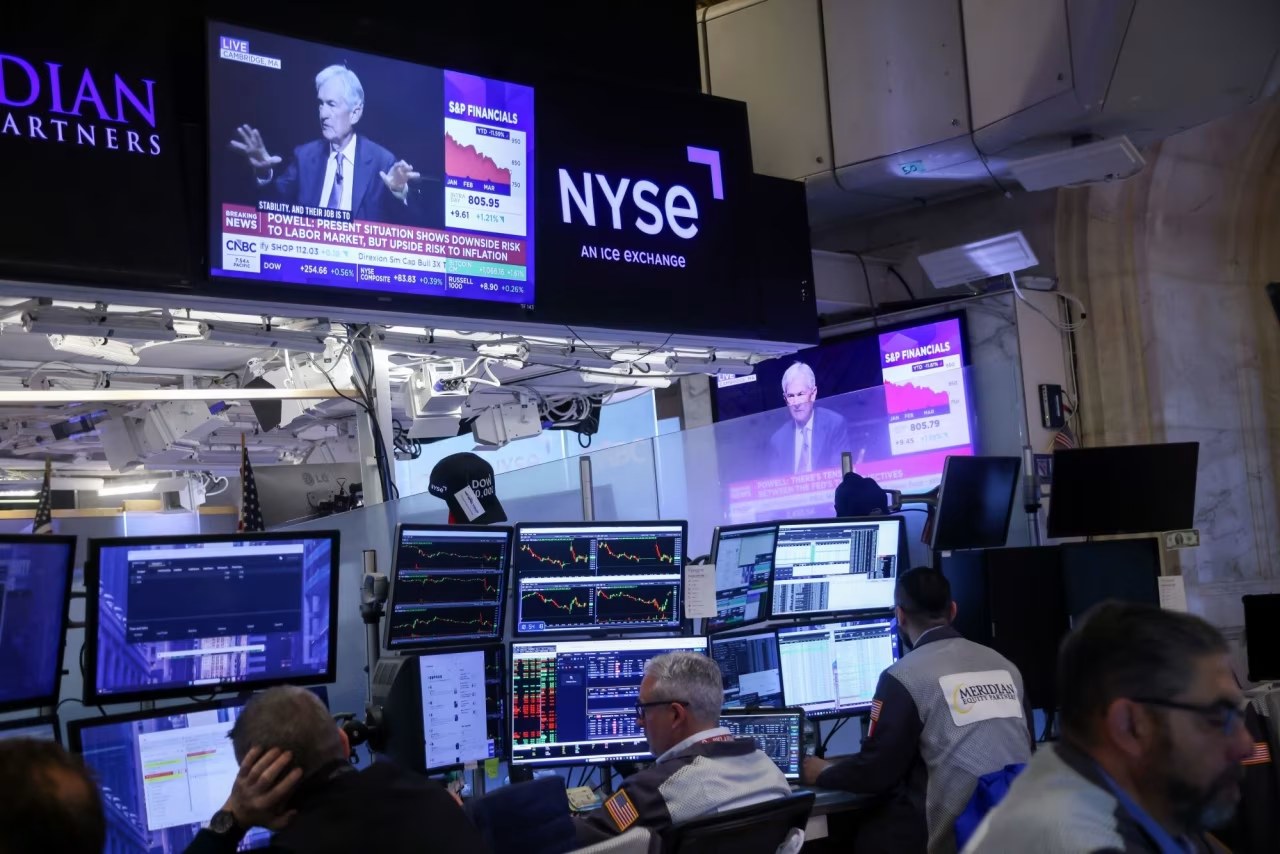
S&P 500 Drops for Third Day as Oil Surges Past $100 on Iran Conflict Risk
- The S&P 500 extended its losing streak, pressured by renewed Middle-East tensions.
- U.S. oil futures closed above $100 a barrel for the first time since July 2022.
- Traders priced in a prolonged conflict after hopes for a quick diplomatic end faded.
- Equity outflows accelerated late in the session, dragging the benchmark index lower.
Energy futures outperformed while risk assets retreated across the board.
S&P 500—NEW YORK—U.S. stocks resumed their slide and crude oil surged to a 42-month peak Monday after investors concluded that the Middle-East stand-off will last longer than previously hoped, forcing portfolio managers to unwind bullish equity bets and raise cash.
The broad S&P 500 index fell for a third consecutive session, dropping 0.9 % to 4,875, while West Texas Intermediate crude futures settled at $101.45 a barrel, up 4.2 % on the day and the highest close since July 2022, data from CME Group show.
Traders cited satellite imagery over the weekend that suggested Iranian ground-force mobilisation, prompting algorithmic funds to trim exposure to cyclical sectors and pile into energy contracts.
From Diplomacy to Dread: Why Traders Soured on a Rapid Resolution
Until late last week, futures markets had been pricing in a cease-fire within weeks, according to CME’s CVOL geopolitical risk gauge. That optimism evaporated after European officials told reporters that back-channel talks had stalled. By Sunday night, S&P 500 e-minis were already 0.7 % lower in thin Asian trade, a move that accelerated once cash equities opened in New York.
Algorithmic funds led the retreat
Commodity Trading Advisors (CTAs) unwound roughly $4.3 billion in equity index length during the session, the largest one-day redemption since October, according to Nomura’s cross-asset flow tracker. Concurrently, net speculative length in WTI crude jumped by 31 %, exchange data compiled by Bloomberg show.
“The market had been lulled into a false sense of security,” said Arthur Hogan, chief market strategist at B. Riley Wealth. “When headlines shifted from ‘negotiations’ to ‘troop build-up’, the only playbook left was to sell risk and buy oil.”
The VIX volatility index rose above 22 for the first time since January, while the energy sector was the lone gainer within the S&P 500, adding 3.1 %. Exxon Mobil shares climbed 3.4 % and Occidental Petroleum advanced 5.7 %, trimming year-to-date losses for both stocks.
Looking ahead, investors will scrutinise satellite footage and diplomatic statements for clues on whether tensions spill into outright conflict or recede, setting the next directional cue for both equities and crude.
Oil Above $100: What History Says About Triple-Digit Crude and GDP
Monday’s $101.45 settle marks the first time U.S. crude has breached triple digits since 13 July 2022, when futures peaked at $102.60 amid sanctions on Russian exports. Oxford Economics calculates that every sustained $10 increase in crude shaves roughly 0.3 percentage points off U.S. GDP growth within twelve months, primarily through higher transportation and petrochemical costs.
Consumer spending faces headwinds
With average gasoline prices now at $3.71 a gallon nationwide, up 18 % year-to-date, discretionary income is under pressure. The Bureau of Economic Analysis reports that fuel outlays account for 3.4 % of total personal consumption—below 2008 highs but still enough to dent retail sales, according to economist Kathy Bostjancic at Nationwide Mutual.
Energy-intensive industries are already sounding alarms. Delta Air Lines said in a regulatory filing that each 5 % rise in jet fuel adds roughly $200 million in annual expense, while parcel giant FedEx cited a potential 30-basis-point margin hit this quarter if prices stay elevated.
Yet higher crude also boosts capital spending in the U.S. shale patch. Rystad Energy expects Permian Basin rig counts to rise by 10 % this summer if WTI holds above $95, adding roughly 90,000 barrels per day of new supply by autumn. That domestic response could cap further rallies, easing pressure on the Federal Reserve as it battles inflation.
Whether oil stays above $100 will hinge on diplomacy as much as drilling rigs, leaving markets in a fragile equilibrium.
Sector Scorecard: Winners and Losers Inside the S&P 500
Energy was the only green sector Monday, surging 3.1 %, while consumer discretionary and technology lagged, falling 1.6 % and 1.4 % respectively. The divergence underscores how oil’s spike feeds directly into input-cost fears for transport-dependent businesses, while boosting earnings prospects for drillers and refiners.
Tech multiples come under scrutiny
Higher crude often coincides with higher real yields, pressuring long-duration equities. The 10-year Treasury yield added 6 basis points to 4.28 %, pushing the NASDAQ 100’s equity risk premium below 300 basis points for the first time since December, according to DataTrek Research.
Microsoft slid 1.8 % and Amazon dropped 2.2 %, together shaving roughly 28 points off the S&P 500. Conversely, oil majors Chevron and Exxon contributed a combined 9 index points, limiting the benchmark’s overall decline.
Smaller caps fared worse: the Russell 2000 sank 1.9 %, hit by both higher borrowing costs and energy expenses. Airlines led decliners, with United Airlines off 5.4 % and American Airlines down 5.1 %, while cruise operator Royal Caribbean tumbled 4.7 %.
If crude remains elevated, analysts see further rotation into cash-rich energy names and away from growth equities, a trend that could persist until geopolitical risk premiums ease.
What Comes Next: Can Diplomacy Still Cap the Risk Premium?
Market-implied odds of further escalation rose sharply. The CBOE’s crude-oil volatility index ended at 42, its highest since the Ukraine invasion, while the euro-area’s Economic Sentiment Indicator posted its steepest one-week drop since March 2020, according to Sentix.
Diplomatic channels remain open
U.S. Secretary of State Marco Rubio told reporters that Washington is ‘working around the clock’ to secure a cease-fire, and United Nations envoys are scheduled to meet in Geneva later this week. Yet traders remain skeptical: prediction market Kalshi now puts a 62 % probability on a ‘regional ground conflict’ before June, up from 38 % a week ago.
Goldman Sachs commodity strategists wrote Monday that a diplomatic breakthrough could send Brent crude back toward the mid-$80s within days, while a full-scale confrontation risks pushing prices to $120. Either scenario would ripple through the Fed’s inflation calculus, potentially delaying anticipated rate cuts.
For equity investors, the key variable is duration, not merely magnitude. A short, contained clash might shave 2–3 % off S&P 500 earnings, but a prolonged disruption could trigger a 10 % correction, according to JPMorgan’s quant team.
Until clarity emerges, volatility is likely to stay bid, keeping both oil and the VIX elevated and forcing portfolio managers to hold elevated cash buffers.
How Should Investors Position for a Prolonged Conflict?
Historical analysis from LPL Financial shows that during the past five major Middle-East conflicts, energy stocks outperformed the S&P 500 by an average of 14 % over the subsequent six months, while consumer staples beat the index by 4 %. Defensive positioning thus tends to pay until headlines fade.
Tactical trades for retail accounts
One low-cost approach is equal-weight energy ETFs, which strip out single-company risk while capturing sector beta. The Energy Select Sector SPDR Fund (XLE) rose 3 % Monday and carries a 12-month distribution yield near 3.7 %, offering income alongside capital appreciation.
On the fixed-income side, short-duration TIPS help hedge oil-driven inflation shocks without excessive rate sensitivity. The iShares 0-5 Year TIPS ETF added 0.2 % Monday even as nominal Treasuries sold off, illustrating real-yield insulation.
Currency investors are piling into the U.S. dollar, which tends to strengthen when geopolitical angst rises. The Bloomberg Dollar Spot Index climbed 0.4 %, while the Japanese yen—often a safe haven—fell 0.3 % as rising energy prices widened Japan’s trade deficit.
Ultimately, the best hedge may be diversification across regions and sectors, combined with a cash sleeve to exploit any relief-driven snapback should diplomacy succeed.
Frequently Asked Questions
Q: Why did the S&P 500 fall after Iran hopes faded?
The S&P 500 slid because traders reassessed geopolitical risk, rotating out of equities and into oil futures, pushing crude above $100 for the first time since July 2022.
Q: How high did oil prices climb?
U.S. benchmark oil futures settled above $100 a barrel, their first triple-digit close since July 2022, according to exchange data.
Q: What does Fed Chair Powell have to do with the sell-off?
While Powell didn’t speak on Iran, traders watching his prior hawkish guidance used the conflict escalation as a fresh catalyst to trim risk exposure.
