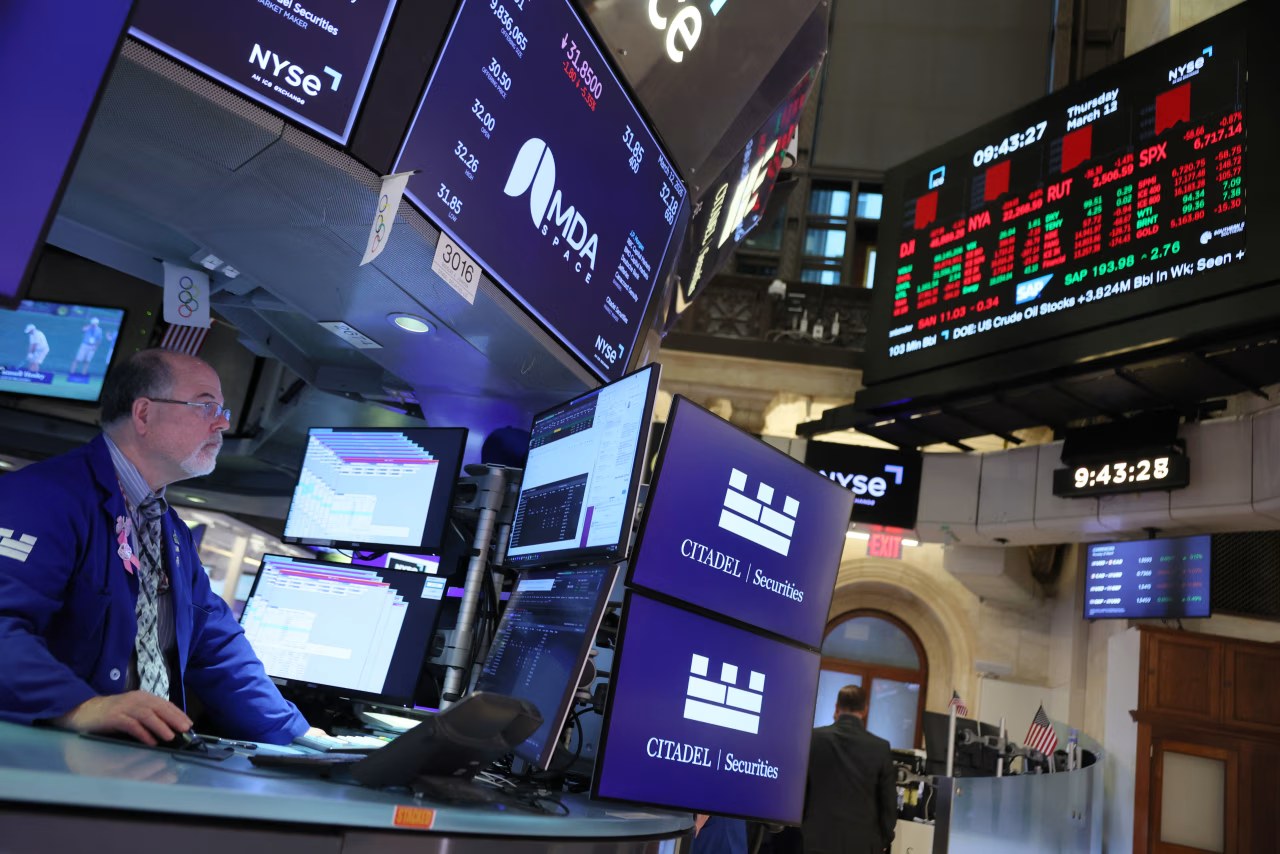
S&P 500 Slips Less Than 3% as Historic Oil Route Closure Fails to Spark Investor Panic
- The International Energy Agency labels the Strait of Hormuz shutdown the largest supply disruption on record.
- Brent crude is hovering near $100 a barrel—about 44% below its 2011 inflation-adjusted peak of $180.
- Countries that rely on Middle East crude are intervening to cap domestic fuel prices, cushioning economic blow.
- Despite burning tankers and drone strikes, U.S. equities have barely budged, underscoring market faith in policy buffers.
Investors are betting that government stock releases and price controls can tame what earlier eras could not.
S&P 500—When mines closed the world’s busiest oil-shipping lane and drone fire left tankers smoldering, traders braced for a replay of the 1970s: rationing, recession, and double-digit inflation. Instead, the S&P 500 has surrendered less than 3% since the conflict began, while Brent crude trades at only two-thirds of its 2011 inflation-adjusted high. The muted reaction signals a market that views today’s shock as fundamentally different.
History argues otherwise. The International Energy Agency calls the near-total closure of the Strait of Hormuz “the largest supply disruption in the history of the global oil market.” Roughly one-fifth of seaborne petroleum normally transits the 21-mile-wide channel, translating into 18–20 million barrels per day now sidelined—triple the shortfall during the 1973 Arab embargo.
Yet investors are pricing in a rapid reversal. Government pledges to release strategic reserves, impose price caps, and reroute cargoes around the Cape of Good Hope have kept Brent anchored near $100. Equity options markets show the lowest volatility skew since Russia’s 2022 invasion of Ukraine, a sign traders are not hedging for a protracted spike.
Why the Strait of Hormuz Still Matters in 2024
The Strait of Hormuz is the chokepoint that makes or breaks global growth. On an average day, 21 million barrels of crude, condensate, and refined products pass through its narrow shipping lanes—about 21% of worldwide petroleum consumption and roughly one-third of seaborne oil, according to the U.S. Energy Information Administration. When the channel shuts, the ripple is immediate: refiners scramble for replacement barrels, freight rates triple, and every barrel must travel an extra 2,700 miles around Africa, adding three weeks to journey times.
The current disruption began after Israeli and U.S. forces struck Iranian ports and missile sites. Within 24 hours, insurers slapped war-risk premiums of $400,000 per voyage on tankers, according to Baltic Exchange data. At least four vessels have been hit by loitering munitions; two remain ablaze. The Iranian navy’s mine-laying operations have rendered the inbound traffic separation scheme almost unusable, forcing captains to hug Omani territorial waters.
Market memory: 1980s tanker wars
During the Iran-Iraq War, both belligerents targeted merchant shipping, cutting traffic by 60%. Brent leapt from $34 a barrel in 1980 to nearly $80 (inflation-adjusted) by 1984. Yet the global economy muddled through, aided by new North Sea and Alaskan output. “The difference today is spare capacity is razor thin,” says Amrita Sen, director of research at Energy Aspects. “OECD strategic stocks can cover 90 days of Hormuz losses, but coordination lags could still push prices above $150.” So far, that fear is not reflected in futures curves, where December 2025 Brent trades at $91, only $9 below the front month.
Investors appear to be betting that China, India, and the EU will jointly release 2 million barrels per day from strategic reserves, mirroring the 2022 action after Russia’s invasion. The Biden administration has already authorized an additional 1 million barrels per day from the U.S. Strategic Petroleum Reserve through year-end, leaving inventory at its lowest level since 1983. Equity strategists argue that any economic damage will be offset by fiscal stimulus. “Washington will mail rebate checks before it allows $5 gasoline,” says Torsten Sløk, chief economist at Apollo Global Management. That political calculus is why the S&P 500 has barely flinched.
Comparing $100 Oil Today With Historic Price Shocks
Context matters more than the nominal quote. Brent at $100 in 2024 is roughly $44 below its 2011 inflation-adjusted peak of $180 and almost 50% under the 1979 post-revolution record of $179. Adjusted for consumer prices, crude has spent 38 months above the century mark since 2008, acclimating both investors and households to triple-digit energy costs. The result: equities no longer sell off indiscriminately when oil spikes.
Data from JPMorgan Asset Management show the S&P 500 fell an average of 9.2% in the 12 months following oil shocks between 1973 and 1985, when adjusted crude averaged $115. By contrast, the index gained 4.8% in the year after the 2022 Ukraine invasion, even with Brent averaging $107. “Energy intensity of GDP has fallen 60% since the 1970s,” notes strategist Marko Kolanovic. “The same barrel today supports far more output, so the hit to earnings is smaller.”
Consumer resilience: plastic, not gas
Transportation now accounts for 48% of U.S. petroleum demand, down from 63% in 1979. Petrochemicals—plastics, fertilizers, solvents—make up the fastest-growing share. Because those end products have few substitutes, producers can pass through costs, cushioning profit margins. S&P 500 energy-sector earnings are projected to rise 22% this quarter despite flat production volumes, according to FactSet.
Household balance sheets also look sturdier. The average U.S. driver spends 2.9% of disposable income on gasoline, up from 1.8% in 2020 but still below the 4.4% that preceded the 2008 financial crisis. Meanwhile, the Inflation Reduction Act channels $370 billion toward EV adoption, blunting future demand. All told, investors view $100 oil as an earnings headwind for airlines and chemical makers, not a recessionary death knell.
Are Government Price Caps Masking Market Reality?
Governments are moving faster than traders. Germany has activated the second stage of its emergency fuel-plan, allowing Berlin to cap retail prices using federal funds. Japan’s trade ministry directed refiners to release 9 million barrels from private inventories. India, the world’s third-largest importer, cut the windfall tax on domestic crude producers to zero, encouraging them to import more seaborne barrels and re-export refined products at controlled margins.
Collectively, these interventions have kept Brent futures in steep backwardation—January 2025 delivery trades $7 below the front month, an indication that officials expect the disruption to ease. “Policy makers are treating this like a temporary blackout, not a supply cliff,” says Caroline Bain, chief commodities economist at Capital Economics. The risk is that artificial caps prolong demand, delaying the price signal that would otherwise destroy 1–1.5 million barrels per day of consumption.
Strategic reserves: how deep is the well?
OECD government stocks stand at 4.1 billion barrels, down 280 million from a decade ago but still equivalent to 90 days of net imports. The U.S. SPR alone holds 347 million barrels, though 40% sits in less-accessible caverns. China’s opaque reserves are estimated at 550 million barrels. Analysts at ClearView Energy Partners calculate that a coordinated release of 2 million barrels per day could cover the Hormuz shortfall for nine months—long enough, they argue, for U.S. shale and Brazilian pre-salt fields to add 1 million barrels per day of new output.
Equity investors are pricing in just that scenario. Energy stocks within the S&P 500 have risen 6% since the conflict began, while the broader index is down only 2.8%. “The market is betting on policy put,” says Neil Beveridge, senior oil analyst at Bernstein. “If reserves are drained and prices still hover above $110, expect a much sharper equity repricing.” Until then, government caps—not fundamentals—are anchoring both crude quotes and share prices.
Which Sectors Win—and Lose—While Oil Stays Near $100?
History offers a playbook. When Brent trades between $95 and $110, S&P 500 energy producers post quarterly earnings beats 72% of the time, according to Bank of America data. Refiners with inland access—such as Marathon Petroleum and Valero—enjoy wider crack spreads as coastal supplies tighten. Oil-services names like Halliburton and Schlumberger see day-rate increases within six weeks of a spike.
On the losing side, airlines face a 3–5% headwind to operating margins for every $10 rise in jet fuel. Delta Air Lines disclosed last week that its 2025 fuel bill would rise by $1.2 billion if Brent stays above $100, prompting the carrier to hedge 40% of next year’s consumption. Chemical giants Dow and LyondellBasell have already announced September price increases of 7–9 cents per pound on polyethylene, risking demand destruction in packaging end-markets.
Green plays: solar and batteries
Higher fossil-fuel prices tilt the competitiveness equation toward renewables. The levelized cost of utility-scale solar is now $45 per megawatt-hour, cheaper than $65–$70 for natural-gas generation when crude-linked LNG prices top $12 per mmBtu. Shares of Enphase and SolarEdge have rallied 18% and 14% respectively since tankers were first hit, while the broader S&P 500 is flat. “$100 oil accelerates the payback on residential batteries from 10 to 7 years,” says Hugh Bromley at BloombergNEF. That dynamic explains why the clean-energy sub-index is up 9% even as consumer discretionary stocks have slid 4%.
Net-net, the sectoral scoreboard mirrors past episodes: energy, renewables and defense outperform; airlines, chemicals, and auto makers lag. Unless Brent punches decisively above $120, strategists expect dispersion—not a broad bear market—to define the remainder of 2024.
Could Calm Turn to Contagion If Oil Breaks $120?
The tipping point is near. A meta-analysis by the Federal Reserve Bank of Dallas finds that when oil spikes above 40% year-over-year, U.S. GDP growth falls by an average of 1.7 percentage points within 18 months. Brent at $120 would mark a 55% YoY increase, putting the economy on course for a technical recession. Equity markets typically peak within two months of such thresholds, led down by rate-sensitive sectors.
Options markets are starting to price the tail. The Cboe Crude Oil ETF Volatility Index has jumped to 38, its highest since the Ukraine invasion, while the S&P 500’s 30-day skew has steepened sharply for energy and consumer-discretionary names. “Investors are hedging sector ETFs, not the index,” notes Anand Omprakash of Deutsche Bank. That selective protection implies a view that $120 oil would fracture today’s narrow leadership, pushing the S&P 500 into a 10–15% correction.
Central-bank calculus
Fed Chair Jerome Powell signaled last week that another energy-driven inflation spike would be treated as “transitory, provided expectations remain anchored.” Yet futures imply only a 38% chance of an additional rate cut this year, down from 68% before the Hormuz closure. Higher oil acts like a tax, sapping consumer spending, but also reignites inflation. A $20 rise shaves 0.4 percentage points off U.S. consumption growth while adding 0.7 points to CPI, according to Oxford Economics. That stagflationary mix would leave the Fed boxed in, amplifying equity downside.
For now, the base case is containment. Analysts peg the probability of Brent exceeding $120 at 30%, contingent on further mining or a misdirected strike on Saudi export facilities. If prices stay below that threshold, forward earnings yield of 5.3% on the S&P 500 remains attractive versus 4.2% on 10-year Treasuries. But history warns complacency fades fast: the 1987 Black Monday rout was preceded by a 40% oil rally and a surprise 125-basis-point rate hike. Today’s calm, while comforting, may prove fragile if diplomacy stalls and reserves run thin.
Frequently Asked Questions
Q: Why isn’t the stock market plunging despite the Middle East oil disruption?
The S&P 500 has fallen less than 3% since fighting closed the Strait of Hormuz. Investors appear to price in swift government price caps, ample global inventories, and prior experience that geopolitical oil spikes often reverse quickly.
Q: How does today’s $100 Brent price compare with past oil crises?
After adjusting for inflation, Brent peaked near $179 in 1979, $155 in 1980, $180 in 2011, and $130 in 2022. Today’s $100 is roughly 30–45% below those shocks, easing recession fears.
Q: What makes this supply disruption the ‘largest in history’?
The IEA says mining and drone strikes have choked the Strait of Hormuz, through which about 21% of seaborne oil transits. Daily flows are down an estimated 18–20 million barrels—triple the shortfall during the 1973 embargo.
