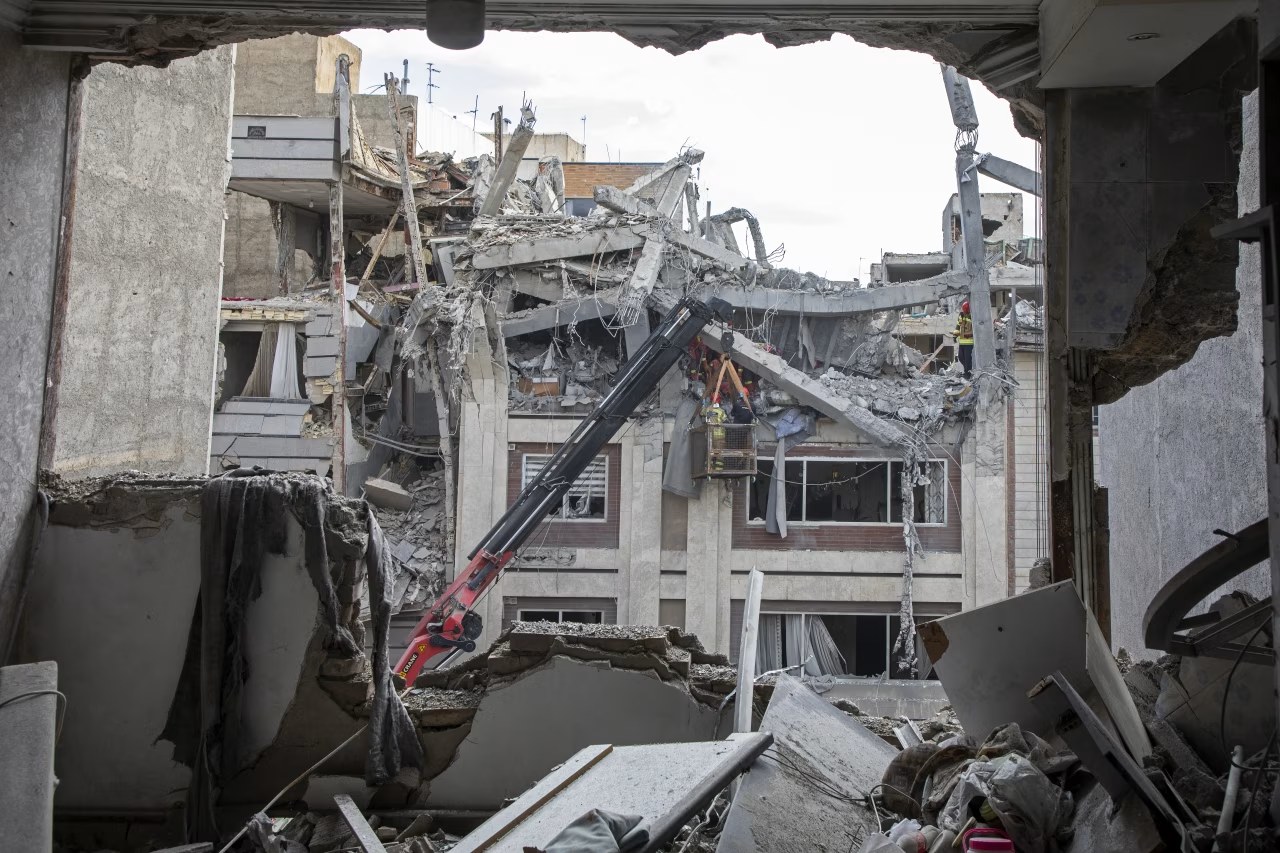
Dow Drops 540 Points as Traders Price in Iran Escalation Risk
- The Dow Jones Industrial Average fell 540 points in the latest session as investors reassessed the odds of a prolonged Middle-East war.
- Crude futures lagged behind the scale of a potential supply shock, leaving room for a sharp energy spike if the conflict widens.
- Bond yields declined in a classic flight-to-safety, with the 10-year U.S. Treasury yield slipping below 4.2%.
- Wall Street’s calm of recent weeks evaporated after fresh airstrikes on Iranian targets signaled the conflict is far from over.
Energy markets are still playing catch-up, and that worries portfolio managers
IRAN CONFLICT—NEW YORK—For weeks Wall Street clung to the hope that tit-for-tat strikes between Israel and Iran would quickly fade. That optimism cracked Tuesday when a broad-based equity selloff sent the Dow Jones Industrial Average down 540 points and the VIX volatility gauge to its highest close since the regional banking scare of early 2023.
Investors are now repricing assets for a scenario in which the Middle East’s low-intensity conflict escalates into a sustained war, disrupting oil flows through the Strait of Hormuz and pushing global benchmark Brent above the psychologically important $100-a-barrel mark.
“Markets are moving from denial to recognition,” said Helima Croft, head of global commodity strategy at RBC Capital Markets. “If the strait is threatened, we could be looking at the most severe oil shock since the 1970s.”
How Iran Anxiety Moved From Bonds to Broader Markets
Until this week the bond market carried most of the geopolitical worry. Ten-year Treasury yields had fallen roughly 40 basis points since mid-September, a textbook safety bid that mirrored patterns seen during the 1990-91 Gulf War preamble. Stocks, however, remained within a few percentage points of record highs, cushioned by hopes for a cease-fire and solid third-quarter earnings.
That calm fractured after overnight satellite images showed fresh damage to Iranian military sites. By Wednesday morning the S&P 500 had erased its November gains, and energy traders finally began to price in a meaningful risk premium. West Texas Intermediate crude for December delivery jumped 4.7% to $77.40 a barrel—still below the $85-$90 range analysts say would reflect a 10% disruption probability.
History offers a sober template
During the 1979 Iranian revolution oil prices doubled within twelve months, helping push U.S. inflation above 13%. A similar percentage move today would lift Brent toward $160, according to calculations by ClearView Energy Partners. “The market is under-adjusted relative to the macro tail-risk,” said Kevin Book, the firm’s managing director.
Gold has also re-entered its traditional haven role, rising 2.5% to $2,040 an ounce, while copper and other growth-sensitive commodities slipped, underscoring how quickly sentiment has darkened.
Forward-looking options markets tell the same story. One-month implied volatility on the Invesco QQQ ETF, which tracks the Nasdaq-100, surged to 23%, its highest since the U.S. debt-ceiling standoff last spring. Traders are paying up for crash protection, pushing the cost of put options to levels last seen days before Russia invaded Ukraine.
“Volatility is repricing faster than spot prices,” noted Amy Wu Silverman, equity derivatives strategist at RBC. “Equities are effectively forcing policymakers to pay attention.”
The speed of the shift has left some portfolio managers scrambling. Hedge funds that entered November net long equities cut exposure at the fastest pace since March, according to Goldman Sachs Prime Services data. Retail investors, who had poured roughly $6 billion into U.S. equity ETFs in the first week of November, pulled $1.3 billion on Tuesday alone.
Still, relative to the scale of a potential supply shock, crude futures remain subdued. Analysts attribute the lag to ample U.S. inventories, weaker Chinese demand and the absence—so far—of direct attacks on Hormuz traffic. If that changes, energy markets could play catch-up in hours, not days.
Which Sectors Bleed Most When Oil Spikes?
Airlines led Wednesday’s decliners, with the U.S. Global Jets ETF falling 3.8%. Every $10 increase in Brent cuts global airline operating profit by roughly $5 billion, estimates Raymond James. Delta Air Lines shares slid 4.6%, while United and American each dropped more than 3%.
Consumer-discretionary names followed. Nike, Starbucks and Marriott International all fell at least 2.5%. Higher fuel prices act like a tax on consumption, especially for low-income households that drive more and save less. Morgan Stanley reckons a sustained $20 oil spike would shave 0.4 percentage points off U.S. GDP growth within a year.
Winners and losers diverge quickly
Defense contractors outperformed, with Northrop Grumman and RTX each rising more than 2%. The iShares U.S. Aerospace & Defense ETF has gained 8% since the Oct. 7 Hamas attack, outperforming the S&P 500 by roughly 1,200 basis points. Energy producers also rallied: Occidental Petroleum jumped 5.1% and Hess added 4.4%, extending month-to-date gains to 12% and 9% respectively.
Chemicals makers, which use oil as both feedstock and energy, face a squeeze. Dow Inc. fell 2.7% and LyondellBasell slid 3.2%. “Margins get crushed on both sides—higher input costs and weaker demand,” said Arun Viswanathan, chemicals analyst at RBC Capital.
Logistics giants are already building in surcharges. FedEx and UPS shares dipped only modestly, but both carriers told customers this week they will re-implement fuel surcharges if diesel rises another 10%. The ripple effect would hit e-commerce margins just as holiday shipping volumes peak.
Automakers, already grappling with UAW wage hikes, confront another headwind. Ford and GM each dropped more than 2%. UBS calculates that a $15 oil spike would reduce North American auto earnings before interest and taxes by roughly 8%. Electric-vehicle makers such as Tesla fared slightly better, but battery-metal lithium prices have also climbed on supply-chain nerves, limiting their advantage.
Retailers with thin margins and long supply chains—think Target and Walmart—are especially exposed. Both stocks fell more than 2%, underperforming the broader market. Higher diesel prices feed directly into freight costs, while gasoline prices sap discretionary spending among their core demographics.
Investment implications extend beyond equities. High-yield bonds of airlines and cruise operators widened by 30-40 basis points versus Treasurys, according to ICE BofA data. If oil stays elevated, default-probability models begin flashing yellow for the most-leveraged issuers.
Could a Hormuz Blockade Redraw Global Oil Maps?
About 21 million barrels of oil, or roughly one-fifth of global consumption, pass through the 21-mile-wide Strait of Hormuz daily. Energy intelligence firm Vortexa estimates that Iran’s coastline covers the single most critical chokepoint for seaborne crude and LNG.
A partial shutdown of just seven days could lift Brent by $15-$20 a barrel, according to Oxford Economics. A month-long closure would send prices toward $120 and push already-fragile European economies into recession, their models show.
Alternate routes exist—but they’re tight
Saudi Arabia can divert 3.5 million barrels a day via its East-West Petroline to the Red Sea, while the UAE’s Habshan-Fujairah pipeline adds another 1.5 million. Combined, that replaces roughly 25% of Hormuz flows. Iraq also ships some volumes through Turkey’s Ceyhan terminal, but those lines are already running near capacity.
The U.S. Strategic Petroleum Reserve holds about 350 million barrels—enough to cover a 60-day Hormuz shutdown at current import levels. Yet releasing more than 1 million barrels a day would require coordination with the IEA and could clash with OPEC+ production cuts, said Bob McNally, president of Rapidan Energy Group.
China, now the world’s largest crude importer, is particularly exposed. Roughly 44% of its oil transits the strait. Beijing’s emergency stockpiles are classified, but satellite inventory analysis by Ursa Space Systems suggests they cover about 80 days of imports—well below the 90-day IEA benchmark.
India, Japan and South Korea are similarly vulnerable. New Delhi sources 18% of all imports through Hormuz; any spike feeds directly into inflation at a time when the Reserve Bank of India is trying to ease rates. Korea’s energy ministry held an emergency meeting Wednesday and said it would release 8.3 million barrels from strategic stocks if prices breach $90.
Beyond immediate supply, insurance costs are surging. War-risk premiums for tankers loading in the Persian Gulf have quadrupled to $400,000 per voyage, according to Howe Robinson Partners. Some owners now refuse to call at Iranian ports without full coverage guarantees, effectively reducing spot availability.
All of this assumes military action stays limited to the waterway. If Iran’s missiles hit Saudi or UAE onshore facilities—as occurred with the 2019 Abqaiq attack—available spare capacity could fall below 1 million barrels a day, the lowest buffer since 1984, said Neil Atkinson, a former head of oil markets at the IEA.
The longer the uncertainty lasts, the greater the structural shift. Capital already flowing back into U.S. shale could accelerate, while Europe’s push into renewables would gain urgency, said Christyan Malek, JPMorgan’s global head of energy strategy. “Geopolitics is speeding up the energy transition,” he noted.
What History Says Markets Do Once Shooting Starts
Looking at the past five major Middle-East conflicts, the S&P 500 has, on average, declined 7% in the 30 trading days after the first missile strike, but recovered to break-even within three months if oil flows were not meaningfully curtailed, data from LPL Financial show.
The 1990-91 Gulf War offers the clearest template. Stocks fell 14% between Iraq’s invasion of Kuwait and the start of Operation Desert Storm, then rallied 20% over the next six months as supply lines stabilized. Crude spiked to $40 a barrel, but retreated to $21 once coalition forces secured Saudi infrastructure.
Yet every war is different
Energy’s share of S&P 500 earnings has fallen from 15% in 1980 to 4% today, cushioning—but not eliminating—oil-driven volatility. Conversely, passive investing now dominates flows, making index-level moves faster and more correlated. During the 2019 Abqaiq attack, U.S. stocks opened down 1% and regained that ground within 48 hours, but sector rotation was violent: energy surged 9% while airlines dropped 8%.
Interest-rate dynamics also matter. In 1990 the Fed had room to cut; today policy rates are above 5%, limiting monetary shock absorbers. “The market’s cushion is fiscal, not monetary,” said Vincent Deluard, global macro strategist at StoneX. He points to the U.S. administration’s willingness to tap strategic reserves and waive Jones-Act shipping rules as key swing factors.
Currency markets provide another signal. During the 2003 Iraq invasion the dollar index rose 9% in six weeks as global capital sought U.S. assets. This time, the greenback has slipped 1%, reflecting both higher U.S. energy self-sufficiency and concern over twin deficits. A weaker dollar could amplify crude’s upside for non-U.S. buyers, potentially prolonging any inflation spike.
Gold’s trajectory is perhaps the most consistent. The metal has outperformed both stocks and bonds in every modern Mideast conflict, posting average six-month returns of 12%, according to a BCA Research study of 11 wars since 1973. Bitcoin, touted as digital gold, has yet to pass the same test; it fell 5% this week despite the risk-off mood.
Corporate credit is flashing amber. High-yield energy bonds have tightened 40 basis points since the conflict began, while airline paper widened 70 basis points, reversing much of this year’s rally. If oil stays elevated, default-probability models begin to price a 15% one-year default rate for the most-levered carriers, up from 8% last quarter, said Winnie Cisar, global head of credit strategy at Wells Fargo.
Finally, retail sentiment has shifted rapidly. The latest AAII bullish sentiment reading fell to 25%, the lowest since March. Options-market put-call ratios for the Energy Select Sector SPDR hit 1.8, indicating traders are paying up for downside protection even on energy shares that would theoretically benefit.
Where Do Markets Go If Diplomacy Fails?
The base case among sell-side strategists is still a contained conflict, but odds are slipping. JPMorgan’s probability-weighted model now assigns a 35% chance of a broader regional war, up from 20% two weeks ago. Under that scenario Brent averages $110 next quarter, global CPI rises 0.7 percentage point and earnings forecasts for 2024 drop 5%.
Equity benchmarks could fall another 10%, led by cyclicals, while gold tests record highs above $2,150, said Marko Kolanovic, the bank’s chief market strategist. Any hint of U.S. or Israeli strikes on Iranian nuclear facilities would push those numbers materially higher.
Central banks face an impossible trade-off
The ECB and Bank of England have already signaled that energy-driven inflation would be treated as transitory, but households may not agree. U.K. five-year inflation expectations rose to 3.6% this week, the highest since 2008, prompting BOE Chief Economist Huw Pill to warn of “second-round effects.”
In the U.S., Fed funds futures now price only a 60% chance of a rate cut by mid-2024, down from 90% last month. Chair Powell reiterated Wednesday that the Fed would “look through” supply shocks, but markets are skeptical. Swaps imply a 20% probability the Fed could be forced to hike if headline CPI re-accelerates toward 5%.
China’s response is crucial. Beijing imported 11 million barrels a day last month; a yuan-denominated crude contract launched in 2018 could see wider adoption if Asian buyers fear dollar-based sanctions. Increased bilateral trade with Iran, already exempt from U.S. banking channels, would further fragment global energy markets.
Corporate hedging activity is rising. Southwest Airlines disclosed it lifted 2024 hedge coverage to 65% from 50%, locking in jet fuel near $2.30 a gallon. Energy producers are doing the opposite: Pioneer Natural Resources unwound 40% of its 2024 oil hedges in the past fortnight, betting prices move higher, according to regulatory filings parsed by Bloomberg.
Private-equity dry powder could provide a floor for domestic energy assets. KKR and Brookfield are reportedly raising $8 billion for new shale ventures, wagering that U.S. policy will favor domestic supply if global flows are weaponized. A wave of consolidation, similar to the post-Ukraine deal spree, may follow.
Ultimately, the biggest risk may be policymakers underestimating market fragility. Liquidity in benchmark Treasury futures has deteriorated to levels last seen in March 2020, according to JPMorgan’s depth proxy. A disorderly oil spike combined with illiquid bond markets could trigger value-at-risk shocks among levered funds, prompting forced selling across assets.
As one senior NYSE floor trader summarized: “We’re one headline away from a 5% gap down, and nobody wants to be short gamma into that.” Options skew confirms the anxiety: 30-day 10% out-of-the-money puts on the Energy Select Sector SPDR now cost twice as much as calls, the widest since the invasion of Ukraine.
If diplomacy revives, the relief rally could be equally violent. Strategists at Citigroup estimate that a cease-fire would send Brent back toward $75, push the S&P 500 to new highs and flatten the VIX below 15 within a month. Until then, cash-heavy portfolios and selective energy exposure remain the consensus prescription.
Frequently Asked Questions
Q: Why did stocks fall after the Iran strikes?
Investors pivoted from hoping for a quick cease-fire to pricing in a longer, wider conflict that could hit energy supplies and corporate earnings.
Q: How much could oil prices rise if the war spreads?
Analysts at Goldman Sachs estimate Brent could spike above $100/bbl if Strait of Hormuz traffic is curtailed, adding roughly 30% to current levels.
Q: Which sectors are most at risk from an Iran war?
Airlines, consumer discretionary and heavy industrials face higher fuel and financing costs, while defense contractors and U.S. shale producers stand to benefit.
